Yen Carry Trade Unwind: Impact & Market Guide

Updated: 2026/04/27  |  CashbackIsland

yen-carry-trade-unwind-analysis

Is a Wave of Yen Carry Trade Unwinding Coming? Understand the Causes of the Yen’s Sharp Appreciation and Its Global Market Impact in One Article

Recently, global markets have turned highly volatile, with US stocks suddenly declining while the Japanese yen surges sharply in the opposite direction. Have you also been confused by this seemingly contradictory movement? This is no coincidence. Behind it lies a massive financial “nuclear bomb” that has been building for years, the “Japanese yen carry trade unwinding wave”. This wave is not only at the core of analyzing the recent sharp appreciation of the yen, but may also trigger a global liquidity tightening. This article will clearly explain the key phenomenon of the reversal of the yen carry trade, comprehensively analyze its mechanism and triggers, and reveal how it will significantly impact your investment allocation.


What Is the Japanese Yen Carry Trade? The Starting Point of Everything

To understand this storm, we must start with the concept of the “Japanese yen carry trade”. In simple terms, this is a strategy that profits from “interest rate differences” between countries, and the Japanese yen has played a central role in this global capital cycle for more than twenty years.


Why Is the Japanese Yen a “Global Cash Machine”? The Power of Japan’s Long-Term Low Interest Rates

After Japan’s asset bubble burst in the 1990s, the country entered a long period of economic stagnation and deflation. This forced the Bank of Japan (BOJ) to maintain ultra-low interest rates or even negative rates for an extended period to stimulate the economy. This created a unique situation:

  • Extremely low borrowing costs: Among major global economies, borrowing from Japanese banks has one of the lowest interest costs, sometimes even “close to zero”.
  • Abundant liquidity: The Bank of Japan injected massive liquidity into the market, making funds easily accessible.

Because of these two factors, the Japanese yen has been regarded by global hedge funds and investment banks as the perfect “funding currency”, like a “global cash machine” for cheap capital.


How the Carry Trade Works: Borrow Yen, Buy US Stocks, “Risk-Free” Profit Strategy Explained

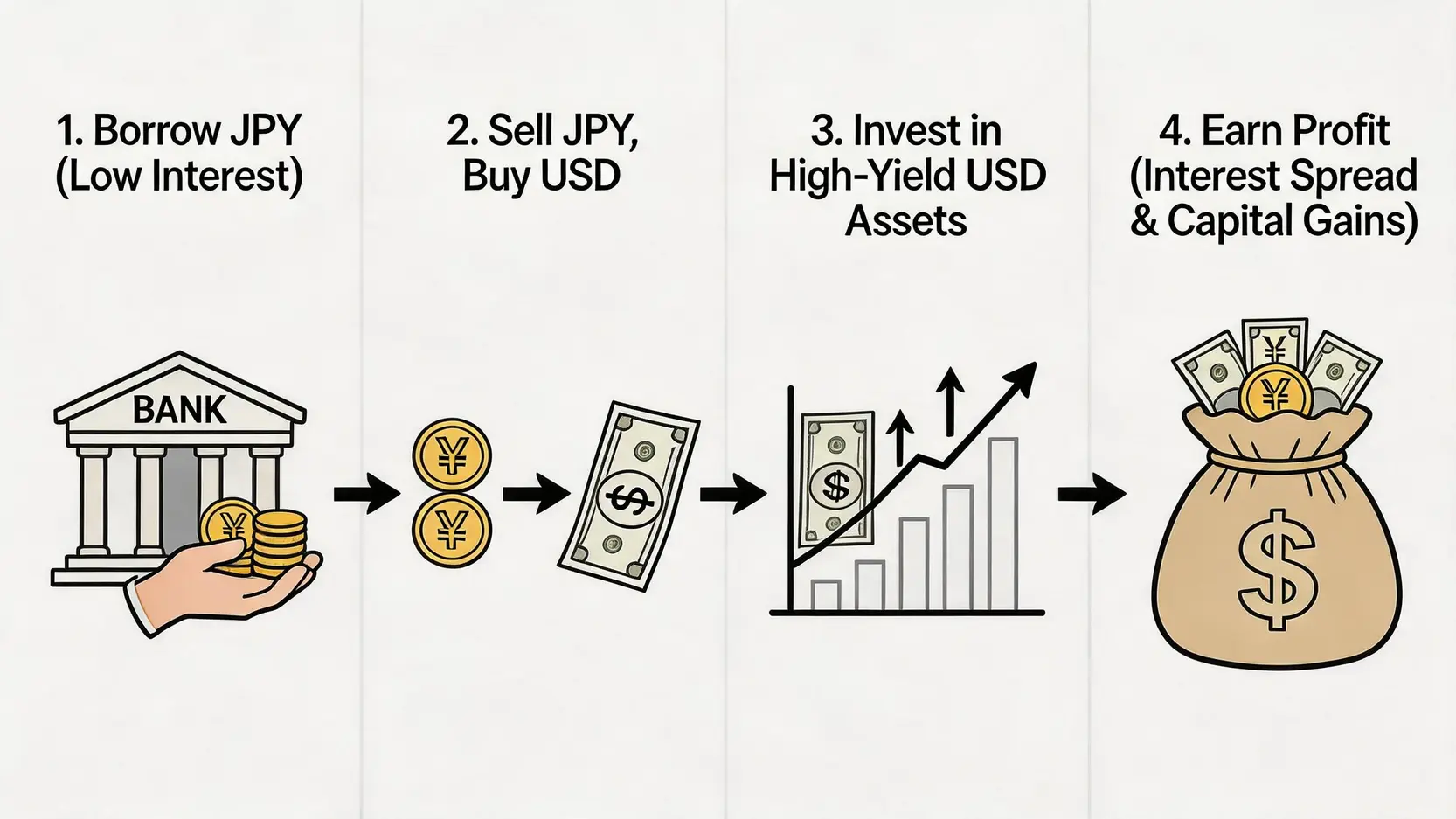
Carry trade participants typically operate as follows:

  1. Step 1: Borrow Japanese yen
    Large institutions borrow massive amounts of yen from the Japanese market at extremely low interest rates (near 0%).
  2. Step 2: Convert currency
    The borrowed yen is sold in the foreign exchange market and converted into higher-yielding currencies such as the US dollar. This “selling yen” flow is also one of the reasons behind long-term yen weakness.
  3. Step 3: Invest in higher-yield assets
    The US dollars are then invested into higher-return assets, most commonly US Treasury bonds or US equities.
  4. Step 4: Earn dual profits
  5. Profits come from two sources: Interest or capital gains from US dollar assets (such as dividends or stock appreciation), and the “interest rate differential” between Japan and the US. As long as investment returns exceed borrowing costs, traders earn stable profits.

日圓套息交易運作模式的四步驟流程圖,從借日圓、換美元、投資美股到賺取利潤。

Illustration: The Four-Step Process of Yen Carry Trade: “Borrow, Convert, Invest, Profit”

In the past, under low volatility and stable US rate environments, this strategy worked extremely well, attracting trillions of dollars in capital.


Storm Arrives: Why Does “Yen Carry Trade Reversal” and “Unwinding Wave”Occur?

However, when market conditions fundamentally change, what was once a “risk-free profit machine” becomes extremely dangerous. The so-called “yen interest rate differential trade reversal” refers to the breakdown of this strategy, which can generate massive losses and trigger large-scale “unwinding waves” (unwind).


Key Trigger: Bank of Japan Monetary Policy Normalization

The origin of the storm comes from Japan itself. As Japan finally exits deflation and inflationary pressure emerges, the Bank of Japan has begun gradually exiting its ultra-loose monetary policy, including ending negative interest rates, abandoning yield curve control (YCC), and signaling potential future rate hikes. These moves fundamentally weaken the foundation of carry trades.
According to recent BOJ policy statements, although its stance remains cautious, the direction of policy normalization is already clear, increasing global expectations of rising yen funding costs.

US–Japan Interest Rate Differential Narrows: When US Rate Cuts Meet Japan Rate Hikes

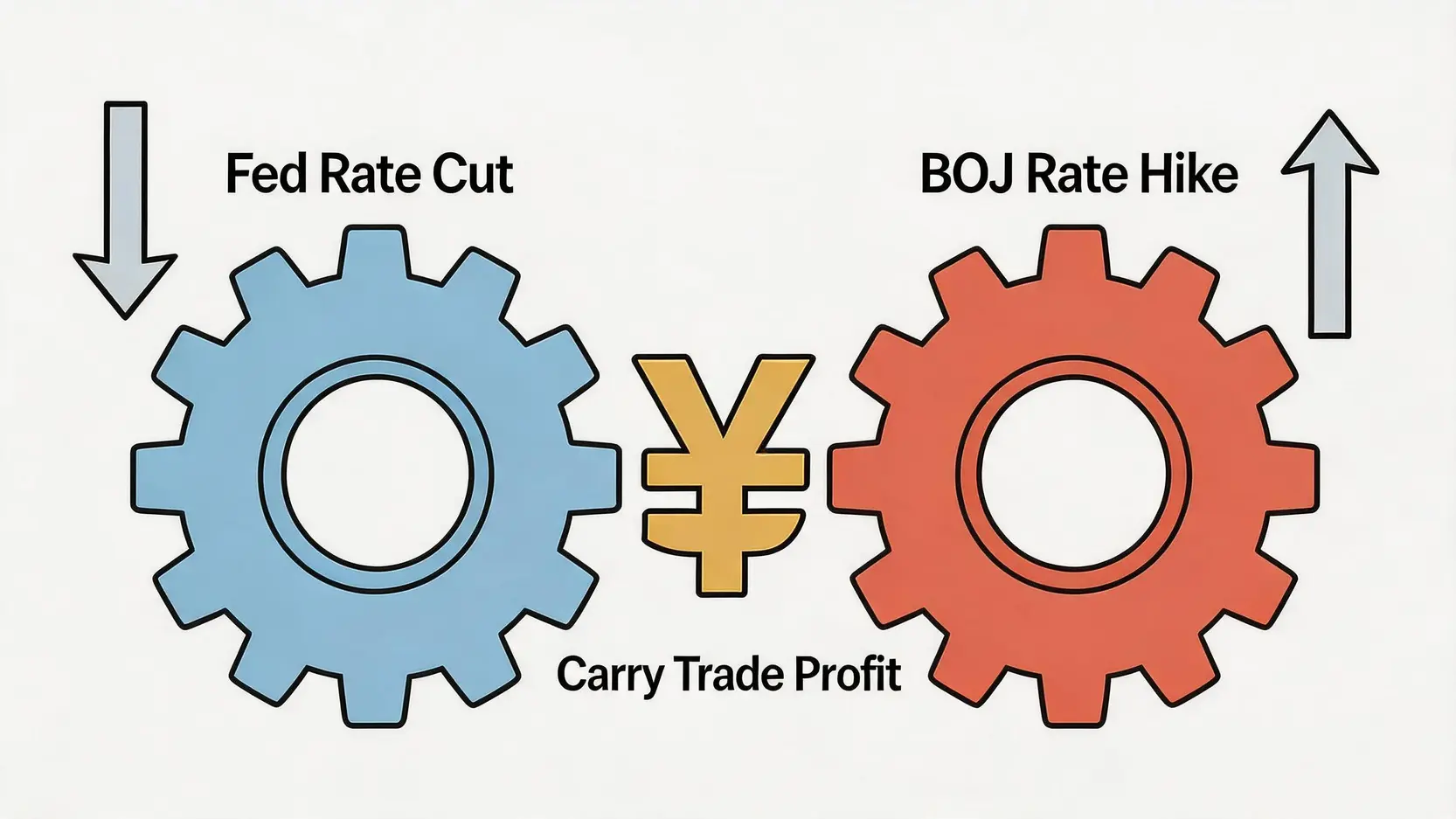
Another key factor comes from the United States. When the Federal Reserve begins cutting rates due to economic slowdown or easing inflation, while Japan raises rates, the “interest rate gap” between the two countries narrows rapidly. This significantly compresses carry trade profit margins and reduces attractiveness.

美國聯準會降息與日本央行升息導致美日利差收窄的概念圖,擠壓了套息交易的利潤。

US–Japan Interest Rate Differential Narrows: Carry Trade Profit Margins Are Squeezed


When Both Conditions Occur Simultaneously, Carry Trade Participants Face Mounting Pressure:

Shrinking spreads: Profit margins become thinner or disappear entirely.

  • Interest rate differential narrows: Profit margins become thinner and may even turn unprofitable.
  • Exchange rate risk: Once the market expects the yen to strengthen due to rate hikes, it can trigger yen appreciation. For traders holding large US dollar assets, every 1% appreciation in the yen increases their exchange loss by 1% when converting back to yen for repayment. This risk has no upper limit.

When profits disappear and risks surge, rational traders choose to “unwind positions”, which means selling US equities and other assets they hold, converting the proceeds back into Japanese yen, and using it to repay the original yen-denominated loans. When tens of thousands of traders do this simultaneously, it forms what is known as an “unwinding wave”.


Deep Analysis of Sharp Yen Appreciation: How the Unwinding Wave Drives Exchange Rates Higher?

Once an “unwinding wave” forms, it triggers a violent chain reaction, which is the core reason behind recent market turbulence and sharp yen appreciation. The entire process behaves like a reverse snowball effect, growing larger and more intense over time.


Demand Reversal: From Selling Yen to Aggressively Buying Yen for Debt Repayment

This can be understood through basic supply and demand principles. During the dominance of carry trades, the market is flooded with demand to “sell yen and buy US dollars” which suppresses the yen exchange rate. However, when the unwinding wave begins, the situation completely reverses:

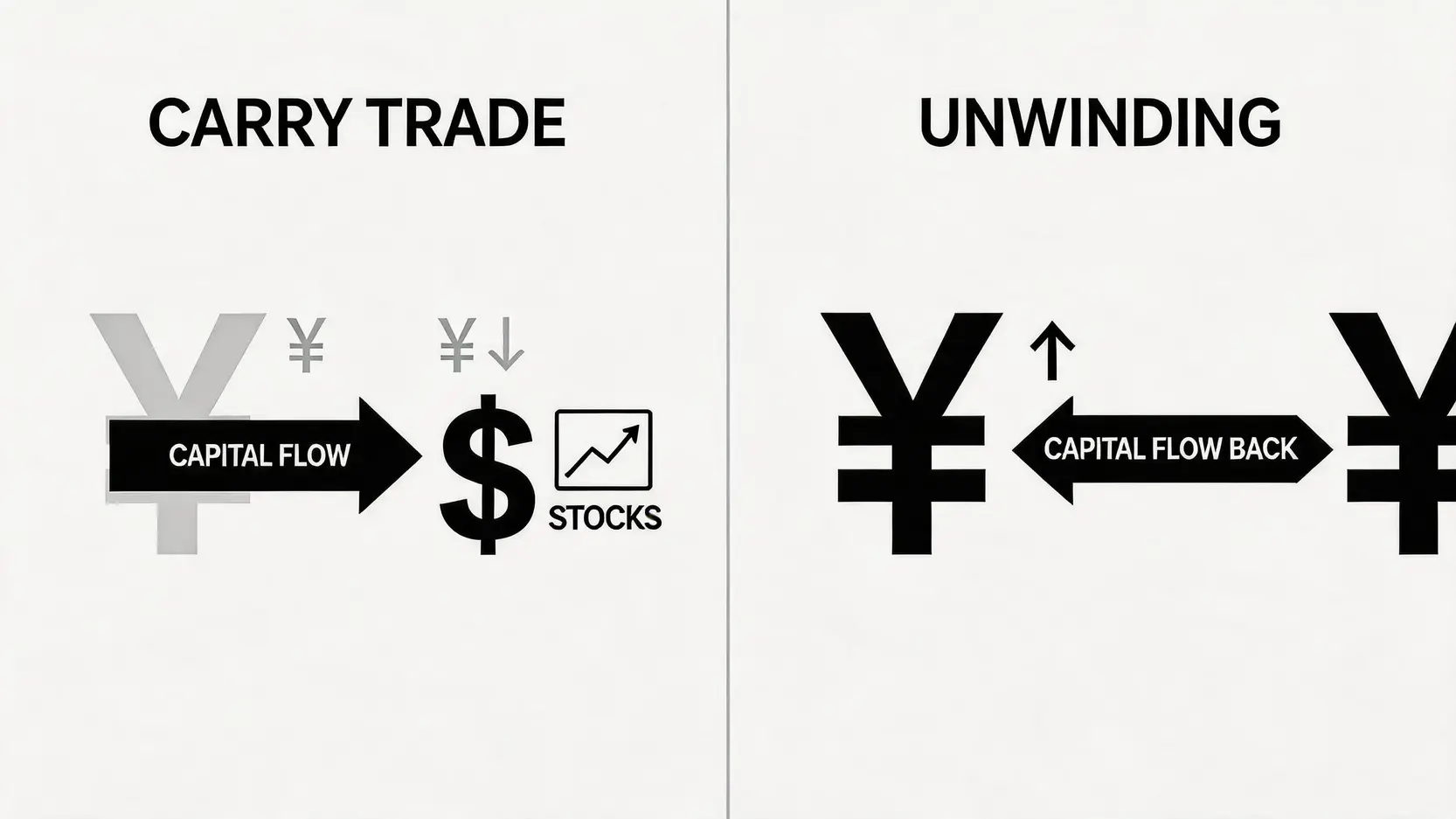
All traders must “sell US dollars (or other foreign currency assets) and buy yen” to repay debt. A massive surge in demand for yen appears instantly, while the supply of yen remains limited in the short term. According to economic principles, when demand far exceeds supply, prices naturally surge. This is the direct reason why the yen appreciates sharply in a short period of time.

日圓套息交易與平倉潮的資金流向對比圖,展示了資金從流出日本變為流回日本的逆轉過程。

Massive Capital Flow Reversal: From Selling Yen to Aggressively Buying Yen


Liquidity Shock Chain Reaction: Impact on Global Stock Markets (Especially US Equities)

The more severe impact occurs in global equity markets, especially US stocks, which are the primary investment destination for carry trades. To raise funds for yen repayment, traders are forced to liquidate their positions, including:

  • US equities: Especially highly liquid large-cap technology stocks become the primary targets of selling pressure, triggering declines in major market indices.
  • Global bonds: These also face selling pressure, leading to falling bond prices and rising yields.
  • Emerging market assets: Higher-risk assets are sold first, potentially triggering regional financial instability.

This global wave of selling drains significant liquidity from the market, resulting in a “credit tightening” effect. This is also why markets can suddenly experience “flash crashes” or sustained declines, seemingly without clear reasons, while in reality being driven by the invisible force of Japanese yen carrying trade unwinding.


Further Reading (Highly Recommended)

Full Analysis of the US Bull Market: Reviewing the Longest Bull Market in History and Outlook for 2026

Allianz South African Rand Fund Ultimate Guide: 5 High-Yield Investment and Risk Management Strategies for 2026


How Should Investors Respond to the Japanese Yen Carry Trade Unwinding Wave?

Facing this global reversal of capital flows, ordinary investors cannot control the market, but they can adjust their strategies to manage potential risks and opportunities.


Potential Market Risks and Investment Opportunities

Main risks:

  • Increased stock market volatility: Global equities, especially US stocks, may face continued selling pressure and higher volatility.
  • Exchange rate risk: Investors holding large amounts of non-yen assets should be aware of potential exchange losses caused by yen appreciation.
  • Liquidity risk: When market liquidity tightens, some assets may become difficult to liquidate quickly.

Potential opportunities:

  • Yen-denominated assets: Yen appreciation benefits Japanese importers and Japanese companies with overseas assets. Capital repatriation may also support the Japanese stock market (including the Nikkei 225).
  • Forex trading: For investors familiar with the FX market, going long on the yen (for example, shorting USD/JPY) may be a direct profit opportunity.
  • Safe-haven assets: During market turbulence, traditional safe havens such as gold and high-grade government bonds may attract capital inflows.


Hedging Strategies and Portfolio Allocation Adjustments

In the current environment, it is crucial to reassess and adjust your asset allocation and hedging strategy:

  1. Increase cash allocation: When market direction is uncertain, maintaining a reasonable cash position can reduce risk and allow you to capture opportunities during sharp selloffs.
  2. Diversify investments: Do not put all eggs in one basket. In addition to US equities, consider allocating funds to markets with lower correlation to US stocks, such as Japan or parts of Europe.
  3. Consider currency hedging: If holding large foreign currency assets, use tools such as FX options or forward contracts to hedge and lock in exchange rate risk.
  4. Review your portfolio: Reassess assets sensitive to interest rates and liquidity. Gradually reduce exposure and shift toward fundamentally strong companies with stable cash flow.


Conclusion

In summary, as Japan moves away from its ultra-low interest rate era, the “Japanese yen carry trade reversal” has become an inevitable trend. This unwinding wave, driven by monetary policy normalization, is not only a core driver of sharp yen appreciation but also has profound implications for global capital flows and equity market stability. The era of borrowing cheap money to easily earn carry profits is coming to an end. Understanding the dynamics of the Japanese yen carry trade unwinding wave and adjusting your portfolio accordingly is a critical survival skill for investors in today’s complex market environment.


FAQ: Common Questions About the Japanese Yen Carry Trade Unwinding Wave

Q: How long will yen appreciation last?

A: The duration of yen appreciation depends on multiple interacting factors, including the pace and magnitude of future Bank of Japan rate hikes, the Federal Reserve’s rate cut timeline, and overall global economic conditions. If the US-Japan interest rate differential continues to narrow and the unwinding wave is large in scale, the appreciation trend could last for several quarters or longer. However, sharp fluctuations may still occur due to central bank intervention or shifts in market sentiment.

Q: How is this unwinding wave different from the 2008 financial crisis?

A: During the 2008 financial crisis, yen carry trade unwinding was triggered by a global credit collapse and extreme risk aversion, forming part of a broad deleveraging event. This time, however, the unwinding is primarily driven by Japan’s monetary policy normalization, making it more policy-driven. Although both scenarios cause market turbulence, the current trigger is more clearly defined, and markets have had more time to anticipate it, which may result in a different transmission pattern compared to 2008.

Q: Are there other currencies used for carry trades besides the yen?

A: Yes. In theory, any low-interest-rate currency can serve as a “funding currency” for carry trades. Historically, the Swiss franc (CHF) has also been used due to its low rates and safe-haven characteristics. On the investment side, higher-yield currencies such as the Australian dollar (AUD) and New Zealand dollar (NZD) are commonly used. However, due to Japan’s economic scale and prolonged ultra-low interest rate environment, the Japanese yen carry trade remains the largest and most influential globally.

Q: How does the yen carry trade unwinding directly affect ordinary investors?

A: The most direct impacts are threefold. First, global equity markets (especially US stock funds or ETFs), may experience unexplained declines. Second, if you plan to travel to Japan or purchase Japanese goods, yen appreciation increases your costs. Third, some high-yield bond funds or emerging market funds may suffer net asset value declines due to capital outflows affecting underlying assets.

编者
Evan Lin

Evan Lin

我是Evan Lin,从大学时期开始接触外汇交易,至今已有多年实战经验,熟悉技术分析与EA策略,热衷于研究市场脉动与风险管控,喜欢分享实战经验和交易技巧,和大家一起学习、一起进步!

If you liked this article, please share it!

Related Articles

  • Order Flow Analysis Tools: Track Institutional Activity
    In-Depth Review of Intelligent Order Flow Detection Tools: Understanding Institutional Activity and Identifying Real Market Buying and Selling Pressure What Is Order Flow, and Why Is It a “Leading Indicator” for Price Prediction? Candlestick charts and technical indicators can be misleading, but the real-money "Order Flow" within the market cannot....
    2026 年 6 月 4 日
  • Social Sentiment Indicators: Predicting Stock Trends
    Social Sentiment Quantitative Indicators: Mining PTT and Dcard Discussions to Predict Stock Prices What Are Social Sentiment Quantitative Indicators, and Why Are They Becoming Increasingly Important? In an era of information overload, financial markets are no longer driven solely by cold financial statements and macroeconomic data. The "Shipping King" phenomenon...
    2026 年 6 月 4 日
  • Taiwan FSC Futures Broker Verification Guide
    Avoid Fraudulent Platforms! A Visual Guide to Taiwan FSC Licensed Futures Merchant Verification and Scam Prevention In recent years, driven by heightened volatility in global financial markets and the impact of monetary easing policies worldwide, more investors have begun seeking diversified investment instruments. However, underground futures operators and overseas fraudulent...
    2026 年 6 月 4 日
返回顶部