Yen Carry Trade Crash: Mrs. Watanabe Case Study

Updated: 2026/05/22  |  CashbackIsland

jpy-leverage-liquidation-case-study

Case Study Review of Yen Leverage Liquidation Events: Understanding Carry Trade Risks Through the Tragedy of “Mrs. Watanabe”

Core Concept Analysis: What Is the JPY Carry Trade?

To understand the tragedy of yen leverage liquidations, you must first understand a long-standing strategy in the forex market that is both attractive and dangerous: the JPY Carry Trade. This is not merely an academic term, but the core behind countless wealth myths and destruction stories over the past several decades. Simply put, it is an arbitrage strategy based on “borrowing at low interest rates and investing at high interest rates”.

Imagine borrowing money from Bank A at an annual interest rate of only 0.1%, then depositing the funds into Bank B, which offers a 5% annual interest rate. Simply by holding the position, you earn a net 4.9% interest spread. Carry trading applies this concept to the global foreign exchange market.


Why Has the Japanese Yen Long Been Considered Both a “Safe-Haven Currency” and a “Funding Currency”?

The Japanese yen plays a highly unique dual role within the global financial system, which is also the foundation for the popularity of carry trades:

  • Ultra-Low Long-Term Interest Rates (Funding Currency): After the collapse of Japan’s bubble economy in the 1990s, Japan entered its “Lost Three Decades”. In order to stimulate the economy, the Bank of Japan (BOJ) maintained near-zero and even negative interest rate policies for an extended period. This made the cost of borrowing yen extremely low, turning it into the perfect “funding currency” in the eyes of global traders. Investors rushed to borrow cheap yen and invest in higher-yielding assets elsewhere.
  • The World’s Largest Creditor Nation (Safe-Haven Currency): Japan’s massive overseas assets have made it the world’s largest net creditor nation. When global markets experience turbulence or panic (such as wars or financial crises), Japanese investors tend to repatriate funds from overseas and convert them back into yen. This large-scale “capital repatriation” strengthens the yen, causing the market to generally view holding yen during crises as relatively safe, thereby giving it “safe-haven currency” status.

These two seemingly contradictory characteristics together created the perfect environment for yen carry trades. When markets are stable and risk appetite is high, investors aggressively borrow yen (funding currency) to purchase high-yield currencies such as the Australian dollar and US dollar. When market panic emerges, traders unwind positions and convert back into yen (safe-haven currency).


The Profit Model of Carry Trades: Earning Both Interest Spreads and Exchange Rate Gains

A perfect yen carry trade allows investors to profit in two ways:

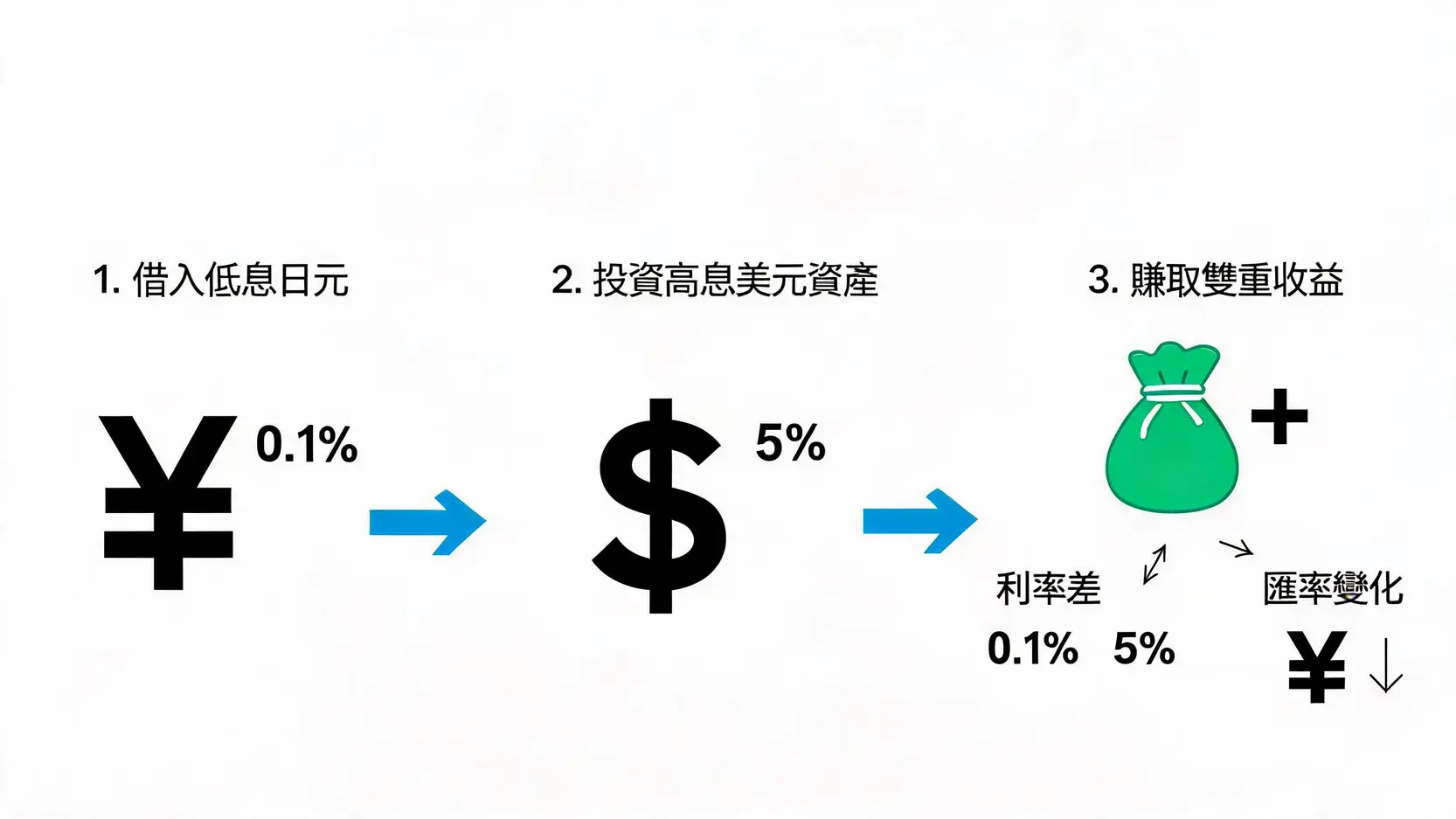
  1. Stable Interest Differential: This is the most basic source of income. For example, borrowing yen at 0.1% interest and purchasing US dollar-denominated assets yielding 5% allows traders to earn the interest spread every day. Through leverage amplification, these returns can become extremely substantial.
  2. Additional Exchange Rate Gains: If the yen depreciates against the purchased currency (such as the US dollar) during the trade period, profits increase even further. When closing the position, fewer yen are needed to repay the borrowed amount, effectively generating additional foreign exchange profits.

日元利差交易獲利模式流程圖,展示了借入低息日元、投資高息資產、賺取利差與匯差的三個步驟。

Figure 1: The Basic Operating Structure of the Yen Carry Trade

For a long period in the past, especially between 2002 and 2007, the global economy was booming and the yen continued depreciating, making this strategy appear like a “money-printing machine”. It attracted everyone from Wall Street giants to Japanese housewives (Mrs. Watanabe).


The Hidden Fatal Trigger: The Double-Loss Risk When Markets Reverse

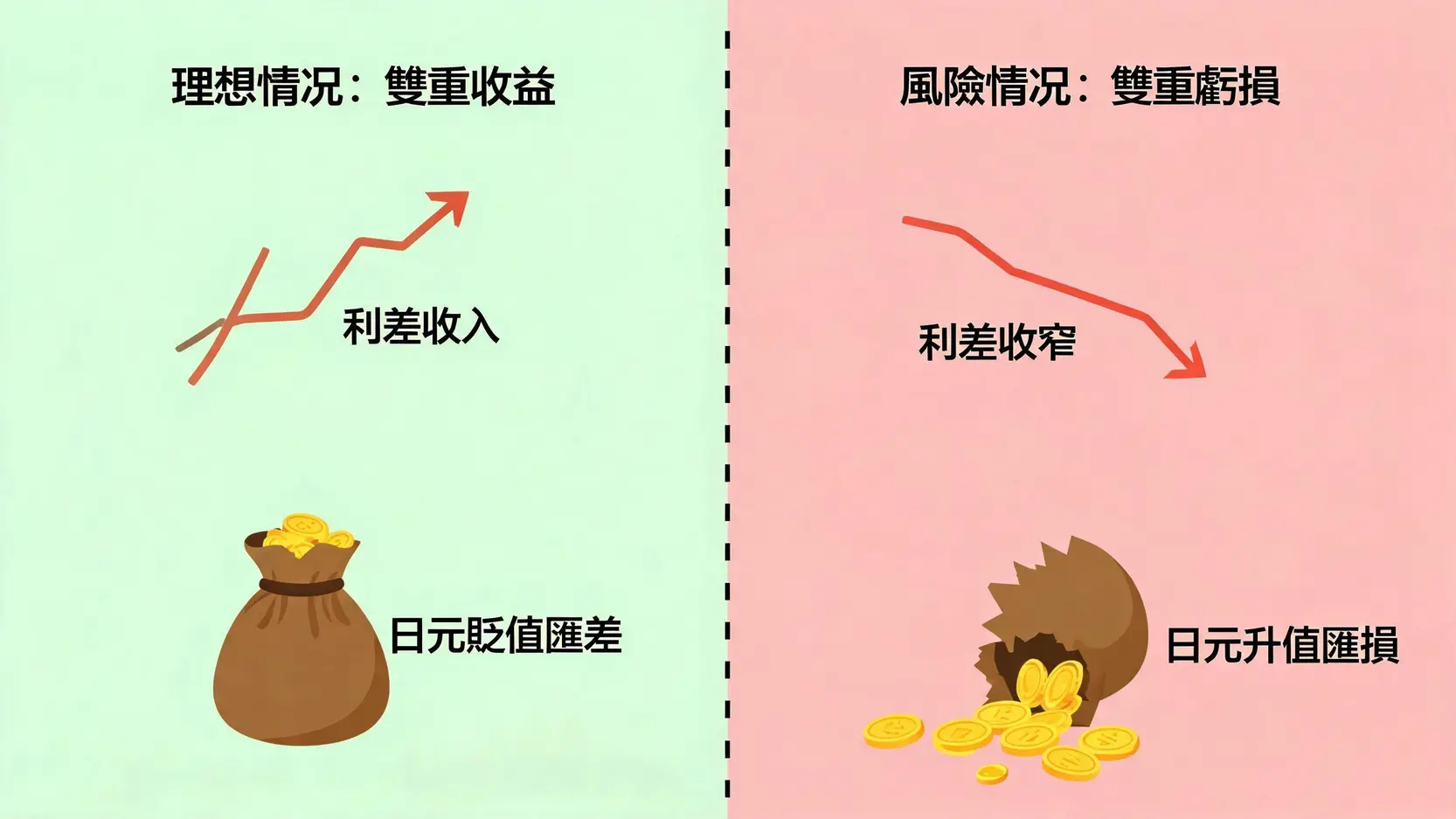
What carries the boat can also overturn it. The profit model of carry trades, when reversed, becomes their fatal risk. Once market direction changes, investors face a terrifying “double blow”:

日元利差交易的風險與回報對比圖,一邊是獲利的雙重收益情境,另一邊是虧損的雙重虧損風險。

Figure 2: The Double-Edged Sword of Carry Trades: Potential Rewards and Risks

  • Narrowing Interest Differentials: If the Bank of Japan raises interest rates or the target currency’s country cuts rates, the interest spread narrows, reducing arbitrage opportunities.
  • Exchange Rate Reversal: This is the deadliest blow. Once the yen rapidly appreciates due to rising safe-haven demand or policy shifts, all carry trade participants face massive exchange rate losses. Traders who originally borrowed yen to buy US dollars must now use more expensive US dollars to exchange back into the same amount of yen needed to repay their loans.

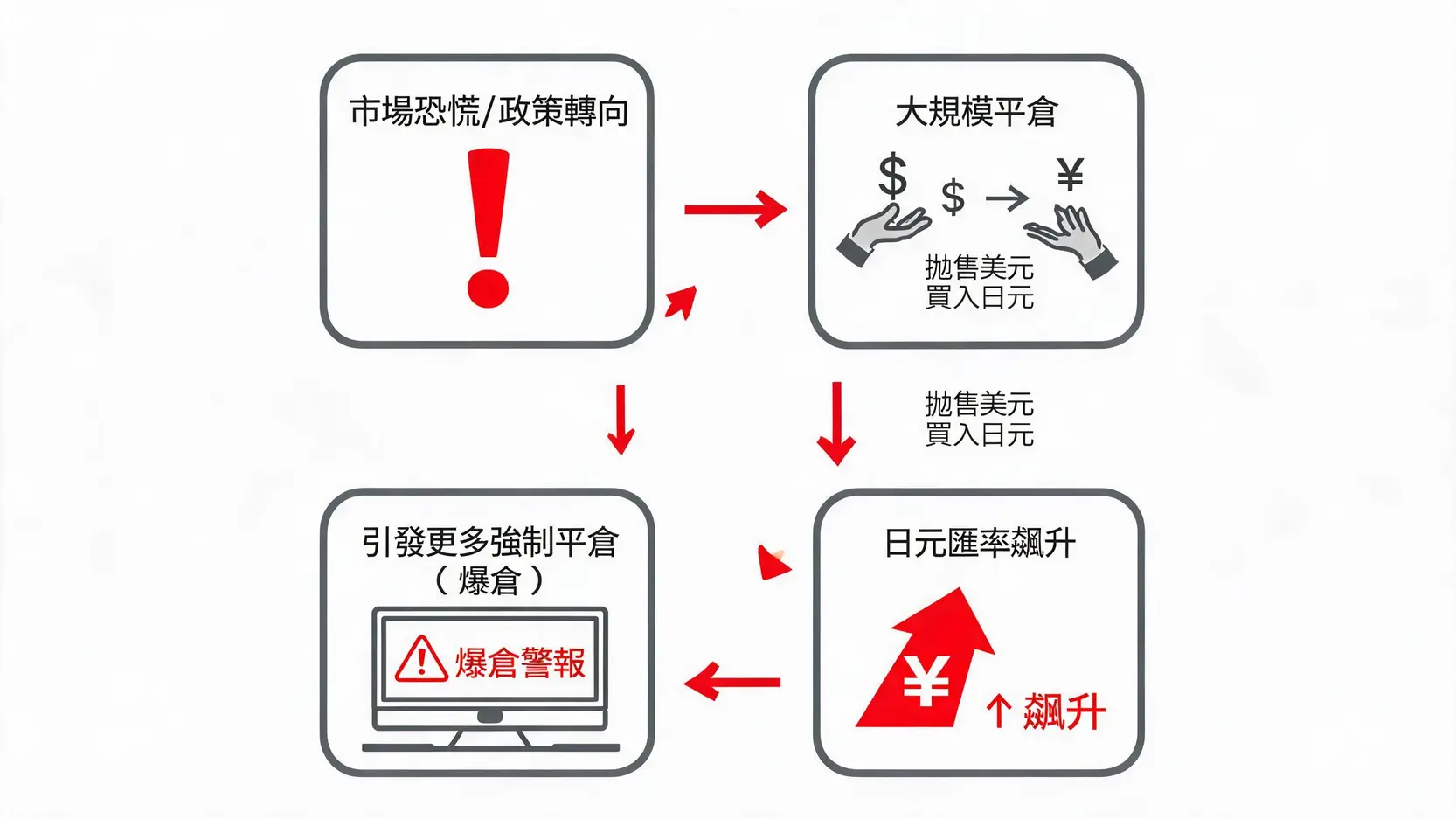
When these losses exceed margin requirements, brokers trigger forced liquidation (Margin Call), commonly known as “blowing up”. When thousands of market participants are forced to liquidate simultaneously (by selling high-yield currencies and buying back yen), the yen strengthens even further, creating a death spiral. This is the standard script behind countless yen leverage liquidation events.


Classic Case Study 1: The Rise and Fall of “Mrs. Watanabe”

No discussion of yen leverage trading tragedies is complete without mentioning the term “Mrs. Watanabe”. It does not refer to a specific individual, but rather a collective name for Japanese housewives who entered forex margin trading during the early 2000s. Their story reflects the struggle of retail traders caught between the temptation of high leverage and the brutal reality of financial markets.


Background of the Era: Japan’s Prolonged Zero Interest Rates and the Global Asset Bubble

At the time, Japanese bank deposit rates were close to zero, meaning money sitting in banks generated almost no returns. “Mrs. Watanabe”, who often controlled household finances, desperately sought higher-return opportunities for their hard-earned savings. Meanwhile, the global economy was experiencing an asset bubble driven by the US, with commodity currencies such as the Australian dollar and New Zealand dollar offering extremely attractive interest rates compared to the yen.

Forex margin trading platforms emerged at the perfect moment, promoting irresistible slogans such as “low barriers, high leverage, and the ability to make money from home”. To “Mrs. Watanabe”, borrowing nearly zero-cost yen to purchase Australian dollars yielding 7%-8% annually appeared to be a guaranteed winning strategy. Their trading approach was straightforward: sell yen, buy high-yield currencies, then enjoy daily interest income flowing into their accounts while watching their assets steadily grow. At its peak, these traders were estimated to account for 20%-30% of Tokyo’s forex market trading volume, becoming a force impossible to ignore.


The Liquidation Trigger: Deleveraging During the 2008 Financial Crisis

The illusion began cracking in 2007 when the US subprime mortgage crisis first emerged, and completely collapsed during the 2008 global financial crisis triggered by the collapse of Lehman Brothers. This crisis triggered a textbook example of “deleveraging”.

Markets fell into extreme panic. Investors no longer pursued high yields, but instead frantically dumped stocks, emerging market currencies, and all other risky assets, rushing toward perceived safe havens such as the yen and US dollar. Speculators who had previously borrowed large amounts of yen, including “Mrs. Watanabe”, were forced or chose voluntarily to unwind positions by selling Australian dollars and British pounds to buy back yen for loan repayment. This process became known as a “Carry Trade Unwind”.

Massive waves of unwinding flooded the market, causing the yen to surge violently within a short period. For example, AUD/JPY collapsed from 105 to 55 within just a few months, nearly cutting in half. This meant that not only did “Mrs. Watanabe” fail to earn interest spreads, but the exchange rate losses alone were enough to completely wipe out their capital. Under high leverage, many transformed overnight from “housewife Buffetts” into bankrupt traders. This was the true reality of the deleveraging caused by the 2008 financial crisis.


Lessons: The Fragility of Retail Traders Against High Leverage and Black Swan Events

The tragedy of “Mrs. Watanabe” taught all forex traders several painful lessons:

  • The Trap of Linear Thinking: After years of one-sided market trends (involving yen depreciation and stable interest spreads), many assumed the future would continue the same way, completely ignoring the possibility of market reversals.
  • Misunderstanding Leverage: Leverage of 100 times or more acts as a profit amplifier during favorable trends, but becomes a wealth-destroying machine during adverse trends. Traders focused only on the former while ignoring the latter.
  • Lack of Risk Management: The vast majority of retail traders lacked stop-loss concepts or chose to “hold and hope” during losses, expecting the market to recover, ultimately leading to even larger losses and liquidation.
  • The Impact of Black Swan Events: The 2008 financial crisis was a classic “black swan event”. The probability of its occurrence was low, but once it happened, the destruction was catastrophic. Any trading strategy focused only on normal conditions while ignoring unexpected events cannot survive a black swan event.

The story of “Mrs. Watanabe” reminds us that markets do not reward overcrowded trades forever. When a strategy becomes universally known and heavily participated in, it is often the moment when risks have accumulated to their extreme.


Further Reading (Highly Recommended)

Forex Trading Risk Management: Veteran Traders Teach You How to Hedge Risks and Achieve Stable Profits

[Forex Trading Guide 2024] The Ultimate Beginner’s Guide to Forex Investing: Master Forex Trading Skills From 0 to 1!


Classic Case Study 2: The Chain Reaction Triggered by the 2024-2025 Policy Shift

If the liquidation of “Mrs. Watanabe” was a tragedy triggered by an external black swan event, then the market entering 2024-2025 faced a long-brewing storm driven by internal factors: the policy shift of the Bank of Japan (BOJ). This time, it was no sudden event, but a “boiling frog” style crisis. The chain reaction it triggered brought a new nightmare to yen leverage traders.


Background: Global Inflation Expectations and Rumors of a BOJ Policy Shift

Following the global inflation surge of 2022-2023, major central banks around the world, (such as the Federal Reserve and the European Central Bank), aggressively raised interest rates, causing the interest rate gap between them and Japan to widen to unprecedented levels. In the short term, this reignited the popularity of yen carry trades, with USD/JPY once breaking above the 150 level.

However, unease also began spreading through the market. Japan’s domestic inflation rate finally reached the BOJ’s long-standing 2% policy target after decades of deflation. Markets began constantly speculating: when would the BOJ abandon negative interest rates and Yield Curve Control (YCC), officially joining the “rate hike club”?

Every speech from BOJ officials or economic data release caused heightened market sensitivity. This extreme uncertainty laid the fuse for the time bomb that was the yen carry trade.


Mechanism Breakdown: How Rapid Yen Appreciation Triggered a Carry Trade Unwind

The trigger point arrived in the spring of 2024, when the BOJ officially announced the end of its negative interest rate policy. Although the first rate hike was small, its symbolic meaning was enormous. It signaled the end of Japan’s ultra-loose monetary era. The market reaction was violent and highly interconnected.

利差交易拆倉引發的死亡螺旋循環圖,展示了市場恐慌如何導致日元升值並觸發更多強制平倉的惡性循環。

Figure 3: The “Death Spiral” Mechanism of Yen Carry Trade Unwinds

  1. Expectation Reversal: Markets no longer believed Japan would maintain low interest rates forever. Speculators reversed their positions from “shorting the yen” to “going long on the yen”, betting on further future rate hikes.
  2. Carry Trade Unwind: The enormous volume of carry trade positions that had previously borrowed yen to purchase high-yield assets began panicked liquidation. Traders had to sell US dollar and Australian dollar assets to buy back yen. This force was far larger and more concentrated than the “Mrs. Watanabe” era because it involved massive hedge funds and institutional investors.
  3. Flash Crash in Exchange Rates: During certain early morning trading sessions or periods of weak liquidity, massive yen-buying orders flooded the market instantly, causing a “flash-crash style” appreciation in the yen. USD/JPY could plunge hundreds of pips within minutes.

For traders using high leverage, volatility of this magnitude was fatal. Suppose a trader used 100x leverage to go long USD/JPY. A move of just 1% against the position would completely wipe out the trader’s capital and trigger forced liquidation. Such “flash crashes” often exceeded 1%, making liquidation almost unavoidable.


The Domino Effect: From the Forex Market to a Liquidity Crisis in Equities

The impact of the 2024-2025 shock extended far beyond the forex market. Due to the enormous scale of yen carry trades, the unwinding triggered a series of domino effects:

  • Asset Sell-Offs: In order to obtain yen, traders not only sold high-yield currencies but also assets linked to those currencies, such as Australian equities and US Treasury bonds, causing widespread declines in global asset prices.
  • Liquidity Dry-Up: During periods of severe market volatility, many market makers withdrew quotes, causing market liquidity to evaporate instantly. This made it even harder for traders to close positions at reasonable prices, further intensifying losses.
  • Risk Contagion: Some large funds suffered massive losses due to yen trade liquidations and were forced to sell unrelated assets to cover losses, transmitting the crisis from one market to another.

This event once again proved that when a trade becomes excessively “crowded”, the trade itself becomes the market’s greatest source of risk. The BOJ policy shift was like opening Pandora’s box, releasing long-suppressed risks and delivering a brutal wake-up call to investors obsessed with the idealized narrative of carry trade strategies

From the Yen to the Swiss Franc: The Next Time Bomb? Modern Lessons From Carry Trades

History does not repeat itself exactly, but it often rhymes. After the yen’s ultra-low interest rate era ended, global speculators did not stop. Instead, they began searching for the next currency capable of acting as a “funding currency”. This hunt, along with the risks revealed by “crowded trades”, offers profound warnings for modern traders.


Searching for the Next “Funding Currency”: Who Is the Market’s New Favorite?

When the cost of one major funding currency, such as the yen, rises, capital naturally flows toward new low-cost alternatives. Markets began focusing on countries with similarly low interest rates, political stability, and relatively loose monetary policies. Among them, the Swiss franc (CHF) emerged as one of the most popular candidates.

  • Swiss Franc (CHF): The Swiss National Bank (SNB) has also maintained extremely low interest rates for years to combat deflation and excessive franc appreciation. Although Switzerland’s economy is far smaller than Japan’s, the franc became a carry trade funding choice for many European investors during certain periods.
  • New Taiwan Dollar (TWD): Although less frequently discussed, Taiwan’s relatively stable low-interest-rate environment has, in certain situations, made the TWD a potential funding currency for regional arbitrage trades, though its liquidity and global acceptance are far below that of the yen or Swiss franc.

However, traders must remain cautious. The size and market depth of these new “funding currencies” cannot compare to the yen. This means that if a collective unwinding similar to the yen carry trade occurs, exchange rate volatility could become even more violent, while liquidity crises could erupt more easily.


How to Identify and Avoid the Risks of Crowded Trades

The repeated collapses of yen carry trades were essentially the result of “crowded trades” collapsing. A “crowded trade” occurs when the overwhelming majority of market participants adopt the same strategy and hold similar positions. Such trades may perform extremely well initially, but risks continuously accumulate beneath the surface.

How can traders identify and avoid these risks?

  1. Monitor Market Sentiment Indicators: Pay attention to trader positioning reports, (such as the CFTC Commitment of Traders (COT) report). When net short or net long positions in a currency reach historical extremes, it becomes a danger signal.
  2. Be Wary of “Consensus”: When every analyst and media outlet promotes the same strategy (such as “the yen can only weaken”), you should become even more cautious. Market consensus is often wrong.
  3. Think Contrarily: Ask yourself one question: “What happens if this trade is wrong?” Simulate the worst-case scenario and prepare for it by setting strict stop-loss levels.
  4. Control Leverage and Position Size: Never commit your entire fortune to a trade you believe is “guaranteed to win”. In crowded trades, reducing leverage and controlling position sizes become even more critical to ensure survival during potential market stampedes.


A Warning for Modern Traders: History Does Not Repeat, but It Rhymes

The history of financial markets is a history of greed and fear intertwined. From “Mrs. Watanabe” to the institutional liquidations of 2024, the characters and settings may change, but the core logic never does:

Under the amplification of high leverage, seemingly stable small returns may conceal deadly tail risks.

The purpose of reviewing yen leverage liquidation cases is not to predict the exact timing of the next crisis, but to deeply understand the inherent fragility of such trades. Whether the market’s next favorite becomes the Swiss franc or another currency, the essence of carry trades, borrowing short and investing long to capture interest spreads, means they remain highly sensitive to liquidity and market sentiment.

As traders, our task is not to discover the next “holy grail”, but to clearly understand the underlying risk structure before entering any trade, and to establish a survival plan capable of carrying us safely through the storm. Remember Mark Twain’s famous quote: “History doesn’t repeat itself, but it often rhymes.” When the next melody begins, make sure you are not the last person left standing in the middle of the dance floor.


FAQ

Q: What Is “Deleveraging”? Why Does It Trigger Market Declines?

A: Deleveraging refers to the process in which individuals, companies, or even the entire financial system repay debt and reduce leverage ratios. This usually occurs after credit bubbles burst or during economic recessions. In leveraged trading, deleveraging means traders must close positions (by selling assets) to repay borrowed funds used for investments. When large numbers of market participants deleverage simultaneously, it triggers chain reactions of asset sell-offs, causing prices to collapse and creating a vicious cycle. The 2008 global financial crisis was a large-scale deleveraging event that caused simultaneous declines across stock markets, forex markets, and real estate markets.

Q: Besides the Japanese Yen, Which Other Currencies Are Commonly Used in Carry Trades?

A: In theory, any stable low-interest-rate currency can serve as a “funding currency” for carry trades. Besides the Japanese yen (JPY), the Swiss franc (CHF) has historically been frequently used due to its long-term low interest rates. During certain periods, the euro (EUR) and even the New Taiwan dollar (TWD) have also been included in certain carry trade strategies because of their relatively low interest rates. Correspondingly, the “target currencies” or “high-yield currencies” are usually the Australian dollar (AUD), New Zealand dollar (NZD), South African rand (ZAR), as well as the US dollar (USD) and British pound (GBP) during rate hike cycles.

Q: As an Ordinary Investor, How Can I Tell if Market Leverage Levels Are Too High?

A: It is relatively difficult for ordinary investors to accurately judge overall market leverage levels, but several indicators can provide clues:

  • Asset Prices Diverging From Fundamentals: When asset prices such as stocks or real estate rise far beyond their intrinsic value (such as earnings or rental yields), it often indicates that large amounts of leveraged capital are driving the market.
  • Extremely Low Volatility: When markets remain in prolonged periods of low volatility and stable upward movement, investors tend to lower their guard and increase leverage. A persistently low VIX Index (Fear Index) is one warning signal.
  • Extremely High Retail Participation: When everyone is discussing how to get rich quickly through high leverage, it is often a sign that markets are overheating and leverage levels are excessive.
  • Credit Data: Pay attention to data released by central banks, such as margin financing balances and consumer credit figures. Rapid growth may indicate rising leverage levels.

Q: What Psychological Traps Exist in High-Leverage Trading?

A: High-leverage trading can easily trigger multiple psychological traps:

  • Overconfidence: After several consecutive small profits, traders may overestimate their judgment abilities, ignore risks, and increase position sizes excessively.
  • Gambler’s Fallacy: After consecutive losses, traders may believe the next trade “must” reverse, causing them to add to losing positions against the trend and expand losses further.
  • Disposition Effect: Traders tend to close profitable positions too early while stubbornly holding onto losing positions, commonly described as “making small profits but suffering huge losses”.
  • Emotional Trading: During periods of sharp price volatility, traders may become dominated by fear or greed, leading to irrational trading decisions such as chasing rallies, panic selling, or revenge trading.

Q: How Can Beginners Safely Try Carry Trades?

A: Beginners who want to try carry trades must place risk control above everything else:

  • Use Extremely Low or No Leverage: In the beginning, avoid leverage entirely if possible and trade only with personal capital to first understand the real impact of interest spreads and exchange rate fluctuations.
  • Choose Major Currency Pairs: Focus on highly liquid major currency pairs such as AUD/JPY or USD/JPY, and avoid illiquid and highly volatile cross pairs.
  • Start With a demo account: Before risking real money, practice on a demo account for at least 3-6 months to understand how the strategy works and the risks involved.
  • Set Strict Stop-Loss Levels: This is the most important rule. Before opening any position, you must define a clear stop-loss level and follow it strictly. This is the only way to protect capital when exchange rates move unfavorably.
  • Maintain Small Position Sizes: Even after transitioning to real-money trading, start with the smallest possible positions. The risk of any single trade should not exceed 1%-2% of total capital.


Conclusion

Looking back at the yen leverage liquidation cases ranging from “Mrs. Watanabe” to more recent institutional investor blowups, one clear pattern emerges: tragedies always occur when the market is at its most optimistic and the strategy becomes the most crowded. Carry trading itself is a neutral market strategy, originally designed to capture interest rate differentials between economies. However, once “high leverage” enters the equation as an amplifier, it mercilessly magnifies human greed and fear, transforming small market fluctuations into devastating account disasters.

The core lesson behind these painful events is not to deny the strategy itself, but to reveal the critical importance of risk management. Whether retail traders or professional investors, anyone facing the temptation of high leverage must clearly understand that market direction can reverse at any moment. Understanding the deeper mechanisms behind these classic liquidation cases and identifying the risks accumulated within crowded trades are essential lessons for every trader entering the financial markets to protect their capital. Only then can they avoid becoming the next victim mercilessly wiped out during the next unpredictable market storm.

编者
Evan Lin

Evan Lin

我是Evan Lin,从大学时期开始接触外汇交易,至今已有多年实战经验,熟悉技术分析与EA策略,热衷于研究市场脉动与风险管控,喜欢分享实战经验和交易技巧,和大家一起学习、一起进步!

If you liked this article, please share it!

Related Articles

  • US Oil Inventories Fall 13 Weeks: Will Prices Surge?
    US Crude Oil Inventories Fall for 13 Consecutive Weeks: Are Oil Prices About to Soar? Complete Analysis of the Latest Market Impact in 2026 International oil prices have recently shown signs of rising. Are you also worried about higher living costs? This is closely related to the major news that...
    2026 年 7 月 20 日
  • WTI Crude Oil at $80: 5 Key Drivers and Strategies
    Understanding the US$80 WTI Crude Oil Threshold: Five Core Factors Influencing Oil Prices and the Latest Investment Strategies Recently, global market attention has once again turned to the energy market, with WTI crude oil prices repeatedly fluctuating around the US$80 threshold as bulls and bears engage in an intense battle....
    2026 年 7 月 20 日
  • NOK/USD Analysis: How Energy Prices Drive the Krone
    NOK/USD Energy Market Analysis: How Do Oil and Natural Gas Prices Drive the Norwegian Krone? The Norwegian krone (NOK) is one of the currencies most heavily influenced by energy prices worldwide, and its exchange rate against the US dollar (USD) is often closely linked to international oil and natural gas...
    2026 年 7 月 20 日
返回顶部