Did Japan’s ¥4.68T FX Intervention Really Work?

Intervention Effectiveness Assessment: Did Japan’s ¥4.68 Trillion Gamble Succeed? An In-Depth Review of Foreign Exchange Intervention History
Japan’s Ministry of Finance recently unleashed another powerful intervention, deploying a record ¥4.68 trillion in an attempt to halt the yen’s relentless decline. The market reacted sharply, with the yen staging an immediate rebound. However, was this enormous expenditure truly worthwhile? Was it a successful counterattack that reversed the trend, or merely an “expensive defensive operation” that temporarily slowed the decline? For investors, understanding how to assess intervention effectiveness is essential. This article provides a clear evaluation framework, objectively analyzes the short-term and long-term impact of the intervention, and reviews key historical foreign exchange interventions to explore both the strengths and limitations of central bank actions in currency markets.
Three Key Dimensions for Evaluating Foreign Exchange Intervention Effectiveness
To objectively determine whether a foreign exchange intervention was successful or unsuccessful, it is not enough to focus solely on the immediate exchange rate reaction. A comprehensive intervention effectiveness assessment should examine at least the following three dimensions.

Evaluating the Success of a Foreign Exchange Intervention Requires a Comprehensive Assessment Across Short-Term, Medium-Term, and Long-Term Dimensions.
Dimension One: Short-Term Stability (Did It Successfully Contain Excessive Volatility?)
The primary objective of intervention is often not to reverse a trend immediately, but rather to restore order to a disorderly market. When an exchange rate experiences a rapid, one-sided decline disconnected from economic fundamentals, market panic can emerge and create a self-reinforcing downward spiral. In such situations, central bank intervention acts like an emergency brake on a rapidly falling elevator. Its main functions include:
- Countering speculative short positions: A sudden surge of official buying can inflict immediate losses on traders who are short the yen, forcing them to cover positions and providing support for the currency.
- Stabilizing market sentiment: Intervention sends a powerful message to the market: “Authorities are monitoring developments closely and possess both the ability and willingness to prevent the exchange rate from becoming disorderly.” This helps restore confidence and break the cycle of panic selling.
- Buying time: Intervention provides market participants and policymakers with a valuable opportunity to reassess conditions, reducing the risk of poor decisions driven by extreme emotions.
From this perspective, intervention often achieves immediate success by curbing excessive short-term volatility.
Dimension Two: Medium-Term Trend Impact (Did It Change Core Market Expectations?)
This represents a higher standard for evaluating whether an intervention truly “succeeded”. A genuinely effective intervention not only stabilizes current market conditions but also influences how market participants view the future direction of the exchange rate. If investors broadly believe that the intervention is temporary and that the fundamental drivers of depreciation (such as widening interest rate differentials) remain unchanged, the exchange rate is likely to resume its previous trend once intervention pressure fades. To alter a medium-term trend, intervention typically needs to be accompanied by at least one of the following conditions:
- A signal of policy change: Intervention serves as a precursor to future monetary policy adjustments (such as interest rate hikes).
- Coordinated international action: Multiple central banks intervene together, demonstrating greater commitment and credibility.
- Fundamental changes: The underlying economic factors driving depreciation begin to reverse, allowing intervention to reinforce an existing shift.
Without these supporting conditions, intervention through currency purchases and sales alone is rarely sufficient to reverse a medium-term trend driven by economic fundamentals.
Dimension Three: Long-Term Cost Effectiveness (What Is the Opportunity Cost of Using Foreign Exchange Reserves?)
Intervention is never cost-free. When a central bank sells US dollars and purchases yen, it consumes the country’s foreign exchange reserves. These reserves are a critical pillar of national financial stability, supporting imports, external debt obligations, and confidence in the financial system. As a result, any assessment of intervention effectiveness must include an evaluation of cost effectiveness:
- Opportunity cost: What alternative investment returns or strategic uses could have been generated by the trillions of yen spent on intervention? Is sacrificing those opportunities justified by the short-term stabilization achieved?
- National credibility: Frequent interventions that fail to produce lasting results may undermine international confidence in the country’s economy and currency.
- Limited resources: Foreign exchange reserves are not infinite. Excessive intervention may reveal the central bank’s limitations, and if markets begin to believe that authorities are “running out of resources”, speculative attacks could intensify.
Consequently, a successful intervention should achieve the greatest possible stabilization effect at the lowest possible cost while creating conditions that help address the underlying causes of exchange rate instability.
Further Reading (Highly Recommended)
Quantitative Assessment of This Intervention: Was the Money Well Spent?
After understanding the evaluation framework, we can objectively analyze Japan’s record-breaking intervention. Although the full effect will require more time to observe, we can make an initial assessment based on several key indicators.
“How Much Time Was Bought”: An Analysis of the Sustainability of Exchange Rate Stability After the Intervention
From the perspective of short-term stability, this intervention was undoubtedly successful. After news of the intervention emerged, USD/JPY quickly retreated from its highs, and volatility declined significantly, preventing the situation from spiraling out of control. However, the key question is how long this stability can last. Market data shows that in the weeks following the intervention, the yen exchange rate became more stable, but depreciation pressure was not completely eliminated. This indicates that the intervention successfully “bought time”, but did not eliminate the underlying problem.
“How Much Did Expectations Change”: Changes in the Options Market Risk Reversal Indicator
To measure shifts in market expectations, investors can observe the “Risk Reversal indicator” in the foreign exchange options market. This indicator reflects the relative demand for options betting on future currency appreciation (call options) versus depreciation (put options). Before the intervention, the indicator showed that the market was extremely bearish on the yen. After the intervention, bearish sentiment eased but did not reverse into bullishness. This means the market acknowledged the short-term power of intervention, but remained cautious about the yen’s medium-term outlook.
Degree of Divergence From Fundamentals: Can Intervention Fight the Gravitational Pull of Interest Rate Differentials?
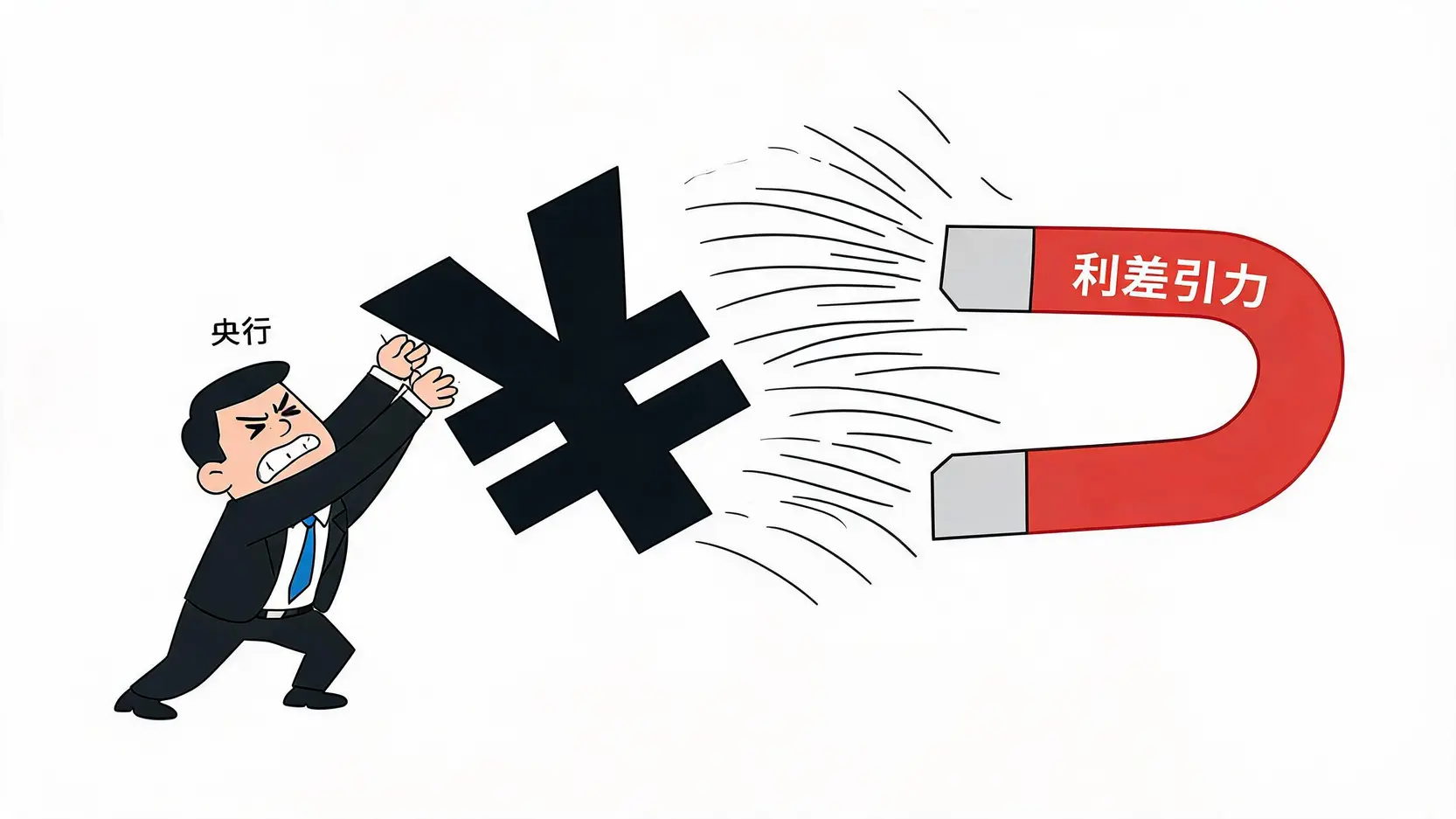
The core force currently driving yen depreciation is the large gap between the monetary policies of Japan and the US. The US Federal Reserve has maintained high interest rates to fight inflation, while the Bank of Japan continues to uphold its ultra-loose monetary policy. This large interest rate differential keeps capital flowing from Japan to the US and represents the fundamental “gravitational pull” behind yen depreciation.
Japan’s unilateral intervention is essentially an attempt to use administrative force to resist the market’s underlying trend. Historical experience shows that without accompanying monetary policy adjustments (namely a narrowing of the interest rate differential), the effects of any intervention are likely to be temporary. Capital’s pursuit of returns will ultimately overpower the force of intervention, and the exchange rate will eventually return to fundamentals.

Unilateral intervention is like a tug-of-war against the fundamental trend. If the “gravitational pull” of interest rate differentials remains unchanged, the effect of intervention is often difficult to sustain.
Historical Review of Intervention Cases: Lessons From Successes and Failures
Reviewing the history of foreign exchange intervention provides valuable lessons for understanding the current situation. Among the most classic examples are the 1985’s “Plaza Accord” and Japan’s unilateral interventions between 2010 and 2011.
Successful Case: The 1985 “Plaza Accord” (Coordinated Multinational Intervention)
In the early 1980s, the United States faced a massive trade deficit, while the US dollar had become excessively strong. To address this issue, in September 1985, the US, Japan, West Germany, France, and the United Kingdom (G5) reached an agreement at the Plaza Hotel in New York to jointly intervene in the foreign exchange market and guide the US dollar lower. This became known as the famous Plaza Accord.
Keys to success:
- Coordinated action: The five G5 countries acted together, creating a force far greater than any single country could generate and sending an unmistakable signal of determination to the market.
- Clear objective: The agreement had a clearly defined goal, which was to guide the US dollar lower in an orderly manner, with policy coordination among all participating countries.
- Alignment with the trend: At the time, US economic fundamentals no longer supported continued dollar strength, and the intervention aligned with the broader trend of economic rebalancing.
After the “Plaza Accord”, the US dollar depreciated significantly against major currencies, while the yen entered a rapid appreciation phase. It is regarded as one of the most successful cases in the history of foreign exchange intervention.
Failed Case: 2010-2011 Unilateral Intervention (Moving Against Fundamentals)
By 2010, following the global financial crisis and amid strong safe-haven demand, the yen appreciated sharply, severely hurting Japan’s export sector. In response, the Japanese government intervened several times between 2010 and 2011 by selling yen and buying US dollars.
Reasons for failure:
- Acting alone: Without support from major economies such as the US, Japan’s unilateral intervention appeared weak against the enormous scale of global capital flows.
- Moving against the trend: At the time, global risk aversion was elevated, and demand for the yen was strong. Japan’s intervention was directly opposed to market fundamentals.
- Short-lived effects: Although each intervention temporarily pushed the yen lower, the impact often lasted only a few days or even a few hours before being absorbed by the market, after which the currency resumed its appreciation trend.

Historical experience shows that coordinated action and alignment with the prevailing trend are key to successful foreign exchange intervention.
Viewing This Intervention Through History: What Key Success Factors Are Missing?
Comparing these two cases clearly shows that Japan’s current intervention resembles the 2010-2011 episode more than the 1985 Plaza Accord. It lacks the most important success factor: multinational coordination. With the US still focused on controlling inflation and maintaining a strong dollar, Japan is unlikely to obtain meaningful support from the US. As a result, this unilateral intervention is destined to be a difficult battle.
Side Effects and Long-Term Challenges of Intervention
Beyond its potentially limited effectiveness, large-scale foreign exchange intervention can also create a series of side effects and long-term challenges that cannot be ignored.
Consumption of Foreign Exchange Reserves and the Impact on National Credit
Every intervention consumes part of the country’s “health bar”, its foreign exchange reserves. Although Japan has substantial reserves, they are not unlimited. If the market forms the expectation that the central bank will continue intervening, speculators may repeatedly attack the exchange rate, forcing the central bank to keep consuming reserves. If reserves fall to a certain level, concerns about national solvency may emerge, potentially affecting the country’s credit rating.
Moral Hazard From Fighting the Market
Government intervention is, by nature, a non-market tool used to influence prices, and it may distort the market’s function in allocating resources. Frequent intervention may also create “moral hazard”. Some market participants may become more willing to take excessive risks, expecting that the government will always step in when markets collapse. This lack of investment risk management is unfavorable for the long-term health of the market.
Further Reading (Highly Recommended)
What Is Hedging? Five Major Hedging Strategies to Manage Investment Risk Easily
Conclusion
Overall, Japan’s ¥4.68 trillion foreign exchange intervention successfully contained panic and disorderly market volatility in the short term, achieving its primary objective of “stabilizing the market”. However, from a longer-term perspective, the outlook is less encouraging. As long as the US-Japan interest rate differential remains unchanged as the fundamental driving force and there is no coordinated international intervention, unilateral action financed through the consumption of foreign exchange reserves is unlikely to fundamentally reverse the yen’s medium- to long-term depreciation trend. This intervention appears more like an expensive defensive operation designed to buy valuable time for future policy adjustments. Its ultimate success or failure will depend not only on whether further interventions occur, but more importantly on whether the Bank of Japan eventually implements a genuine shift in monetary policy.
FAQ
Q: Can a country intervene in the foreign exchange market an unlimited number of times?
A: Both theoretically and practically, the answer is no. Intervention requires the use of foreign exchange reserves, and every country’s reserves are finite. If authorities intervene frequently without achieving lasting results, causing reserves to decline rapidly, market confidence may weaken and even greater financial risks could emerge. As a result, intervention is generally regarded as an ultimate policy tool that is not deployed lightly except in exceptional circumstances.
Q: Why is coordinated multinational intervention more likely to succeed than unilateral intervention?
A: There are three primary reasons. First, the financial resources involved are significantly larger. The combined capital deployed by multiple central banks far exceeds that of a single country, creating a greater impact on the market. Second, the signaling effect is much stronger, demonstrating that major economies have reached a consensus on exchange rate issues, making market participants less willing to challenge the intervention. Third, costs and risks can be shared among participating countries, preventing any single nation from excessively depleting its own resources.
Q: Besides directly buying and selling currencies, are there other ways to intervene in the market?
A: Yes. In addition to direct intervention through foreign exchange transactions, central banks frequently employ verbal intervention. This involves central bank officials or senior government policymakers publicly expressing concern about current exchange rate levels or suggesting that action may be taken. Because verbal intervention carries almost no direct financial cost, it can sometimes effectively deter speculation and influence market expectations, making it an important “supplementary policy tool”.
Q: Where does the money used for foreign exchange intervention come from?
A: The funds used for foreign exchange intervention primarily come from a country’s “foreign exchange reserves”. These reserves consist of foreign currency assets held by the central bank that can be readily converted when needed, typically denominated in major currencies such as the US dollar and the euro. When Japan intervenes to support the yen, it does so by selling part of its US dollar reserves and using the proceeds to purchase yen.
Related Articles
-
Japan Ministry of Finance ¥4.68 Trillion Intervention Revealed: A Complete Breakdown of the Golden Week Low-Liquidity Operation As USD/JPY plunged deeper into depreciation territory and the market approached the brink of losing control, the long-anticipated intervention by Japanese authorities finally arrived with full force. During the Golden Week holiday period...2026 年 6 月 9 日
-
JPY/HKD Back Above 5.0! Is Japan's Intervention Working? A Comprehensive Guide for Hong Kong Travelers and Investors One of the biggest market stories recently has been the dramatic recovery of JPY/HKD above the 5.0 level. Following suspected intervention by Japanese authorities, the yen rebounded sharply, bringing an end to the...2026 年 6 月 9 日
-
USD/JPY 160: More Than Just a Number, Unveiling Japan's Economic Lifeline and Psychological Defense Line As the USD/JPY exchange rate once again approaches the USD/JPY 160 psychological threshold, the atmosphere across global markets seems to freeze. This number is not merely a price level on a trading screen. It represents...2026 年 6 月 9 日