US Debt Tops $39 Trillion: Crisis or Safe Haven?

US Debt Surpasses $39 Trillion! Time Bomb or Safe Haven? An In-Depth Analysis of Its Ultimate Impact on the Global Economy
The Current State of US Debt: Just How Alarming Are the Numbers?
The total US national debt has continued to snowball to record highs. According to the latest data from the US Treasury, total US debt officially surpassed $39 trillion by mid-2026. This figure exceeds the combined GDP of China, Japan, Germany, and India. It is far more than just a staggering number. It has become a key source of concern across global financial markets. As debate over the impact of US debt on the economy intensifies, repeated political standoffs over the “US debt ceiling” have also prompted investors to ask what once seemed unthinkable: Could the US, the anchor of global asset pricing, actually default? This article provides an in-depth analysis of the current state of US debt, its structural risks, and its far-reaching implications for the global economy and personal investment portfolios.
Total National Debt vs. Debt-to-GDP Ratio: Two Ways to Measure Debt
While the absolute figure of $39 trillion is certainly striking, a more accurate assessment of its severity requires comparing it with gross domestic product (GDP). The debt-to-GDP ratio is a fairer measure of a country’s ability to repay its debt. Currently, the US debt-to-GDP ratio has climbed to approximately 125%, meaning the government’s debt exceeds the total value of all goods and services produced by the country in a single year. Historically, debt levels this high have typically occurred only during wartime. Reaching such a level during peacetime is undoubtedly a warning sign. A high debt burden not only increases future principal and interest repayment obligations but also limits the government’s fiscal flexibility in responding to the next economic crisis.
The Composition of US Debt: Debt Held by the Public vs. Intragovernmental Holdings
To understand US debt, it is essential to understand its two main components.
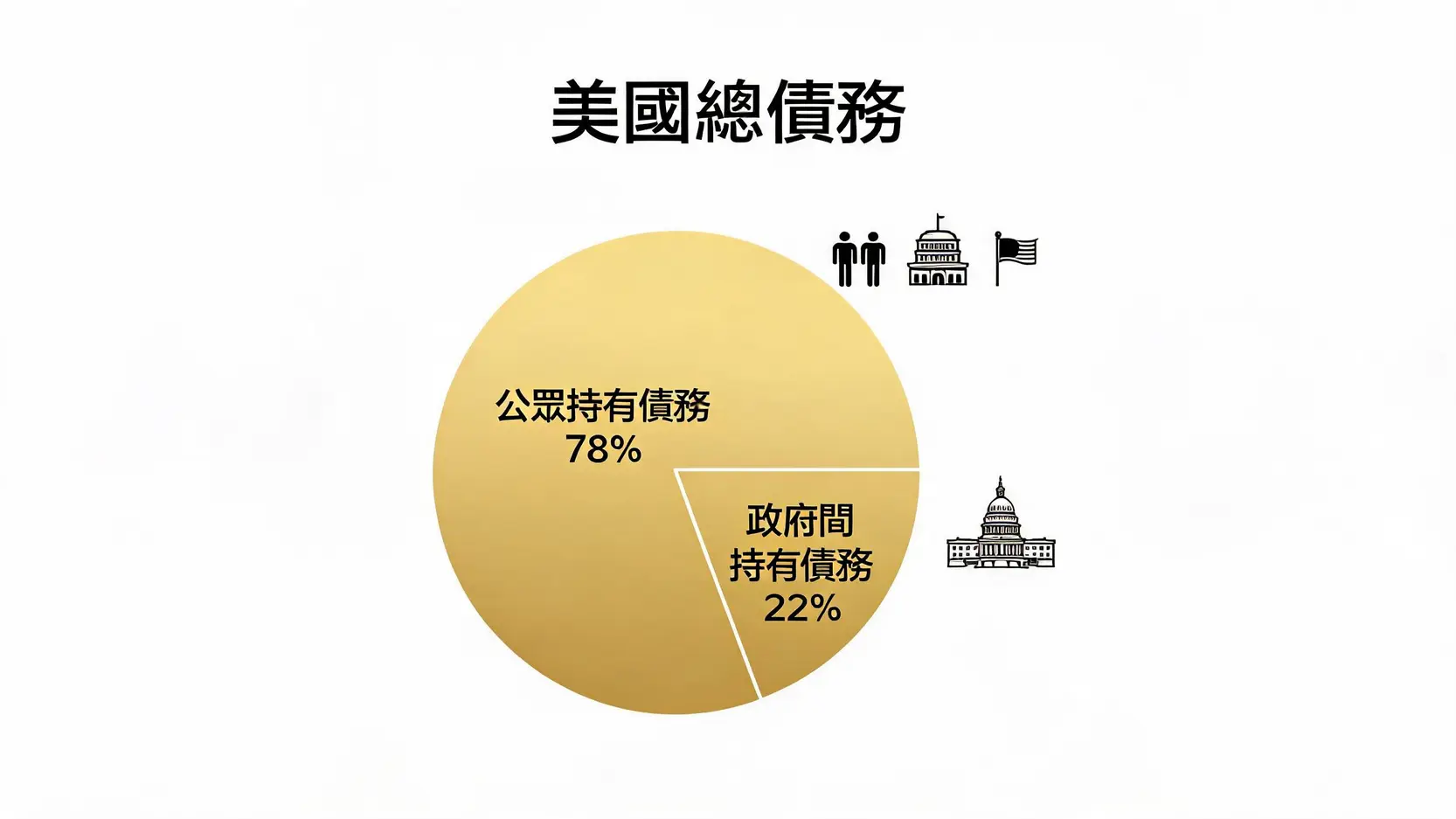
- Debt Held by the Public: This consists of debt issued by the US Treasury and purchased by individual investors, businesses, pension funds, and foreign governments. It accounts for approximately 78% of total US debt and represents the primary focus of financial markets because it directly reflects external confidence in US creditworthiness.
- Intragovernmental Holdings: This consists of debt owed by one part of the US government to another, accounting for approximately 22% of total debt. The most prominent example is the Social Security Trust Fund investing its surplus funds in US Treasuries. In essence, this is the government “owing money to itself”. Although it still needs to be repaid, its urgency and market impact are far lower than those of debt held by the public.

Composition of US National Debt: Public Debt vs. Intragovernmental Debt
Distinguishing between these two categories is crucial because when discussing “who owns US debt”, the focus is primarily on the first category, namely the domestic and foreign entities that hold publicly traded US government debt.
The History of US Debt Growth and Future Projections
The explosive growth of US debt did not happen overnight. Looking back, several major events accelerated debt accumulation, including the economic stimulus measures following the 2008 global financial crisis, years of spending on the War on Terror, and the massive fiscal relief packages introduced after the COVID-19 pandemic in 2020. Each crisis has largely been addressed through increased borrowing. According to projections from the Congressional Budget Office (CBO), if current policies remain unchanged, the US fiscal deficit will continue expanding over the next decade, with publicly held debt projected to reach an unprecedented 180% of GDP by around 2035. This steep upward trajectory lies at the heart of growing global market concerns.
The US Debt Ceiling: A Recurring Political Standoff
No discussion of US debt would be complete without mentioning the “debt ceiling”, a unique mechanism that has repeatedly turned into a political drama, leaving global financial markets on edge each time.
What Is the Debt Ceiling and Why Does It Exist?
The debt ceiling is the maximum amount the US federal government is legally allowed to borrow, as established by Congress. Unlike a credit card limit, it does not restrict future spending. Instead, it limits the government’s ability to finance expenditures that have already been approved (such as military salaries, Social Security benefits, and interest payments on government debt). The system was introduced during World War I to provide the Treasury with greater borrowing flexibility without requiring Congressional approval for every issuance. Today, however, it has evolved into a bargaining chip in political negotiations, allowing both parties to pressure each other during budget debates.
Historical Debt Ceiling Crises and Their Market Impact
Debt ceiling negotiations have become increasingly difficult in recent years. The most notable example occurred during the 2011 debt ceiling crisis, when political deadlock prompted Standard & Poor’s (S&P) to downgrade the US sovereign credit rating for the first time, from AAA to AA+, triggering severe volatility across global equity markets. A similar scenario unfolded again in 2023. Although lawmakers ultimately reached a last-minute agreement that suspended the debt ceiling through early 2025, the prolonged uncertainty damaged market confidence and increased the US government’s borrowing costs.
How Real Is the Risk of a “Technical Default”?
Although each debt ceiling crisis attracts widespread attention, the likelihood of the US actually “defaulting on its debt” is extremely low. If it were to happen, the consequences would be catastrophic, including:
- Destroy global confidence in the US dollar and US Treasuries.
- Trigger a sharp surge in interest rates, severely impacting businesses and consumers.
- Potentially spark a global financial recession.
For these reasons, no rational political leader would willingly accept responsibility for such an outcome. However, the risk of a “technical default” is real. This refers to a temporary delay in payments because Congress fails to raise the debt ceiling in time, forcing the Treasury to postpone certain obligations, such as government employee salaries or payments to contractors. Even a brief delay would be sufficient to damage economic confidence and unsettle financial markets. This recurring political standoff has become an unnecessary source of risk in itself.
Further Reading (Highly Recommended)
Who Owns US Debt? Understanding the Holders of US Treasuries
Understanding who holds US Treasuries is key to assessing their stability. Many people mistakenly believe that China is the largest creditor to the US, but that is no longer the case. In reality, the ownership structure of US Treasuries is highly diversified, which helps spread risk to some extent.
Domestic Holders: The Federal Reserve, Social Security Funds, and Individual Investors
In fact, the largest holders of US Treasuries are domestic institutions and investors. They mainly include:
- The Federal Reserve (The Fed): Through open market operations (particularly during periods of monetary easing), the Fed purchases large amounts of US Treasuries to regulate market liquidity and interest rates.
- Government funds such as the Social Security Trust Fund: As mentioned earlier, these funds invest their surplus assets in US Treasuries, making them the largest holders of intragovernmental debt.
- Mutual funds, pension funds, banks, and insurance companies: These institutions hold US Treasuries as core portfolio assets due to their liquidity and safety.
- State and local governments, as well as individual investors: They also hold a substantial portion of US Treasuries as a conservative investment.
Foreign Holders: The Influence of Major Creditors Such as Japan and China
Among all foreign holders, Japan has long remained the largest overseas holder of US Treasuries. According to data from early 2026, the largest foreign holders of US Treasuries are ranked approximately as follows:
| Rank | Country/Region |
Holdings (Approximate) |
| 1 | Japan | ~US$1.2 trillion |
| 2 | United Kingdom | ~US$0.9 trillion |
| 3 | China | ~US$0.7 trillion |
| 4 | Belgium | ~US$0.45 trillion |
| 5 | Canada | ~US$0.44 trillion |
| … | Taiwan | ~US$0.3 trillion (Ranks Among the Top 10) |
Note: The data is subject to change and reflects an overview as of early 2026.
The Geopolitical and Economic Implications of Foreign Reductions in US Treasury Holdings
In recent years, one notable trend has been the gradual reduction of US Treasury holdings by several countries, including China. There are multiple reasons behind this trend:
- Geopolitical considerations: Against the backdrop of rising US-China tensions, reducing US Treasury holdings is viewed as a strategy to lessen dependence on the US dollar and mitigate the risk of potential financial sanctions.
- The need for economic diversification: Central banks around the world are seeking to diversify their foreign exchange reserves by allocating more assets to gold, the euro, and other alternatives.
- Market operations: In some cases, reductions in US Treasury holdings are intended to support exchange rate intervention and stabilize domestic currencies.
Although this trend has attracted considerable attention, it has not undermined the US Treasury market in the short term. Whenever a major seller emerges, other buyers (such as the United Kingdom and Belgium) have stepped in. However, over the long term, if global “de-dollarization” accelerates, it will undoubtedly increase US financing costs and challenge its financial dominance.
The Long-Term Economic Impact of Massive Government Debt
America’s continuously expanding national debt is like a frog slowly being boiled. Its long-term effects are gradually becoming more apparent, creating challenges for the economy on multiple fronts.
Crowding Out Effect: How Government Borrowing Affects Private Investment
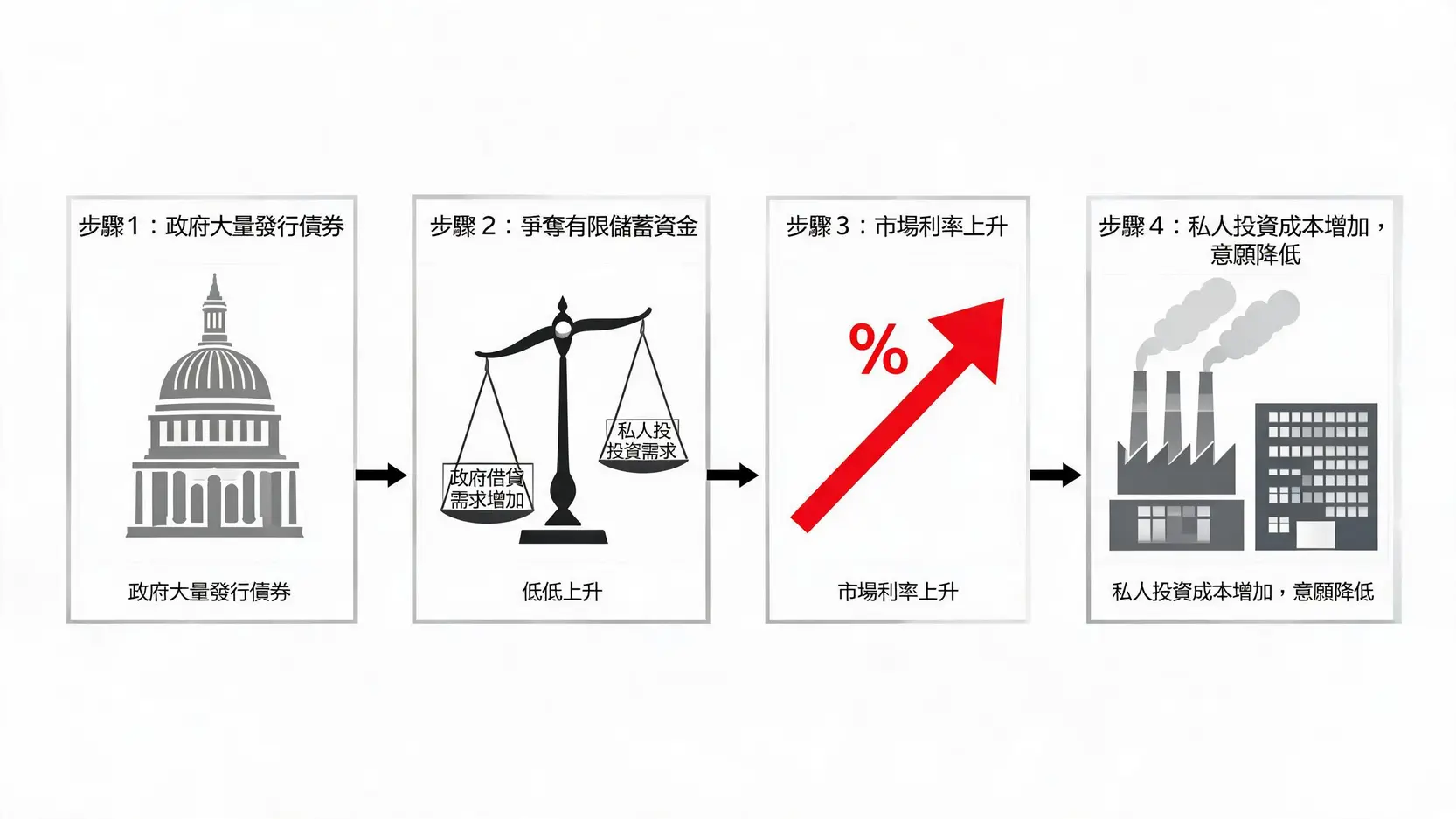
When the government issues large amounts of bonds to raise funds, it competes with the private sector (including businesses and individuals) for a limited pool of savings. This pushes interest rates higher, increases borrowing costs for businesses, and reduces their willingness to invest and expand. This phenomenon is known as the “Crowding Out Effect”. Over time, innovation and productivity growth in the private sector may slow, ultimately reducing the economy’s long-term growth potential.

How the Crowding Out Effect Works
Inflationary Pressure: The Risk of Debt Monetization
The government faces tremendous pressure to repay its enormous debt and interest obligations. In an extreme scenario, if the Federal Reserve is forced to continue financing government deficits by purchasing large amounts of US Treasuries through quantitative easing, it would effectively be equivalent to printing money. As large amounts of money flow into the economy to chase a limited supply of goods and services, inflation could eventually become difficult to control. Part of the global inflation surge between 2021 and 2023 was linked to the extremely accommodative monetary policies and fiscal stimulus introduced during the pandemic. Persistent large fiscal deficits continue to create inflationary risks for the future.
Erosion of Confidence in the US Dollar
The US dollar’s position as the world’s leading reserve currency is fundamentally supported by confidence in the US government and the strength of the US economy. However, unchecked debt growth can gradually undermine global investors’ confidence in the US government’s long-term ability to meet its obligations. Although US Treasuries remain the world’s primary safe-haven asset in the short term due to the lack of comparable alternatives, the erosion of confidence is a slow and continuous process. Once a critical threshold is crossed, it could trigger a global shift away from US dollar-denominated assets, severely weakening the US dollar’s status and having far-reaching consequences for both the US and the global financial system.
Conclusion
The US debt issue is a complex macroeconomic challenge that combines economic, political, and geopolitical factors. In the short term, supported by the US dollar’s status as the world’s reserve currency and the deepest, most liquid financial market in the world, US Treasuries continue to be widely regarded as safe assets, making the likelihood of a full-scale debt crisis extremely low. However, the long-term risks associated with continuously rising debt cannot be ignored, including higher interest rates, persistent inflationary pressures, and the crowding out of private investment. For global investors, understanding the structure of US debt, the political dynamics surrounding it, and its far-reaching economic implications is essential for assessing future global financial stability and developing long-term investment risk management strategies. This elephant in the room is becoming increasingly difficult to ignore.
Frequently Asked Questions (FAQ)
Q: Could the US Government Ever Declare Bankruptcy?
A: Theoretically, no. Unlike individuals or corporations, a sovereign government has the power to levy taxes and issue currency. The US government can meet its obligations by raising taxes or (in extreme circumstances) with assistance from the Federal Reserve to finance its debt. Therefore, “bankruptcy” in the traditional sense is unlikely to occur. The greater concern is a “sovereign debt default”, meaning the government fails to make principal or interest payments on its bonds on time, although the probability of this remains extremely low.
Q: If the US Defaults, How Would It Affect My Personal Investments?
A: The impact would be catastrophic and widespread. First, global stock markets would likely plunge because US Treasury yields serve as the foundation for pricing all risk assets. Second, the US dollar could depreciate sharply, creating turmoil across global foreign exchange markets. Interest rates would surge, severely affecting the real estate market and corporate financing. The security of your retirement accounts, stocks, funds, and even bank deposits could all come under significant pressure.
Q: Why Do Investors Continue Buying US Treasuries Despite the High Debt Level?
A: There are several key reasons. First, the US Treasury market is the largest and most liquid bond market in the world, making it easy for large amounts of capital to enter and exit. Second, the US dollar’s status as the world’s primary reserve and trading currency requires central banks and institutions to hold substantial US dollar-denominated assets. Third, despite the risks, US Treasuries are still regarded as one of the safest “safe-haven” assets during global crises, creating a situation often described as “There Is No Alternative” (TINA).
Q: Has the US Debt Ceiling Been Eliminated?
A: No, it has not been permanently eliminated. Under the agreement reached in 2023, the debt ceiling was “suspended” until January 2025. This allowed the US Treasury to issue debt without restriction to meet government obligations during the suspension period. However, once the suspension expires, the debt ceiling automatically resets to the debt level at that time. Congress must then take action again (either by raising or suspending the ceiling once more), potentially leading to another round of political confrontation.
Related Articles
-
Global Asset Repricing: Why Has Japan’s Property Market Become a Safe Haven for Smart Money Amid Yen Depreciation? What Is “Global Asset Repricing”? Why Has Japan Become the Main Focus? While investment forums around the world are heatedly discussing yen depreciation pressure, the real smart money has already begun positioning...2026 年 6 月 23 日
-
Farewell to Negative Interest Rates! The Truth Behind Japan Meeting Its Inflation Target: Why Has Yen Depreciation Pressure Increased Instead of Easing? The Japanese economy is staging an extremely contradictory drama: after waiting for thirty years, it has finally welcomed the long-awaited Japan inflation, yet the market’s response has been...2026 年 6 月 23 日
-
A Complete Analysis of Central Bank Policy Shifts: From YCC to QT, Decoding the BOJ and the Fed’s Next Move The Bank of Japan (BOJ) and the US Federal Reserve (Fed), two giants of the global financial markets, are seeing their diverging monetary policy directions become the core force driving...2026 年 6 月 23 日