USD/JPY Outlook: Fed Cuts & BOJ Policy Divergence

Updated: 2026/05/14  |  CashbackIsland

us-japan-policy-usdjpy-analysis

Widening US-Japan Monetary Policy Divergence: A Complete Analysis of USD/JPY Trends and Investment Opportunities Under US Federal Reserve Rate Cut Expectations

As the Japanese yen exchange rate continues hitting new lows, is your investment portfolio coming under increasing pressure? Faced with the widening gap in US-Japan monetary policy divergence, many investors feel uncertain about the future direction of USD/JPY. At the core of this divergence is the fact that the US Federal Reserve has adopted aggressive tightening policies to combat inflation, while the Bank of Japan has maintained an ultra-loose monetary environment for an extended period. This article will provide an in-depth analysis of the root causes behind the widening US-Japan interest rate gap, examine how expectations of US Federal Reserve rate cuts may influence market sentiment, and provide you with a comprehensive USD/JPY trend analysis alongside potential investment strategies. 


Core Analysis: What Is US-Japan Monetary Policy Divergence?

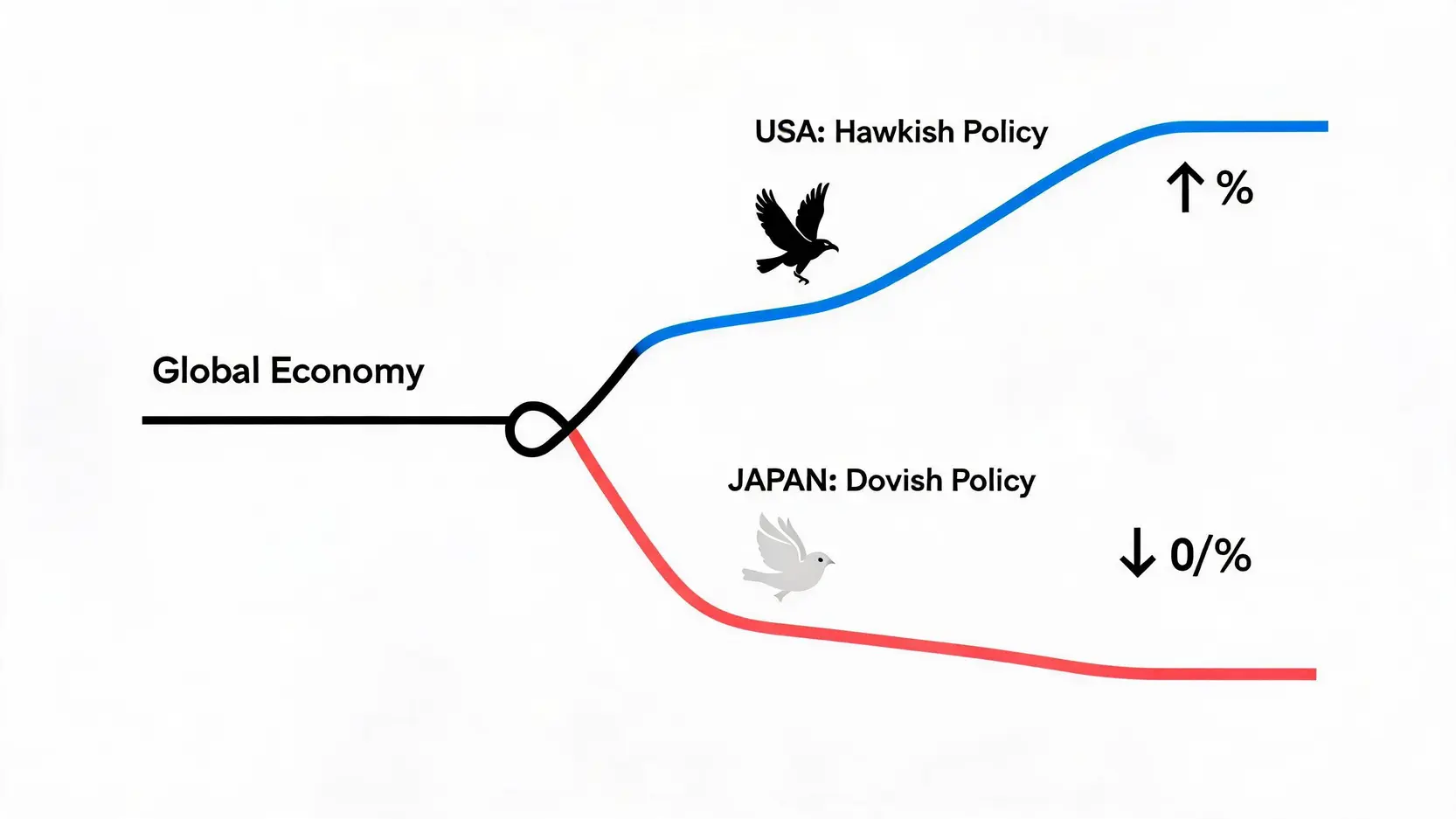
“US-Japan monetary policy divergence” may sound highly technical, but it is actually the key to understanding the extreme weakness of the Japanese yen today. Simply put, it refers to the completely opposite monetary policy directions being adopted by the central banks of the US and Japan in pursuit of their respective economic objectives. It is like two trains racing in opposite directions, with the gap between them growing wider and wider.

日美貨幣政策分化示意圖,展示美國鷹派升息與日本鴿派寬鬆的對比。

US-Japan Monetary Policy Divergence: One Tightening, One Loosening, Two Completely Different Paths.


Hawkish United States: Why Has the Federal Reserve Continued Tightening Policies?

Over the past several years, the US has faced its most severe inflationary pressure in decades. In order to curb surging prices, the Federal Reserve adopted a “hawkish” stance and implemented multiple aggressive rate hikes, pushing the federal funds rate to multi-year highs. The objectives behind this approach are very clear:

  • Increase Borrowing Costs: Higher interest rates raise borrowing costs for businesses and individuals, effectively suppressing consumer spending and investment demand while cooling down an overheated economy.
  • Stabilize Inflation Expectations: Demonstrating determination to fight inflation helps prevent consumers from accelerating spending due to expectations of even higher future prices, thereby avoiding an inflationary spiral.
  • Attract International Capital: Higher interest rates make US dollar assets (such as US Treasury bonds) more attractive, drawing global capital inflows and further strengthening the US dollar.

Although inflation data has recently shown signs of easing, Federal Reserve officials remain cautious, emphasizing that they need to see clear evidence of inflation sustainably moving toward the 2% target before considering a policy shift. This firm hawkish stance remains the foundation of US dollar strength.


Dovish Japan: Why Does the Bank of Japan Continue Defending Negative Rates and Loose Policies?

In contrast to the US, Japan has spent more than two decades trapped in deflation, where prices continue falling over time. To stimulate the economy, the Bank of Japan adopted an extremely “dovish” strategy, maintaining negative interest rates and implementing large-scale asset purchase programs, including Quantitative and Qualitative Easing (QQE) and Yield Curve Control (YCC). Its main objectives are:

  • Lower Borrowing Costs: Through negative interest rates, banks are encouraged to lend more money to businesses and consumers, stimulating investment and spending.
  • Create Moderate Inflation: Set a 2% inflation target in hopes of reversing the public’s deflationary mindset of “buying when prices rise, not when they fall”.
  • Suppress the Japanese Yen Exchange Rate: Loose monetary policy increases the supply of yen, benefiting export industries and boosting corporate profitability.

Even as the rest of the world entered a rate hike cycle, the Bank of Japan remained the only major central bank still insisting on ultra-loose policies. This dramatic policy contrast directly created heavy selling pressure on the Japanese yen.


How Has the US-Japan Interest Rate Gap Become the Core Engine Driving USD/JPY Trends?

When the monetary policy directions of two countries diverge, the most direct consequence is the widening “US-Japan interest rate differential”. This differential refers to the gap between the interest returns generated from holding US dollar assets versus Japanese yen assets. The larger this gap becomes, the stronger the upward pressure on the USD/JPY exchange rate.


How Does the Interest Rate Gap Trigger “Carry Trades” and Accelerate Japanese Yen Depreciation?

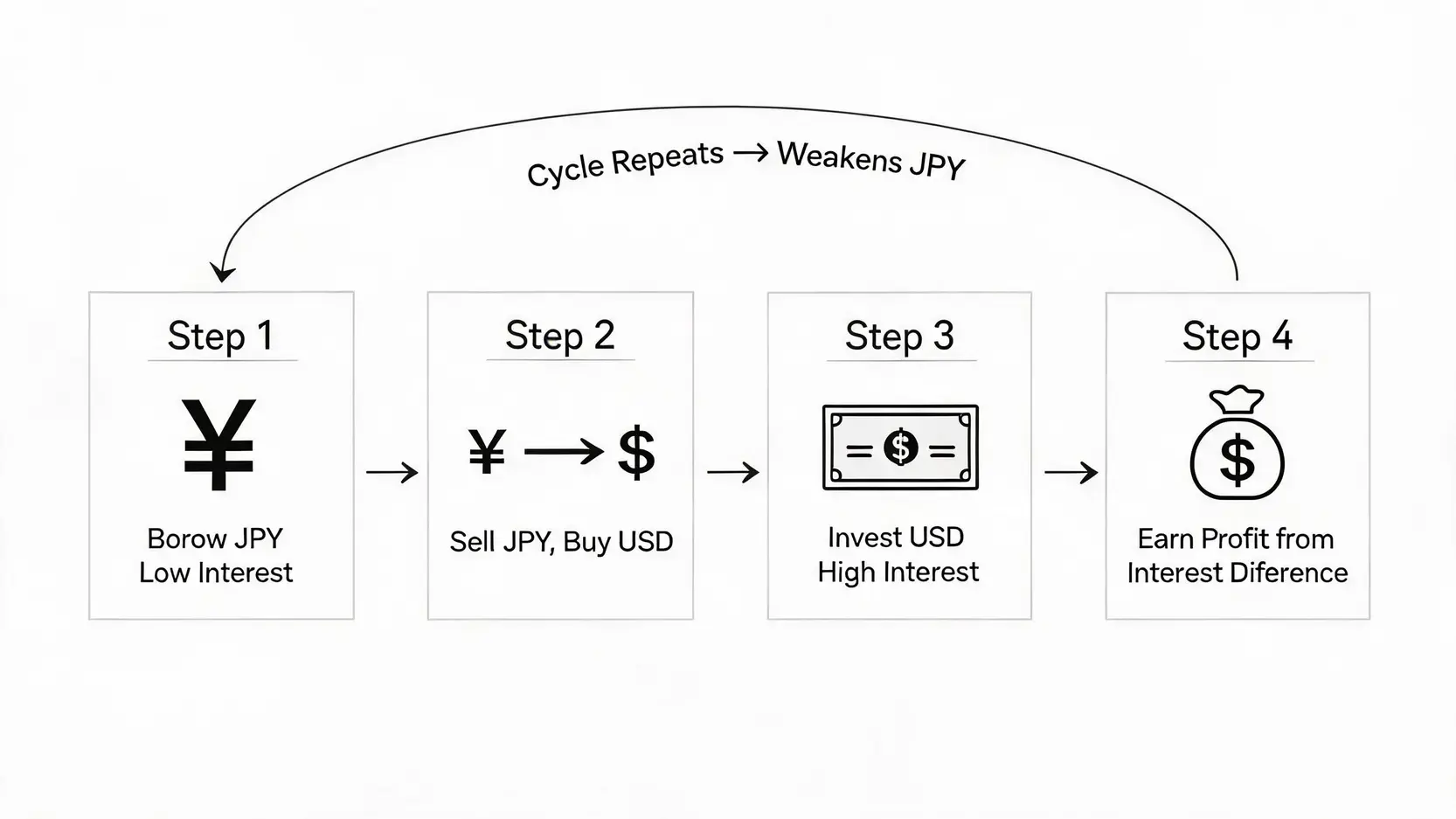
The “carry trade” is one of the most classic strategies in the forex market, and the widening US-Japan interest rate gap has created the perfect environment for it. The process works as follows:

日圓套息交易運作原理的四步驟流程圖。

Carry Trade Mechanism: Borrow Low-Interest Japanese Yen, Purchase Higher-Yield US Dollar Assets, and Earn the Interest Rate Differential.

  1. Traders borrow currencies with extremely low interest rates (such as the Japanese yen).
  2. They convert those yen into higher-yield currencies (such as the US dollar).
  3. They purchase US dollar-denominated assets, such as US Treasury bonds, to earn higher interest returns.
  4. As long as USD/JPY exchange rate movements do not erase the interest differential profits, this strategy remains highly profitable.

When large numbers of institutions and investors engage in yen carry trades, it means continuous “selling of Japanese yen and buying of US dollars”. This enormous market force continuously pushes the yen toward depreciation and drives USD/JPY steadily higher. This is one of the core reasons why the yen’s decline has remained difficult to reverse despite already weakening significantly. 

Data Illustration: The Historical Correlation Between the US-Japan 10-Year Government Bond Yield Differential and USD/JPY

If we examine historical data, we can observe an astonishingly strong positive correlation between the US-Japan 10-year government bond yield differential and the movement of USD/JPY. This relationship can be summarized as follows:

Scenario Change in US-Japan Interest Rate Differential

Impact on Capital Flows

USD/JPY Trend
US Rate Hikes vs Japan Unchanged Widens ⬆️ Capital Flows Into the US in Search of Higher Returns Rises
US Rate Cuts vs Japan Unchanged Narrows US Dollar Assets Become Less Attractive Falls
Japan Rate Hikes vs US Unchanged Narrows Partial Capital Flows Back Into Japan Falls 📉

As shown in the table above, as long as the US-Japan interest rate differential continues widening, the upward momentum of USD/JPY will remain difficult to reverse. This also explains why the market is paying such close attention to the next moves made by both central banks.


Market Focus: How Will US Federal Reserve Rate Cut Expectations Affect USD/JPY?

As signs emerge that US inflationary pressure is peaking and gradually cooling, the market focus has shifted from “how long will rate hikes continue” to “when will rate cuts begin”. Expectations of US Federal Reserve rate cuts are viewed as the key turning point that could potentially reverse the long-term upward trend of USD/JPY.


Cooling Inflation Data: Why Does the Market Expect the Federal Reserve to Begin Cutting Rates?

Market expectations for Federal Reserve rate cuts are mainly based on the following factors:

  • Continued Cooling in Core Inflation: The Core PCE (Personal Consumption Expenditures) Price Index, which excludes food and energy prices, is the inflation indicator most closely monitored by the Federal Reserve. If this data continues declining steadily, it will provide room for the Federal Reserve to cut rates.
  • Slowing Labor Market: Signs such as slower nonfarm payroll growth and a slight rise in unemployment indicate that the previously overheated labor market is cooling, helping reduce inflationary pressure driven by wage growth.
  • Risk of Slowing Economic Growth: Maintaining high interest rates for an extended period places pressure on business investment and consumer spending, potentially causing a hard economic landing. To avoid an economic recession, the Federal Reserve may adopt preventive rate cuts.

Investors can monitor minutes from Federal Open Market Committee (FOMC) meetings to gain insights into official views regarding the future policy path. 

How Could Rate Cut Expectations Narrow the US-Japan Interest Rate Gap and Bring a Turning Point for USD/JPY?

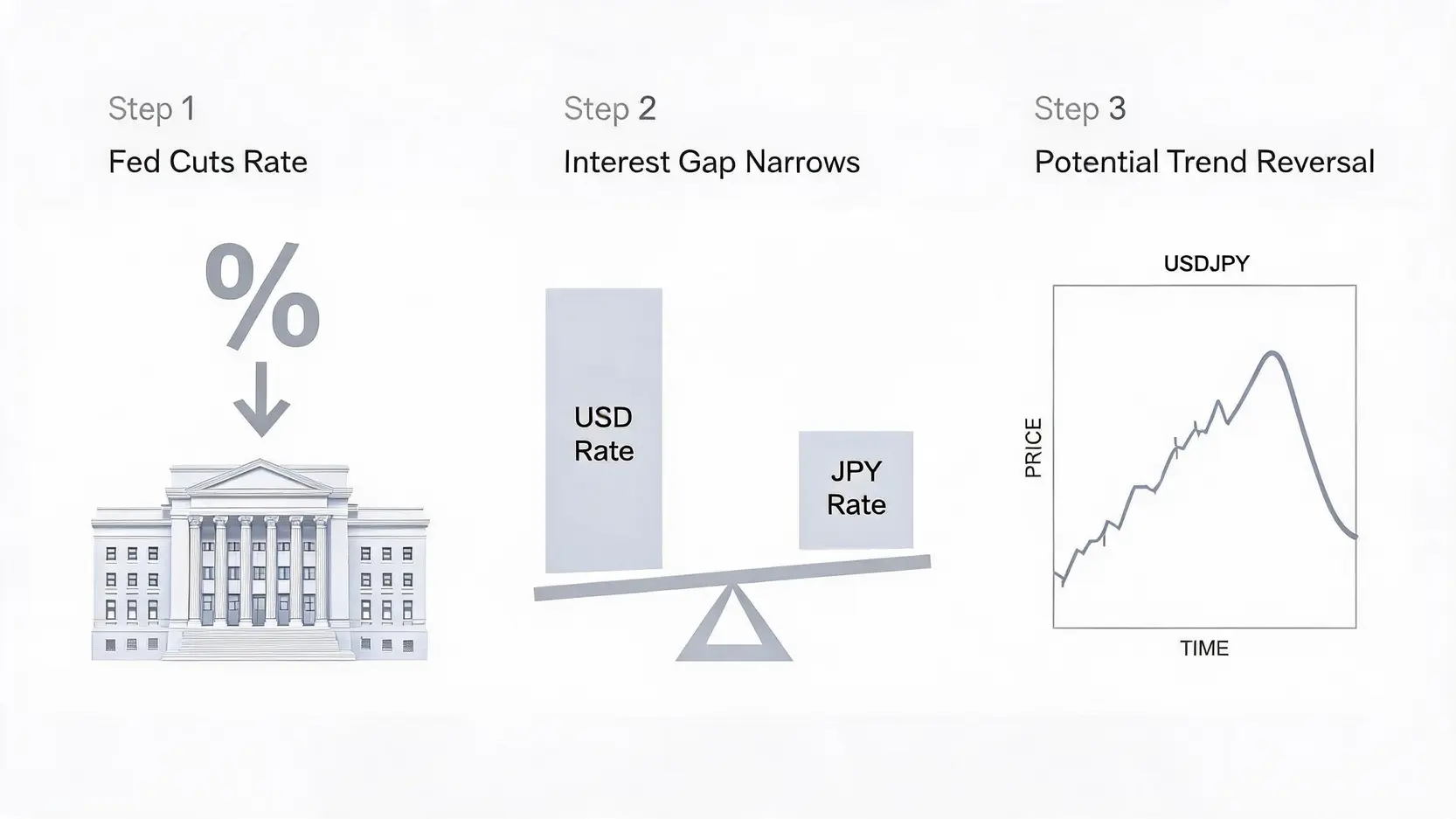
Once the Federal Reserve begins a rate cut cycle while the Bank of Japan maintains unchanged policies, the US-Japan interest rate differential will narrow directly. This would fundamentally weaken the foundation of carry trades. As the yield advantage of US dollar assets declines, carry traders may begin unwinding positions by “selling US dollars and buying back Japanese yen”. This reversal of capital flows would provide strong support for the Japanese yen and could push USD/JPY lower from elevated levels, potentially leading to a trend reversal.

美國聯儲局減息對日美息差及 USDJPY 走勢影響的連鎖反應示意圖。

The Chain Reaction of Rate Cuts: A Narrowing Interest Rate Differential Could Trigger Carry Trade Unwinding and Bring a Turning Point for the Japanese Yen.


Further Reading (Highly Recommended)

2025 Ultimate Guide to Forex Fundamental Analysis: Practical Lessons From Economic Data to Central Bank Decisions

[Forex Beginner Tutorial] From 0 to 1 for New Investors: Understanding the Basics of Foreign Exchange Trading!


Outlook for 2026: USD/JPY Technical Analysis and Key Price Levels

After understanding the broader fundamental backdrop, combining it with forex technical analysis can help investors better identify entry and exit timing. 

Analysis of Key Support and Resistance Levels

For the future direction of USD/JPY, the following psychological and technical levels deserve close attention:

  • Upper Resistance Levels:
    • 158.00: This has recently become an important psychological level for the market. Multiple failed breakout attempts suggest that a successful breakout could trigger fresh buying momentum.
    • 160.00: Widely regarded as a potential “defense line” where Japanese authorities may intervene, giving it extremely strong psychological resistance.
  • Lower Support Levels:
    • 155.00: A key level that has shifted from resistance to support. If broken below, it may signal the end of the short-term upward trend.
    • 152.00: The base platform from the previous rally, providing relatively strong technical support.

Traders should closely observe how the exchange rate reacts around these critical levels while combining analysis with indicators such as trendlines and moving averages for a more comprehensive assessment.


The Possibility of “Verbal Intervention” and Actual Intervention by Japan’s Ministry of Finance

When the Japanese yen depreciates too rapidly, officials from Japan’s Ministry of Finance often issue hawkish statements such as “closely monitoring forex market volatility” or “not ruling out any options”. This is known as “verbal intervention”. Its purpose is to intimidate speculators and slow the pace of yen depreciation through public messaging.

However, if verbal intervention proves ineffective and exchange rate fluctuations are considered “disorderly”, Japanese authorities may directly intervene by using foreign exchange reserves to buy Japanese yen and sell US dollars in the market. Intervention risk remains the biggest uncertainty that USD/JPY bullish traders must constantly monitor, as it could trigger sharp pullbacks of several hundred pips within a very short period.


Frequently Asked Questions About US-Japan Monetary Policy and USD/JPY

Q: Once the US Begins Cutting Rates, Will the Japanese Yen Immediately Strengthen?

A: Not necessarily. Markets usually “trade the expectation in advance” (Buy the rumor, sell the fact). Before the Federal Reserve officially announces a rate cut, USD/JPY may have already started pricing in the expectation and pulled back. In addition, the “pace” and “magnitude” of the rate cuts are equally important. If the cuts are smaller than market expectations, the market may even see a “priced-in bad news” reaction, limiting the strength of the yen’s rebound. At the same time, the policy direction of the Bank of Japan is also a key variable.

Q: Is It Possible for the Bank of Japan to Change Its Ultra-Loose Monetary Policy?

A: The possibility exists, but the process would likely be extremely gradual and cautious. The primary condition for the Bank of Japan to change policy is confirmation that domestic wage growth and inflation have formed a healthy cycle capable of remaining sustainably above the 2% target. Investors should closely monitor Japan’s “Shunto” spring wage negotiations and core CPI data. Any signs of policy normalization could trigger a sharp appreciation in the Japanese yen.

Q: Besides the US-Japan Interest Rate Differential, What Other Factors Affect USD/JPY Prices?

A: In addition to the interest rate differential, factors influencing USD/JPY include:
1.Global Safe-Haven Sentiment: During periods of global financial turmoil or geopolitical risk, the Japanese yen, as a traditional safe-haven currency, often strengthens due to inflows of safe-haven capital, causing USD/JPY to decline.
2. Energy Prices: Japan is a major energy importer, so rising international oil prices worsen its trade conditions and place pressure on the Japanese yen.
3. US Economic Data: Strong US economic data (such as nonfarm payrolls and GDP growth) tend to strengthen the US dollar, and vice versa.

Q: What Is the Biggest Risk When Investing in USD/JPY?

A: The two biggest risks are primarily as follows. The first is “policy shift risk”, where the US Federal Reserve or the Bank of Japan unexpectedly changes policy direction, triggering sharp market volatility. The second is “intervention risk”, where Japan’s Ministry of Finance suddenly enters the market to intervene at levels and timings the market does not expect, dealing a heavy blow to bullish positions. Therefore, strict risk management and stop-loss settings are extremely important.


Conclusion

In summary, deeply understanding US-Japan monetary policy divergence is the foundation for accurate USD/JPY trend analysis. The currently widening US-Japan interest rate differential continues providing strong fundamental support for USD/JPY. However, market attention has now fully shifted toward the future path of US Federal Reserve rate cuts, which will become the core variable determining whether the Japanese yen can reverse its long-term weakness. Investors should remain patient, closely monitor official developments from both central banks and key economic data, and combine technical analysis with comprehensive trading plans in order to gain an advantage in the volatile forex market while effectively managing risk.

编者
Evan Lin

Evan Lin

我是Evan Lin,从大学时期开始接触外汇交易,至今已有多年实战经验,熟悉技术分析与EA策略,热衷于研究市场脉动与风险管控,喜欢分享实战经验和交易技巧,和大家一起学习、一起进步!

If you liked this article, please share it!

Related Articles

  • Trading Drawdown Recovery: Psychological Adjustment Guide
    The Taiwan Dollar Surges Past 31.5! With Hot Money and Foreign Capital Inflows, Is This an Opportunity or a Risk? An In-Depth Analysis The Capital Frenzy: The Three Major Drivers Behind the Taiwan Dollar Breaking Above 31.5 The New Taiwan dollar has recently become the absolute focal point of the...
    2026 年 6 月 10 日
  • Taiwan Dollar Surge: Stocks, Bonds, or USD?
    Taiwan Dollar Appreciation and Hot Money Inflows! An Investor's Action Guide: Should You Buy Stocks, Bonds, or Exchange for US Dollars at This Stage? One of the hottest topics in the market recently has been the capital-driven rally fueled by foreign investors' consecutive net buying of Taiwan stocks, pushing the...
    2026 年 6 月 10 日
  • Hot Money Flows Into Taiwan Bonds: What It Means
    Hot Money Flows Into Taiwan's Bond Market: Understanding the Causes, Impact, and Investor Response Strategies in One Article One of the hottest topics in the market recently is "hot money flowing into Taiwan's bond market". Why have these fast-moving international funds, which come and go like the wind, chosen the...
    2026 年 6 月 10 日
返回顶部