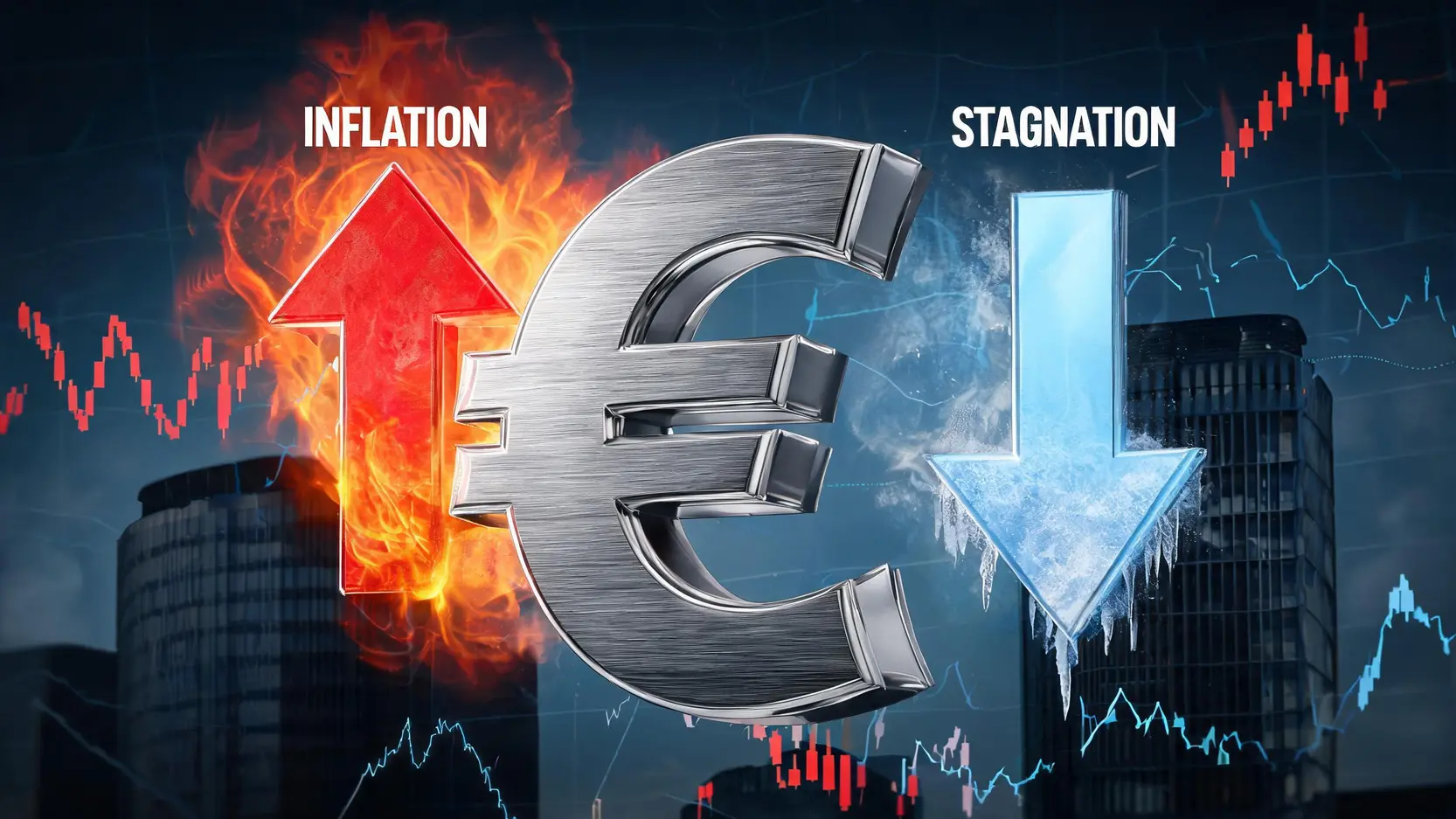
European Central Bank Stagflation Dilemma Explained: Eurozone Economic Outlook and Monetary Policy Response Strategies
The Eurozone economy is currently at a difficult crossroads. On one hand, persistent inflationary pressure remains a constant concern; on the other hand, economic growth is sluggish and losing momentum. This has placed the European Central Bank (ECB) in a “stagflation dilemma”. Faced with such a challenging situation, investors, business owners, and even the general public are eager to know: how will the ECB’s monetary policy respond? And where is the Eurozone economy headed? This article provides an in-depth analysis of this complex situation, from the root causes of stagflation to the ECB’s policy options, offering forward-looking insights and strategic interpretation.
What Is Stagflation? Why Is the ECB Caught in a Policy Dilemma?
To understand the ECB’s current predicament, we must first understand the term “stagflation”. It is not simply an economic recession or inflation, but a combination of both, which is precisely why it is so difficult to manage.
Definition of Stagflation: A Deadly Combination of High Inflation and Low Growth
Stagflation is a hybrid term formed from “stagnation” and “inflation.” It describes a highly challenging macroeconomic environment with the following key characteristics:
- High inflation: Prices continue to rise broadly, reducing purchasing power and significantly increasing the cost of living.
- Economic stagnation: Gross Domestic Product (GDP) growth slows, stalls, or even turns negative.
- High unemployment: Due to weak economic conditions, companies reduce hiring or lay off workers, increasing unemployment.
In simple terms, stagflation is a situation where “everything becomes more expensive, salaries do not increase, and job security declines” Its economic damage is far greater than either inflation or recession alone.
A Difficult Balancing Act: Raising Rates Risks Hurting the Economy, Cutting Rates Risks Uncontrolled Inflation
Traditionally, central banks have a clear toolkit: “raise interest rates” to cool down an overheating economy and high inflation, or “cut interest rates” to stimulate growth during a downturn. However, in a stagflation environment, this logic breaks down.
- If interest rates are raised: Higher borrowing costs can help control inflation by reducing demand, but they also weaken already fragile business investment and consumer spending, potentially pushing the economy into a deeper recession and worsening unemployment.
- If interest rates are cut: Lower rates can stimulate economic growth, but increased liquidity may further fuel already high inflation, potentially leading to runaway price increases.
This is the ECB’s “policy dilemma”: moving in either direction carries significant risks. The ECB is essentially walking a tightrope, where even a small misstep could destabilize the economy.
Further Reading (Highly Recommended)
What Are Non-Farm Payrolls? Why Are They So Important for Global Traders
Japan YCC Policy Exit Explained: Understanding the End of Yield Curve Control in One Guide
Analyzing the Eurozone Economic Outlook: Key Data and Influencing Factors
To assess the ECB’s next move, we must first understand the current state of the Eurozone economy. Key economic data and external factors together paint a complex picture.
Latest GDP and Inflation Data: Is the Recovery Losing Momentum?
Recent data shows that the Eurozone’s economic recovery remains uneven. Although inflation has declined from its peak, it is still well above the European Central Bank’s 2% target. In particular, sticky core inflation (excluding energy and food prices) indicates that price pressures have spread across multiple sectors of the economy.
|
Economic Indicators
|
Latest Data (Estimated) |
Market Expectations |
Potential Interpretation |
| Quarter-on-quarter GDP growth rate |
+0.1% |
+0.2% |
❌ Growth is nearly stagnant, below expectations, indicating weak economic momentum |
| Consumer Price Index (CPI) year-on-year growth rate |
3.5% |
3.3% |
❌ Inflationary pressure remains persistent, above target and higher than expected |
| Unemployment rate |
6.8% |
6.7% |
⚠️ The labor market is showing slight weakening but remains resilient |
From the table above, it is evident that Eurozone economic growth is weak, while inflation has not yet been fully resolved. This is a typical early-stage stagflation characteristic. Weak GDP data limits the central bank’s room for aggressive rate hikes, while persistent CPI prevents it from cutting rates easily.
Geopolitical Risks and Energy Crisis: How External Shocks Affect the European Economy
In addition to internal data, external shocks are another major variable influencing the Eurozone economic outlook. Europe is highly dependent on imported energy, making its economic lifeline extremely vulnerable to geopolitical risks.
- Geopolitical tensions: Ongoing regional conflicts not only disrupt global supply chains but also directly increase transportation costs for energy and food, creating imported inflationary pressure in Europe.
- Energy price volatility: Although energy prices have retreated from historical highs, any risk of supply disruption could trigger another surge, directly impacting European industrial production and household costs, further intensifying stagflation risks.
European Central Bank Monetary Policy Toolbox and Future Direction
Against such a complex backdrop, how will the European Central Bank deploy its policy tools? Markets are closely watching. Its decisions will mainly revolve around interest rates and asset purchase programs.
Interest rate decisions: Will the ECB hike, cut, or hold rates?
There is currently significant divergence in expectations regarding future interest rate movements, and the ECB itself is experiencing a tug-of-war between hawkish members (favoring tightening to fight inflation) and dovish members (favoring easing to support growth).
- Possibility of rate hikes: If inflation data in the coming months, especially core inflation, surprises to the upside again, hawkish voices will strengthen. They will argue that “it is better to endure short-term pain” to fully anchor inflation expectations, even at the cost of some growth.
- Possibility of rate cuts: If economic data deteriorates sharply, with GDP turning negative and unemployment rising significantly, policy focus will shift toward “avoiding a deep recession”. In that case, dovish members would likely gain the upper hand, potentially leading to preemptive rate cuts.
- Possibility of holding rates: This is currently seen by the market as the most likely scenario. In a situation where data is mixed and the outlook remains uncertain, the ECB may choose to “stay on hold”, maintaining current interest rates to gain more time to assess incoming data and avoid policy mistakes.
Investors should closely monitor official ECB meeting minutes to look for clues regarding future policy direction.
Future of Monetary Easing (QE): What Comes Next for Asset Purchase Programs?
In addition to interest rates, asset purchase programs (commonly known as QE or monetary easing) are another key monetary policy tool of the ECB. In the past, the ECB injected liquidity into the market by purchasing large volumes of government and corporate bonds. Under the current high inflation environment, however, its stance has shifted toward quantitative tightening (QT), gradually reducing its large balance sheet.
The key question going forward is the pace of QT. A rapid balance sheet reduction could lead to a sharp tightening of financial conditions and trigger market volatility, while a slow pace may fail to effectively curb inflation. The ECB is expected to adopt a gradual and predictable approach to its balance sheet reduction to minimize market disruption.
Further Reading (Highly Recommended)
What Are Non-Farm Payrolls? Why Are They So Important for Global Traders
Japan YCC Policy Exit Explained: Understanding the End of Yield Curve Control in One Guide
Frequently Asked Questions (FAQ)
Q: What is the most likely monetary policy action the European Central Bank will take next?
A: In the short term, the most likely scenario is to “remain on hold” and continue observing incoming data. The European Central Bank will emphasize its “data dependency” approach and avoid providing explicit forward guidance. Unless there is a sharp rebound in inflation or a sudden collapse in economic data, it will likely aim to maintain policy stability and adopt a wait-and-see stance.
Q: How does stagflation affect the euro exchange rate?
A: The impact is typically negative. Stagflation reflects weak economic fundamentals, while the central bank is unable to significantly raise interest rates due to concerns about harming the economy. This reduces the euro’s attractiveness. Compared with currencies backed by stronger economic growth or more hawkish monetary policy (such as the US dollar), the euro may face depreciation pressure.
Q: How should investors respond to Eurozone economic uncertainty?
A: In a stagflation environment, defensive strategies are essential. The following approaches may be considered:
- Diversification: Avoid overexposure to the Eurozone and adopt a global asset allocation strategy.
- Focus on value stocks: Select industry leaders with stable cash flows and strong pricing power that can pass costs on to consumers.
- Hold commodities: Precious metals such as gold tend to perform well during stagflation and can serve as a hedge against inflation and currency depreciation.
- Avoid long-term bonds: High inflation erodes real returns on fixed income, making long-duration bonds more risky.
Q: What is the biggest risk to the Eurozone economy?
A: The biggest risk lies in a combination of “policy missteps” and “external shocks”. For example, the ECB cutting rates too early could trigger a resurgence in inflation, forcing aggressive tightening that leads to financial instability and recession. Alternatively, a new geopolitical conflict could cause energy prices to surge again, pushing the Eurozone into a deeper stagflationary trap.
Conclusion
In summary, the European Central Bank is walking a tightrope, and every monetary policy decision will have a profound impact on the Eurozone economic outlook. Facing the complex stagflation dilemma, market uncertainty is unlikely to disappear in the short term. For investors, this represents both a challenge and an opportunity. Staying alert, closely monitoring key signals such as ECB policy direction, core inflation, and GDP growth, and flexibly adjusting investment portfolios will be essential to navigating this complex period successfully.