Short Put Strategy: Income & Lower Stock Entry Guide

Complete Guide to the Short Put Strategy: The Ultimate Guide to Stable Income Generation and Buying Stocks at Lower Prices
Have you ever wanted to find an investment strategy that can both generate stable cash flow and help you buy your favorite stocks at more attractive prices? Many investors wait endlessly for stock pullbacks only to miss the opportunity, while others settle for relying solely on dividend income. This article will provide a detailed breakdown of the “Short Put strategy”, a powerful tool that achieves both “Short Put income generation” and “buying stocks at lower prices through options“. Whether you are a beginner in options trading or looking to optimize your investment portfolio, this comprehensive guide will serve as the perfect starting point.
What Is a Short Put? Understanding the Core Concept
Before diving deeper into the strategy, it is important to understand the true nature of a Short Put. Simply put, selling a Put Option means you are “selling” a right to the buyer, giving them the right to sell you 100 shares of stock at a specific price (known as the strike price) before or on a future date (known as the expiration date). As the seller, you have the “obligation” to buy those 100 shares at the strike price if the buyer exercises the option. Naturally, taking on this obligation is not free. You immediately receive cash income known as the “option premium”. This premium is the core source of income in the Short Put strategy.

Figure 1: Core Concept of the Short Put Strategy – Earn Option Premiums While Taking on the Obligation to Buy Shares
Further Reading (Highly Recommended)
How Does a Short Put Work? Why Can Selling Rights Generate Profit?
The profit mechanism behind a Short Put is similar to running an insurance company. You collect an insurance premium, the option premium, from the market, meaning the option buyer, in exchange for providing protection against the “possibility of a stock price decline”. If the stock price does not fall below the agreed strike price by expiration, you keep the entire premium as profit, and the trade ends. If the stock price falls below the strike price, you must fulfill the contract and buy the stock at the agreed higher price, similar to paying out an insurance claim. However, because you originally intended to buy this quality stock at a lower price anyway, this acts more like a “paid limit order”, a smarter passive income investment approach.
Maximum Profit and Potential Risk Analysis: There Is No Free Lunch
Understanding profit and loss potential is critical in every investment strategy, and the Short Put strategy is no exception.
- Maximum Profit: The maximum profit you can earn is the “option premium” you receive upfront. If the stock price remains at or above the strike price by expiration, the option expires worthless, and you keep 100% of the premium without needing to take any further action.
- Potential Risk: The risk comes from a sharp decline in the stock price. Theoretically, the maximum loss equals “(Strike Price – Stock Price) × 100 – Premium Received”. In the worst-case scenario, if the company goes bankrupt and the stock price falls to zero, your loss would be “Strike Price × 100 – Premium Received”. Therefore, this is definitely not a risk-free strategy. Choosing high-quality companies that you are willing to hold long term is the key to risk management.
Breaking Down Key Terms: Strike Price, Expiration Date, and Premium
To trade options effectively, you must become familiar with the following core terms:
- Strike Price: The future stock transaction price agreed upon between you and the buyer. Selecting the strike price is central to the strategy because it determines both your potential purchase cost and the amount of premium received.
- Expiration Date: The validity period of the option contract. Options are available with weekly, monthly, quarterly, and other expiration cycles. The further away the expiration date, the higher the premium is usually, because you are taking on risk for a longer period.
- Option Premium: The payment you receive as the seller for taking on the obligation to buy shares. This cash is deposited into your brokerage account immediately after selling the option contract and represents your most direct source of cash flow.
Short Put Income Strategy: How to Generate Stable Monthly Cash Flow?
Using Short Puts as a tool for stable cash flow generation is a core strategy for many investors. The key to success lies in systematically selecting the right stocks, strike prices, and expiration dates to achieve the best balance between risk and return.
Choosing the Right Stocks: Quality Companies Are the Foundation of Success
This is the cornerstone of the entire strategy. Never sell put options simply because the premium looks attractive if you do not truly understand or want to hold the company long term. When selecting stocks, follow these principles:
- Strong Company Fundamentals: Choose industry-leading companies with solid financial health, competitive advantages, and strong long-term growth prospects.
- Moderate Stock Volatility: Stocks with extremely low volatility may offer unattractive premiums, while highly volatile stocks carry significantly greater downside risk.
- Sufficient Liquidity: Select options contracts with high daily trading volume and narrow bid-ask spreads to ensure smooth entry and exit execution.
In simple terms, ask yourself one question: “If I were forced to buy this company at the strike price today and hold it for five years, would I be comfortable doing so?” If the answer is no, then walk away immediately. Learning how to identify quality stocks is essential before executing this strategy.
How to Choose the Best Strike Price and Expiration Date to Maximize Returns?
Selecting the right contract parameters can significantly improve your probability of success and overall returns. Here are several practical guidelines:
- Choosing the Strike Price:
- Out-of-the-Money (OTM): The strike price is below the current stock price. This is the most conservative and highest-probability approach. Premiums received are smaller, but the chance of assignment is also the lowest. This is suitable for investors primarily focused on generating income.
- At-the-Money (ATM): The strike price is very close to the current stock price. Premiums are the highest, but the probability of assignment is also close to 50%. This is suitable for investors who do not mind being assigned shares and want to maximize premium income.
- Choosing the Expiration Date:
- 30-45 Days: This is considered the ideal timeframe. Options within this range experience the fastest rate of time decay, known as Theta, which benefits option sellers the most. It also provides sufficient time for the stock price to move in your favor.
- Avoid Weekly Options: Although short-term premiums may appear attractive, the timeframe is too short. Random stock price fluctuations can easily trigger assignment or unnecessary trading costs and losses.
Practical Tutorial: Step-by-Step Guide to Setting Up Your First Short Put Income Trade
Let us walk through a complete order placement process using a practical example:
- Log In to Your Brokerage Platform: Open your securities trading account and enter the options trading interface.
- Enter the Stock Ticker: Suppose you are bullish on Microsoft (MSFT). Enter MSFT in the trading section.
- Open the Option Chain: Locate and click the “Option Chain” button. You will see all available strike prices and expiration dates.
- Choose an Expiration Date: Select an expiration date approximately 30-45 days away.
- Choose the Trade Type: Make sure you select “Sell” and “Put”.
- Select the Strike Price: Assume MSFT is currently trading at $450. You choose an out-of-the-money strike price, such as $430. Click the corresponding “Bid Price” for the $430 strike price, assuming it is $5.50.
- Set Up the Order: In the order interface, confirm the contract quantity (where 1 contract represents 100 shares) and set the price (usually using a Limit Order), before submitting the order.
- Confirm Execution: Once the order is executed, you immediately receive $5.50 × 100 = $550 in option premium (excluding commissions). Your account will also reserve sufficient margin to purchase 100 shares of MSFT if assigned.
Using Short Puts to Buy Stocks at Lower Prices
Beyond generating income, Short Puts are also powerful tools professional investors use to “purchase stocks at discounted prices”. They allow you to earn income while waiting, effectively reducing your actual holding cost.
Setting Your Ideal “Purchase Price”: How to Use Short Puts Like an Upgraded Limit Order
A traditional Limit Order automatically buys shares when the stock reaches your specified price or lower. A Short Put functions as an “enhanced version” of a limit order. Suppose you want to buy MSFT at $430. You have two choices:
- Method A (Traditional Limit Order): Place a limit buy order at $430 and wait. If the stock price never reaches that level, you earn nothing.
- Method B (Short Put): Sell a Put option with a $430 strike price and immediately collect a $550 premium.
Two Possible Outcomes:
- Stock Price Does Not Fall Below $430: You keep the $550 premium. Although you did not purchase the stock, you still earned a solid return. You may continue selling Put options the following month to generate ongoing income.
- Stock Price Falls Below $430: You are assigned and must buy 100 shares of MSFT at $430. However, because you already received $550 in premium (equivalent to $5.50 per share), your effective cost basis becomes $430 – $5.50 = $424.50. You successfully purchased the stock at a price even lower than originally planned!

Figure 2: The Two Possible Outcomes of a Short Put – Income Generation or Discounted Stock Purchase
What Comes Next After Successful Assignment? Seamlessly Transition Into the Covered Call Strategy for Dual Income Streams
When your Short Put is assigned and you successfully acquire 100 shares of stock, the strategy is only beginning. You can immediately activate the next cash flow engine: “the Covered Call strategy”. Simply put, you sell an out-of-the-money Call Option against the 100 shares you now own, collecting another option premium. This combination of “using Short Puts to acquire shares and Covered Calls to generate income” is known as “The Wheel Strategy”, one of the most effective methods for creating continuous passive income.
Case Study: Using Popular Hong Kong or US Stocks to Demonstrate the Lower-Price Stock Acquisition Process
Suppose you are bullish on TSMC (TSM) long term, and the stock is currently trading at $180. You believe this price is too high, and your ideal entry point is $170.
- Deploy the Short Put: You sell one Put option expiring next month with a strike price of $170 and receive a $300 premium (or $3 per share).
- Scenario 1: TSM Price > $170 at Expiration
The option expires worthless, and you keep the full $300 cash premium. You may continue selling new Put options the following month. - Scenario 2: TSM Price < $170 at Expiration
You are assigned and purchase 100 shares of TSM at $170. Your effective cost basis becomes $170 – $3 = $167. You successfully establish a position below both the market price and your original target price. - (Advanced) Launch the Covered Call Strategy: You now hold 100 shares of TSM with a cost basis of $167. You can immediately sell a Call option with a strike price of $185 to collect another premium, further reducing your holding cost while generating additional cash flow.
Risk Management: A Survival Guide for the Short Put Strategy
Every high-return strategy comes with corresponding risks. Successful investors are not those who never make mistakes, but those who know how to manage risk effectively. Below are several key points you must pay attention to when executing a Short Put strategy.
What Should You Do if the Stock Price Collapses? Three Main Ways to Handle Assignment
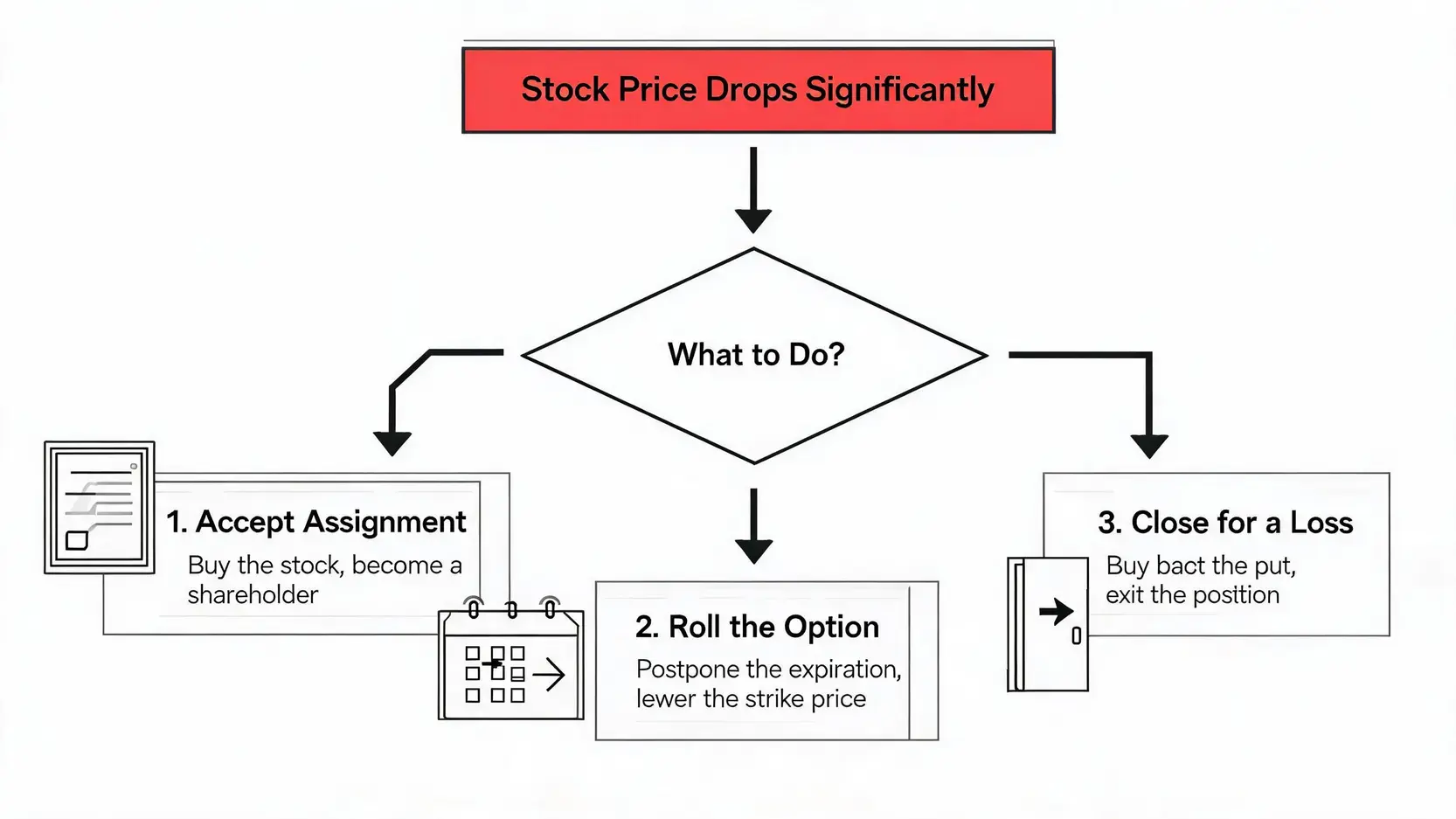
Markets will not always move smoothly. If the stock price collapses after you sell a Put option and falls far below your strike price due to unexpected negative news, do not panic. You have three primary choices:

Figure 3: Three Main Response Strategies When Stock Prices Decline
- Accept Assignment: If you still have confidence in the company’s long-term value, this was the original purpose of the strategy. Purchase the shares at the agreed strike price. Although you may face short-term unrealized losses, your effective cost basis has already been reduced by the option premium received. You may later use the Covered Call strategy to continue lowering your holding cost.
- Roll Forward or Down: This is the most common defensive technique. Before expiration, you “close” the losing position by buying back the Put option, while simultaneously “opening a new position” (by selling another Put option with a later expiration date and lower strike price). In many cases, you can still receive an additional net premium (known as a Net Credit). This gives you more time while lowering your future purchase price, providing greater flexibility for the strategy to recover.
- Close the Position for a Loss: If negative developments have fundamentally changed the company’s outlook, or you are no longer willing to hold the stock, the smartest choice may be to admit the mistake, buy back the Put option, and accept the loss. This prevents you from being forced to purchase a stock you no longer believe in, potentially avoiding much larger losses.
Further Reading (Highly Recommended)
How to Avoid Margin Deficiency Risk?
Selling Put options requires margin to ensure you have sufficient financial capacity to fulfill the obligation of purchasing shares. For beginners, the safest approach is to use a “Cash-Secured Put“.
This means that when you sell a Put option with a $100 strike price, your account must hold $100 × 100 = $10,000 in cash as collateral. By doing this, you completely avoid margin deficiency risk because you already have the full funds prepared for assignment. Never sell more “Naked Put” contracts than your financial capacity can support. Otherwise, if the market experiences extreme volatility, you may face the serious risk of a forced liquidation or Margin Call from your broker.
FAQ: Common Questions
Q: If the Stock Price Falls Below the Strike Price, Am I Required to Accept Assignment?
A: Yes. As the seller of the option, you have the “obligation” to fulfill the contract. As long as the option buyer decides to exercise their right (which usually happens when the stock price falls below the strike price), you must purchase the agreed number of shares at the strike price. Of course, as mentioned earlier, you may also choose to roll the position or close it before expiration to avoid assignment.
Q: What Is the Maximum Risk of the Short Put Strategy? Can the Loss Be Unlimited?
A: The maximum risk of a Short Put occurs if the stock price falls to zero. The loss is not unlimited, unlike a Short Call. The maximum loss equals: (Strike Price × 100) – Premium Received. This is considered a relatively manageable-risk strategy, provided that you choose companies with strong fundamentals and maintain proper capital management.
Q: How Should Beginners Start Their First Short Put Trade?
A: It is recommended to begin with large-cap blue-chip stocks that you know well and are willing to hold long term. Choose a further out-of-the-money strike price along with a 30-45 day expiration date. Make sure to use a “Cash-Secured” approach and start with only one contract. Use a small amount of capital to experience the complete process first, learning and building experience gradually.
Q: What Is the Difference Between Short Put Income and Dividend Income From Stocks?
A: Dividend investing requires you to own the stock first, tying up your capital, and dividends are usually paid only several times per year. Short Put income allows you to generate returns before owning the stock, offering greater flexibility in capital usage. In addition, you can execute the strategy monthly, creating more frequent cash flow opportunities. Both approaches can complement each other, but Short Puts provide greater flexibility.
Conclusion
In summary, the “Short Put strategy” is a highly flexible investment tool. Not only does it allow you to generate passive income through “Short Put income generation” while waiting for stock price pullbacks, but it also serves as an efficient “options-based lower-price stock acquisition method”. As long as you fully understand how the strategy works, practice proper risk management (especially by selecting quality underlying companies) and treat it as a long-term investment approach rather than short-term speculation, you can integrate this powerful tool into your investment system and significantly enhance overall returns. Start researching your preferred stocks today and try deploying your first Short Put strategy!
Related Articles
-
How Do Federal Reserve Interest Rate Hikes Trigger Waves of Cryptocurrency Liquidations? Understanding the Logic Behind It in One Article Introduction Late at night, alarm bells ring across the market. The prices of Bitcoin and other cryptocurrencies suddenly plunge, causing hundreds of thousands of investors to be liquidated within moments....2026 年 6 月 12 日
-
The Interest Rate and Exchange Rate Seesaw: How Does the Central Bank Use the "Dual-Rate Policy" to Stabilize Taiwan's Economy? Interest rates and exchange rates are the two lifelines of a country's economy. Any movement in either one directly affects the stock market, property market, corporate profitability, and even the...2026 年 6 月 12 日
-
US-Japan Interest Rate Differential Out of Control? Uncovering the Root Causes of Yen Depreciation and the Bank of Japan's Policy Dilemma Recently, even though Japan's Ministry of Finance has repeatedly deployed large-scale intervention measures, the yen has only enjoyed brief periods of relief before returning to its depreciation trend. This...2026 年 6 月 9 日