HK Dividend Stocks 2026: 15 Value & Income Picks

2026 Hong Kong Stock Income Guide: A Handy Guide to 15 Must-Watch High-Dividend Blue-Chip and Value Stocks
In the current environment of low interest rates and market volatility, finding a stable source of passive income has become a top priority for many investors. Investing in Hong Kong stocks for income, especially high-quality Hong Kong value stocks, is an effective way to achieve financial growth and build stable cash flow. This article provides you with a comprehensive guide to selecting high-dividend Hong Kong stocks, explores in depth how to choose quality blue-chip income stocks, and identifies potential value stocks to help you avoid the common trap of “earning dividends but losing on price”, and build a resilient income portfolio.
Why Invest in Hong Kong Stocks for Income? 3 Key Advantages You Must Know
For investors seeking stable returns, allocating capital to a Hong Kong stock income strategy is not just about collecting dividends, but also embodies deeper financial wisdom. This strategy helps your portfolio withstand market turbulence and achieve long-term asset growth.
Advantage 1: Combat Inflation and Create Stable Passive Cash Flow
As inflation continues to erode purchasing power, simply holding cash means watching your assets depreciate. High-quality dividend stocks, especially blue-chip companies with mature businesses and stable cash flow, often have the ability to pass cost pressures on to consumers. Their dividends tend to increase alongside earnings growth, forming an effective hedge against inflation. The stable dividends received annually act like a reliable “passive income”, providing a continuous source of cash flow to support your financial needs, whether for daily expenses or reinvestment.
Advantage 2: Leverage the Power of Compounding to Accelerate Wealth Growth
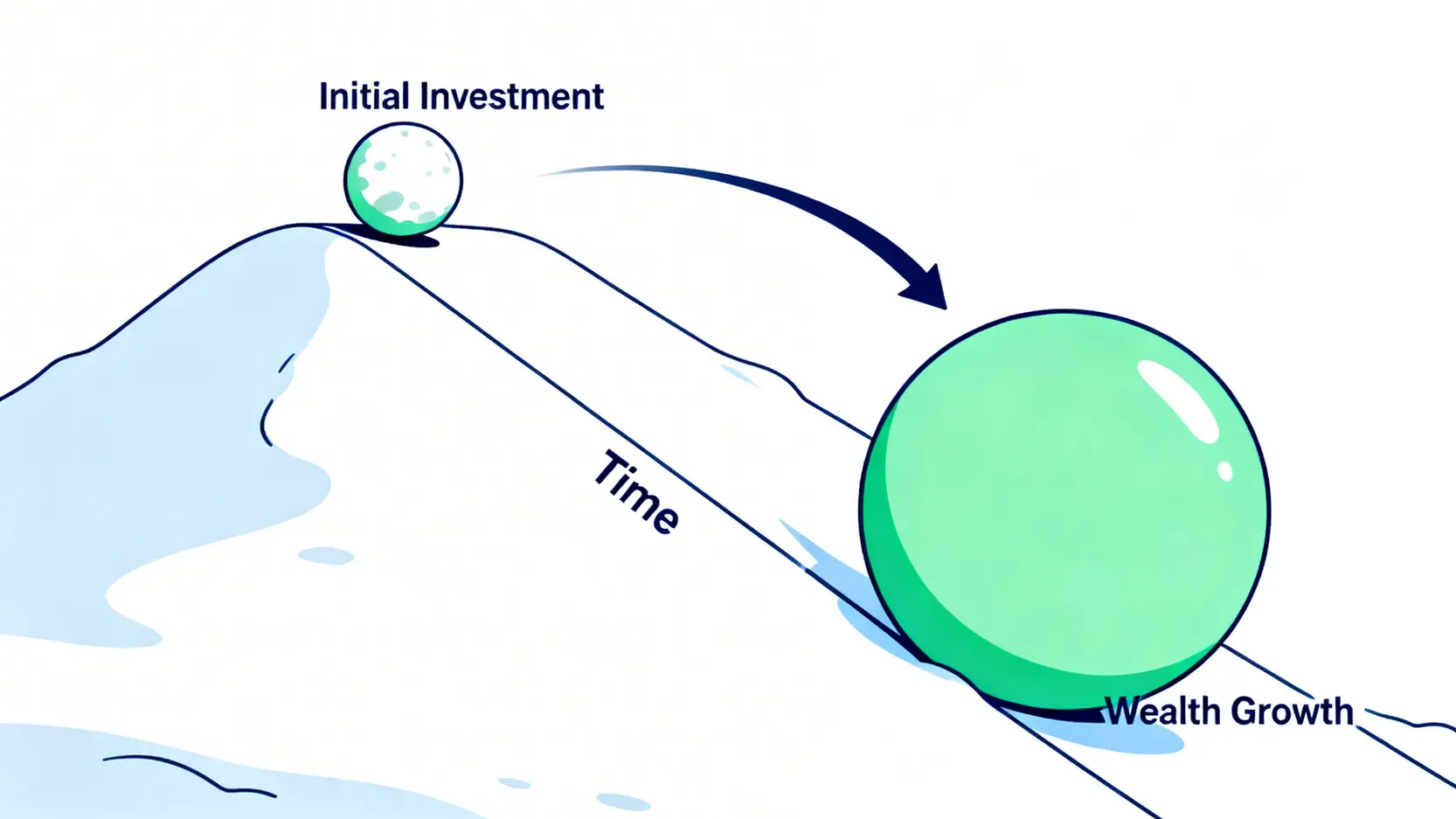
Warren Buffett once said, “Life is like a snowball. The important thing is finding wet snow and a long hill.” This is the power of compounding. By reinvesting dividends (Dividend Reinvestment Plan, DRIP) to purchase more shares of the same company, your holdings will grow like a snowball. In the next dividend cycle, you will receive dividends based on a larger number of shares. Repeating this process allows your assets to grow exponentially, which is the core strategy many experienced investors use to achieve financial freedom.

Compounding Effect: Let Time Become the Accelerator of Your Wealth Growth
Advantage 3: The Defensive Strength of Blue-Chip and Value Stocks
Markets always fluctuate, but during economic downturns or uncertain conditions, high-quality blue-chip and Hong Kong value stocks often demonstrate stronger downside resilience. These companies are typically industry leaders with solid market positions, strong brand moats, and healthy financial conditions. Their business models enable them to maintain profitability and dividend-paying capacity even in adverse environments, with relatively lower price volatility. Therefore, including these income stocks in your portfolio can act as a “stabilizer”, allowing you to stay at ease even in bear markets.
What Smart Investors Must Learn: 5 Core Criteria for Selecting High-Dividend Hong Kong Stocks
There is a wide variety of high-dividend stocks in the market, but not all are worth investing in. Learning how to screen them and avoid potential “value traps” is key to building a successful blue-chip income portfolio. The following five criteria are essential guidelines every investor should master.
Criterion 1: Review Dividend History and Identify Consistently Growing Dividend Leaders
A company’s ability to maintain or steadily increase dividends is the best proof of its financial health and management’s commitment to shareholders. Do not focus only on short-term high dividend yields. Instead, review at least 5 to 10 years of dividend history. Ideal income stocks should show stable or gradually increasing dividends, indicating sustainable earnings and strong cash flow that can fulfill shareholder return commitments across different economic cycles. You can check listed companies’ historical announcements through the HKEX “披露易” website to understand their dividend policies.
Criterion 2: Evaluate Dividend Yield and Avoid High-Yield Traps
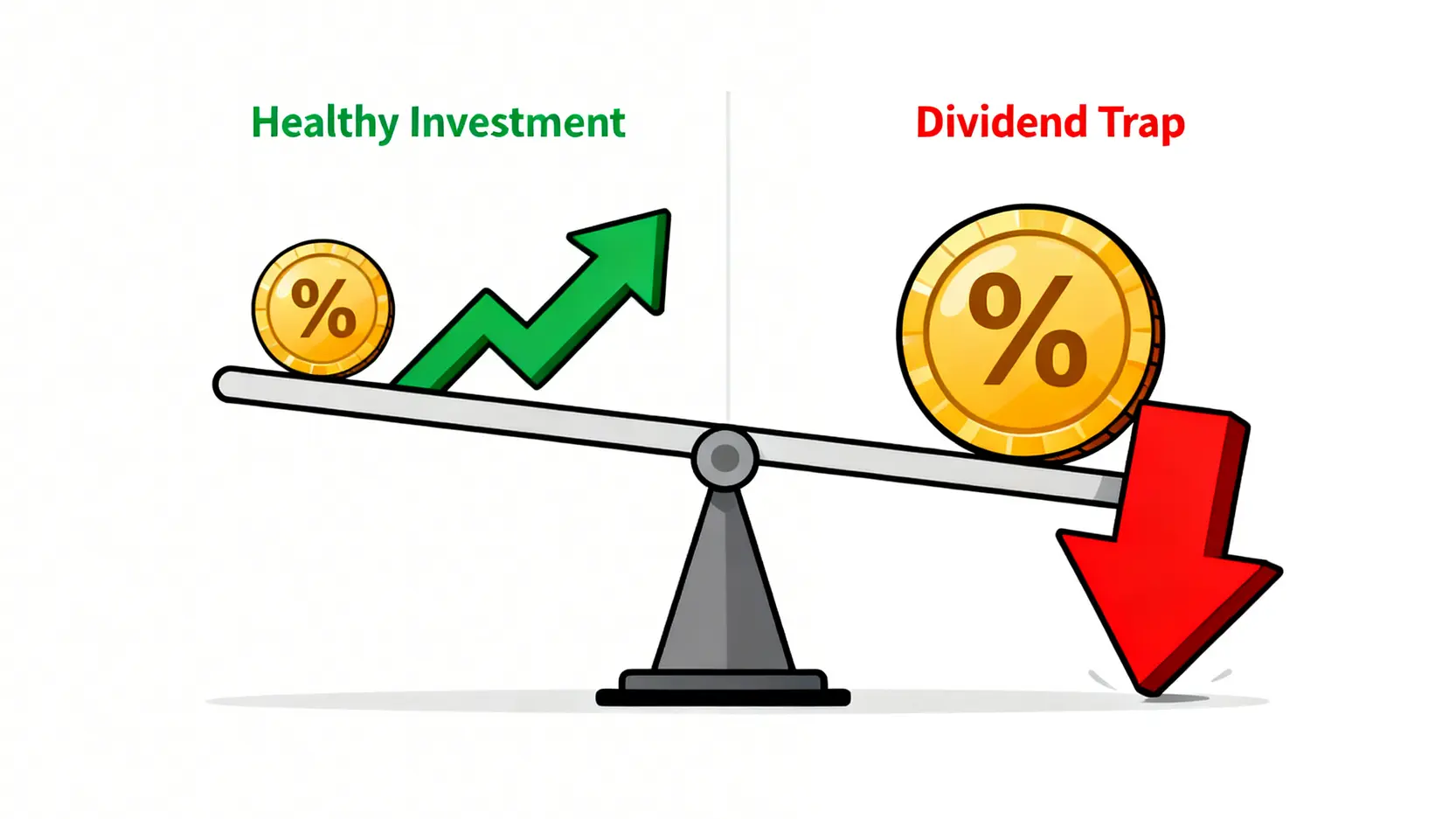
Dividend yield, calculated as annual dividends divided by share price, is a key metric for measuring income returns. However, excessively high yields (for example above 8-10%) can sometimes be a warning sign. This may indicate a recent sharp decline in share price, reflecting market concerns about the company’s outlook and potential dividend cuts. A healthy dividend yield should align with the company’s industry position and earnings growth. Avoid blindly chasing the highest numbers while ignoring the risk of “earning dividends but losing on price”.

Be Alert to “Earning Dividends but Losing on Price”: High Dividend Yield Does Not Equal High Return
Criterion 3: Analyze the Payout Ratio to Ensure Financial Health
The payout ratio represents the proportion of earnings distributed as dividends to shareholders. The formula is “dividend per share / earnings per share”. A healthy ratio typically ranges between 40% and 60%. If the ratio is too high (for example above 80%), it means the company is distributing most of its profits as dividends, leaving insufficient funds for reinvestment, research and development, or handling unexpected situations, which may affect future growth. If the ratio exceeds 100%, it indicates that dividends exceed earnings, which is unsustainable and a potential warning signal.
Criterion 4: Assess Company Fundamentals and Industry Outlook
Quality income stocks are rooted in strong company fundamentals. Before investing, conduct a thorough analysis of financial statements, focusing on key indicators such as earnings growth, gross margin, and debt levels. At the same time, evaluate the industry’s development trend. A company in a declining industry may face significant challenges in the future, even if its current dividend is stable. Choose companies that operate in stable or growing industries and possess strong competitive advantages (moats) to ensure that your dividend income remains sustainable over the long term.
Criterion 5: Evaluate Valuation and Identify True Hong Kong Value Stocks
Even the best companies can erode returns if purchased at excessively high prices. Learning to assess intrinsic value is essential. Common valuation metrics include the price-to-earnings ratio (P/E Ratio) and price-to-book ratio (P/B Ratio). Compare the target company’s valuation with its historical levels and industry peers to identify “Hong Kong value stocks” that are reasonably priced or undervalued. Buying quality assets at attractive prices not only provides higher initial dividend yields but also offers potential capital appreciation, achieving both “income and capital gains”.
Further Reading (Highly Recommended)
2026 List of 15 Selected High-Dividend Hong Kong Stocks (Across Blue-Chip and Value Stocks)
Based on the above criteria, we have selected 15 high-quality Hong Kong income stocks across different industries, including stable blue-chip stocks and potential value stocks, as a reference for building your portfolio. Please note that the following list is for reference only, and independent research should be conducted before investing.
Stable Choices: Recommended Financial and Banking Blue-Chip Stocks
- HSBC Holdings (0005.HK): A globally systemically important bank with operations worldwide and a stable dividend policy.
- Hang Seng Bank (0011.HK): A leading local bank in Hong Kong with strong credibility and stable dividends.
- BOC Hong Kong (2388.HK): One of the three note-issuing banks in Hong Kong, benefiting from widening interest margins with a positive earnings outlook.
- AIA Group (1299.HK): The largest independent listed pan-Asian life insurance group, offering both growth and dividends.
- Ping An Insurance (2318.HK): A comprehensive financial conglomerate with valuations at historical lows and strong value investment potential.
Defensive Essentials: Recommended Utilities and Telecommunications Stocks
- CLP Holdings (0002.HK): One of Hong Kong’s two major electricity suppliers, highly defensive and a traditional income stock choice.
- The Hong Kong and China Gas Company (0003.HK): A highly monopolistic business with stable cash flow and a strong dividend history.
- Power Assets Holdings (0006.HK): A diversified international energy investment company with an attractive dividend yield.
- HKT -SS (6823.HK): A leading local telecommunications operator, with 5G business driving new growth and generous dividends.
- China Mobile (0941.HK): A leading global telecommunications operator, with a steadily increasing payout ratio and attractive dividend returns.
Growth Opportunities: Recommended Value Stocks with Growth Potential
- CNOOC (0883.HK): Benefiting from high oil prices, with strong profitability and generous dividends.
- Sinopec (0386.HK): An integrated energy and chemical company with low valuation and high dividend yield.
- Swire Pacific A (0019.HK): A diversified established conglomerate with significant asset discount and revaluation potential.
- Sun Hung Kai Properties (0016.HK): A leading Hong Kong property developer with high-quality assets and a substantial discount to net asset value.
- MTR Corporation (0066.HK): A unique “rail plus property” model with stable operations and long-term growth potential.
【Table】Overview of Key Data of 15 Selected Income Stocks
| Stock Name (Ticker) | Industry | Forecast Dividend Yield (%) | Payout Ratio (%) |
Investment Highlights |
| HSBC Holdings (0005.HK) | Financials | ~7.5 | ~55 | Benefiting from the interest rate hike cycle, with improved profitability |
| Hang Seng Bank (0011.HK) | Financials | ~6.8 | ~60 | Stable business, with a long history of dividend payments |
| CLP Holdings (0002.HK) | Utilities | ~4.8 | ~60 | Highly defensive, with minimal impact from economic cycles |
| HKT -SS (6823.HK) | Telecommunications | ~8.0 | ~90 | Generous dividend policy, with stable cash flow |
| CNOOC (0883.HK) | Energy | ~9.5 | ~45 | A key beneficiary of high oil prices, with strong earnings elasticity |
Note: The data in the above table are approximate and for reference only. Actual data should be based on company disclosures.
Common Questions About Selecting High-Dividend Hong Kong Stocks
Q: Is a higher dividend yield always better?
A: Absolutely not. An extremely high dividend yield is often the result of a sharp decline in share price, which may reflect extreme market pessimism about the company’s outlook, such as deteriorating earnings, management issues, or industry decline. Investors may face the risk of “earning dividends but losing on price”, where losses from falling share prices far exceed the dividends received. Therefore, it is essential to evaluate the company’s fundamentals, dividend history, and payout ratio comprehensively, rather than simply chasing the highest yield.
Q: What do ex-dividend date, record date, and payment date mean?
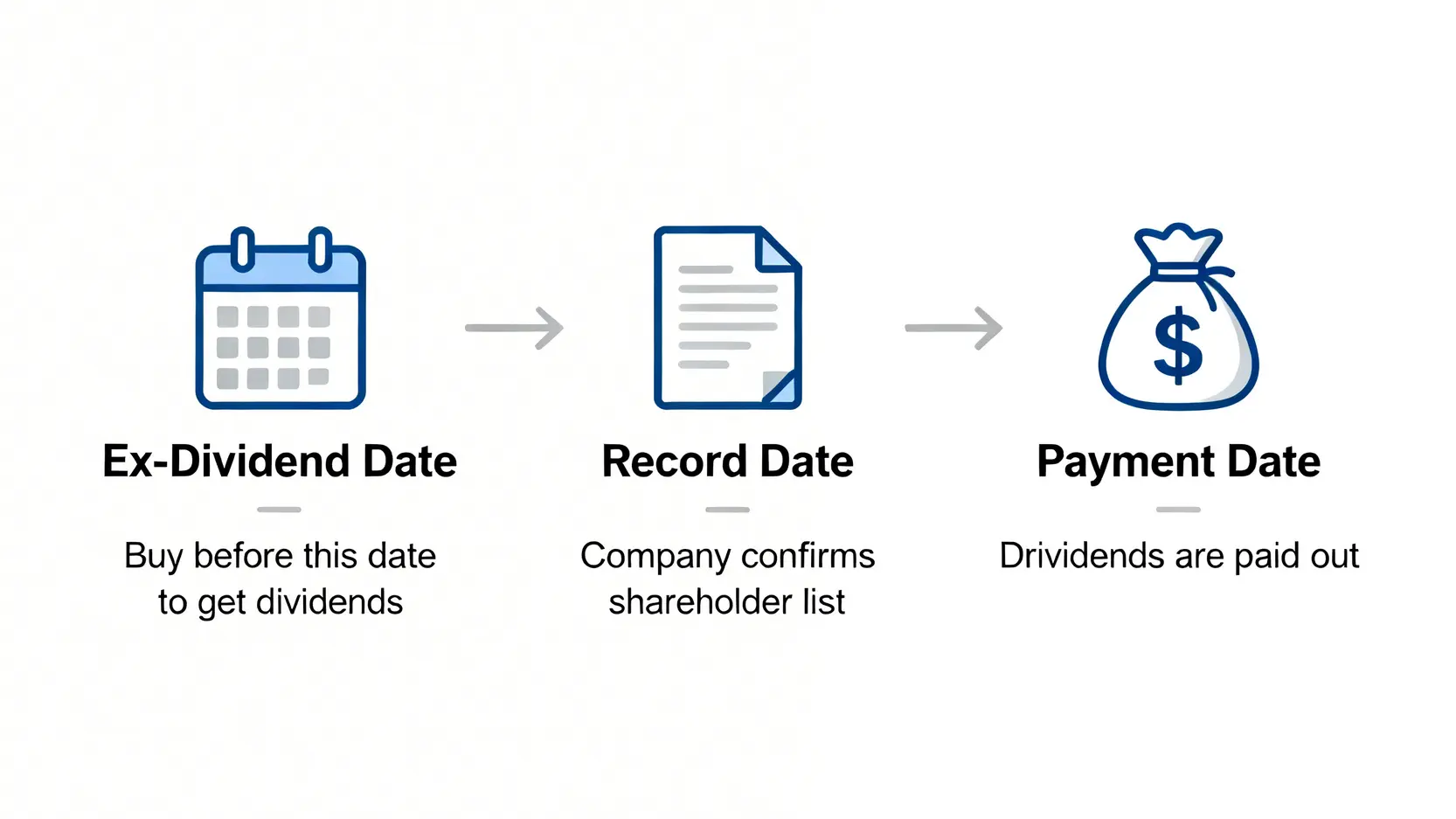
A: These are the three key dates in the dividend distribution process:
- Ex-Dividend Date: Investors who buy the stock on or after this date will “not” be entitled to that dividend. Conversely, shareholders who buy and hold the stock before the ex-dividend date are entitled to receive the dividend.
- Record Date: The date on which the company determines which shareholders are on record and eligible to receive the dividend. It is usually one to two business days after the ex-dividend date.
- Payment Date: The date on which the company officially distributes dividends to eligible shareholders.

The Three Stages of Dividend Distribution: Easily Master the Key Dates
Q: Besides buying individual stocks, can I invest in high-dividend ETFs?
A: Certainly. For investors who do not want to spend time researching individual stocks or who wish to diversify risk, investing in high-dividend ETFs is an excellent option. High-dividend ETFs hold a basket of stocks that meet specific high-yield or dividend growth criteria, effectively diversifying the risk of price fluctuations or dividend cuts from a single company. There are also multiple ETFs in the Hong Kong market that track the Hang Seng High Dividend Yield Index.
Q: Are dividends subject to tax?
A: Under Hong Kong tax regulations, individual investors do not need to pay any tax on dividends received from Hong Kong-listed companies. However, for H-shares (mainland-registered companies listed in Hong Kong), mainland tax authorities levy a 10% dividend tax, which is usually withheld directly by the listed company when dividends are distributed. Investors should understand the tax arrangements of different stocks before investing.
Conclusion
In summary, to successfully build stable passive income through blue-chip income stocks and Hong Kong value stock investments, the key lies in in-depth research and patient holding. The Hong Kong high-dividend stock selection framework and curated list provided in this article serve as a solid foundation for your first step toward success. Remember, markets are constantly changing. Continuous learning and adjusting strategies according to market conditions are the long-term path to financial freedom. Smart investing is not about getting rich overnight, but about using disciplined strategies to let time become your most loyal ally.
Related Articles
-
How to Get Started with Bitcoin? The Complete 2026 Bitcoin Buying Guide for Beginners After watching Bitcoin repeatedly reach new highs in recent years and successfully pass spot ETF reviews in the US and Hong Kong in 2024, officially entering mainstream financial markets, many investors have turned their attention to...2026 年 7 月 20 日
-
Is Gold’s V-Shaped Rebound a Bottom-Fishing Signal? A Complete Guide to Trading Strategies Amid “$100 Price Swings” What Is a Gold V-Shaped Rebound? More Than Just a Technical Pattern The gold market has recently experienced sharp rises and falls, with prices frequently displaying dramatic “gold V-shaped rebounds”. Single-day “$100 price...2026 年 7 月 20 日
-
What Is PPI Data? 2026 Latest Analysis: Understand the Differences from CPI and How It Affects Stock Market Trends With market information constantly changing, do you always hold your breath while waiting for CPI data to be released? But did you know that a more forward-looking inflation indicator, PPI data...2026 年 7 月 20 日