Covered Call Strategy: Generate Monthly Income

Ultimate Covered Call Strategy Tutorial: Learn How to Generate Income From Stock Holdings and Grow Your Assets Monthly in 5 Steps
Do you hold a portfolio of quality stocks but only wait for the share prices to rise? In reality, your stock holdings can generate continuous cash flow for you. This article will explain the “Covered Call strategy” in a simple and practical way, a powerful income-generating tool for stock holdings. Through this complete covered call option tutorial, you will learn how to use your existing assets to earn additional “rental income” every month, transforming dormant stocks into income-producing assets and easily creating passive income.
What Is a Covered Call? An Introduction Through the Concept of Collecting Rent
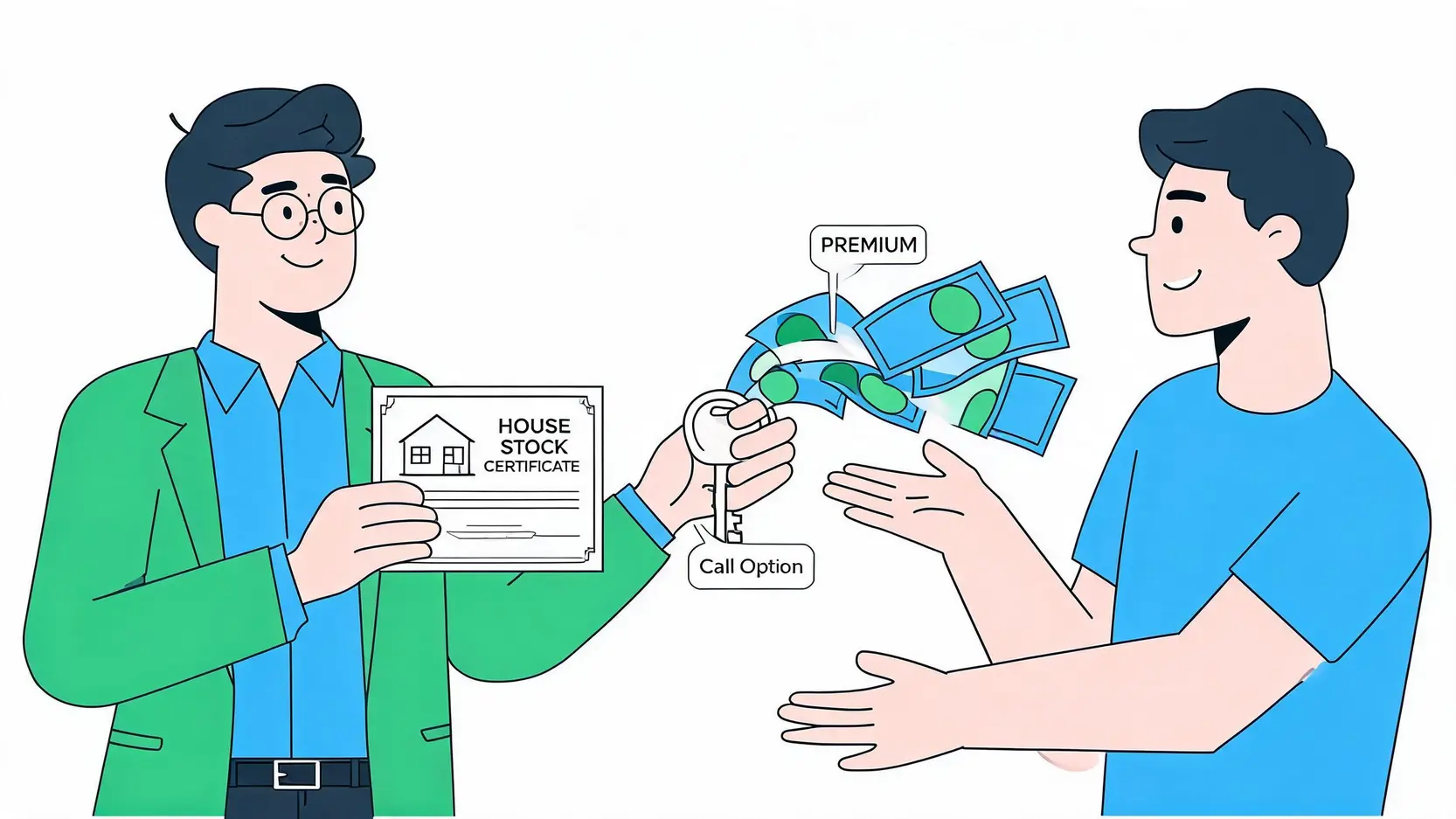
A Covered Call, also known as a “covered call option”, is a relatively stable beginner-friendly options strategy. Its core concept is very intuitive, similar to becoming a “stock landlord”. You “rent out” the stocks you already own to potential buyers in the market and collect an option premium, which acts as your “rental income”. Regardless of how the stock price moves afterward, you keep this premium.
Core Principle: “Renting Out” Your Stocks to Collect Option Premiums
When executing a Covered Call strategy, you sell a “Call Option” to the market. This option contract gives the buyer the “right”, but not the “obligation”, to purchase 100 shares of your stock at a specified price (known as the strike price) before a specific future date (known as the expiration date).

The core concept of the Covered Call strategy: becoming a “stock landlord” and collecting premiums by renting out your holdings.
- As the Seller (Landlord): You receive the option premium paid by the buyer. In exchange, under certain conditions, you are obligated to sell your shares at the agreed strike price.
- As the Buyer (Tenant): The buyer pays the premium in exchange for the opportunity to buy the stock at a locked-in lower price if the share price rises significantly in the future.
This strategy is called “Covered” because you actually own enough shares (at least 100 shares) to fulfill the obligation if assigned, which greatly reduces the risk. In contrast, selling call options without owning the underlying shares is called a “Naked Call” which carries extremely high risk and should be avoided by beginners.
The Three Core Components of a Covered Call Strategy: 100 Shares, Sell Call, and Premium
To successfully build a Covered Call position, you need to understand the following three key components:
- 100 Shares of the Underlying Stock: This is the foundation of the strategy. Since standard US stock option contracts represent 100 shares, you must first own at least 100 shares (or multiples of 100 shares) of the same stock or ETF.
- Sell Call: This is the action that generates cash flow. You sell one (or more) call option contracts against the shares you own. On trading platforms, this action is usually labeled as “Sell to Open”. If you want to understand the fundamentals of options trading in more depth, you may refer to this options beginner tutorial.
- Premium: This is the cash you receive immediately after executing the Sell Call transaction. The premium amount is influenced by several factors, including the stock price, strike price, time until expiration, and implied volatility.
Further Reading (Highly Recommended)
[Practical Guide] Learn How to Execute a Covered Call Strategy in 5 Steps
Now that you understand the theory, let us move on to the practical execution of the Covered Call strategy. By following these five steps, you can easily build your first income-generating stock position.
Step 1: Choose the Right Underlying Stock (Liquidity and Outlook)
Not every stock is suitable for Covered Calls. The ideal underlying stock should have the following characteristics:
- Stable Outlook or Mildly Bullish Trend: You should be comfortable holding the stock long term and not mind if the price moves sideways or rises slightly. If the stock surges sharply, your upside gains will be capped. If the stock falls significantly, you still bear the downside risk of holding the shares.
- High Liquidity: Choose stocks with high trading volume and active options markets, (such as large-cap blue-chip stocks or popular ETFs). This helps ensure narrower bid-ask spreads and better execution prices.
- Moderate Price Volatility: Stocks with moderate volatility are ideal. If volatility is too low, premiums will be small. If volatility is too high, premiums may look attractive, but the risk of large price declines also increases.
Step 2: How to Choose the Best Strike Price
The strike price is the agreed price at which you are willing to sell your stock. Choosing the strike price is an art that requires balancing “premium income” and the “probability of assignment”.
- Out-of-the-Money (OTM) Options: The strike price is above the current stock price. This is the most common choice. It provides smaller premiums, but the probability of your shares being called away is lower. You can still enjoy capital gains up to the strike price.
- At-the-Money (ATM) Options: The strike price is approximately equal to the current stock price. This generates the highest premium, but also has the highest probability of assignment (around 50%). It is suitable when you are bearish or believe the stock will not rise further.
- In-the-Money (ITM) Options: The strike price is below the current stock price. Premiums are the highest, but assignment is almost guaranteed. This behaves more like a strategy for “setting a target selling price” rather than purely generating income.
Step 3: Choosing the Expiration Date and Its Impact
The expiration date is when the option contract you sold becomes invalid. Generally, traders prefer contracts expiring within 30 to 45 days.
- Time Decay (Theta Decay): This is the option seller’s best friend. Option value decreases over time, especially as expiration approaches. Choosing expiration dates about one month away allows you to benefit from the period where time decay accelerates the fastest.
- Short-Term vs. Long-Term Contracts: Short-term contracts (such as weekly options), generate smaller premiums but allow for more frequent income generation. Long-term contracts generate larger premiums but tie up your capital and shares for longer periods, reducing flexibility in responding to market changes.
Step 4: Execute the “Sell Call” Trade
After selecting the stock, strike price, and expiration date, you can place the trade through your securities account. In the option chain, locate the corresponding call option contract and execute the “Sell to Open” order. The premium will immediately be credited to your account as cash.
Step 5: Three Possible Outcomes at Expiration and Follow-Up Actions
At expiration, your position may result in one of the following three outcomes:

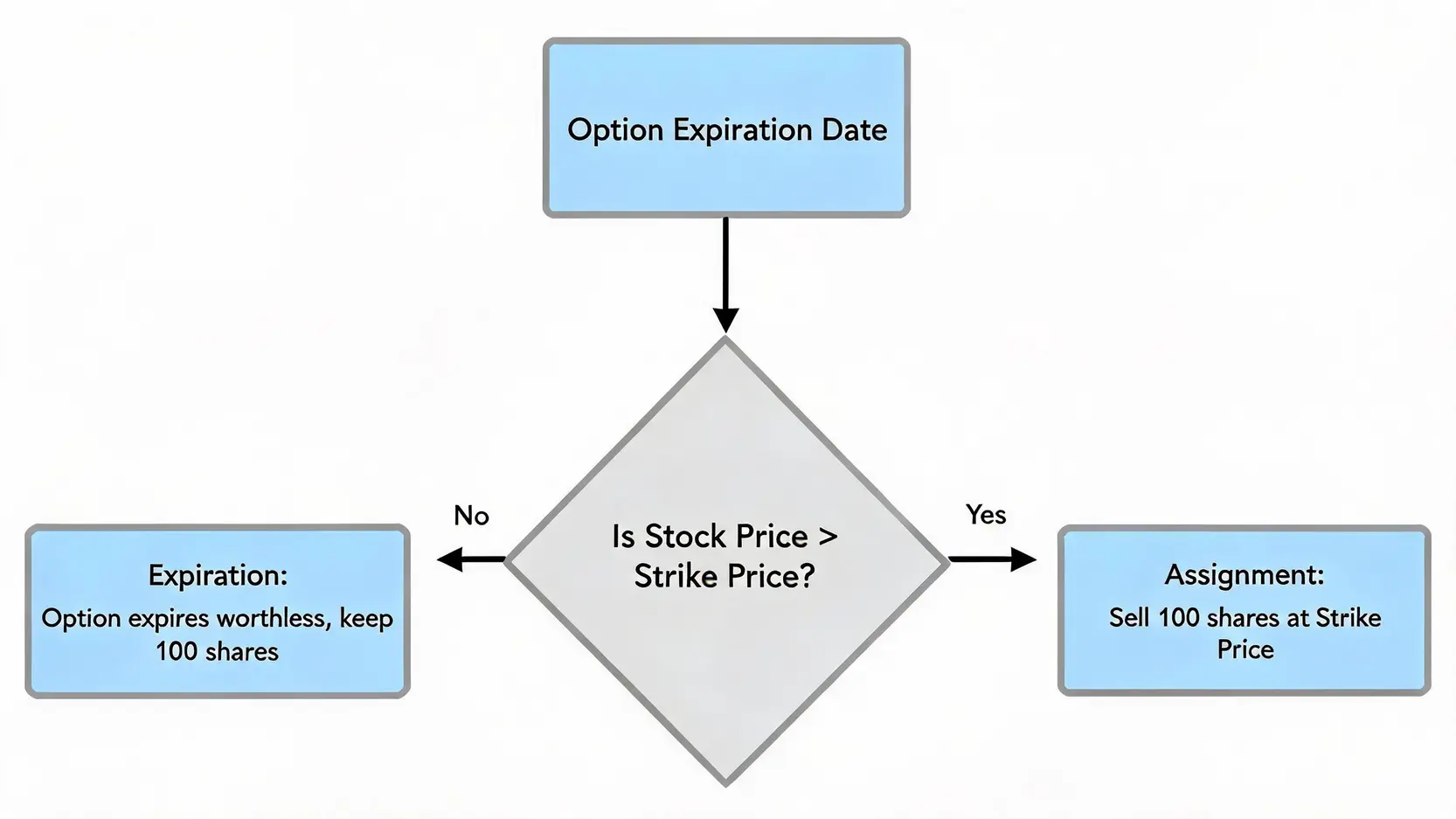
Covered Call expiration outcome flowchart.
- Stock Price < Strike Price (Most Ideal Outcome): The option expires out-of-the-money, and the buyer will not exercise it. The contract expires worthless, allowing you to keep the full premium while continuing to hold your 100 shares. You may repeat the process the following month to continue generating income.
- Stock Price > Strike Price: The option expires in-the-money, and the buyer exercises the option. You must sell your 100 shares at the agreed strike price. Your total profit equals: (Strike Price – Original Purchase Price) + Premium Received. Although you miss out on additional upside beyond the strike price, you still exit with a profit.
- Manage the Position Early: If the stock price moves unexpectedly, you do not need to wait until expiration. You can “Buy to Close” the option you originally sold at any time. For example, if the stock price rises sharply and assignment becomes likely, but you do not want to sell your shares, you may buy back the option, usually at a loss, and then sell another option with a later expiration date and higher strike price (a process known as “rolling”).
A Complete Analysis of the Advantages and Potential Risks of Covered Calls
Every investment strategy has two sides. Fully understanding the advantages and disadvantages of Covered Calls can help you determine whether the strategy matches your investment goals and risk tolerance.
Advantages: Generate Stable Cash Flow, Reduce Holding Costs, and Profit in Sideways Markets
- Generate Stable Cash Flow: This is the core advantage. Regardless of whether the stock market rises or falls, the option premiums collected each month provide an additional source of passive income, similar to dividends.
- Reduce Holding Costs: The premium received can be viewed as reducing your average stock purchase cost. For example, if you bought a stock at $50 and received a $2 premium, your effective cost basis drops to $48. This creates a buffer for your position.
- Profit in Sideways Markets: When the market moves sideways (range-bound market), simply holding stocks may generate zero returns. Covered Call strategies perform especially well in such environments, allowing you to profit steadily from the passage of time.
Risks: Limited Upside Potential and Ongoing Exposure to Stock Price Declines
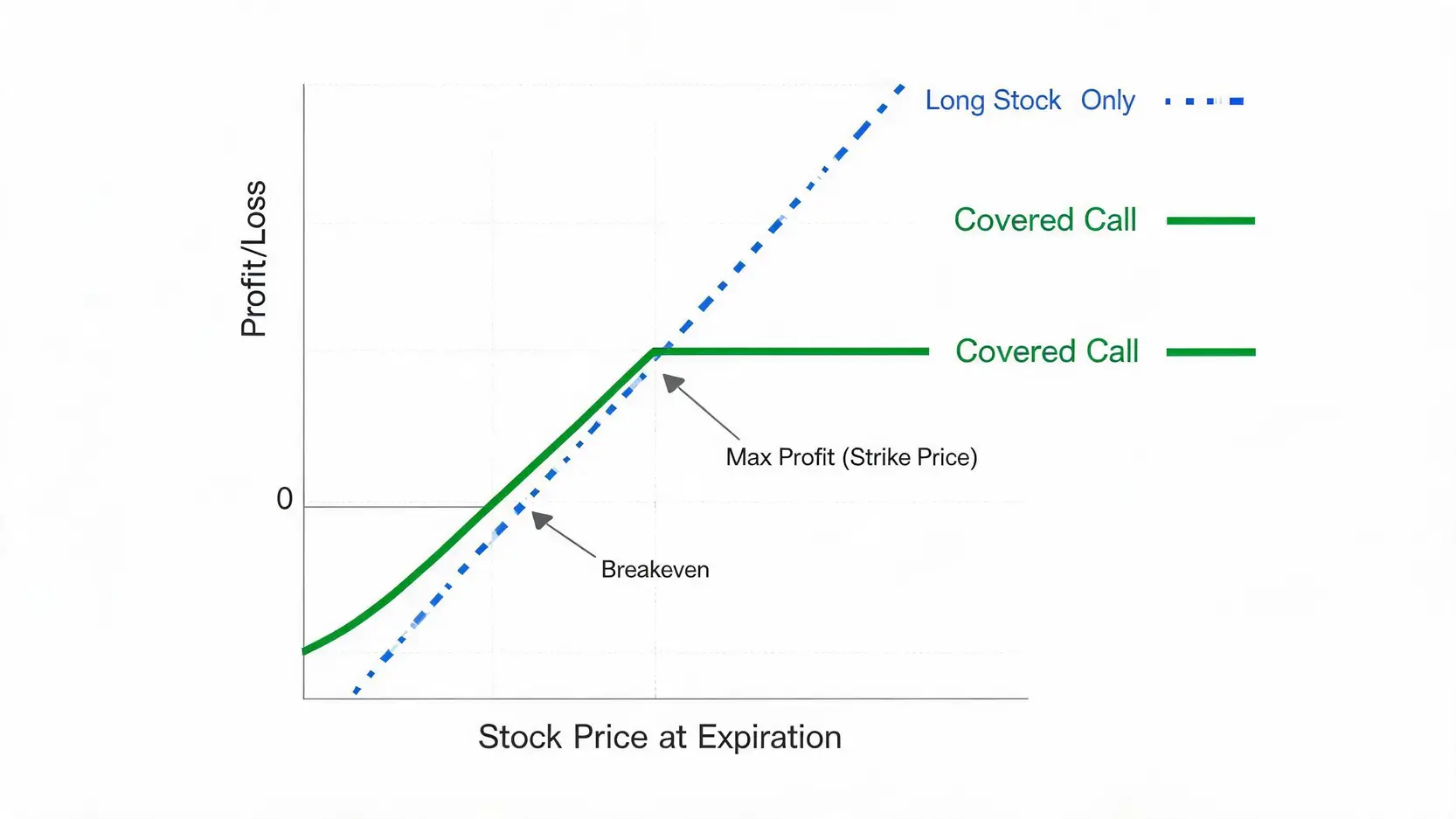
- Limited upside potential: This is the biggest trade-off. If the stock price surges significantly after you sell the call, far beyond the strike price, your profit will be capped at the strike price. You will miss out on all further gains beyond that level, commonly known as “gaining on the stock price but losing on the option”.
- Stock Price Decline Risk Still Exists: A Covered Call strategy does not protect you from losses caused by falling stock prices. Although the premium received provides some downside cushion, it becomes insignificant if the stock experiences a major decline. You still bear the market risk of being a shareholder. Authoritative investor sentiment analysis indicators often include options trading volume as part of their calculations, reflecting overall market risk appetite.

Covered Call payoff chart: sacrificing unlimited upside potential in exchange for premium income and downside cushioning.
Covered Call vs. Simply Holding Dividend Stocks: Which Is More Suitable for You?
For investors seeking cash flow, buying high-dividend stocks is the most common alternative to Covered Calls. Both approaches can generate income from stock holdings, but each has its own strengths and is suitable for different types of investors.
Comparison Table: Return Potential, Risk Level, and Operational Complexity
| Comparison Item |
Covered Call Strategy |
Simply Holding High-Dividend Stocks |
| Return Potential | Moderate (Premium Income + Limited Capital Appreciation) | High (Dividends + Unlimited Capital Appreciation) |
| Cash Flow Source | Option Premiums (Monthly/Weekly) | Dividends (Quarterly/Semi-Annually) |
| Downside Risk | Premiums Provide Some Cushion, but Most Downside Risk Still Remains | Fully Exposed to Downside Risk |
| Upside Potential | Limited, Capped by the Strike Price | Unlimited |
| Operational Complexity | Higher, Requires Regular Management of Options Positions | Low, Simply Buy and Hold |
Investor Type Analysis: How Should Conservative, Balanced, and Growth Investors Choose?
- Conservative Investors: If you are extremely risk-averse and unfamiliar with options trading, then traditional high-dividend blue-chip stocks introduced in beginner US stock investing tutorials may be more suitable for you.
- Balanced Investors: If you already hold a stable investment portfolio and want to enhance returns without taking on significantly more risk, then Covered Calls can be an excellent income-enhancing tool. This strategy is especially suitable for investors who expect the market to remain flat or rise moderately in the short term.
- Growth Investors: If your primary objective is maximizing capital growth, then Covered Calls may limit your upside potential. In this case, you may be better suited to directly holding high-growth stocks.
FAQ: Common Questions
Q: What Happens if the Stock Price Falls Sharply at Expiration?
A: If the stock price falls sharply and ends far below your strike price, the call option you sold will expire worthless, allowing you to keep the full premium. However, your 100 shares of stock will still suffer unrealized losses. The premium received can partially offset these losses. At this point, you may choose to continue selling new Covered Calls at lower strike prices to further reduce your holding cost.
Q: How Much Margin Is Required to Execute a Covered Call?
A: Since you already own 100 shares of the underlying stock as collateral, this strategy is called “Covered”. In most securities accounts, executing a Covered Call does not require additional margin because the stock itself serves as the guarantee for fulfilling the contract obligation.
Q: Are Covered Call ETFs Worth Investing In?
A: There are many ETFs in the market specifically designed to execute Covered Call strategies (such as QYLD and XYLD). Their advantage is convenience, as they handle all operations for you and distribute relatively high monthly income automatically. Their disadvantage is that they systematically sell at-the-money call options, meaning they almost entirely miss major upward market moves. As a result, the fund’s net asset value (or share price) often trends downward or sideways over the long term. They are purely cash flow tools rather than asset growth tools.
Q: Can I Use Covered Calls on Any Stock?
A: In theory, yes, as long as the stock has an options market. However, it is strongly recommended to choose highly liquid large-cap stocks or ETFs. Options with low trading volume and wide bid-ask spreads are difficult and costly to trade effectively.
Conclusion
In summary, the Covered Call strategy is an effective tool for generating income and enhancing returns from stock holdings, especially for investors seeking to improve returns in sideways or moderately bullish markets. It allows you to activate your stock assets and create ongoing passive income. As long as you fully understand how the strategy works and its potential risks, namely sacrificing unlimited upside potential in exchange for immediate cash flow, this Covered Call strategy can become a valuable addition to your investment portfolio. Review your holdings today and start your first Covered Call trade!
Related Articles
-
Practical Applications of Volatility Surfaces: From Options Modeling to Advanced Skew Trading Strategies In options markets, implied volatility is never a flat line. Instead, it forms complex "smile" or "skew" surfaces. For advanced traders, mastering the practical applications of volatility surfaces is equivalent to possessing a lens that reveals market...2026 年 6 月 3 日
-
Building a Foreign Capital Flow Copy Trading Model: A Stock Market Indicator for Accurately Tracking Institutional Positioning In Asia-Pacific stock markets, foreign capital inflows and outflows often determine the direction of the index. However, simply looking at daily net buy and sell data is no longer enough. Only by building...2026 年 6 月 3 日
-
Options Buyer Strategies During Extreme Market Conditions: Black Swan Hedging and Cross-Market Arbitrage During Volatility Surges The most terrifying aspect of financial markets is not a gradual decline, but overnight flash crashes and cross-market capital withdrawals accompanied by volatility surges. In the highly unpredictable global macroeconomic environment of 2026, geopolitical...2026 年 6 月 3 日