Bull Call Spread Guide: Profit-Locking Strategy

Complete Guide to the Bull Call Spread Strategy: Learn How to Use a Call Option Combination to Lock in Profits
Do you want to profit from a rising stock market, but worry that simply buying Call Options is too expensive and carries excessive risk? Are you looking for an investment approach that can both control risk and capture upside opportunities? This article will provide a detailed explanation of a powerful tool, the Bull Call Spread strategy. This comprehensive Bull Call Spread tutorial will help you deeply understand this classic call option combination strategy. Whether you are an options beginner or an investor seeking to optimize your strategy, this guide will help you master its practical application and achieve more stable growth.
What Is a Bull Call Spread?
A Bull Call Spread is a vertical spread strategy with both limited risk and limited profit potential. It is highly suitable for investors who are moderately bullish on the price movement of an asset (such as a stock). Simply put, you expect the stock price to rise, but not in an explosive or extreme manner, or you want to participate in the upside while lowering your upfront cost.
Core Concept: Why Does It Reduce Cost and Risk in a Bull Market?
Directly purchasing a Long Call can generate substantial profits when the market moves in the correct direction, but it also comes with clear disadvantages:
- High Cost: You must pay 100% of the option premium upfront. If your market view is wrong or the stock price remains flat, the premium may become a total loss.
- Time Decay: Also known as Theta, time decay continuously erodes the value of your option every day, creating invisible pressure on the position.
The Bull Call Spread cleverly addresses these problems. By simultaneously buying one Call option and selling another Call option with a higher strike price, the premium received from the short Call partially or fully offsets the cost of the long Call. This premium income effectively acts as a discount on your investment, directly reducing both your initial capital outlay and overall risk exposure.
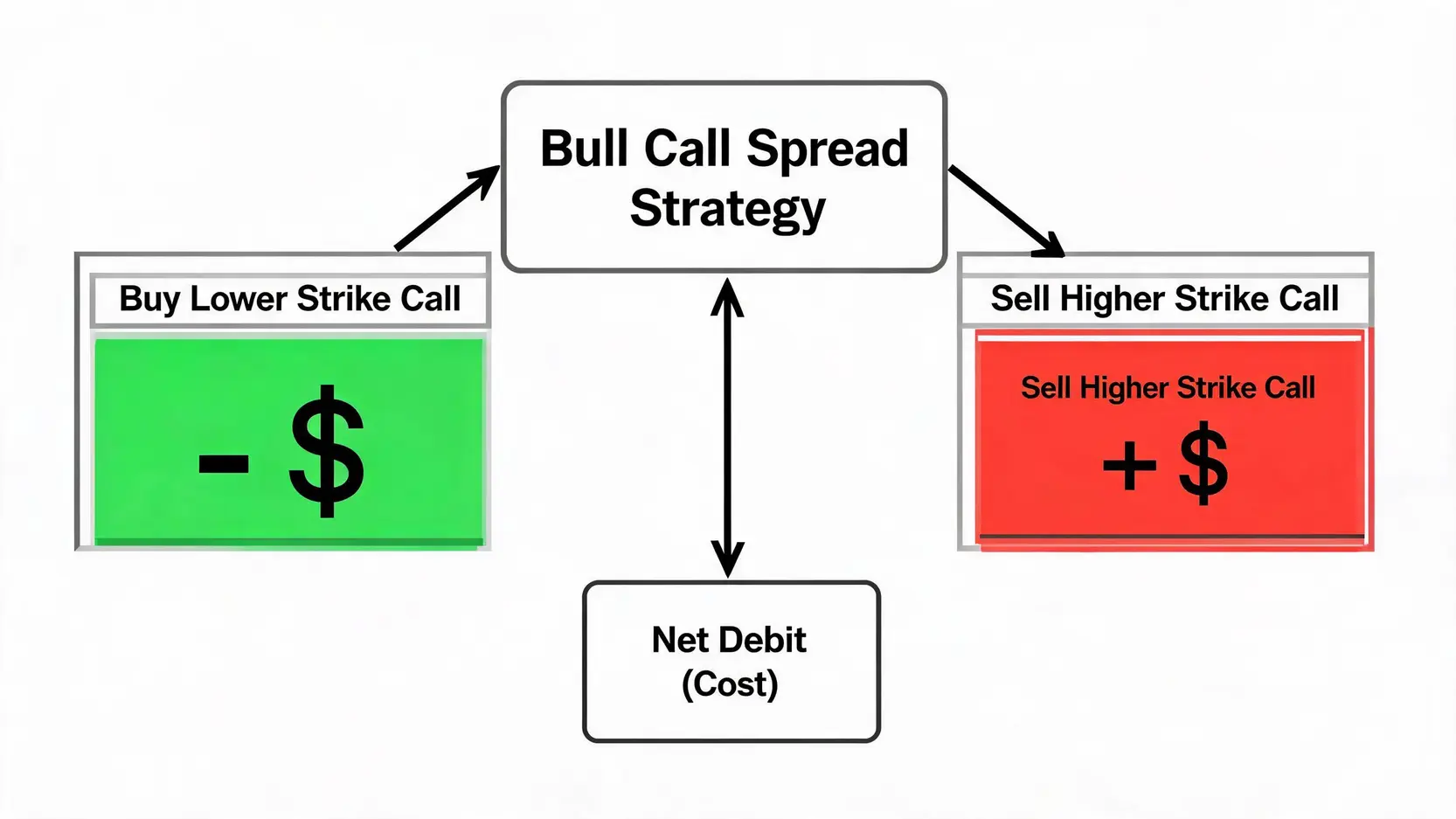
Strategy Structure: Buy a Lower Strike Call + Sell a Higher Strike Call
A standard Bull Call Spread consists of two trades. Both trades use the same underlying asset and expiration date, with the only difference being the strike prices:
- Buy One Lower Strike Call: This is the main bullish component of the strategy. Traders usually select an In-the-Money (ITM) or At-the-Money (ATM) Call option.
- Sell One Higher Strike Call: This component helps reduce the overall cost. Traders usually choose an Out-of-the-Money (OTM) Call option.
Because lower strike Call options are always more expensive than higher strike Call options, establishing this position results in a net debit. This net debit represents the maximum potential loss of the trade.

The Core Structure of the Bull Call Spread Strategy
Further Reading (Highly Recommended)
[Practical Tutorial] Build Your First Bull Call Spread Position in 5 Steps
Now that the theory is covered, let us move directly into practical execution. By following these five steps, you can easily establish your first Bull Call Spread position.
Step 1: Identify the Right Market Conditions (Moderately Bullish Market)
The key to this strategy lies in the word “moderately”. You do not need to predict that the stock price will double. You only need to believe that it will most likely rise before expiration, but with limited upside potential. Suitable scenarios include:
- The stock price is moving within a stable upward trend.
- The company has strong fundamentals but lacks a major short-term catalyst.
- The stock has experienced a pullback and is showing signs of stabilization with rebound potential.
If you expect the stock price to surge aggressively like a rocket, then simply buying a Long Call may be more suitable. However, if your view is “the stock will rise, but the upside is limited”, then the Bull Call Spread is the ideal strategy.
Step 2: How to Choose the Most Suitable Strike Prices and Expiration Date
This is the key factor determining whether the strategy succeeds. Different strike prices and expiration dates directly affect your cost, potential return, and probability of success.
- Choosing Strike Prices:
- Long Call: Traders usually select ATM or slightly ITM options. ATM options generally have a Delta value around 0.5, making them sensitive to stock price movements. ITM options have higher Delta values and greater probabilities of success, but they are also more expensive.
- Short Call: Traders usually select OTM options. This strike price is often placed near the target price you expect the stock to reach. The distance between the two strike prices (known as the spread width) determines the maximum profit potential. Wider spreads offer higher potential profits but also require higher upfront costs.
- Choosing the Expiration Date:
- It is generally recommended to choose options expiring within 30 to 60 days.
- Very short-term options (such as weekly options), experience extremely rapid time decay and leave very little time for your market view to play out correctly.
- Very long-term options (such as those expiring several months later), decay more slowly but are significantly more expensive and tie up more capital.
Step 3: Calculating Profit and Loss (Maximum Profit, Maximum Loss, and Breakeven Point)
Before entering the trade, you must clearly calculate the following three key figures. Assume:
- You buy a Call option with strike price $A$ and pay a premium of $C_A$.
- You sell a Call option with strike price $B$, where $B > A$, and receive a premium of $C_B$.
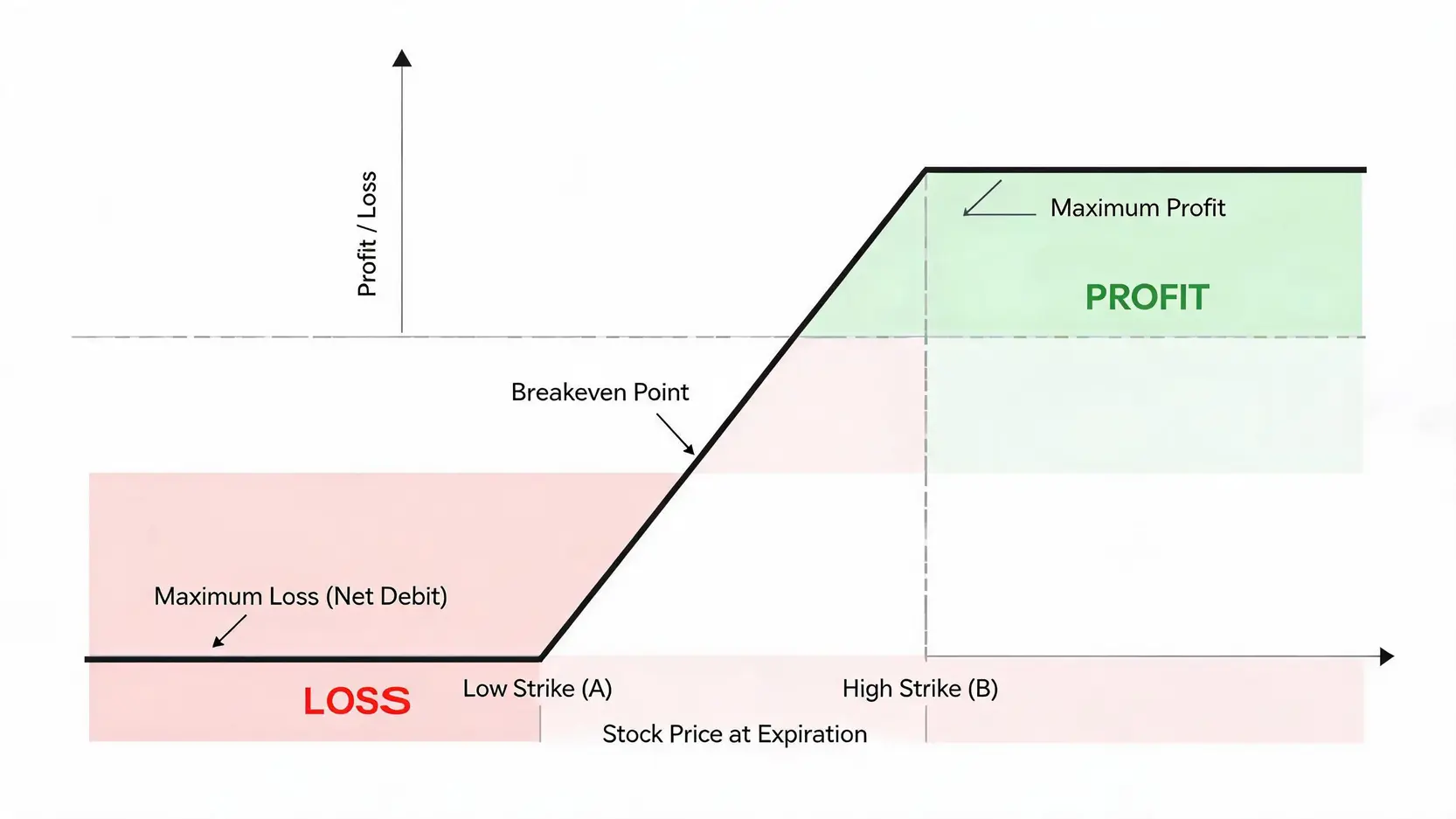
Maximum Profit
The maximum profit is fixed and occurs when the stock price is at or above the short Call strike price $B$ at expiration.
Formula:(B – A) × 100 – Net Premium Cost
Net Premium Cost = (C_A – C_B) × 100
Maximum Loss
The maximum loss is also fixed and equals the initial net premium paid. This occurs when the stock price is at or below the long Call strike price $A$ at expiration.
Formula:Net Premium Cost = (C_A – C_B) × 100
Breakeven Point
This is the stock price level at which the position transitions from loss to profit.
Formula:Long Call Strike Price A + Net Premium
Net Premium = C_A – C_B

Risk and Reward Overview of the Bull Call Spread Strategy
Once you understand these formulas, you will have a clear expectation of the potential risk and reward before entering the trade, a critical skill required of professional traders.
The 3 Major Advantages and Potential Risks of the Bull Call Spread Strategy
Every investment strategy is a double-edged sword, and the Bull Call Spread is no exception. Only by understanding its strengths and weaknesses can you use the right tool at the right time.

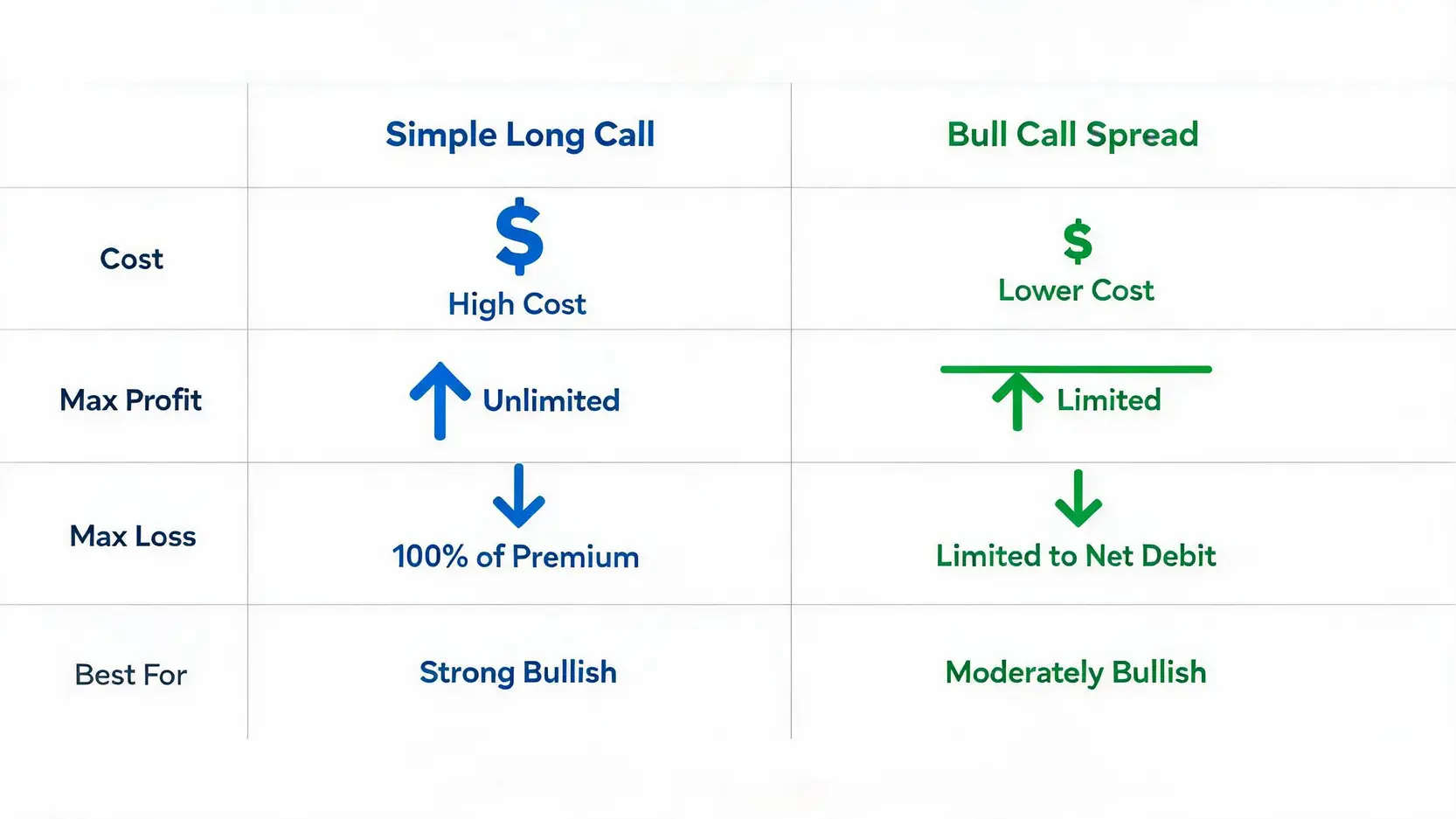
Strategy Comparison: Buying a Call Option vs. Bull Call Spread
Advantages: Defined Risk, Lower Cost, and Higher Probability of Success
- Defined Risk: Unlike directly buying a Call option, which offers unlimited profit potential but also the possibility of a 100% loss, the maximum loss of a Bull Call Spread is fixed from the beginning, namely the net premium paid. This allows you to sleep more comfortably when facing market uncertainty.
- Lower Cost: The premium received from selling the Call option directly reduces your entry cost. In some cases, this income allows you to participate in a potential upward move at a very low cost.
- Partial Protection Against Time Decay: Although the Call option you purchase suffers from time decay, the Call option you sell also experiences time decay. These effects partially offset each other, reducing the negative impact of Theta on your overall position.
Risks: Limited Profit Potential and the Impact of Time Decay
- Limited Profit Potential: This is the primary “disadvantage” of the strategy. Since you sold a higher strike price Call option, you effectively give up all potential profits above that strike price. Even if the stock price rises dramatically, your profit remains capped at the maximum profit level.
- Early Assignment Risk: Although uncommon, if the Call option you sold becomes Deep In-the-Money (Deep ITM), you may be assigned before expiration and required to fulfill the contract obligation (meaning selling the stock at the strike price). This situation is especially important to monitor before dividend payments.
- Losses From Incorrect Market Predictions: If the stock price falls instead of rising, you can still lose all or part of the premium paid. The strategy only reduces losses rather than completely eliminating them.
Real Case Study: Applying Call Option Combinations to Different Stocks
Let us use a practical example to see how the Bull Call Spread strategy can be applied in real markets.
Case Study: Deploying the Strategy on Tencent Holdings (0700.HK)
Assume Tencent is currently trading at HK$380. After analysis, you believe the stock is likely to rise moderately above HK$400 within the next month, but the probability of breaking above HK$420 is low.
- Your Market View: Moderately bullish.
- Your Strategy: Establish a Bull Call Spread.
Execution Steps:
- Buy Call: You buy a Call option expiring in approximately 45 days with a strike price of HK$380, which is an ATM option, paying a premium of HK$15.
- Sell Call: At the same time, you sell a Call option with the same expiration date and a strike price of HK$420, which is an OTM option, receiving a premium of HK$5.
Cost and Return Calculations:
- Net Cost (Maximum Loss): (HK$15 – HK$5) × 100 = HK$1,000
- Maximum Profit:((HK$420 – HK$380) – (HK$15 – HK$5)) × 100 = (40 – 10) × 100= HK$3,000
- Breakeven Point: HK$380 + (HK$15 – HK$5) = HK$390.
- Return Ratio: Maximum Profit / Maximum Loss = HK$3,000 / HK$1,000 = 300%.
In this example, you are risking a limited HK$1,000 to pursue a potential HK$3,000 profit. As long as Tencent’s stock price rises above HK$390 by expiration, you begin generating profits. If the stock price rises to or above HK$420, you achieve the maximum return of 300%.
Further Reading (Highly Recommended)
Scenario Simulation: Strategic Positioning Before Earnings Announcements
Before earnings announcements, market volatility usually increases sharply, causing option premiums to become very expensive. Directly buying Call options can therefore become extremely costly and risky. This is exactly where the Bull Call Spread strategy becomes highly effective.
Suppose a company is about to release earnings results. You expect the earnings to be positive and believe the stock price will rise, but you are also concerned that the market reaction may be excessive or weaker than expected. In this case, you can establish a Bull Call Spread. The expensive premium received from the short Call helps significantly reduce your overall trade cost. Even if the stock only rises slightly after earnings, you may still generate profits. If the earnings disappoint and the stock price falls, your losses remain limited within a controlled range.
Conclusion
In summary, the Bull Call Spread strategy is a balanced options trading strategy that combines both offense and defense. Through a carefully structured call option combination, investors can participate in moderately bullish markets with lower costs and reduced risk. Although the strategy sacrifices unlimited profit potential, it provides controlled losses and greater strategic certainty in return. Through this tutorial, you should now understand its core principles, practical execution steps, and risk management techniques. The best next step is to open your demo account and build your own Bull Call Spread position, transforming knowledge into a real investment advantage.
FAQ: Common Questions
Q: What Happens if the Stock Price Rises Above the Strike Price of the Short Call Option?
A: If the stock price rises above the strike price of your short Call option at expiration, your entire position will achieve maximum profit. The Call option you sold will be assigned, requiring you to sell the stock at the strike price. However, the value of the long Call option you purchased will also increase significantly. You may choose to exercise the long Call to offset the obligation, although the more common approach is to manually close the entire spread position before expiration to lock in profits directly and avoid the complexities of assignment.
Q: How Much Margin Is Required to Execute a Bull Call Spread Strategy?
A: Since a Bull Call Spread is a net debit strategy, the maximum risk is limited to the net premium paid upfront. Therefore, most brokers do not require additional margin. Your account only needs sufficient cash to cover the net premium cost. This is also one reason why it is more suitable for beginners and investors with smaller capital compared with strategies requiring significant margin (such as selling naked options).
Q: Should I Manually Close the Position Before Expiration or Wait for Automatic Exercise?
A: It is strongly recommended to manually close the position before the market closes on the final trading day before expiration. Waiting for automatic exercise may create unexpected risks, such as significant after-hours stock price volatility or the need to handle stock settlement procedures, and it may also result in additional transaction costs. Manually closing the position allows you to lock in profits or cut losses cleanly while maintaining better control over the trade outcome.
Q: What Is the Difference Between a Bull Call Spread and a Bull Put Spread?
A: Both are bullish strategies, but their structures and cash flows are completely different. A Bull Call Spread involves buying a lower-strike “call option” and selling a higher-strike “call option”, making it a net debit strategy (Debit Spread) that profits when the stock price rises. A Bull Put Spread involves selling a higher-strike “put option” and buying a lower-strike “put option”, making it a net credit strategy (Credit Spread) that profits as long as the stock price stays above the strike price of the sold put (does not fall significantly). Simply put, a Call Spread is a “bet on a rise”, while a Put Spread is a “bet on stability or limited downside”.
Related Articles
-
Unable to Borrow Money Through Stock Pledge Loans? Uncovering Brokerage Funding Shortages and the FSC’s Deleveraging Policy When you urgently need funds or want to add to your positions, but do not want to sell your high-quality holdings, what should you do? “Stock pledge” is the secret weapon that helps...2026 年 7 月 9 日
-
What Is Stock Lending? A Guide to Earning Interest on Idle Stocks, Asset Activation Strategies Every Dividend Investor Should Learn, and a Full Breakdown of Brokerage Settings Are the stocks in your hands stuck in long-term losses, or are you holding quality stocks that you are reluctant to sell? Instead...2026 年 7 月 9 日
-
2026 Bond Yield Full Guide: US Treasury Trends, Inversion Analysis, and Bond ETF Allocation In the vast ocean of the investment market, whether you prefer the dramatic waves of the stock market or the steady reliability of fixed income, there is one core indicator that no market participant can ignore,...2026 年 7 月 9 日