Risk vs Commodity Currencies: AUD, CAD & NZD Guide

Updated: 2026/06/25  |  CashbackIsland

risk-commodity-currency-guide

What Are Risk Currencies and Commodity Currencies? Understand the Trading Logic of the Australian Dollar, Canadian Dollar, and New Zealand Dollar in One Article

Dear investors, when reading financial news or observing forex market quotes every day, do you often hear phrases such as “risk currencies strengthen” or “commodity-related currencies come under pressure”? These professional terms are not merely labels used by market analysts. Behind them lies the pulse of the global economy and potentially huge trading opportunities. For investors new to forex, clarifying the definition of risk currencies and understanding what commodity currencies are is the first step in building solid trading logic.

In the rapidly changing global macroeconomic environment of 2026, from adjustments in monetary easing policies to geopolitical volatility, every data point is affecting capital flows. This article will take you through what risk currencies and commodity-related currencies really are, and provide a detailed analysis of the unique characteristics and key trading points of the three major representative currencies, the Australian dollar, Canadian dollar, and New Zealand dollar, helping you navigate the market with greater confidence.


Detailed Definition: What Exactly Is a Risk Currency and the Definition of Risk Currency?

To enter practical forex trading, we must first clarify the essence of “risk currencies”. So-called risk currencies usually refer to currencies that are highly positively correlated with global economic growth prospects and perform well when market sentiment is optimistic. The economies behind these currencies often rely heavily on global trade or the export of specific resources.


High Interest Rates and High Volatility: Core Characteristics of Risk Currencies

Historically, countries issuing risk currencies have usually maintained relatively high benchmark interest rates in order to attract foreign capital or curb domestic inflation. This high-interest-rate characteristic attracts global capital seeking returns, forming what is known as the “carry trade”. However, high returns often come with high volatility. When the global economy faces recession concerns or a black swan event breaks out, these funds chasing high interest rates will quickly withdraw, causing the exchange rates of risk currencies to depreciate sharply within a short period.


Why Do They Perform Well When the Global Economy Is Optimistic? (Risk-On Sentiment)

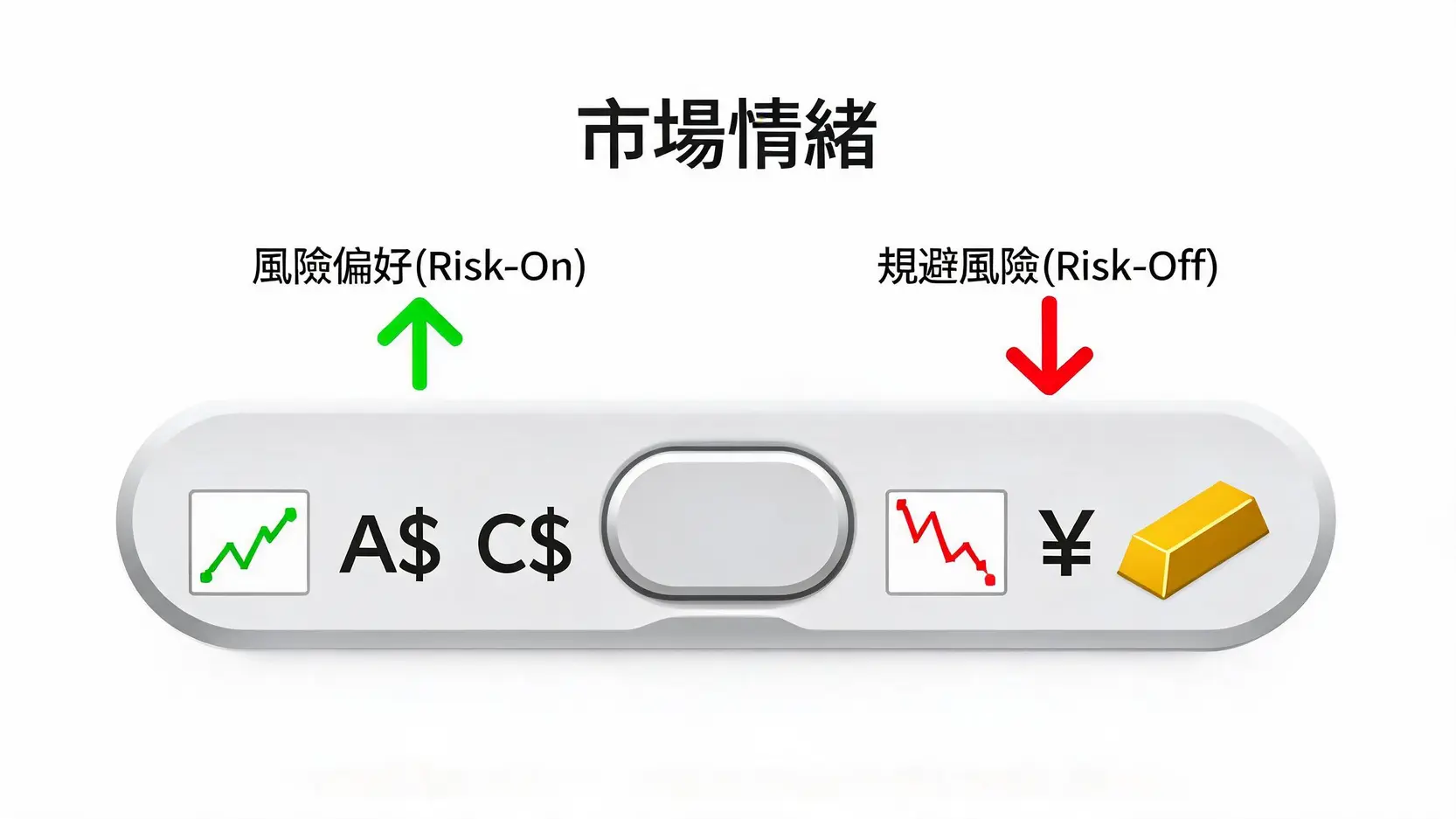
Financial markets have two extreme emotional states: “Risk-On” (risk appetite) and “Risk-Off” (risk aversion). When global economic data is strong, corporate earnings are robust, and international trade is active, the market enters a Risk-On state. At this time, investors are willing to take on higher risk in exchange for higher returns, and capital flows heavily into the stock market and high-yielding risk currencies, pushing their exchange rates higher.

市場風險偏好(Risk-On)與規避風險(Risk-Off)情緒的概念示意圖,展示了不同情緒下資金流向的資產類別。

The “switch” of market sentiment: Risk-On vs. Risk-Off


What Are Common Commodity Currencies? (Australian Dollar, New Zealand Dollar, Emerging Market Currencies)

When discussing what commodity currencies are, the most representative examples are the Australian dollar (AUD), Canadian dollar (CAD), and New Zealand dollar (NZD) among G10 currencies. In addition to these three major currencies, many emerging market currencies, such as the South African rand (ZAR) and Mexican peso (MXN), also have strong risk currency attributes. Their common feature is that their national economic lifelines are closely connected to commodity prices or global supply chains.


Further Reading (Highly Recommended)

What Are Major Currency Pairs? 2026 Complete List, Definition, and Full Analysis of 5 Major Trading Characteristics

What Are Commodity Currencies? Understand Australian Dollar and Canadian Dollar Investing in One Article (2026 Update)


Unveiling the Truth: What Are Commodity Currencies? An In-Depth Analysis of the Logic Behind Them

Many people often ask, what are commodity currencies? In simple terms, commodity-related currencies refer to currencies of countries whose exports rely heavily on one or more primary raw materials (such as minerals, energy, and agricultural products), causing their currency exchange rates to show a high positive correlation with the price movements of those commodities.


The Close Link Between a Country’s Economy and Natural Resource Exports

When commodities account for a very large share of a country’s total exports, the rise and fall of that commodity’s price in the international market will directly determine the country’s terms of trade, current account balance, and even the direction of the central bank’s monetary policy. Therefore, trading this type of currency is equivalent to trading the underlying physical raw material market behind it.


The Relationship Between the Australian Dollar (AUD) and Iron Ore

Australia is one of the world’s largest exporters of iron ore and coal, and its economic lifeline is closely tied to China’s infrastructure construction and real estate demand. According to the Australian Bureau of Statistics (ABS) and the latest Australian iron ore export data, iron ore exports account for a significant share of Australia’s GDP. When international iron ore prices rise, Australian mining companies’ profits increase, and the taxes paid and employment they drive will push the Reserve Bank of Australia (RBA) toward a hawkish stance, thereby lifting the Australian dollar exchange rate. Therefore, the Australian dollar is often regarded as a “proxy currency” reflecting the strength of China’s economy. 

The Relationship Between the Canadian Dollar (CAD) and Crude Oil

Canada has abundant oil sands resources and is a major global crude oil exporter, with more than 70% of its crude oil exported to the United States. Therefore, the Canadian dollar’s trend is highly tied to international crude oil prices (especially WTI crude oil). When oil prices surge, the amount of US dollars flowing into Canada increases, and the Canadian dollar appreciates accordingly. Conversely, if oil prices collapse, the Canadian dollar often struggles to stay unaffected. In addition, the Canadian dollar is also directly affected by US economic data.


The Relationship Between the New Zealand Dollar (NZD) and Dairy Products

Unlike Australia and Canada, which are mainly driven by minerals and energy, New Zealand is known as the “world’s farm”. Its largest source of export earnings comes from agricultural and livestock products, especially dairy products such as whole milk powder. The auction price index of Global Dairy Trade (GDT) is an important leading indicator for judging the New Zealand dollar’s trend. In addition, New Zealand’s tourism industry also has a significant influence on the New Zealand dollar.
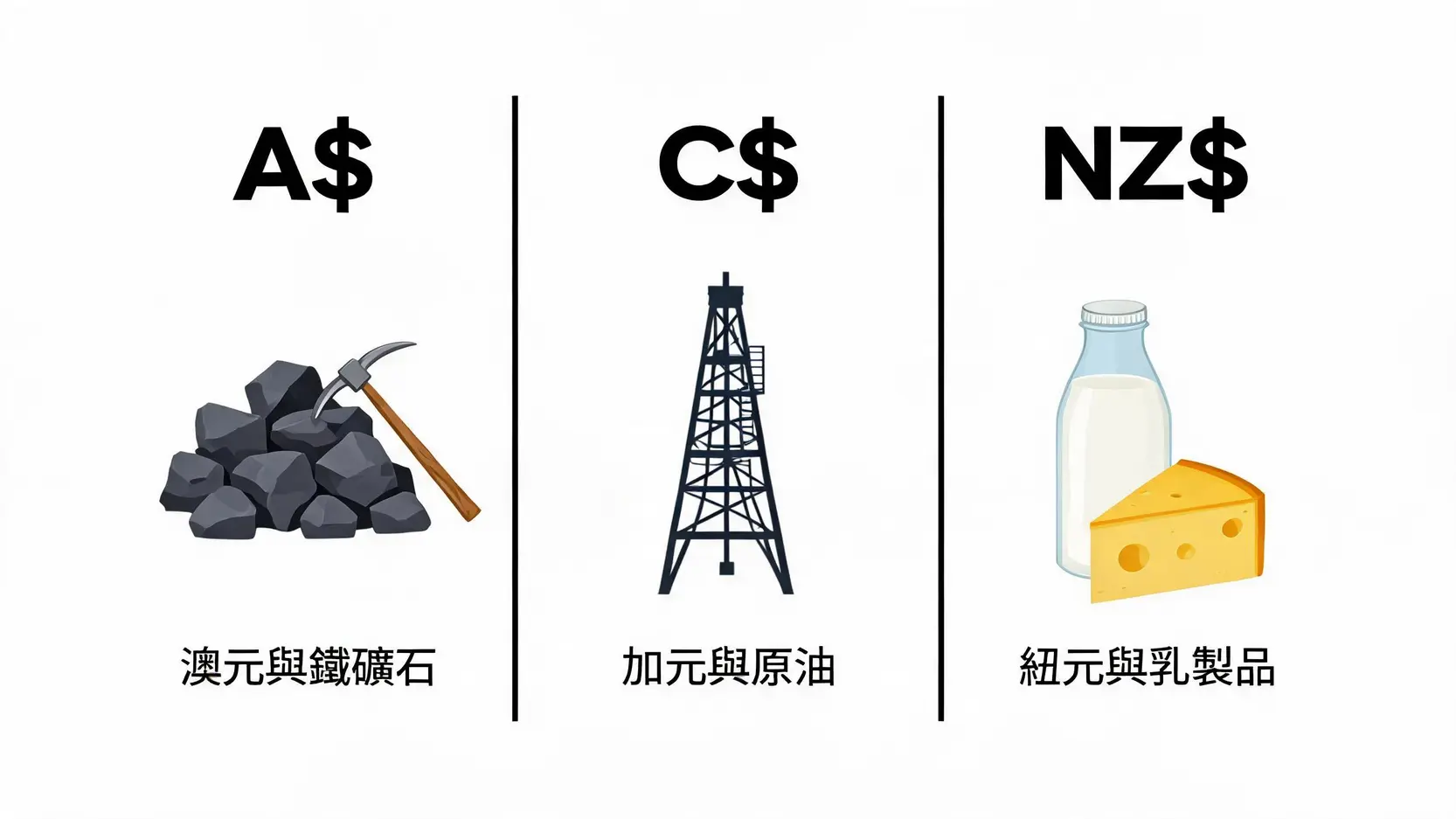
澳元、加元、紐元三大商品貨幣與其對應的鐵礦石、原油、乳製品的關係圖。

The Three Major Commodity Currencies and Their Corresponding Key Raw Materials


Core Comparison: Differences Between Risk Currencies and Safe-Haven Currencies and Practical Market Applications

After understanding the characteristics of the Australian dollar, Canadian dollar, and New Zealand dollar, we must discuss the differences between risk currencies and safe-haven currencies. This is the core key for forex traders to understand market capital flows. 

Definition and Representatives of Safe-Haven Currencies (US Dollar, Yen, Swiss Franc)

Opposite to risk currencies are safe-haven currencies. These currencies often become safe havens for capital when the market panics, the economy falls into recession, or geopolitical conflicts break out. Common safe-haven currencies include: the US dollar (USD), which enjoys global liquidity dominance; the yen (JPY), which has massive overseas net assets and long-term low interest rates; and the Swiss franc (CHF), which has permanent neutral status and a stable financial system.


How Does Capital Flow When Market Risk Aversion Heats Up?

When “Risk-Off” sentiment spreads, institutional investors quickly close high-risk asset positions, sell stocks and commodity-related currencies, and park funds in US Treasuries, gold, or safe-haven currencies. At this time, you will observe sharp declines in the Australian dollar and New Zealand dollar, while the yen and Swiss franc strengthen against the trend. This pendulum effect of capital is one of the most classic trading logics in the forex market.


Trading Strategy: How to Use the Australian Dollar/Yen (AUD/JPY) to Judge Market Risk Appetite?

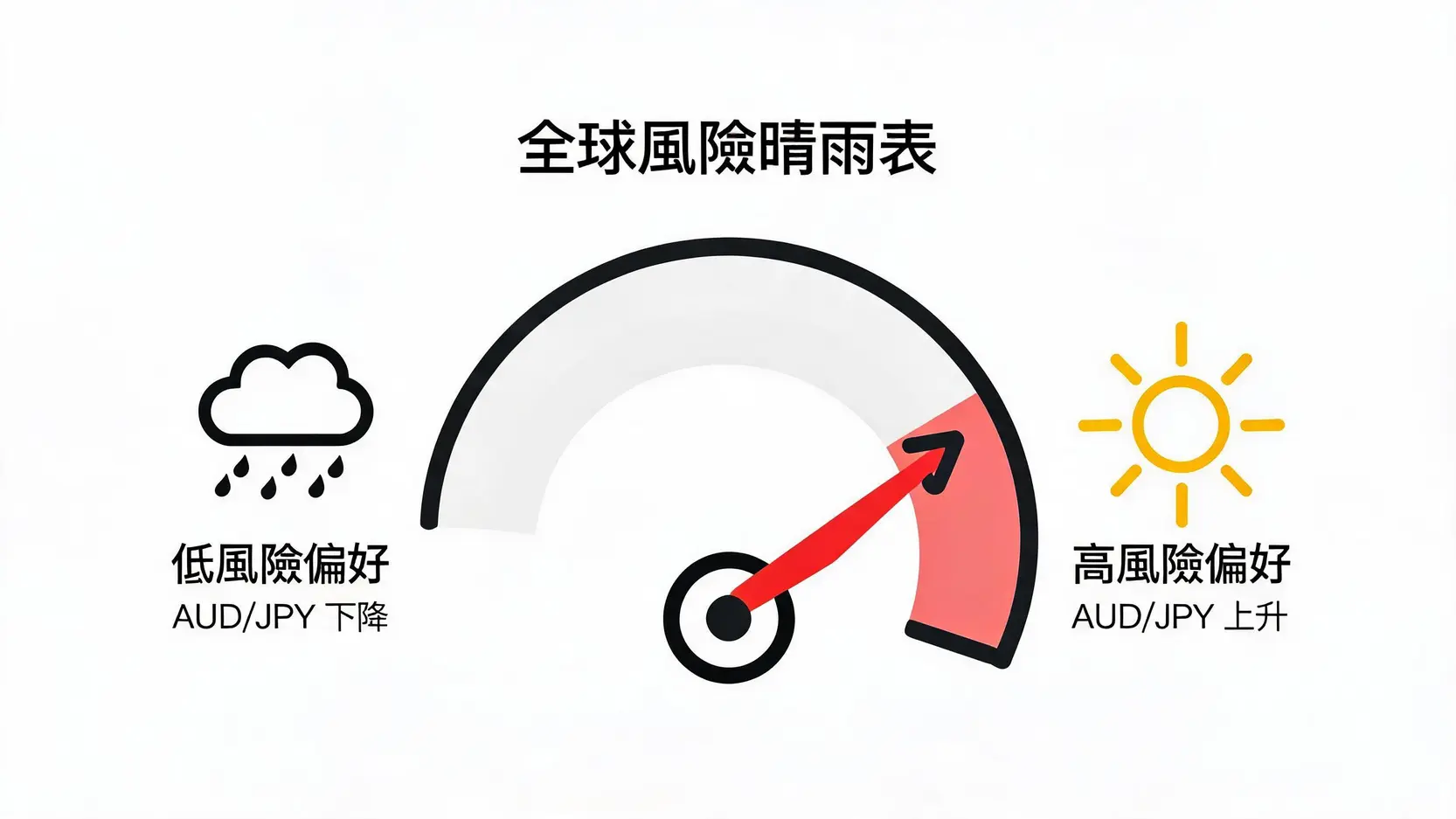
In practice, seasoned investors often regard the Australian dollar against the yen (AUD/JPY) as a “barometer” of global risk sentiment. This is because the Australian dollar represents extreme risk appetite, while the yen represents extreme safe-haven demand. When AUD/JPY shows a clear bullish alignment, it means global hot money is actively seeking returns and market risk sentiment is healthy; conversely, if AUD/JPY breaks below an important supporting moving average, it strongly suggests that a wave of market correction or panic may be approaching. Investors may consider adding this currency pair to their daily monitoring dashboard.

澳元兌日圓(AUD/JPY)作為全球風險情緒晴雨表的概念圖,顯示其匯率走勢如何反映市場風險偏好。

AUD/JPY: A Key Indicator for Measuring Market Risk Sentiment


Further Reading (Highly Recommended)

Yen Cross Pair Volatility Analysis: The Ultimate Guide to Australian Dollar/Yen Trading Strategies and Risk Management

What Are Safe-Haven Currencies? 2024 Guide to 3 Major Safe-Haven Currencies, Gold, and Treasury Investments


Frequently Asked Questions (FAQ): Mastering the Characteristics and Trading Concepts of the Australian Dollar, Canadian Dollar, and New Zealand Dollar

Q: Are risk currencies really riskier?

A: The so-called “risk” in finance refers to the magnitude of price fluctuations. Because risk currencies are affected by the interaction of multiple factors such as the global macroeconomy, commodity prices, and market sentiment, their exchange rate volatility is indeed higher than that of ordinary major currencies. However, for traders, volatility is the source of profit. As long as strict capital management is in place, high volatility can instead become an excellent trading opportunity.

Q: Is investing in commodity currencies the same as investing in commodities?

A: The two are highly correlated, but not exactly the same. When investing in commodity currencies, in addition to considering commodity prices (such as iron ore and crude oil), you must also take into account the interest rate policies of the country’s central bank (such as the RBA and BOC), domestic inflation data, and labor market conditions. Commodity prices are only one of the weighted variables affecting exchange rates (although a very important one).

Q: Why is the US dollar sometimes a risk currency and sometimes a safe-haven currency?

A: The US dollar has a dual characteristic known as the “Dollar Smile Theory”. When the global economy falls into severe recession or panic, the US dollar shows its status as the dominant safe-haven currency and appreciates; when the US economy itself stands out, grows strongly, and the Federal Reserve (Fed) raises interest rates, the US dollar will also strengthen as it attracts capital. Only when the global economy recovers steadily in sync and market sentiment is extremely optimistic will capital leave the US dollar and move toward emerging markets. At that point, the US dollar will tend to weaken.

Q: How can forex currency pairs be used to position commodity-related currencies?

A: Investors can position through trading mainstream forex currency pairs, such as AUD/USD and CAD/JPY. Going long on AUD/USD means being bullish on the Australian economy and commodity prices while bearish on the US dollar; trading AUD/JPY, meanwhile, is purely about capturing shifts in overall market Risk-On and Risk-Off sentiment. 

Conclusion: Understand Risk Currencies and Commodity-Related Currencies to Optimize Your Trading Decisions

Understanding the characteristics of risk currencies and commodity-related currencies is a required lesson for every forex trader to grasp market sentiment. Once you understand why the Australian dollar closely follows China data and iron ore, why the Canadian dollar moves with international oil prices, and why the New Zealand dollar is affected by global dairy product auctions, you can judge market direction more accurately than ordinary retail investors.

By integrating these characteristics of the Australian dollar, Canadian dollar, and New Zealand dollar into your analytical framework, together with a deep understanding of the differences between risk currencies and safe-haven currencies, you can not only become more logical when selecting trading instruments, but also deepen your understanding of global economic linkages, and steadily build your own long-term profit strategy in the ever-changing financial markets.

If you liked this article, please share it!

Related Articles

  • FedWatch Guide: Predict Rate Hikes Before the Market
    Rate Hike Expectations Trading Guide: Use FedWatch to Predict Rate Hikes and Position Ahead of the Market Core Concept: Why Trade “Expectations” Instead of “Facts”? After spending enough time in the financial markets, you will notice an interesting phenomenon: the market often completes a major move before the Federal Reserve...
    2026 年 6 月 25 日
  • Monetary Policy Shifts: Hawkish vs Dovish Guide
    What Is a Monetary Policy Shift? Understand Hawkish and Dovish Signals to Position Ahead of the Market Why does the market always hold its breath for the results of Federal Reserve (Fed) meetings? Why can every interest rate decision, and even a slight “shift” in wording, always trigger sharp volatility...
    2026 年 6 月 25 日
  • 2026 Australian Dollar Trading Strategy Guide
    Ultimate Guide to 2026 Australian Dollar Trading Strategy: Master the 3 Key Factors Affecting the Australian Dollar From Scratch The Australian dollar (AUD), due to its unique attributes as both a commodity currency and a risk currency, has become an excellent choice in the forex market where volatility and opportunities...
    2026 年 6 月 25 日
返回顶部