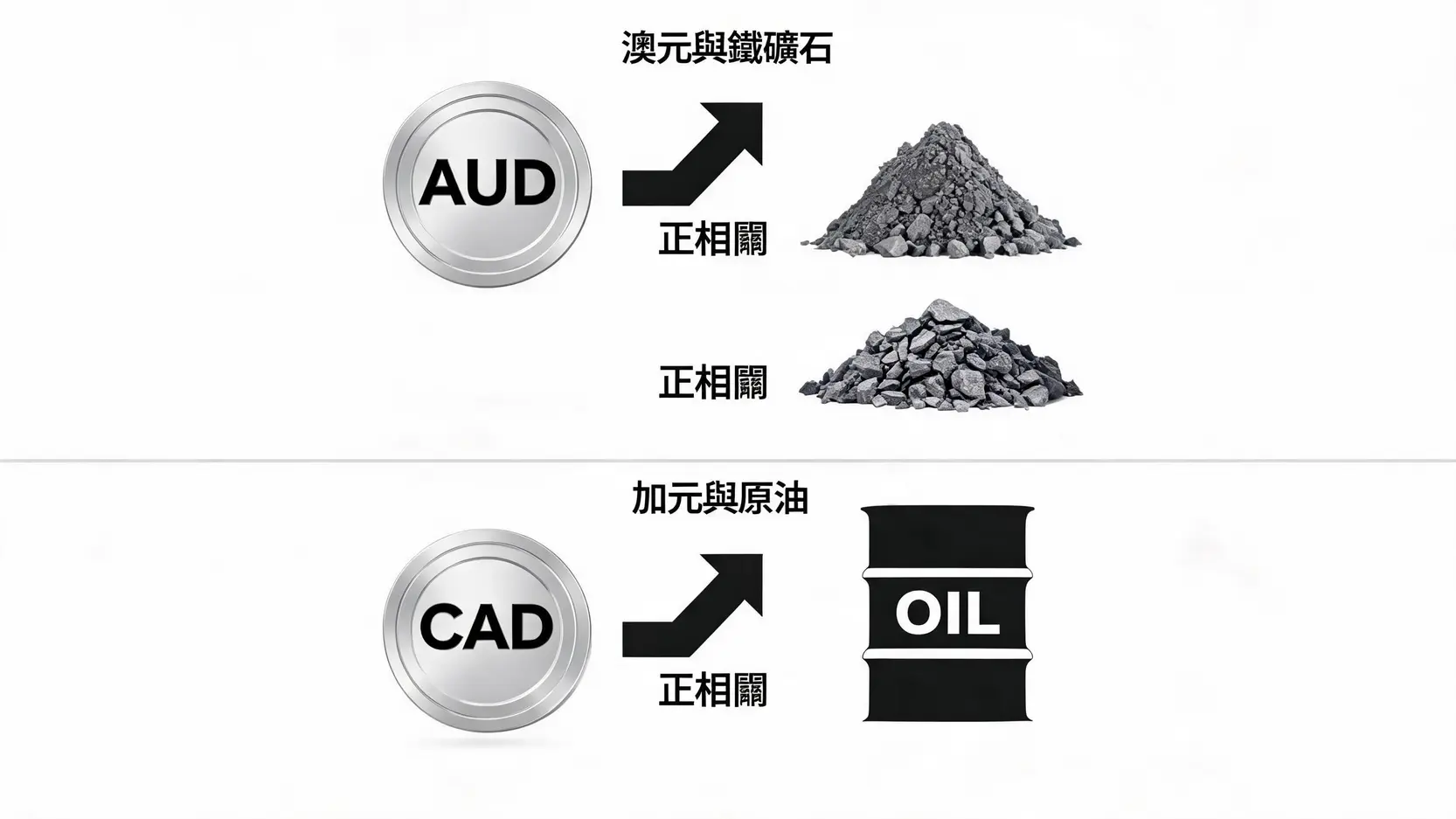
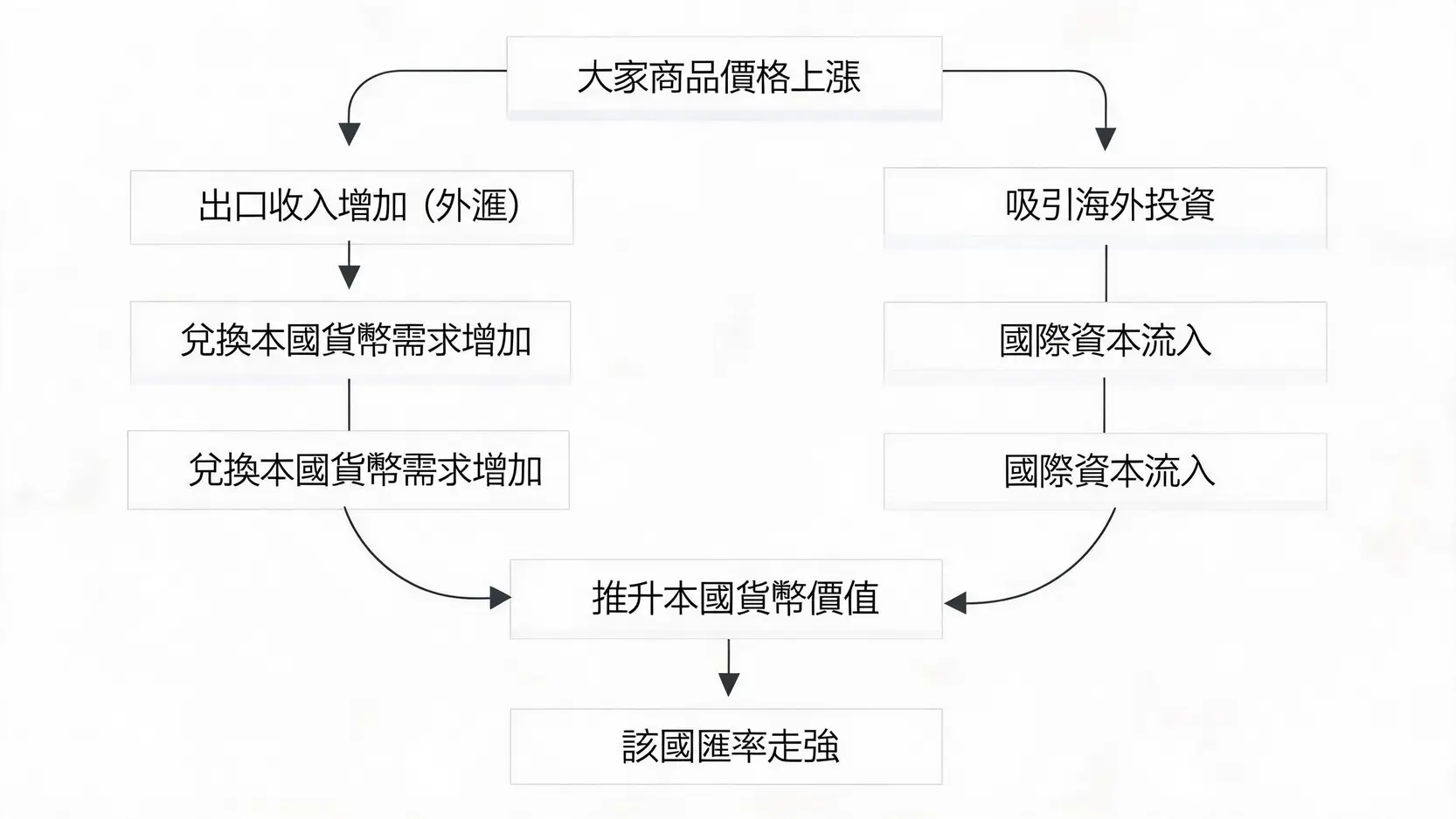
Transmission mechanism by which rising commodity prices push up the exchange rates of corresponding countries
First-Layer Impact: How Do US Monetary Policy Shifts Affect Commodity Prices?
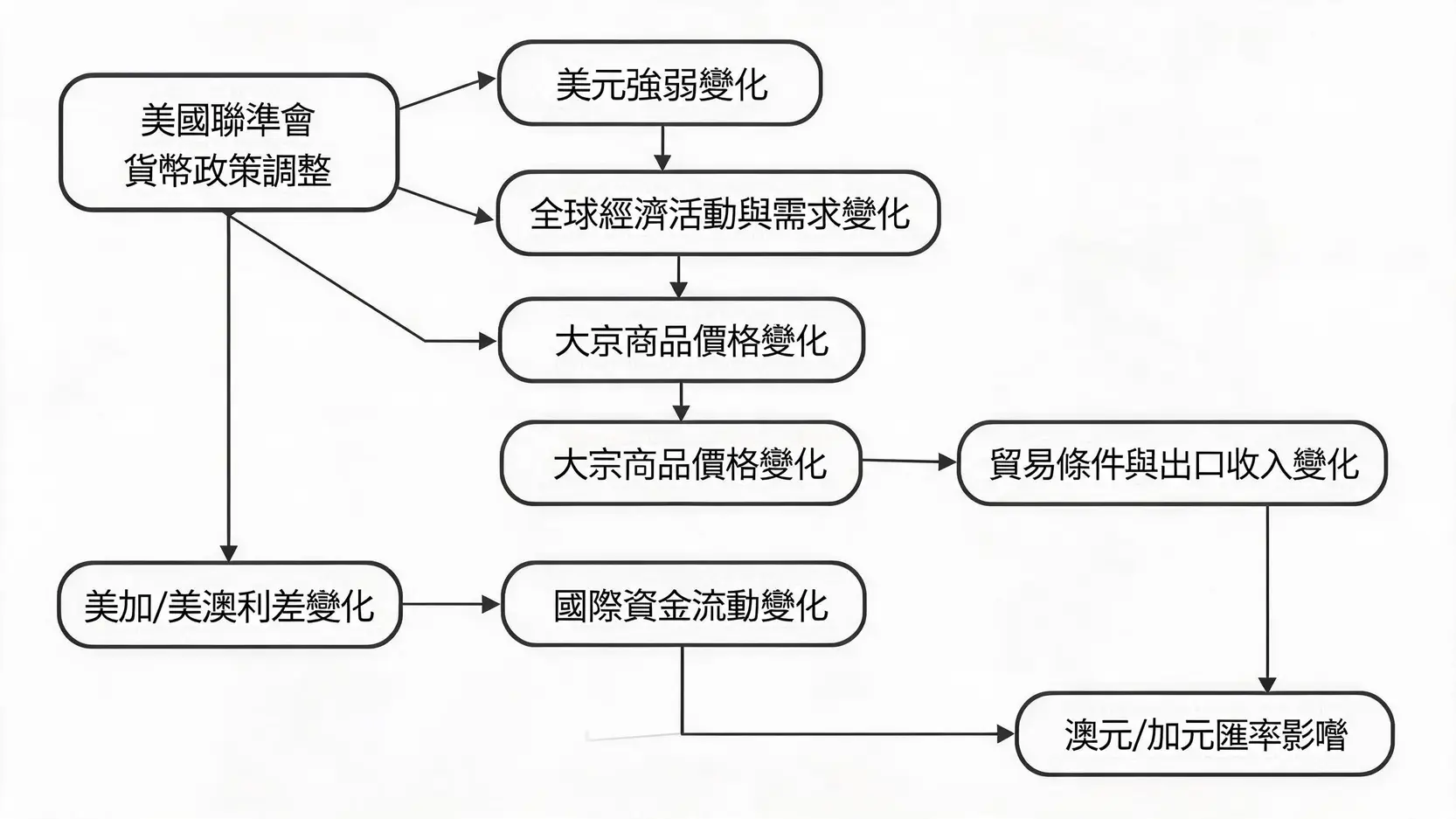
After understanding the link between commodities and currencies, the next point to explore is: when the Federal Reserve’s monetary policy shifts, how does it create a “first-layer impact” on the commodity market?
The US Dollar Pricing Effect: US Dollar Appreciation Is Usually Unfavorable for Commodity Prices
Most global commodities (such as gold, crude oil, and copper) are priced in US dollars. When the US Federal Reserve begins a rate hike cycle and drives the US dollar higher, buying the same amount of commodities becomes more expensive for buyers holding non-US currencies.
This leads to cooling global demand, thereby suppressing commodity prices. This is the logic behind the common saying that a “strong US dollar weighs on commodities”. To gain a deeper understanding of the US dollar’s influence, it is recommended to read this US dollar strength guide and US Dollar Index DXY analysis. According to a 2026 research report by the Bank for International Settlements (BIS), there is a significant correlation between the strength of the US dollar and commodity prices.
Global Demand Effect: US Rate Hikes May Suppress Global Economic Activity
In addition to the pricing effect, monetary policy tightening also affects the real economy. US rate hikes mean higher borrowing costs for businesses and individuals, which suppresses investment and consumption.
As the world’s largest economy, a slowdown in the US economy often drags down the pace of the global economy, thereby reducing real demand for commodities such as crude oil and industrial metals. When demand expectations decline, commodity prices are naturally the first to come under pressure. For commodity-related currencies that rely on exports, this is undoubtedly a negative factor.
Second-Layer Impact: The Impact of Federal Reserve Monetary Policy Shifts on Commodity-Related Currency Countries
In addition to directly hitting commodity prices, US policy adjustments also create a “second-layer impact” on central banks in countries such as Australia and Canada through interest rate differentials and capital flows.
Interest Rate Differential Effect: Will the Reserve Bank of Australia (RBA) and Bank of Canada (BOC) Follow?
When the Federal Reserve raises interest rates sharply, central banks in other countries usually face enormous pressure. If the Reserve Bank of Australia (RBA) or the Bank of Canada (BOC) does not follow with rate hikes, the “interest rate differential” between these two countries and the United States will widen.
If the central banks of commodity countries choose to stay on hold, the disadvantage from interest rate differentials will lead to depreciation of their currencies.
Capital Flows: How Does a Widening Interest Rate Differential Guide Capital Outflows From Commodity Currencies?
International capital chases returns. When US dollar assets (such as US Treasuries), can provide higher and safer risk-free returns, investors will choose to sell the Australian dollar or Canadian dollar and park their capital in the US dollar.
This large-scale capital outflow not only offsets the exchange rate support that commodity prices may bring, but may even trigger a deeper depreciation cycle. For investors who are enthusiastic about forex carry trades, the narrowing or widening of interest rate differentials is the core key in determining trading direction.
Differentiated Highlight: Commodity-Related Currency Trading Scenario Simulation and Analysis
To turn theory into practice, let us simulate several common trading scenarios under monetary policy shifts and see how commodity-related currencies may react.
Scenario One: US Rate Hikes + Rising Commodity Prices
Classic Case: Such as the Early Stage of the Russia-Ukraine Conflict in 2022
In this extreme scenario, geopolitics caused crude oil and wheat prices to surge, while the United States rapidly raised interest rates due to high inflation.
Exchange rate reaction: The Canadian dollar and Australian dollar usually show resilience. Although a strong US dollar brings pressure, record-high commodity prices provide a strong buffer for these countries’ trade surpluses. At this time, commodity currencies may trade at high levels against the US dollar, while they may strengthen sharply against other non-US currencies (such as the yen or euro).
Scenario Two: US Rate Hikes + Falling Commodity Prices
Classic Case: When Global Economic Recession Concerns Intensify
When the United States continues tightening monetary policy, causing the market to worry about an economic recession, weak industrial demand leads to sharp declines in commodities such as copper and crude oil.
Exchange rate reaction: This is the most unfavorable “double hit” scenario for commodity-related currencies. The disadvantage in interest rate differentials, combined with deteriorating terms of trade, will cause the Australian dollar and Canadian dollar to face enormous selling pressure. At this time, following the trend to short AUD/USD or CAD/USD is often a reasonable trading strategy.
Scenario Three: US Rate Cuts + Rising Commodity Prices
Classic Case: The Early Stage of Global Economic Recovery
When the Federal Reserve starts a rate-cut cycle to stimulate the economy (monetary policy shifts toward easing), while recovering global manufacturing demand drives commodity prices higher.
Exchange rate reaction: This is the “golden age” for commodity currencies. A weaker US dollar causes capital to flow into markets with high interest rates and high growth expectations. Driven by the dual engines of commodity prices and capital inflows, the Australian dollar and Canadian dollar usually enter a strong appreciation trend.
Further Reading (Highly Recommended)
[AUD/TWD Exchange Rate] 2026 Best Guide to Exchanging TWD for AUD and Trend Analysis
What Are Commodity Currencies? Understand Australian Dollar and Canadian Dollar Investing in One Article
Frequently Asked Questions (FAQ): Commodity-Related Currencies and Monetary Policy Shifts
Q: How much influence does China’s policy have on commodity currencies?
Very significant, especially for the Australian dollar. China is the world’s largest consumer of industrial metals. When China launches large-scale infrastructure or monetary easing policies, demand for commodities such as iron ore surges, which usually directly pushes up the Australian dollar’s exchange rate trend. Therefore, when trading the Australian dollar, you cannot only watch the Federal Reserve, but must also closely monitor China’s developments.
Q: Is the New Zealand dollar (NZD) also considered a commodity-related currency?
Yes. Although New Zealand is not mainly driven by oil or minerals, its economy is highly dependent on agricultural exports (such as dairy products and meat). Therefore, the New Zealand dollar also has the characteristics of a commodity currency. Its trend is not only affected by global agricultural product prices, but also has a very high correlation with the Australian economy.
Q: Besides the US dollar, does eurozone monetary policy affect commodities?
Although the US dollar is the global pricing benchmark for commodities, the European Central Bank’s (ECB) monetary policy also affects global capital liquidity and risk appetite. If the eurozone implements monetary easing, it will boost market optimism toward global economic growth, thereby indirectly supporting commodity demand and related currencies.
Q: How can carry trades be used to invest in commodity currencies?
A carry trade involves borrowing a low-interest-rate currency (such as the yen) and buying a high-interest-rate currency (such as the Australian dollar or Canadian dollar) to earn the interest rate differential. When central banks in commodity countries maintain relatively high interest rates due to inflation, and global risk appetite is healthy, this type of operation becomes quite active. However, when market turbulence triggers capital flight to safe havens, the unwinding of carry trades can cause commodity currencies to fall sharply, so investors need to pay special attention to risk management.
Conclusion
Trading commodity-related currencies is a three-dimensional game. Successful traders must pay attention to both the direction of Wall Street’s monetary policy and the dynamics of commodity demand in the real economy. We can see that the trends of currencies such as the Australian dollar and Canadian dollar are deeply affected by the two-layer impact of US Federal Reserve policy, from the US dollar pricing effect on commodities to the interest rate differential and capital flow game between central banks.
In the complex economic environment of 2026, by understanding the two-layer impact model and market reactions under different scenarios proposed in this article, you will be able to see through the complex trends of currencies such as the Australian dollar and Canadian dollar more clearly, and make wiser decisions in a changing market.