2026 Australian Dollar Trading Strategy Guide

Updated: 2026/06/25  |  CashbackIsland

aud-trading-strategy

Ultimate Guide to 2026 Australian Dollar Trading Strategy: Master the 3 Key Factors Affecting the Australian Dollar From Scratch

The Australian dollar (AUD), due to its unique attributes as both a commodity currency and a risk currency, has become an excellent choice in the forex market where volatility and opportunities coexist. Many traders are attracted by its potential, but repeatedly suffer losses because they do not understand the driving factors behind it. This article will provide an in-depth analysis of the three core factors affecting the Australian dollar trend, and provide practical Australian dollar trading strategies to help you gain an edge in practical Australian Dollar (AUD) trading techniques. To trade forex well, building good risk awareness and understanding fundamentals is the first step. Interested readers can refer to [Forex Beginner’s Guide] Newbie Investing From 0 to 1, Understand the Basic Knowledge of Forex Trading!, to first build a solid foundation for their forex trading basics


Australian Dollar (AUD) Fundamental Analysis: Why Is It Called a “Commodity Currency” and a “Risk Currency”?

Analysis of the Link Between the Australian Dollar and Iron Ore and Gold Prices

When discussing how to formulate an effective Australian dollar trading strategy, we must first recognize that the Australian dollar is one of the world’s most representative “commodity currencies”. Australia is the world’s largest iron ore exporter and also an important gold producer. Therefore, commodity price trends are closely related to the Australian dollar exchange rate. When global infrastructure demand increases and drives iron ore prices higher, Australia’s export revenue will rise significantly, thereby pushing up the Australian dollar exchange rate. Conversely, if the commodity market is weak, the Australian dollar often faces considerable downward pressure.


How Does Global Risk Sentiment Affect the Australian Dollar? (Risk Appetite vs. Risk Aversion)

The Australian dollar is not only a commodity currency, but also a “risk currency” in the forex market. When the global economic outlook is optimistic, stock markets rise, and investor risk appetite is high, capital often flows into high-yield or growth-potential assets, and the Australian dollar strengthens accordingly. Conversely, when geopolitical tensions or financial market turmoil trigger risk aversion, capital quickly exits risk assets and shifts toward safe-haven investment tools such as the US dollar, yen, or gold. At this time, the Australian dollar often faces heavy selling pressure.


The Reserve Bank of Australia (RBA)’s Interest Rate Decisions and Their Influence

Monetary policy is the cornerstone that determines long-term exchange rate trends. The interest rate decisions of the Reserve Bank of Australia have a decisive impact on the Australian dollar trend. When the RBA decides to raise interest rates or releases hawkish signals in 2026 in response to inflation and economic growth, the yield on Australian dollar assets rises, attracting more international capital inflows and pushing up the Australian dollar. Therefore, when formulating a trading plan, closely tracking the RBA’s monetary policy direction is indispensable. To gain a deeper understanding of fundamental interpretation, it is strongly recommended to read Ultimate Guide to Forex Fundamental Analysis: Analytical Techniques From Economic Data to Central Bank Decisions.


Two Major External Key Factors Affecting the Australian Dollar Exchange Rate Trend

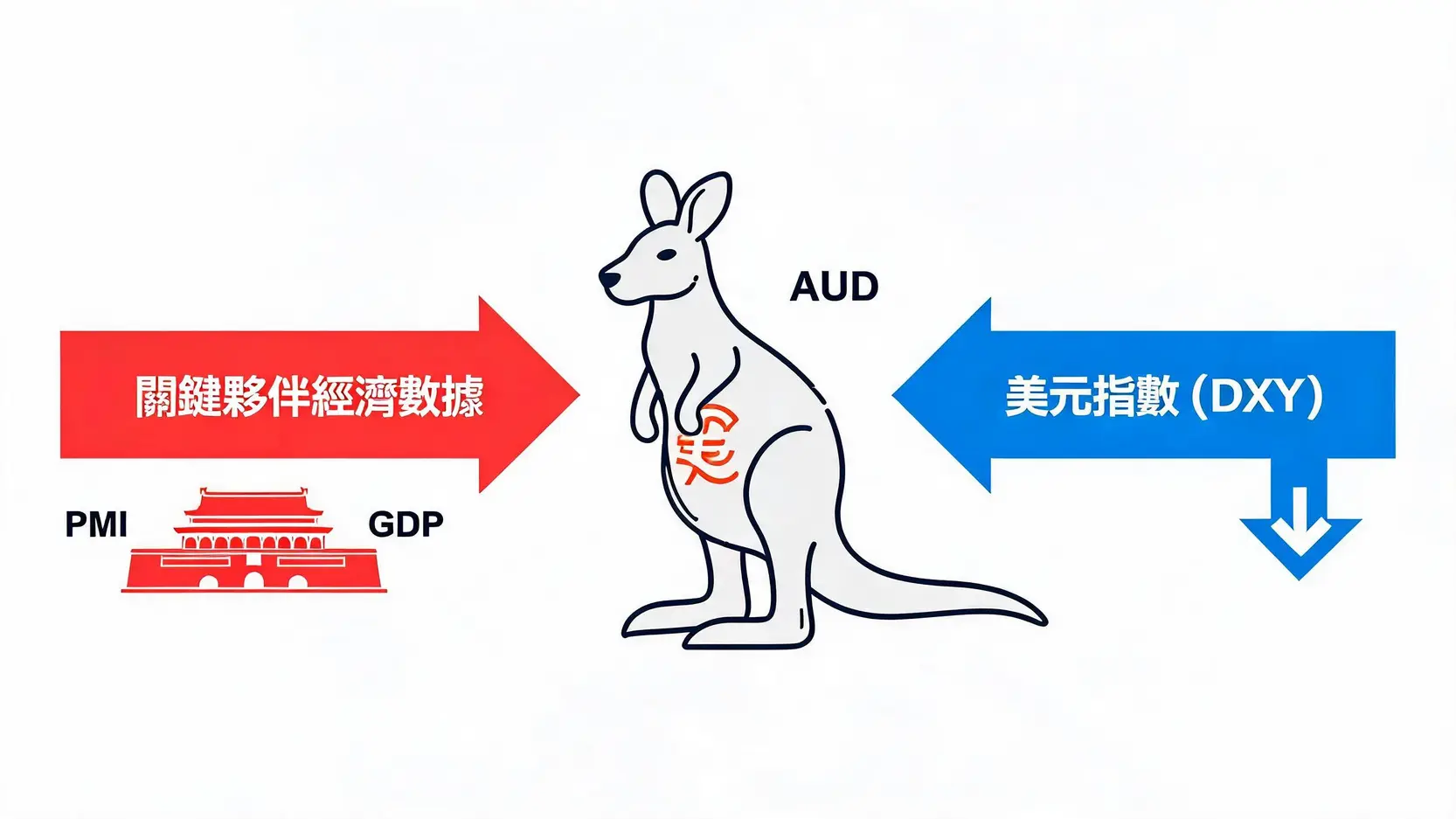
影響澳元匯率的兩大外部因素圖:來自關鍵夥伴的經濟數據和美元指數的強弱。

The two major external engines affecting the Australian dollar trend: key partner economies and US dollar strength


Key Trading Partner: The Direct Impact of China’s Economic Data (PMI, GDP)

Australia’s economy is highly dependent on exports, and China is Australia’s largest trading partner. China’s economic data, especially the Manufacturing Purchasing Managers’ Index (PMI) and Gross Domestic Product (GDP), directly reflect demand expectations for Australian iron ore and other raw materials. When China releases strong economic data or implements further monetary easing policies to stimulate the economy, the market expects an increase in imports of Australian commodities, which is positive for the Australian dollar. Therefore, mature trading thinking must include China’s macroeconomic indicators in the analysis.


The Strength of the US Dollar Index (DXY) and Its Negative Correlation With AUD/USD

In the forex market, AUD/USD is the most popular Australian dollar currency pair. Due to the dominant position of the US dollar in the international financial system, the strength of the US Dollar Index (DXY) directly determines the trend of AUD/USD. When the US Federal Reserve (Fed) adopts tightening policies or the US dollar strengthens due to safe-haven demand, AUD/USD usually falls. Understanding how the US dollar works is crucial for traders. You can refer to this US Dollar Strength Guide: Understand the Reasons Behind It, Global Impact, and Investment Response Strategies, to more accurately grasp volatility opportunities brought by a strong US dollar. 

Practical Highlight: Building High-Win-Rate Australian Dollar Trading Times and Session Strategies


Why Is the Asian Trading Session the Golden Time to Trade the Australian Dollar?

Many investors often overlook the time factor when trading forex. For the Australian dollar, the Asian trading session (especially the Sydney and Tokyo sessions) is an excellent time to enter the market. This is because key economic data from Australia and China are usually released during this period, triggering rapid fluctuations in the Australian dollar exchange rate. Mastering the rhythm of the Asian session can help you capture market opportunities brought by data at the earliest moment, thereby improving the win rate of AUD/USD.


Practical Teaching: How to Combine RBA Meetings and China Data Release Times to Formulate Strategies

In practice, traders should prepare an economic calendar in advance. Before the RBA interest rate decision or the release of important China data, the market usually enters a wait-and-see state, and price volatility contracts. At this time, technical analysis can be used to set breakout orders at key support or resistance levels. When the data result differs significantly from market expectations, following the trend often brings substantial returns. Of course, data-driven markets come with high risk, so capital management and stop-loss settings must be done properly before entering the market.


Further Reading (Highly Recommended)

Forex Trading Risk Management: Senior Traders Teach You How to Hedge Risks and Profit Steadily

Beginner Pack for Futures and Forex Technical Analysis: Master Trend Judgment and Common Indicators From 0 to 1


Risk Management: Stop-Loss Setting Techniques for Australian Dollar Volatility

Any excellent Australian dollar trading strategy must be built on rigorous risk management. Since the Australian dollar is simultaneously affected by both commodity prices and global risk sentiment, its volatility can sometimes exceed expectations. When setting stop-losses, you should refer to the recent Average True Range (ATR) indicator and give prices appropriate room to fluctuate, avoiding being stopped out by short-term market noise. Remember, preserving principal is always the first rule of survival in forex investing.


Frequently Asked Questions (FAQ) About Australian Dollar Trading Strategies

Q: What news should I follow when trading the Australian dollar?

A: You need to focus on the Reserve Bank of Australia (RBA)’s monetary policy statements, as well as Australia’s employment and inflation data. In addition, China’s manufacturing PMI and economic growth data, along with global commodity price trends (especially iron ore and gold) are also indispensable key areas to monitor.

Q: What are the characteristics of the AUD/JPY currency pair?

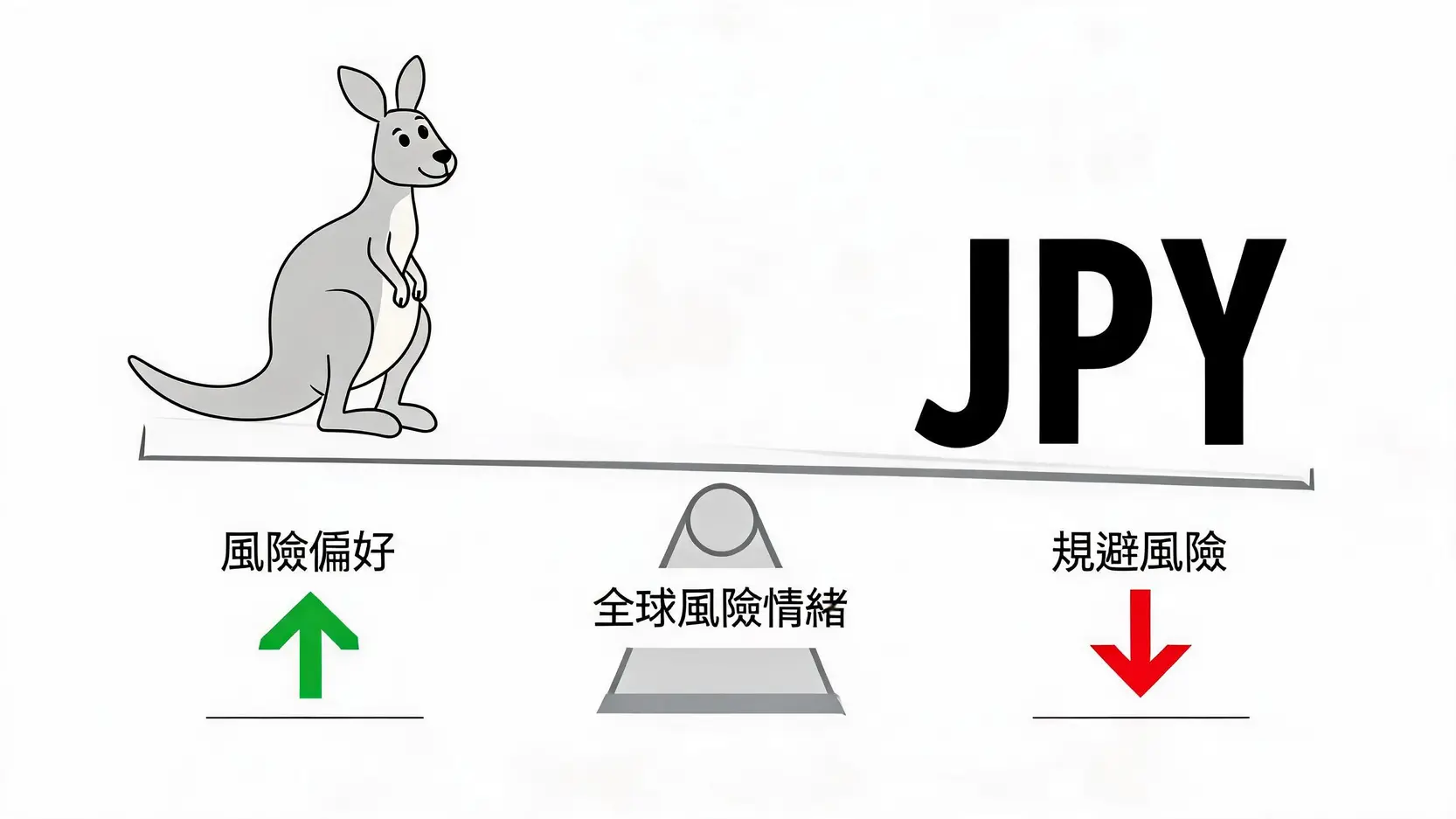
A: AUD/JPY is regarded by the forex market as a “barometer” of global risk sentiment. The Australian dollar is a typical risk currency, while the yen is a traditional safe-haven currency. When market sentiment is optimistic, AUD/JPY often rises; when the market panics, it tends to fall sharply. This makes it very suitable for trend investing and carry trading.

AUD/JPY作為風險晴雨表的蹺蹺板示意圖,顯示風險偏好時澳元端上升。

AUD/JPY: The Seesaw of Market Risk Sentiment

Q: What is the biggest factor affecting the long-term trend of the Australian dollar?

A: In the long run, interest rate differences between countries (such as the interest rate differential between the US and Australia) as well as the commodity supercycle, are the core forces determining the Australian dollar’s trend. When Australia’s interest rates are higher than those of other major economies, and the world is in a commodity bull market, the Australian dollar will receive strong long-term support.

Q: Is the Australian dollar suitable as a main trading currency for beginners?

A: The Australian dollar has relatively strong trend characteristics, and its movements are influenced by fundamental data in a very intuitive way, making it very suitable for beginners who are willing to spend time studying the macroeconomy and commodity markets. In the early stage, beginners should start with AUD/USD and strictly control leverage and position size.


Conclusion

A mature Australian dollar trading strategy must comprehensively consider its inherent connection with commodities, changes in global risk sentiment, and macroeconomic data from the two major economies, China and the US. Through a thorough understanding of fundamentals, combined with seizing data-driven market opportunities during the Asian session, you have already mastered the core elements for formulating your own trading plan. The forex market changes rapidly, and theoretical knowledge must be tested through practice. Please continue observing relevant economic indicators and price action, combine them with strict risk management, and turn theory into practical trading ability to steadily build your own profit formula.

If you liked this article, please share it!

Related Articles

  • FedWatch Guide: Predict Rate Hikes Before the Market
    Rate Hike Expectations Trading Guide: Use FedWatch to Predict Rate Hikes and Position Ahead of the Market Core Concept: Why Trade “Expectations” Instead of “Facts”? After spending enough time in the financial markets, you will notice an interesting phenomenon: the market often completes a major move before the Federal Reserve...
    2026 年 6 月 25 日
  • Monetary Policy Shifts: Hawkish vs Dovish Guide
    What Is a Monetary Policy Shift? Understand Hawkish and Dovish Signals to Position Ahead of the Market Why does the market always hold its breath for the results of Federal Reserve (Fed) meetings? Why can every interest rate decision, and even a slight “shift” in wording, always trigger sharp volatility...
    2026 年 6 月 25 日
  • How Monetary Policy Affects Commodity Currencies
    In-Depth Analysis: How Do Monetary Policy Shifts Affect Commodity-Related Currencies (Australian Dollar, Canadian Dollar)? When trading commodity-related currencies such as the Australian dollar (AUD) and Canadian dollar (CAD), you must never focus on a single economic data point alone. Their exchange rate trends are actually the result of a tug-of-war...
    2026 年 6 月 25 日
返回顶部