Major Currency Pairs Guide 2026: List & Features

What Are Major Currency Pairs? 2026 Complete List, Definition, and Full Analysis of Five Key Trading Characteristics
Just stepped into the forex market and feeling confused by the wide variety of currency combinations? Many beginners are unsure where to start, or have heard of “major currency pairs” but do not fully understand their importance or the specific definition of major currency pairs. In fact, mastering this information is the first step toward successful trading. This article is designed for forex beginners, guiding you from the ground up with an in-depth explanation of what major currency pairs are, providing a complete list, and analyzing their key trading characteristics to help you build a solid trading foundation.
What Are Major Currency Pairs? Understand the Core Definition in Seconds
In the world of forex trading, all transactions exist in the form of “currency pairs”. Simply put, it is the exchange ratio between one currency and another. “Major currency pairs” refer to the most frequently traded and most influential group of currency pairs in the global forex market. Their common characteristic is that they all include the US dollar (USD) and are paired with currencies from other major global economies.
Basic Structure of Currency Pairs: Base Currency vs Quote Currency
To understand any currency pair, you must first recognize its basic structure. A currency pair consists of two currencies, formatted as “XXX/YYY”.
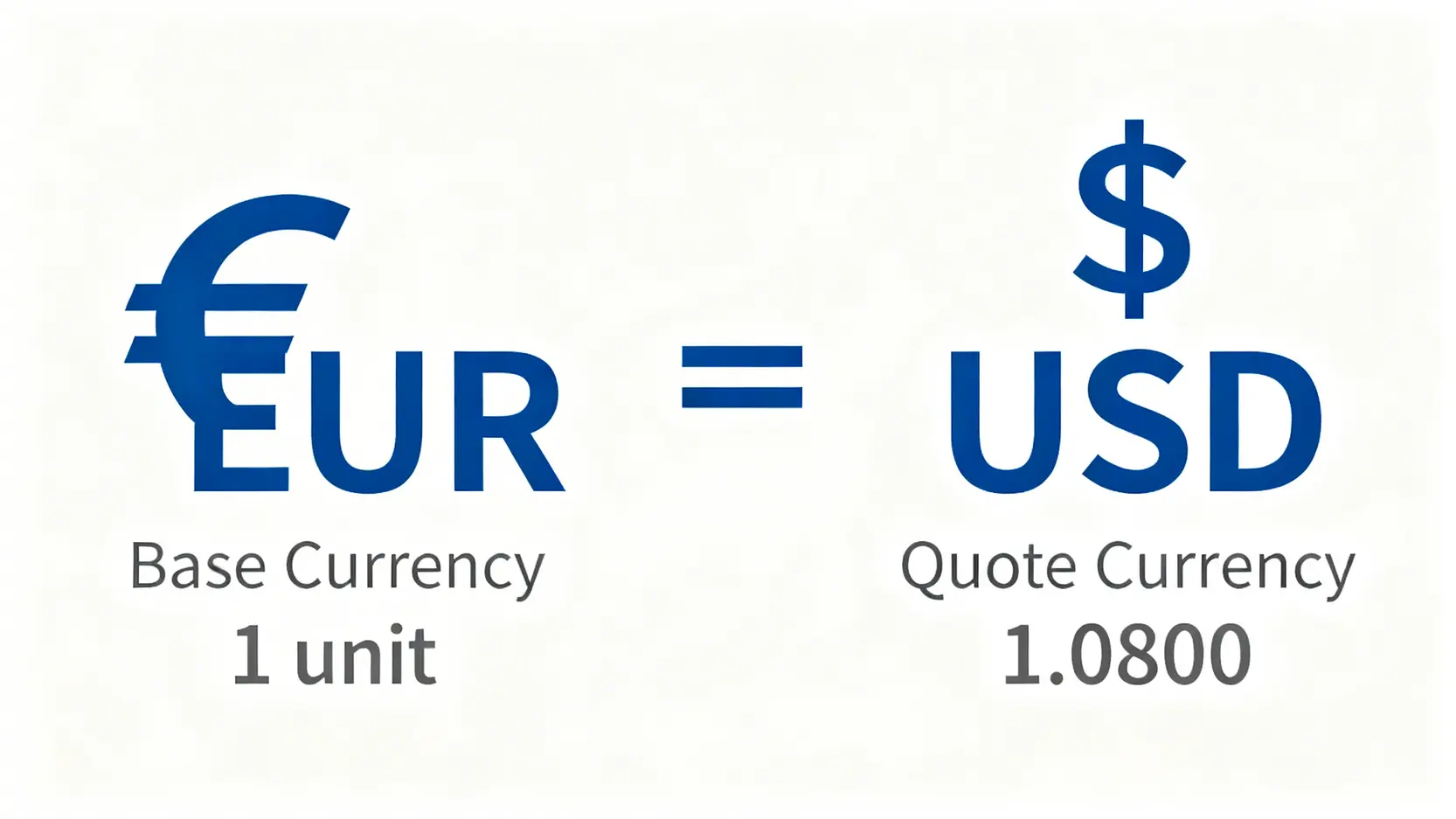
- Base Currency: The currency on the left side of the slash (/), which serves as the “base” of the trade. For example, in EUR/USD, the euro (EUR) is the base currency. The quotation always represents 1 unit of the base currency.
- Quote Currency: The currency on the right side of the slash, which indicates how much of the quote currency is needed to exchange for 1 unit of the base currency. In the quote EUR/USD = 1.0800, the US dollar (USD) is the quoted currency, meaning that 1 euro can be exchanged for 1.0800 US dollars.
When you buy (go long) EUR/USD, you are actually buying euros while selling US dollars, expecting the euro to appreciate relative to the US dollar. Conversely, when you sell (go short), you expect the euro to depreciate.

Illustration: Understanding the Quotation Structure of Currency Pairs
Why Are They Called Major? Differences From Minor and Exotic Currency Pairs
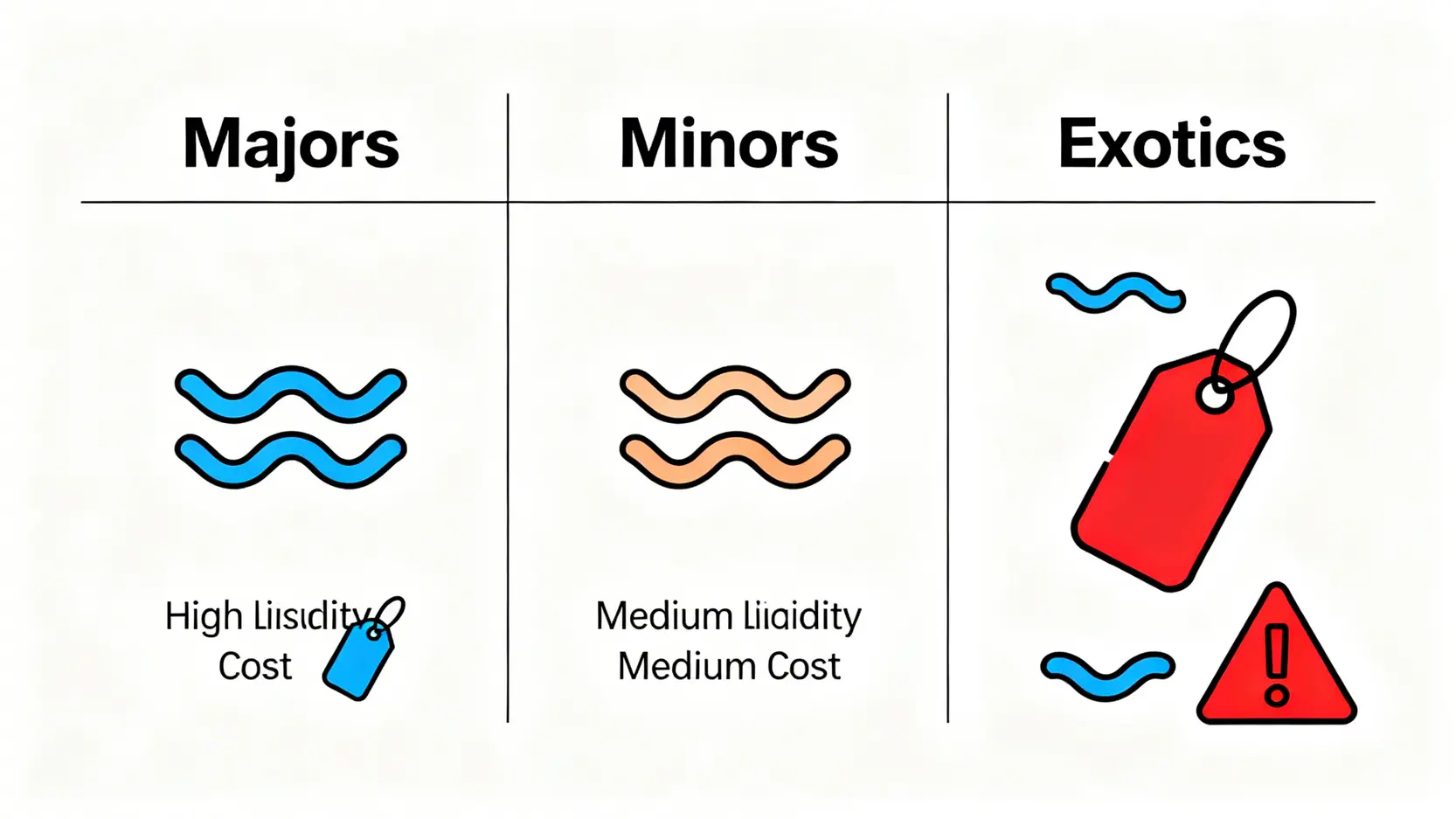
Not all currency pairs are created equal. Based on trading volume, liquidity, and whether they include the US dollar, the market commonly categorizes them into three types: major, minor, and exotic currency pairs. The key differences among them are reflected in the following aspects:
| Category |
Definition |
Characteristics | Representative Examples |
| Major Currency Pairs (Majors) | All currency pairs that include the US dollar (USD) | Extremely high liquidity, largest trading volume, lowest trading spreads, transparent market information | EUR/USD, USD/JPY, GBP/USD |
| Minor Currency Pairs (Minors / Crosses) |
Do not include the US dollar, but consist of currencies from other major economies |
Relatively good liquidity, relatively low spreads, diverse trading opportunities | EUR/GBP, EUR/JPY, GBP/JPY |
| Exotic Currency Pairs (Exotics) | Composed of one major currency and one emerging market economy currency |
Lower liquidity, high spreads, sharp price fluctuations, higher trading risk |
USD/SGD, USD/HKD, EUR/TRY |

Major vs. Minor vs. Exotic Currency Pairs: Understand the Core Differences at a Glance
In summary, “major currency pairs” are named for their massive trading volume and high liquidity, making them the focus of global financial markets and the preferred starting point for most beginner traders.
Further Reading (Highly Recommended)
[Forex Beginner Guide] From 0 to 1: Understand the Fundamentals of Forex Trading!
2026 Latest Complete List of Major Currency Pairs
There are seven widely recognized major currency pairs in the forex market, accounting for the majority of the global average daily trading volume. Understanding this list is a fundamental skill for every trader.
The Seven Most Traded Major Currency Pairs Globally
Below are the seven globally recognized major currency pairs, highly regarded due to the strength of the economies behind them:
- EUR/USD (euro/US dollar): Known as “Fiber”, it is the most traded and most liquid currency pair in the world. Its movements are often seen as a direct comparison of the economic strength between the eurozone and the US.
- USD/JPY (US dollar/Japanese yen): Known as “Gopher”, it ranks second in trading volume after EUR/USD. The Japanese yen is often considered a safe-haven currency, making this pair particularly active during periods of global market turbulence.
- GBP/USD (British pound/US dollar): Known as “Cable”, its name originates from early transatlantic cable transmission of quotes. It is typically more volatile and significantly influenced by UK economic data and policies.
- USD/CHF (US dollar/Swiss franc): Known as “Swissy”. The Swiss franc is also a traditional safe-haven currency and tends to appreciate during times of increased market uncertainty.
- AUD/USD (Australian dollar/US dollar): Known as “Aussie”, the Australian dollar is a typical “commodity currency”, closely linked to prices of commodities such as iron ore and gold.
- USD/CAD (US dollar/Canadian dollar): Known as “Loonie”, named after the loon on the Canadian one-dollar coin. The Canadian dollar is also a commodity currency, highly correlated with oil prices.
- NZD/USD (New Zealand dollar/US dollar): Known as “Kiwi”, the New Zealand dollar is also a commodity currency, mainly influenced by export prices of agricultural products such as dairy.
Why Does the US Dollar (USD) Hold a Central Position in Major Currency Pairs?
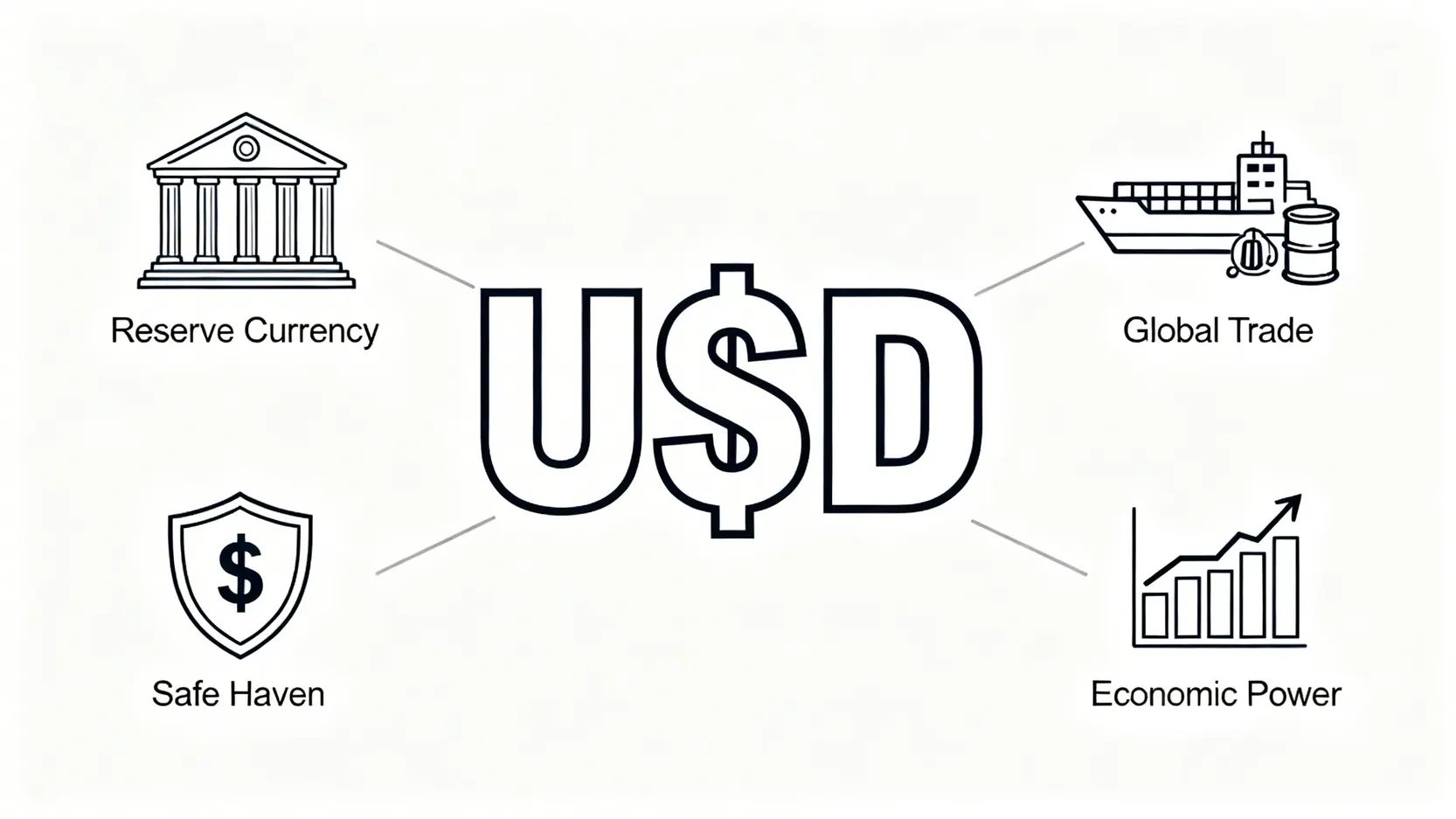
You will notice that every major currency pair includes the US dollar. This is not a coincidence, but stems from the irreplaceable central role of the US dollar in the global financial system:
- Global primary reserve currency: Central banks around the world hold large amounts of US dollars as foreign exchange reserves for international settlement and exchange rate stability.
- Unit of account in international trade: Key commodities such as oil, gold, and raw materials are mostly priced and traded in US dollars, making it indispensable for any country engaged in international trade.
- Safe-haven asset characteristics: During global economic crises or uncertainty, investors tend to move capital into US dollar-denominated assets, increasing demand for the currency.
- Influence of the US economy: As the world’s largest economy, US economic data (such as non-farm payroll reports and GDP) and monetary policy (Federal Reserve interest rate decisions) have a decisive impact on global markets.

The Central Role of the US Dollar: The Foundation of Global Finance
Master the Five Core Trading Characteristics of Major Currency Pairs
Understanding the trading characteristics of major currency pairs can help you better develop strategies and manage risk. Their popularity among global traders is mainly due to the following five unmatched advantages.
Characteristic One: Extremely High Market Liquidity and Trading Volume
Liquidity refers to how easily an asset can be bought or sold without significantly affecting its market price. Major currency pairs have a daily trading volume reaching trillions of dollars. According to the authoritative triennial survey by the Bank for International Settlements (BIS), EUR/USD alone accounts for nearly one quarter of total trading volume. This means:
- Fast order execution: There are always a large number of buyers and sellers, allowing your orders to be executed instantly at current market prices.
- Lower slippage risk: Due to sufficient market depth, even large trades are less likely to significantly impact prices, reducing the occurrence of slippage.
Characteristic Two: Relatively Low Trading Spread
The spread is the difference between the Ask price and the Bid price, and it is one of the most direct costs for traders. Due to the extremely high liquidity of major currency pairs and intense market competition, brokers usually offer very low spreads. For example, the spread of EUR/USD is often below 1 pip.
In contrast, exotic currency pairs, due to lower trading volume and poor liquidity, may have spread several times or even dozens of times higher than major pairs. Lower spreads mean lower trading costs and a greater likelihood of achieving profitability. To learn more about spreads, you can refer to this complete guide on forex spreads.
Characteristic Three: Abundant and Transparent Market Information and Analytical Resources
Information surrounding major currency pairs is widely available. Whether it is financial news, economic data releases (such as US non-farm payroll data and central bank interest rate decisions), or professional institutional analysis reports, all are easily accessible. This level of transparency and availability provides traders with sufficient basis for decision-making. Whether you prefer technical analysis or fundamental analysis, you can find extensive resources to support your judgment.
Characteristic Four: Relative Stability Suitable for Beginners
“Stability” is relative, as the forex market itself is inherently volatile. However, compared to exotic currency pairs, major currency pairs exhibit more stable price movements, with fewer extreme, unexpected gaps or sharp spikes and drops. This is mainly because the economies behind them are large, making it difficult for a single event or capital flow to easily manipulate prices. For beginners, this relatively predictable volatility is more conducive to learning risk management and executing trading strategies, helping to avoid significant losses caused by sudden extreme movements.
Characteristic Five: 24-Hour Continuous Trading Opportunities
The forex market is a global, decentralized market that operates 24 hours a day, from the opening in Sydney on Monday to the closing in New York on Friday. This means that no matter where you are, there is always an active trading session. Major currency pairs exhibit different levels of activity across various trading sessions (such as the Asian, European, and North American sessions), providing flexible trading opportunities for traders with different schedules. For example, EUR/USD and GBP/USD are usually most active during the overlap of the European and US sessions (GMT 13:00-17:00).
FAQ: Common Questions About Major Currency Pairs
Q: Which major currency pair is most suitable for beginners to trade?
A: It is generally considered that EUR/USD (euro/US dollar) is the most suitable choice for beginners. The reason is that it has the highest trading volume globally and the best liquidity, which results in the lowest trading spreads. Its market movements are relatively stable, and technical analysis chart patterns are more classical. In addition, related financial news and analytical resources are the most abundant.
Q: What are the potential risks of trading major currency pairs?
A: Although relatively stable, trading major currency pairs still involves risks. The main risks include leverage risk (overuse of leverage amplifies losses), market volatility risk (major economic data releases or unexpected political events may cause sharp price fluctuations), and interest rate risk (changes in central bank monetary policies directly affect exchange rate movements). Therefore, strict capital management and risk control are essential.
Q: Which major currency pair has the largest trading volume globally?
A: According to authoritative data from the Bank for International Settlements (BIS), EUR/USD (euro/US dollar) has long been the currency pair with the largest average daily trading volume in the global forex market, accounting for more than 20% of total market trading volume. Its position is unlikely to be challenged in the foreseeable future.
Q: How to distinguish between major and minor currency pairs?
A: The simplest way to distinguish them is to check whether the currency pair includes the US dollar (USD). All currency pairs directly paired with the US dollar, such as EUR/USD and USD/JPY, are classified as major currency pairs. Currency pairs that do not include the US dollar and are composed of other major economy currencies, such as EUR/GBP and AUD/JPY, are referred to as minor currency pairs or crosses.
Conclusion
In summary, gaining a deep understanding of the definition of major currency pairs, becoming familiar with the complete list of major currency pairs, and mastering their core trading characteristics are essential steps for every forex investor progressing from beginner to advanced. With their unmatched high liquidity, low trading costs, abundant market information, and relatively stable price movements, they provide an ideal starting point for beginners. By starting with major currency pairs and combining this with prudent risk management, you will be able to begin and explore the vast world of forex trading more steadily.
Related Articles
-
How to Get Started with Bitcoin? The Complete 2026 Bitcoin Buying Guide for Beginners After watching Bitcoin repeatedly reach new highs in recent years and successfully pass spot ETF reviews in the US and Hong Kong in 2024, officially entering mainstream financial markets, many investors have turned their attention to...2026 年 7 月 20 日
-
Is Gold’s V-Shaped Rebound a Bottom-Fishing Signal? A Complete Guide to Trading Strategies Amid “$100 Price Swings” What Is a Gold V-Shaped Rebound? More Than Just a Technical Pattern The gold market has recently experienced sharp rises and falls, with prices frequently displaying dramatic “gold V-shaped rebounds”. Single-day “$100 price...2026 年 7 月 20 日
-
What Is PPI Data? 2026 Latest Analysis: Understand the Differences from CPI and How It Affects Stock Market Trends With market information constantly changing, do you always hold your breath while waiting for CPI data to be released? But did you know that a more forward-looking inflation indicator, PPI data...2026 年 7 月 20 日