Hedging vs. Arbitrage: Key Differences Explained

Hedging vs. Arbitrage: Key Differences and Risk-Free Arbitrage Explained
After years in the financial industry, I often hear both beginners and experienced investors talk about “hedging” and “arbitrage”, and there are always people in the market constantly promoting so-called “risk-free arbitrage” strategies. What exactly is the difference between the two? Is there really a trade that guarantees profits with no losses? This article will take you through an in-depth analysis of the essence of hedging and arbitrage, and explore the reality of risk-free arbitrage in the market. Whether you want to understand the difference between hedging and arbitrage, or are looking for practical techniques for cross-market and intertemporal arbitrage, this article will lift the veil on what lies behind the financial market.
Analysis of the Core Differences Between Hedging and Arbitrage: What Is the Difference Between Hedging and Arbitrage?
Many investors often confuse hedging with arbitrage, believing that both are intended to generate profits during market volatility. However, they are fundamentally different in terms of core logic, operational purpose, and the risks involved. To master the rules of survival in the market, these two concepts must first be clearly understood.
Hedging: Aiming to Reduce Risk
The original purpose of hedging is “defense”. When you hold an asset (such as a particular stock or Bitcoin spot position), you may establish an opposite position in the futures or options market to prevent major losses caused by future price declines. The purpose of this operation is not to create excess profits, but to lock in existing value, similar to buying insurance for your investment portfolio.
For example, when the market faces uncertainty from monetary easing policy, investors may protect long positions by shorting a broad market index. This is a classic hedging operation. To gain a deeper understanding of more defensive operations, you can refer to What Does Hedging Mean? 5 Major Hedging Strategies, which will help you better build risk management awareness.
Arbitrage: Aiming to Earn Risk-Free Price Spreads
Compared with the defensive nature of hedging, arbitrage is an offensive approach that “actively seeks market inefficiencies”. In theory, when the same asset has price differences across different markets or at different points in time, investors can simultaneously buy low and sell high to lock in the spread between them. This is also the core concept of risk-free arbitrage that many people pursue.
According to Investopedia’s definition of Arbitrage, arbitrage is the use of pricing errors across different markets to earn profits, and theoretically does not involve directional market risk. But in practice, is it really completely risk-free? This is exactly the key point we will explore next.
What Is Hedge Arbitrage? Practical Cross-Market and Calendar Arbitrage Strategies
After understanding the basic concepts, the market has also developed a more advanced approach that combines the two: hedge arbitrage. Rather than simply buying and selling, this strategy uses hedging techniques to lock in arbitrage opportunities, making it a common tool in the investment toolkit of institutional investors and professional traders.
An Advanced Trading Strategy Combining Hedging and Arbitrage
The core of hedge arbitrage is to use hedging techniques to minimize directional market risk (Delta) while identifying changes in relative value between two highly correlated assets or markets. This approach requires traders to have exceptional market sensitivity and execution speed.
Further Reading (Highly Recommended)
The Ultimate Guide to Arbitrage: 5 Risk-Free Arbitrage and Hedging Strategies
What Is Hedging? 5 Key Hedging Strategies to Manage Investment Risk with Ease
Examples of Cash-and-Carry Arbitrage and Funding Rate Arbitrage
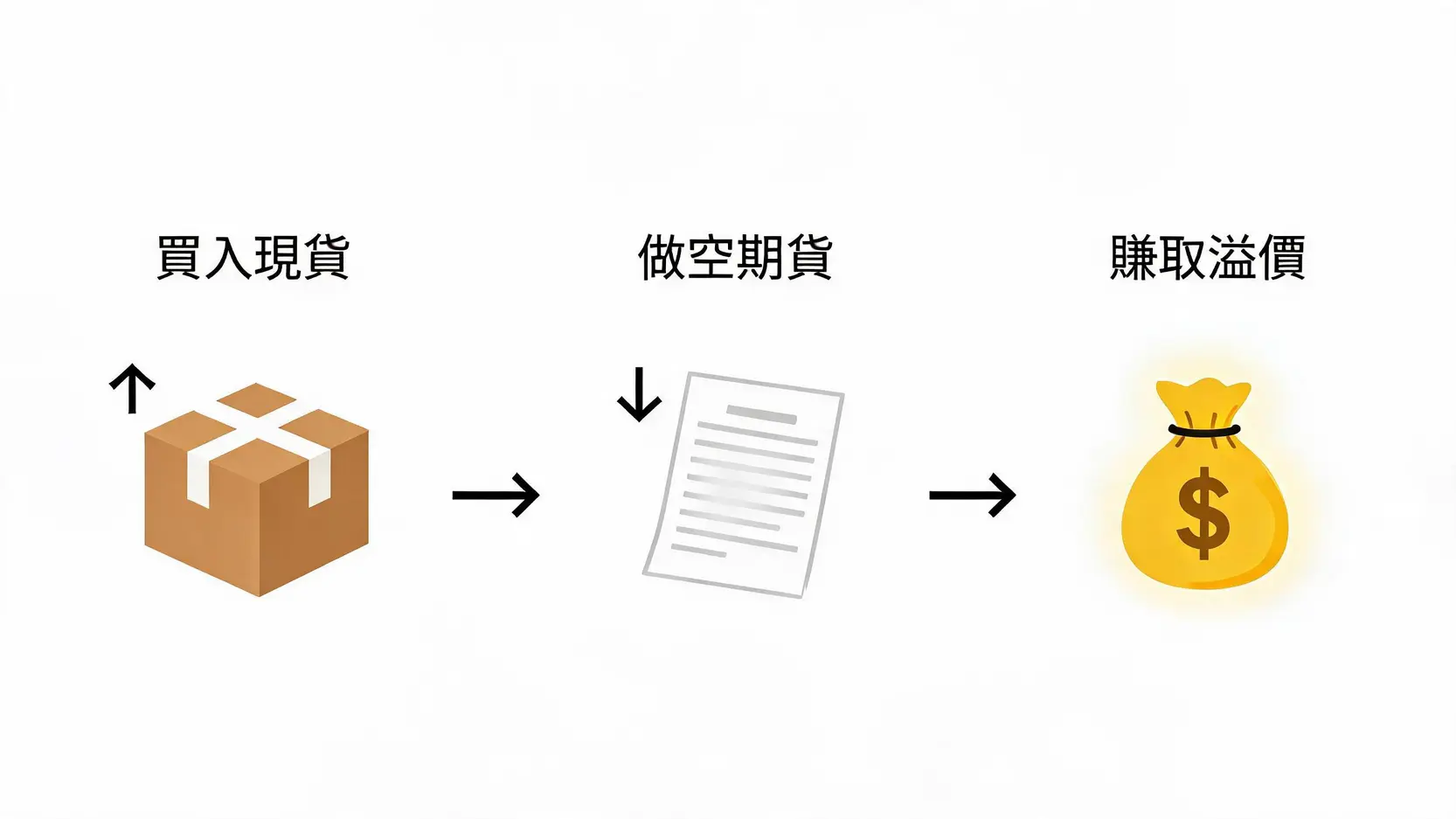
In modern cryptocurrency markets and traditional derivatives markets, cash-and-carry arbitrage and funding rate arbitrage are among the most widely used strategies. Taking cash-and-carry arbitrage as an example, during a bull market, futures prices are often higher than spot prices (contango). Investors can buy the spot asset while simultaneously shorting an equivalent value of futures, using hedging to eliminate directional risk and capturing the premium at settlement.
Cash-and-Carry Arbitrage Process
Another approach is to take advantage of the funding rate on perpetual contracts. When bullish sentiment is strong, long position holders are required to pay funding fees to short position holders. Investors can hold the spot asset while shorting an equivalent amount through a perpetual contract, allowing them to steadily collect funding fees. This is one of the arbitrage trading methods that has gained significant popularity in recent years.
Debunking the Myth of “Risk-Free Arbitrage” and Its Hidden Risks
There is a famous saying in financial markets: “There is no such thing as a free lunch”. Although risk-free arbitrage may appear perfect in theory, real-world trading environments contain many “hidden risks” that can erode your principal. The true viability of risk-free arbitrage is often highly questionable.
Liquidity Risk and Slippage
Any arbitrage strategy requires buy and sell orders to be executed simultaneously within an extremely short period. When the market experiences severe volatility, liquidity may suddenly dry up, preventing you from executing trades at the desired prices. This is known as “slippage”. Once slippage becomes too significant, the small profit originally expected can instantly turn into a loss, potentially leaving you in a difficult position.
Platform Failure and Systemic Risk (Lessons from the FTX Collapse)
This has become the greatest nightmare for countless arbitrage traders in recent years. No matter how sophisticated your hedge arbitrage model is, once your funds are held on a centralized exchange, you are exposed to the platform’s credit risk. The collapse of FTX, once the world’s second-largest cryptocurrency exchange, serves as one of the most painful lessons. If a platform is unable to process withdrawals, even the highest arbitrage returns become worthless.
How Fees and Funding Costs Erode Arbitrage Opportunities
Arbitrage typically relies on high-frequency trading and substantial capital to amplify small price discrepancies. This means that trading commissions, borrowing interest, withdrawal fees, and other transaction costs become critical factors. Without carefully calculating these hidden costs in advance, you may spend an entire year trading only to discover that all of your profits have gone to the trading platform.
Frequently Asked Questions About Hedging and Arbitrage
Is Arbitrage Trading Suitable for the Average Investor?
Arbitrage trading typically requires substantial capital, extremely low transaction fees, and the support of automated trading programs. It is relatively difficult for ordinary retail investors with limited capital and no technical background. However, slower-paced strategies such as cash-and-carry arbitrage can still form part of an asset allocation strategy.
What Is the Typical Return on Risk-Free Arbitrage?
The annualized return on genuine low-risk arbitrage is typically only a few percentage points higher than the market’s risk-free rate (such as fixed deposit or government bond rates). It generally ranges from 5% to 15%. If someone promises you exceptionally high risk-free returns, it is highly likely to be a Ponzi scheme.
How Can You Find Arbitrage Opportunities in the Market?
Finding arbitrage opportunities requires continuous monitoring of prices across different exchanges and asset classes (such as spot and futures markets). Today, most professionals rely on APIs and algorithmic monitoring software to capture fleeting price discrepancies.
Does Hedging Guarantee Capital Protection?
Hedging is intended to reduce specific risks, but establishing a hedging position also involves costs. If the market does not move adversely as expected, the hedging costs will erode your original profits. Therefore, hedging is a risk management tool, not a magic solution that guarantees capital protection.
Conclusion
In summary, hedge arbitrage is an advanced approach in financial markets that demonstrates intelligence and discipline. Hedging helps us preserve gains and maintain stability amid volatility, while arbitrage allows us to seek opportunities from market imbalances. However, as rational investors, we must remain alert to the myth of so-called risk-free arbitrage. While pursuing steady returns, it is essential to fully understand hidden risks such as liquidity, platform credit, and transaction costs. Only by establishing a rigorous risk management mechanism can investors survive over the long term and achieve stable growth in the ever-changing investment market.
Related Articles
-
2026 Complete Guide to US Treasury Yields: Trend Analysis, Impact of Surging Yields, and Asset Allocation Strategies In the rapidly changing global financial market, US Treasury yields have long been regarded as the most important benchmark for the risk-free rate. Entering 2026, amid recurring shifts in inflation expectations and dynamic...2026 年 7 月 13 日
-
2026 Gold Investment Tools Comparison: Which Is Better, a Gold Passbook, Gold ETF, or Physical Gold? Once you have determined that you are bullish on gold prices, the next step is “how to buy”. From traditional physical gold jewelry and bank gold passbooks to gold ETFs traded on the stock...2026 年 7 月 13 日
-
Complete Guide to Forex Trading Hours: Global Market Opening Sessions and the Best Times to Trade The Complete Guide to Forex Trading Hours: Keeping Pace With Global Markets The forex market is the world’s largest and most liquid financial market. Its appeal lies not only in its potential profit opportunities...2026 年 7 月 13 日