Arbitrage Meaning: 5 Forex & Crypto Strategies

Updated: 2026/03/03  |  CashbackIsland

套利意思終極指南:5種無風險套利與對沖策略(外匯/加密貨幣)

In today’s highly volatile markets, are you seeking a stable and low-risk way to generate profits? Many investors have heard of “arbitrage trading”, and even the appealing concept of “risk-free arbitrage”, yet often confuse it with “hedging”. To truly master low-risk profit generation, understanding the meaning of arbitrage is essential. This article will explain the core definition of arbitrage in a clear and accessible manner, analyze the true nature of risk-free arbitrage, and provide 5 practical forex arbitrage strategies and cryptocurrency approaches applicable from traditional finance to emerging markets, helping you grasp a scientific method of profit-making in complex financial markets. 


What Exactly Is Arbitrage? Understanding the Core Definition at a Glance

Arbitrage is a concept in financial markets that may sound highly technical, but its principle is quite intuitive. It refers to the act of taking advantage of price differences of the same asset across different markets, at different times, or through different instruments, by simultaneously executing buy and sell transactions to lock in profits.


The Plain Explanation of the Meaning of Arbitrage: Finding the Market’s “Free Lunch”

Imagine the same limited-edition sneakers being sold at HK$1,000 in Mall A, but only HK$950 in Mall B. A smart buyer would immediately purchase them in Mall B and sell them at once in Mall A, instantly earning the HK$50 price difference (ignoring time and transportation costs). This is the simplest model of arbitrage. Financial market arbitrage follows the same logic, except that the traded assets become stocks, foreign exchange, futures, or cryptocurrencies, and the transactions are completed electronically within seconds. Such opportunities arise from “temporary market imbalances” or “inefficiencies”, and arbitrageurs act like market cleaners, whose operations quickly eliminate price discrepancies and restore market efficiency.


Arbitrage vs Hedging: One Is for Profit, the Other for Risk Management, With Completely Different Objectives

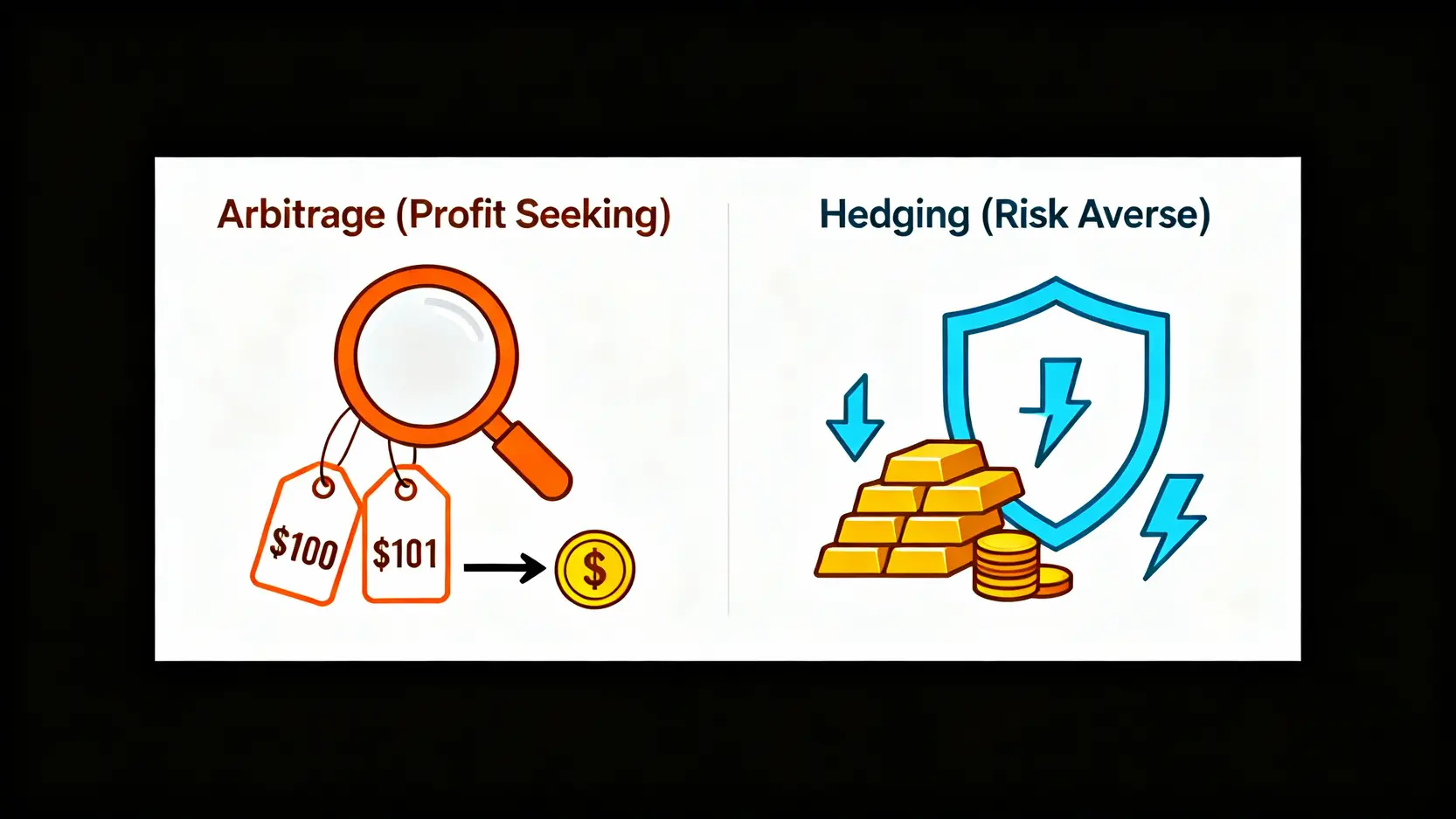
Many people confuse “arbitrage” with “hedging” because both often involve buying and selling different assets simultaneously, yet their fundamental objectives are entirely different. In simple terms, although the phrase hedging arbitrage is commonly used, a more accurate understanding is that arbitrage is about “actively seeking profit”, whereas hedging is about “passively managing risk”.

套利與對沖的比較圖,左邊顯示套利是從價差中獲利,右邊顯示對沖是保護資產規避風險。

Arbitrage aims for active profit generation, while hedging focuses on passive risk management. Their objectives are fundamentally different.

Comparison Item Arbitrage Hedging
Core Objective Capture certain profits from market price differences Reduce or lock in potential risk for assets already held
Method of Operation Simultaneously buy undervalued assets and sell the same or related overvalued assets Establish a position opposite to the direction of the existing holding
Risk Profile Theoretically “risk-free” or “extremely low risk” Does not generate profit on its own, but uses one potential loss to offset another potential loss
Example Illustration Buy Bitcoin at $100 on Exchange A while simultaneously selling Bitcoin at $101 on Exchange B Hold a large amount of stocks and, fearing a market decline, buy short positions in stock index futures to protect the portfolio

Understanding the difference between the two is crucial. Arbitrage seeks to profit from market inefficiencies, while hedging is like buying “insurance” for your investment portfolio. In some complex strategies, both may be used simultaneously, for example by conducting hedging operations through instruments such as Contracts for Difference (CFDs), but their fundamental starting points are entirely different. 

Further Reading (Highly Recommended)

2026 Beginner’s Guide to Forex Trading: Master Risk Management and Broker Selection for Steady Profits!

What Is a Contract for Difference (CFD)? How to Trade CFDs? 

Unveiling Risk-Free Arbitrage: Is It Truly Zero Risk?

The term “risk-free arbitrage” sounds like the holy grail of investing, but does a completely riskless opportunity really exist in the real world? Theoretically yes, but in practice, so-called “risk-free” opportunities usually come with many hidden challenges.


How Risk-Free Arbitrage Works: Profiting From Temporary Price Imbalances

The core of risk-free arbitrage lies in locking in a certain profit at the very moment the trades are executed. This typically occurs in the following situations:

  • Cross-market price differences: The same asset is priced differently across exchanges.
  • Structural price discrepancies between financial instruments: For example, when the relationship between futures prices and spot prices deviates from theoretical values.
  • Currency exchange rate imbalances: Temporary calculation discrepancies arise among cross exchange rates of three or more currencies.

In highly efficient modern markets, especially in highly liquid markets such as forex, these opportunities are extremely short-lived and are usually captured and corrected within milliseconds by high-frequency trading (HFT) algorithms. Therefore, for ordinary investors, pure risk-free arbitrage opportunities are very rare.


Potential Risks: Execution Speed, Slippage, and Transaction Costs You Must Understand

Even when an arbitrage opportunity is identified, execution is not truly “zero risk”. The following are several potential risks that must be taken seriously:

  • Execution risk: This is the greatest challenge. When attempting to complete two or more trades simultaneously, one trade may be executed while the other fails or is delayed due to rapid price changes. This may turn the arbitrage position into a one-sided risk exposure.
  • Slippage: During sharp price fluctuations, the actual execution price may be less favorable than the quoted price at the time of order placement. For arbitrage trades with already thin profit margins, even minimal slippage can turn profit into loss.
  • Transaction costs: Commissions, spreads, exchange fees, deposit and withdrawal fees, and other related costs must be calculated precisely. In many cases, theoretical arbitrage profits are completely eroded by transaction costs.
  • Network latency and technical issues: Executing arbitrage strategies, especially across multiple platforms, requires extremely high network speed and system stability. Any technical failure may lead to severe consequences.

Therefore, rather than calling it “risk-free”, it is more appropriate to describe it as a “low-risk” or “risk-controlled” trading strategy.


Latest in 2026! 5 Popular Arbitrage Strategies With Practical Guidance

After understanding the theory and risks, let us look at several arbitrage strategies that remain relatively effective and widely discussed in today’s markets. These strategies cover forex, futures, and cryptocurrency markets, and are suitable for investors with different levels of experience.


Strategy 1: Triangular Arbitrage in Forex

This is a classic forex arbitrage strategy that profits from mismatched cross exchange rates among three currencies. The authoritative financial website Investopedia provides a detailed explanation of its principles, which are as follows:

Assume the following exchange rates exist in the market:

  • EUR/USD = 1.0800
  • USD/JPY = 157.00
  • EUR/JPY = 169.50

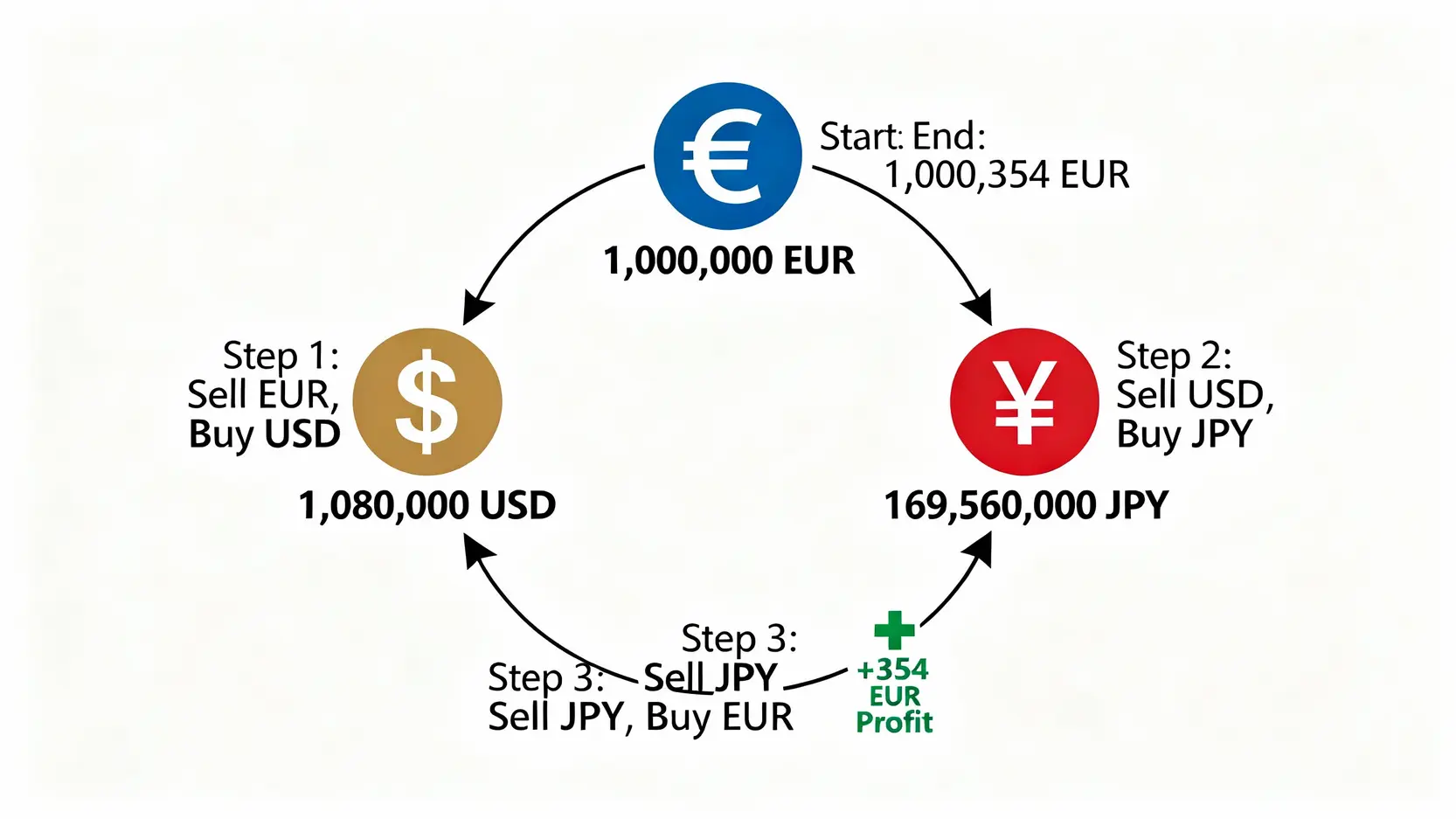
Theoretically, the cross rate of EUR/JPY should be EUR/USD × USD/JPY = 1.0800 × 157.00 = 169.56. However, the market quotation is 169.50, creating an arbitrage opportunity!

  1. Step 1: Exchange 1,000,000 euros into US dollars, obtaining 1,080,000 US dollars.
  2. Step 2: Exchange 1,080,000 US dollars into Japanese yen, obtaining 1,080,000 × 157.00 = 169,560,000 yen.
  3. Step 3: Convert 169,560,000 yen back into euros at the market rate, obtaining 169,560,000 / 169.50 = 1,000,354 euros.

Ultimately, the original 1,000,000 euros became 1,000,354 euros, realizing a risk-free profit of 354 euros. Of course, this represents an ideal scenario without considering spreads and execution speed. In reality, such opportunities require automated systems to capture.

外匯三角套利流程圖,展示如何將歐元換成美元,再換成日元,最後換回歐元以賺取匯率差的利潤。

Triangular arbitrage takes advantage of temporary exchange rate imbalances among three currencies and locks in profit through cyclical conversions.


Strategy 2: Futures-Spot Arbitrage

This strategy is also known as “basis trading”, which profits from the price difference between a futures contract and its corresponding spot asset. The theoretical price of futures is generally determined by the spot price plus the cost of carry (such as storage fees and interest).

  • Cash-and-Carry Arbitrage: When the futures price > spot price + cost of carry. The investor can “buy the spot asset while simultaneously selling the futures contract”. Upon futures contract expiration, the spot asset is delivered to lock in the price difference profit between futures and spot.
  • Reverse Cash-and-Carry Arbitrage: When the futures price < spot price + cost of carry. The operation is reversed, “sell the spot asset (or short sell through securities borrowing) while simultaneously buying the futures contract”.

This type of arbitrage is very common in commodities (such as gold and crude oil) as well as in stock index futures markets, and is a low-risk strategy frequently used by institutional investors.


Strategy 3: Cryptocurrency Funding Rate Arbitrage (Funding Rate Arbitrage)

This is a popular variant of “spot-futures arbitrage” in the cryptocurrency market in recent years. In cryptocurrency perpetual contracts, also known as perpetual swaps, a “funding rate” mechanism is introduced to anchor the contract price to the spot price.

  • When bullish sentiment dominates the market, long positions pay funding fees to short positions (meaning the funding rate is positive).
  • When bearish sentiment dominates the market, short positions pay funding fees to long positions (meaning the funding rate is negative).

Arbitrage operation:

When the funding rate is positive and relatively high, the investor can:

  1. Buy a certain amount of cryptocurrency in the spot market (for example 1 BTC).
  2. At the same time, open an equivalent short position in the perpetual contract market, (meaning short 1 BTC perpetual contract).

In this way, regardless of whether the BTC price rises or falls, the profit or loss from the spot position will offset the loss or profit from the contract position, achieving price risk hedging. Your profit source is the steady funding fees paid by long positions. This resembles a “rent collection” model, and especially during bull markets, the annualized return can be considerable.

加密貨幣資金費率套利原理圖,顯示投資者同時買入現貨比特幣並做空等值的永續合約,從而穩定賺取資金費用。

The core of spot-futures arbitrage: hedge price risk through spot and contract positions while steadily earning funding rates.


Strategy 4: Cross-Market and Cross-Exchange Arbitrage

This is the most fundamental and easiest-to-understand form of arbitrage. Simply put, buy on a platform with a lower price and sell on a platform with a higher price.

  • Forex market: Minor quotation differences may exist among different liquidity providers or brokers. High-frequency trading firms use dedicated connections and algorithms to capture these discrepancies.
  • Cryptocurrency market: Due to market segmentation and regulatory differences, price differences for the same cryptocurrency (such as BTC or ETH) across different countries or exchanges may be more significant, sometimes even exceeding 1 percent (such as the Korean premium).

Challenge: The main obstacle in executing this strategy is the speed of fund transfer. Transferring assets from one exchange to a wallet and then depositing them into another exchange requires time, during which prices may have already changed. Therefore, a more professional approach is to pre-fund both exchanges with assets and capital in advance for immediate trading.


Strategy 5: Statistical Arbitrage

Statistical arbitrage is a more sophisticated quantitative strategy. It does not pursue theoretical “risk-free” returns, but rather relies on historical data and statistical models to achieve a “high probability” of success.

The most classic example is “pairs trading”. First, identify two assets with historically highly correlated price movements, such as Coca-Cola (KO) and PepsiCo (PEP). When the price spread or ratio between them deviates from its historical average level, execute the arbitrage strategy:

  • Short the relatively “overperforming” asset.
  • Long the relatively “underperforming” asset.

The bet is that the price spread between the two will ultimately “mean revert” (Mean Reversion). The risk of this strategy lies in the possibility that the historical correlation between the two may break down. It requires strong data analysis and model construction capabilities and is one of the core strategies of many hedge funds.


Frequently Asked Questions (FAQ)

Q: Is arbitrage trading suitable for beginners?

A: Pure risk-free arbitrage strategies that require high-speed execution and complex calculations (such as triangular arbitrage) are not suitable for beginners. These opportunities are extremely short-lived and are typically dominated by automated programs operated by institutions. However, some lower-threshold strategies (such as cryptocurrency funding rate arbitrage) are relatively simple in principle. Beginners may start with small capital after fully understanding the associated risks, such as liquidation risk in leveraged contracts.

Q: How Much Capital Is Required for Forex Arbitrage Strategies?

A: This depends on the specific strategy and the leverage used. Since profit margins in forex arbitrage (meaning price differences) are usually very small, a relatively large capital base is often required to generate meaningful profits. For example, the profit from a single triangular arbitrage transaction may amount to only a few basis points. Therefore, while there is theoretically no minimum threshold, to cover transaction costs and achieve considerable returns, it is generally recommended to have capital of several thousand US dollars or more.

Q: Are There Any Recommended Automated Arbitrage Tools?

A: There are many tools and platforms on the market that provide automated trading or arbitrage functions, but their quality varies widely and scams are common. They can generally be categorized into several types: 1) commercial trading bots; 2) platforms that allow users to customize strategies through API interfaces (such as 3Commas and Pionex); 3) self-programmed solutions (such as using Python to connect to exchange APIs). For any tool, priority should be given to security, transparency, and historical reputation, and caution should be exercised toward services that promise excessively high returns.

Q: Why Do Arbitrage Opportunities Still Exist in the Market?

A: Although market efficiency continues to improve, arbitrage opportunities still exist for several main reasons: 1) delays in information dissemination, leading to asynchronous pricing across markets; 2) trading restrictions, such as capital controls in different countries or withdrawal limits imposed by exchanges; 3) market microstructure factors, such as liquidity differences caused by varying order book depth; 4) the emergence of new financial instruments whose pricing models have not yet fully matured. The actions of arbitrageurs themselves serve as a driving force in restoring market efficiency.


Conclusion

In summary, the core meaning of arbitrage lies in accurately identifying and capturing temporary price differences across markets to achieve low-risk profits. The concept of hedging arbitrage should be understood as using hedging techniques to execute arbitrage strategies while ensuring risk control. Although true risk-free arbitrage exists in theory, in practice traders must remain vigilant regarding execution speed, transaction costs, and slippage. From classic forex arbitrage strategies to emerging cryptocurrency funding rate arbitrage, each method has its own operational logic and challenges. Mastering the strategies introduced in this article is an important step toward becoming a more professional and systematic investor.


If you liked this article, please share it!

Related Articles

  • Volatility Surface Guide: Skew Trading Strategies
    Practical Applications of Volatility Surfaces: From Options Modeling to Advanced Skew Trading Strategies In options markets, implied volatility is never a flat line. Instead, it forms complex "smile" or "skew" surfaces. For advanced traders, mastering the practical applications of volatility surfaces is equivalent to possessing a lens that reveals market...
    2026 年 6 月 3 日
  • Foreign Capital Flow Model: Track Institutional Money
    Building a Foreign Capital Flow Copy Trading Model: A Stock Market Indicator for Accurately Tracking Institutional Positioning In Asia-Pacific stock markets, foreign capital inflows and outflows often determine the direction of the index. However, simply looking at daily net buy and sell data is no longer enough. Only by building...
    2026 年 6 月 3 日
  • Options Buying Strategies for Extreme Market Risks
    Options Buyer Strategies During Extreme Market Conditions: Black Swan Hedging and Cross-Market Arbitrage During Volatility Surges The most terrifying aspect of financial markets is not a gradual decline, but overnight flash crashes and cross-market capital withdrawals accompanied by volatility surges. In the highly unpredictable global macroeconomic environment of 2026, geopolitical...
    2026 年 6 月 3 日
返回顶部