Complete Guide to Forex Trading Hours: Global Market Opening Sessions and the Best Times to Trade
The Complete Guide to Forex Trading Hours: Keeping Pace With Global Markets
The forex market is the world’s largest and most liquid financial market. Its appeal lies not only in its potential profit opportunities but also in its uninterrupted 24-hour operating model. For investors actively engaged in forex trading, understanding the opening and closing times of different markets, as well as the periods when they overlap, is essential for developing trading strategies and identifying profitable opportunities.
Overview of Major Global Forex Market Trading Hours
The Four Major Markets: Sydney, Tokyo, London, and New York
Forex trading operates continuously for 24 hours because four major global financial centers take turns leading the trading sessions:
Sydney Market: The first market to open each day, marking the beginning of trading in the Asia-Pacific region.
Tokyo Market: The core of the Asian trading session, bringing together substantial amounts of Asian capital.
London Market: The representative market of the European trading session and traditionally one of the markets with the highest trading volume.
New York Market: The core of the American trading session. The period when it overlaps with the London market is often when market volatility reaches its peak.
Global Market Opening Times in Taiwan Time
After understanding the opening times of each market, it is essential to convert them into Taiwan Standard Time (GMT+8). Below are the trading hours of the major markets in Taiwan time. Please note that these are standard hours and do not include adjustments for daylight saving or standard time:
Sydney: 6:00 a.m. – 3:00 p.m.
Tokyo: 7:00 a.m. – 4:00 p.m.
London: 3:00 p.m. – 11:00 p.m.
New York: 9:00 p.m. – 6:00 a.m.
Finding the Best Trading Opportunities: Analysis of Market Overlap Periods
London and New York Overlap Period (Golden Trading Period)
From 9:00 p.m. to 1:00 a.m. Taiwan time (during standard time), the London and New York markets are open simultaneously. These two markets bring together the largest concentration of capital and traders worldwide, making this period the golden trading period for forex trading. During this time, almost all major currency pairs experience significant volatility, particularly EUR/USD and GBP/USD.
Tokyo and London Overlap Period
From 3:00 p.m. to 4:00 p.m. Taiwan time (during standard time), the Tokyo and London market opening hours briefly overlap. Although this period is relatively short, the opening of the London market usually brings a certain degree of volatility and trading opportunities. For Asian traders in particular, it provides a useful afternoon trading window.
Strategic Application of Trading Hours
Understanding and making effective use of the opening and overlap periods of different markets can help you:
Select Suitable Currency Pairs: Different currency pairs have different levels of activity during specific periods.
Identify Trading Opportunities: Entering the market during periods of high volatility may provide greater gains from price movements.
Manage Trading Risk: Reduce risk exposure during periods of low volatility or market closures.
Develop a Personal Trading Plan: Arrange the best times for monitoring and trading based on your schedule and market characteristics.
The appeal of forex trading lies in its global reach and around-the-clock accessibility. By gaining an in-depth understanding of the trading hours above and applying this knowledge flexibly, you will be better equipped to navigate trends in the rapidly changing forex market and uncover your own formula for wealth.
The forex market is known as the “market that never sleeps”, but do you know when market volatility is highest and profit opportunities are greatest during the day? Understanding the trading hours of the world’s major forex markets, particularly forex trading hours, forex market trading hours, and Taiwan forex market trading hours, is the first step in developing a successful trading strategy. Only by understanding the characteristics of these periods can you find your own rhythm in an unpredictable market.
Overview of Major Global Forex Market Trading Hours
To gain an in-depth understanding of the forex market, you must first become familiar with the operating hours of the world’s four major markets. As the Earth rotates, the opening and closing hours of these markets alternate, creating an uninterrupted 24-hour trading network.
The Four Major Markets: Sydney, Tokyo, London, and New York
The global forex market is primarily led by four major financial centers:
Sydney Market: The first market to open each day, marking the beginning of trading in the Asia-Pacific region.
Tokyo Market: The center of the Asian trading session, with a significant influence on yen-related currency pairs.
London Market: The world’s largest forex trading center, accounting for more than half of global trading volume and representing the period of greatest market volatility.
New York Market: The core of the American trading session. The period when it overlaps with the London market is often when market volatility reaches its peak.
The 24-Hour Alternating Operation of the World’s Four Major Forex Markets
Differences Between Daylight Saving Time and Standard Time
Many countries (particularly in Europe and the US), observe Daylight Saving Time (DST), which directly affects the opening and closing times of the forex market. During daylight saving time, European and US markets open one hour earlier than during standard time. Investors must closely monitor these time changes to avoid missing important trading opportunities. Understanding global forex market trading hours can help you better manage the challenges caused by time differences.
Essential for Taiwan Investors: Converting Taiwan Forex Market Trading Hours
For investors in Taiwan, converting global market trading hours into Taiwan time is a fundamental skill. This not only helps them keep pace with international markets but also allows them to coordinate trading with local financial service hours.
Taiwan Bank Foreign Exchange Rate Quotation Hours
The foreign exchange rate quotation hours of local banks in Taiwan are generally from 9:00 a.m. to 3:30 p.m. on each business day. During this period, investors can conduct physical or online foreign currency exchange transactions through banks. For questions about currency exchange, you can refer to this Complete Guide to Bank Currency Exchange Fees to understand the advantages and disadvantages of different banks. In addition, for real-time exchange rate information, you can monitor the latest announcements from major banks or use online currency exchange services, such as the detailed instructions provided in the Fubon Online Currency Exchange Guide.
Global Market Opening Times in Taiwan Time
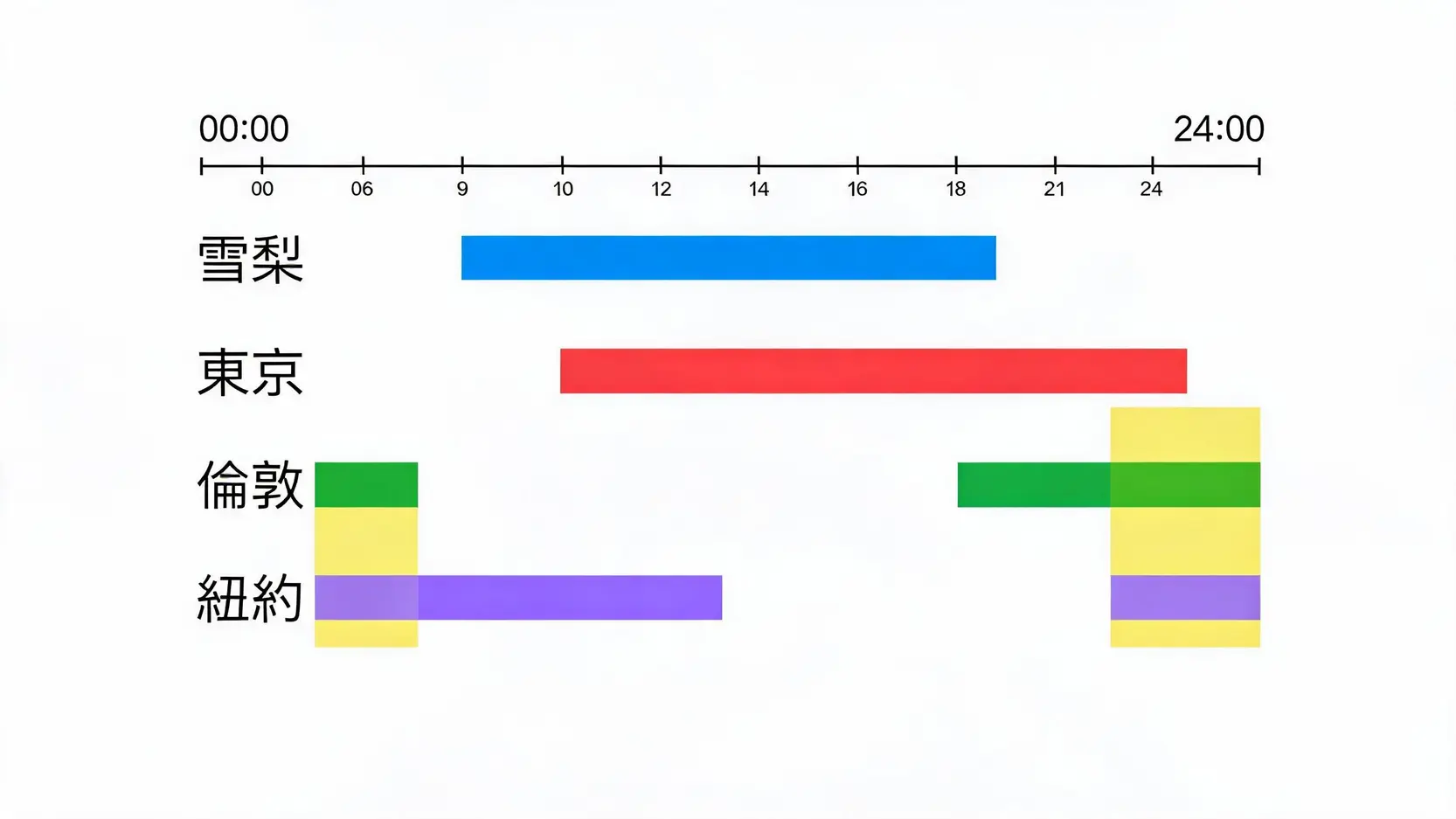
Below is an overview of the major global market trading hours in Taiwan time (during standard time):
Sydney: 6:00 a.m. – 3:00 p.m.
Tokyo: 8:00 a.m. – 5:00 p.m.
London: 4:00 p.m. – 1:00 a.m.
New York: 9:00 p.m. – 6:00 a.m.
Timeline of Major Global Market Trading Hours in Taiwan Time
Finding the Best Trading Opportunities: Analysis of Market Overlap Periods
The forex market does not offer opportunities during every session. The true golden trading periods often occur when two major markets overlap. During these periods, trading volume rises significantly, liquidity is abundant, and price movements become more pronounced, making them the most active times for short-term traders.
London and New York Overlap Period (Golden Trading Period)
From 9:00 p.m. to 1:00 a.m. Taiwan time (during standard time), the London and New York markets are open simultaneously. These two markets bring together the largest concentration of capital and traders worldwide, making this period the golden trading period for forex trading. During this time, almost all major currency pairs experience significant volatility, particularly EUR/USD and GBP/USD.
The Overlap Between the London and New York Markets Creates the Golden Forex Trading Period
Characteristics of the Tokyo and London Overlap Period
From 4:00 p.m. to 5:00 p.m. Taiwan time (during standard time), the Tokyo market is approaching its close while the London market has just opened. Although trading volume during this period is lower than during the London and New York overlap, it still offers many trading opportunities for investors focusing on cross pairs involving the yen and European currencies (such as the euro and pound sterling).
Recommended Currency Pairs for Each Trading Session
Asian Session (Tokyo/Sydney): Suitable for trading AUD/USD, NZD/USD, and USD/JPY.
European Session (London): Suitable for trading EUR/USD, GBP/USD, and EUR/GBP.
American Session (New York): All currency pairs involving the US dollar are active, such as USD/CAD.
Frequently Asked Questions (FAQ)
Can the Forex Market Really Be Traded 24 Hours a Day?
Yes, the forex market operates continuously 24 hours a day, five days a week, from the opening of the Sydney market on Monday morning until the closing of the New York market on Friday evening.
Can Forex Be Traded on Weekends?
Generally, the retail forex market is closed on weekends. Although over-the-counter transactions may occur between a small number of institutions, ordinary investors cannot trade through trading platforms on weekends. Positions held over the weekend are subject to gap risk.
When Is the Worst Time to Trade Forex?
Trading is not recommended during major holidays (such as Christmas and New Year’s Day), or when market liquidity is extremely low, such as the brief interval between the New York close and the Sydney open. During these periods, spreads may widen and unexpected price movements may occur.
When Does Daylight Saving Time Begin and End?
Daylight saving time in Europe and the US generally begins in spring (around March) and ends in autumn (around October or November). The exact dates may vary slightly each year, so investors should monitor the financial calendar regularly.
Conclusion
Understanding forex trading hours, particularly the high-volatility market overlap periods, can effectively improve trading efficiency. Investors should select the most suitable trading sessions based on their own schedules. Whether using the stability of the Asian session for range trading or capturing breakout movements during the overlap between the European and US sessions, understanding the significance of timing is one of the keys to success.
2026 Complete Guide to US Treasury Yields: Trend Analysis, Impact of Surging Yields, and Asset Allocation Strategies In the rapidly changing global financial market, US Treasury yields have long been regarded as the most important benchmark for the risk-free rate. Entering 2026, amid recurring shifts in inflation expectations and dynamic...
2026 Gold Investment Tools Comparison: Which Is Better, a Gold Passbook, Gold ETF, or Physical Gold? Once you have determined that you are bullish on gold prices, the next step is “how to buy”. From traditional physical gold jewelry and bank gold passbooks to gold ETFs traded on the stock...
Hedging vs. Arbitrage: Key Differences and Risk-Free Arbitrage Explained After years in the financial industry, I often hear both beginners and experienced investors talk about “hedging” and “arbitrage”, and there are always people in the market constantly promoting so-called “risk-free arbitrage” strategies. What exactly is the difference between the two?...