Gold Investment Guide: 7 Ways to Build a Safe Haven

Updated: 2026/06/24  |  CashbackIsland

increase-gold-investment-guide

Gold Overweight Recommendation: Experts Teach You 7 Gold Investment Tools to Strengthen Your Asset Safe Haven

Facing potential uncertainty in global markets, from Bank of America and Barclays to Goldman Sachs, major top-tier financial institutions have recently issued gold overweight recommendations in unison. But for most investors, especially beginners who have just entered the market, what do these signals mean? More importantly, how should you take practical action to effectively keep up with this trend? This article will serve as your complete action guide, exploring in depth why you should increase your gold holdings and providing a detailed analysis of the advantages and disadvantages of 7 mainstream investment channels in the market, from physical gold to gold CFDs. Finally, it offers a specific blueprint on how to increase gold holdings through gold asset allocation, allowing you to easily include this long-established safe-haven asset in your investment portfolio based on your own risk preference and build a solid safe haven for your wealth. 


Why Should You Consider Increasing Your Gold Holdings Now? Three Major Reasons to Convince You

The market is filled with all kinds of investment opportunities. Why has gold’s strategic position been highlighted again in 2026? This is not merely traditional wisdom, but a rational judgment based on the current macroeconomic environment. The following three major reasons clearly explain why gold should have a place in your investment portfolio.

一張展示投資黃金三大理由的示意圖:對沖通膨、分散風險及掌握趨勢。

The three key roles gold plays in an investment portfolio.


Reason One: Hedge Against Inflation and Protect Your Purchasing Power

When central banks turn on the printing press and implement monetary easing policies, the amount of money circulating in the market increases, which often leads to a decline in the purchasing power of fiat currencies, commonly known as inflation. In this environment, the real value of cash and fixed deposits is quietly eroded. As a globally recognized physical asset, gold has a relatively stable supply and cannot be created without limit. Therefore, historically, gold has long been regarded as an effective tool for fighting inflation. When paper currencies depreciate, the price of gold usually rises, helping preserve the value of your assets and protecting the wealth you have worked hard to accumulate.


Reason Two: Diversify Risk and Reduce Portfolio Volatility

“Do not put all your eggs in one basket” is a basic principle of investing. Gold is unique because its price trend usually has a low correlation with mainstream financial assets such as stocks and bonds, and sometimes even shows a negative correlation. This means that when the stock market falls sharply due to an economic recession or a black swan event, capital often flows into gold in search of safety, pushing up gold prices. Adding a certain proportion of gold to your investment portfolio is like buying insurance for your assets. It can act as a “stabilizer” during market turbulence, effectively smoothing overall asset volatility and making your investment journey more stable.


Reason Three: Capture the Trend and Participate in a Potential Gold Bull Market

In addition to its defensive safe-haven function, gold also has offensive appreciation potential. The current global economic landscape is full of variables: rising geopolitical tensions, heavy debt burdens in major economies, and continued increases in gold reserves by central banks around the world all provide strong support for gold prices. Many analysts believe we may be at the beginning of a new gold bull market. Responding to the “Gold Overweight Recommendation” is not only about risk aversion, but also about actively participating in a potentially emerging trending market and seizing potential opportunities for asset growth.


Further Reading (Highly Recommended)

Gold ETF Recommendations, Gold Passbooks, and Physical Gold: The Ultimate Comparison and Beginner’s Investment Guide

How to Build a Futures Investment System? 5 Core Steps From Asset Allocation to Portfolio Strategies


7 Channels for Increasing Gold Holdings! A Detailed Analysis of Pros, Cons, and Suitable Investors

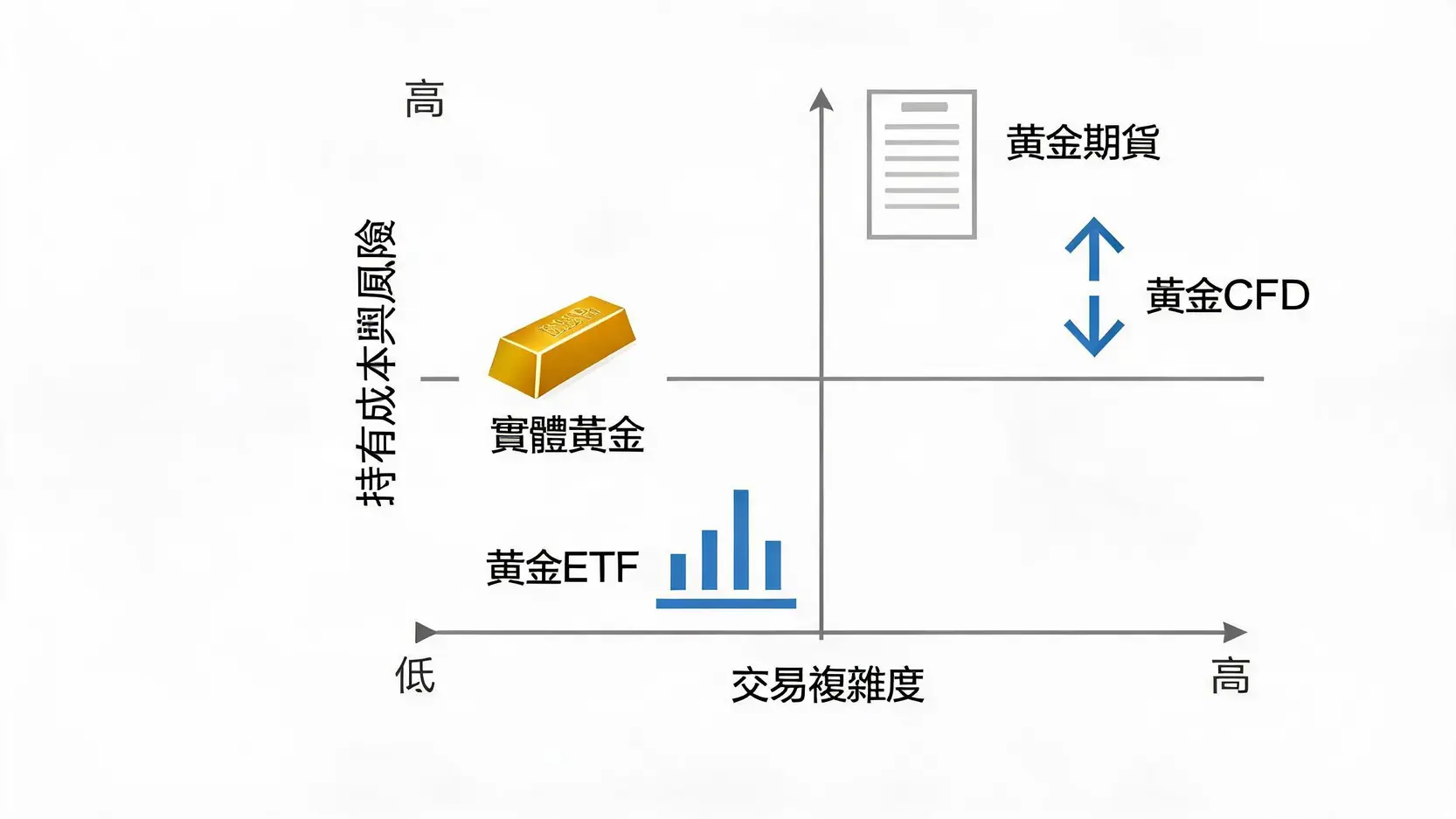
After understanding the importance of increasing gold holdings, the next step is to choose the investment tool that best suits you. The market offers a wide range of options, from the most traditional gold bars to the most modern financial derivatives, each with its own strengths. Below is a comprehensive analysis of 7 mainstream gold investment channels.

一張比較黃金ETF、實體黃金、黃金期貨和黃金CFD在交易複雜度與持有風險上的四象限分析圖。

The risk and complexity spectrum of different gold investment channels.


Physical Gold (Gold Bars and Gold Coins): The Strongest Sense of Security, but Liquidity and Storage Are Issues

  • What it is: This refers to gold that you can physically touch and hold, such as gold bars and commemorative gold coins sold by banks or jewelry stores.
  • Advantages:

    • Visible and tangible, providing an unmatched sense of psychological security.
    • No counterparty risk, with value not dependent on any financial institution.
    • The ultimate store-of-value tool in extreme situations.
  • Disadvantages:
    • The bid-ask spread is relatively large, and transaction costs are high.
    • A secure storage space is required, such as a bank safe deposit box, which incurs additional fees.
    • Liquidity is relatively poor. Liquidation requires authentication, making the process comparatively cumbersome.
  • Suitable for: Extremely conservative investors who highly value physical asset ownership, have a long-term storage plan, and do not pursue short-term trading.


Gold Passbook: Buy Gold Through a Bank Account, Convenient but With Higher Fees

  • What it is: You open an account at a bank, with the passbook recording the grams of gold you hold. When trading, buying and selling are conducted only on the books, without physical delivery (you may also choose to withdraw physical gold, but this requires additional fees).
  • Advantages:
    • Stored by the bank, eliminating the hassle of storing it yourself.
    • Low trading threshold, usually allowing buying and selling from 1 gram.
    • Regular fixed-amount investments can be set up, suitable for passive investors.
  • Disadvantages:

    • Transaction fees and bid-ask spreads are relatively higher than other online tools.
    • It is not physical ownership, so there is institutional risk related to the bank’s operations.
    • Trading hours are limited by bank business hours.
  • Suitable for: Beginner investors who are used to conducting all financial operations through banks, want to invest through regular fixed amounts, and are unfamiliar with securities account operations.


Gold ETF (Such as GLD): Low Transaction Costs and Good Liquidity, Best Suited for Small-Capital Investors

  • What it is: A gold ETF (Exchange-Traded Fund) is a fund listed and traded on a stock exchange. The fund company actually holds equivalent physical gold as backing and divides it into shares for investors to buy and sell.
  • Advantages:
    • The trading method is just like stocks, making it very convenient with excellent liquidity.
    • Small bid-ask spreads and low management fees, making it one of the most cost-effective channels.
    • Directly tracks gold prices, with transparent pricing.
    • Eliminates the storage and security issues of physical gold.
  • Disadvantages:
    • An annual management fee must be paid (deducted internally from net asset value).
    • Although the fund holds physical gold, individual investors cannot redeem it directly.
  • Suitable for: Most investors, especially small-capital and conservative investors who want to participate in the gold market at low cost and high efficiency.


Gold Futures: A High-Leverage Tool Suitable for Professional Short-Term Traders

  • What it is: A standardized contract that agrees to buy or sell a specific quantity of gold at a predetermined price at a specific time in the future.
  • Advantages:
    • High leverage allows you to control a high-value contract with a smaller amount of margin, amplifying profits (and also losses).
    • The trading market is active, with extremely high liquidity.
    • Both long and short positions can be traded, offering profit opportunities whether prices rise or fall.
  • Disadvantages:
    • High leverage means high risk, and losses may exceed the initial margin invested.
    • There is a contract expiration date, making it unsuitable for long-term holders who want to “buy and forget”.
    • A deep understanding of the market and risk management capability are required.
  • Suitable for: Professional short-term traders with strong capital, high risk tolerance, and the ability to monitor the market constantly.


Gold CFD (Contract for Difference): More Flexible Leveraged Trading, With Both Long and Short Positions Available

  • What it is: A contract for difference (CFD) is a financial derivative that allows you to speculate on the rise and fall of gold prices without actually owning it. What you trade is the price difference between the opening price and the closing price.
  • Advantages:
    • The leverage ratio is very flexible and can be adjusted independently.
    • The trading threshold is extremely low and more accessible than futures.
    • 24-hour trading, allowing entry and exit at any time.
    • Both long and short positions are available, offering great operational flexibility.
  • Disadvantages:
    • Overnight interest (swap fees) must be paid, making it unsuitable for long-term holding.
    • Leverage is a double-edged sword, making risk control crucial.
    • It is necessary to carefully choose a strictly regulated trading platform.
  • Suitable for: Active traders who pursue extremely high capital efficiency, are familiar with technical analysis, and conduct short- to medium-term swing trading.


Gold Funds: Managed by Professional Managers, Suitable for Passive Investors

  • What it is: Similar to mutual funds, these are operated by a fund manager team and mainly invest in gold-related assets, which may be physical gold or stocks of gold mining companies.
  • Advantages:
    • Managed by a professional team, saving you the trouble of doing your own research.
    • Can invest in a basket of gold-related assets to achieve diversification.
  • Disadvantages:
    • Management fees and subscription fees are usually higher than ETFs.
    • Fund performance is affected not only by gold prices, but also by the manager’s operating ability.
    • If the fund invests in mining stocks, it also bears the operating risks of individual companies.
  • Suitable for: Investors who do not want to take action themselves, trust professional managers, and are willing to pay higher management fees.


Gold Mining Company Stocks: Linked to Gold Prices, but Affected by Company Operations

  • What it is: Directly buying stocks of listed companies engaged in gold mining, refining, sales, and other businesses, such as Barrick Gold and Newmont Corporation.
  • Advantages:
    • When gold prices rise, the profitability of mining companies can be amplified through leverage, and their stock price gains may exceed the increase in gold prices themselves.
    • There is an opportunity to receive company dividends.
  • Disadvantages:
    • Stock prices are not only affected by gold prices, but also impacted by multiple factors such as company management, mining costs, political risks, and environmental regulations.
    • The risk is higher than direct investment in gold, and there may be situations where gold prices rise but stock prices fall.
  • Suitable for: Experienced investors who have a strong interest in individual stock research and are willing to take on higher risk in exchange for excess returns.


Further Reading (Highly Recommended)

Hot Money Is Pouring In! Investor Action Guide: At This Stage, Should You Buy Stocks, Buy Bonds, or Exchange for US Dollars?

How to Reduce Investment Risk? 5 Risk Management Strategies and Practical Diversification Investing Tutorial


How Should I Allocate Gold in My Assets? Three Allocation Methods Based on Risk Preference

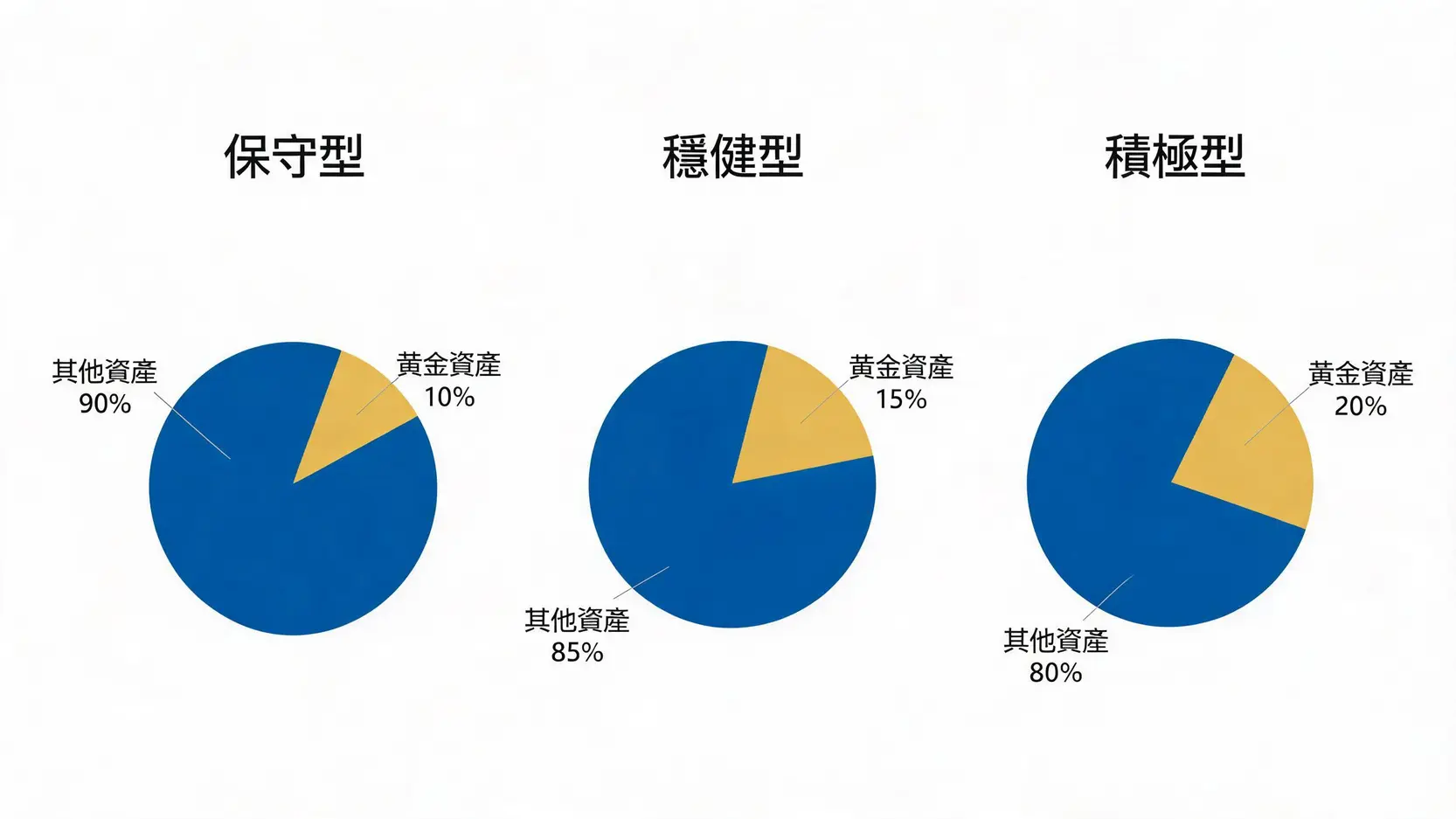
After understanding the various tools, the most critical question comes: “How much money should I allocate to gold?” There is no standard answer. It depends entirely on your personal financial situation, investment goals, and risk tolerance. Here is an asset allocation teaching framework based on different risk preferences for your reference.

三張分別顯示保守型、穩健型、積極型投資者建議的黃金資產配置比例(5-10%, 10-15%, 15-20%)的餅圖。

Find the golden ratio for gold assets based on your risk preference.


Conservative Investors: Recommended Allocation of 5%-10%, Mainly Gold ETFs and Gold Passbooks

For investors with lower risk tolerance who pursue stable asset preservation (such as those approaching retirement or with stable income), the core role of gold is “insurance”.

  • Allocation ratio: Allocate 5% to 10% of your total investment portfolio to gold.
  • Main tools: Mainly use gold ETFs and gold passbooks. Their transaction costs are relatively controllable, and there is no need to worry about physical storage issues, meeting conservative investors’ needs for convenience and stability.
  • Strategic thinking: This proportion of gold is enough to provide effective downside protection when the market falls sharply, while not excessively dragging down the long-term returns of the overall portfolio due to gold’s non-yielding nature.


Stable Investors: Recommended Allocation of 10%-15%, Combining ETFs, Physical Gold, and Some Mining Stocks

These investors are willing to take moderate risk in exchange for better long-term returns, viewing gold as an asset that balances “offense and defense”.

  • Allocation ratio: Allocate 10% to 15% of your total investment portfolio to gold-related assets.
  • Main tools: Build a diversified gold portfolio. You can allocate most of it (about 70%) to core gold ETFs, add a small portion (about 20%) of physical gold as a long-term safeguard, and use the remaining funds (about 10%) to try investing in leading gold mining company stocks or related funds to capture additional returns when gold prices rise.
  • Strategic thinking: This allocation balances gold’s safe-haven attributes and appreciation potential. The core position remains solid, while the satellite positions increase flexibility and room for imagination.


Aggressive Investors: Recommended Allocation of 15%-20%, With Futures or CFDs Included for Strategic Trading

Aggressive investors pursue maximum returns and are not afraid of high risks. They view gold as a “trading tool” that can be actively operated to obtain excess profits.

  • Allocation ratio: You can allocate 15% to 20% of your funds to the gold market, but this portion of funds must be carefully risk-layered internally.
  • Main tools: It is still recommended to use gold ETFs as the foundation for the core position (about 60% of this allocation). The remaining funds (about 40%) can be flexibly used in gold futures or gold CFDs for strategic trading. For example, when you judge that gold prices will experience major short-term volatility, you can use leveraged tools to amplify profits.
  • Strategic thinking: This is the highest-risk allocation method, requiring investors to have extremely high market sensitivity, strict discipline, and risk management ability. Strictly setting stop-loss points is the survival rule when using leveraged tools. Never mix long-term core positions with short-term satellite trading positions.


Frequently Asked Questions About Increasing Gold Holdings (FAQ)

Before taking actual action, many people still have quite a few questions. Here are several of the most common questions, along with concise answers.

What Are the Potential Risks of Increasing Gold Holdings?

The main risks of increasing gold holdings include: First, price volatility risk. Gold prices can also be affected by multiple factors such as market sentiment and US dollar trends, leading to sharp short-term fluctuations. Second, opportunity cost risk. Gold itself is a non-yielding asset, and holding gold means giving up the opportunity to put funds into assets such as stocks and bonds that may generate dividends or interest. Finally, if you invest in derivatives such as futures or CFDs, you must face leverage risk, which may lead to rapid and substantial losses.

What Factors Have the Greatest Impact on Gold Prices?

Gold prices are the result of the interplay of multiple global forces. According to the analysis of the World Gold Council (World Gold Council), the main influencing factors include:

  • US dollar exchange rate: Gold is priced in US dollars. When the US dollar strengthens, gold prices usually come under pressure; conversely, they rise.
  • Global interest rate levels: Especially the real interest rate in the United States (nominal interest rate minus inflation rate). When interest rates rise, the opportunity cost of holding gold increases, which is unfavorable for gold prices; conversely, it is favorable for gold prices.
  • Geopolitical and economic uncertainty: Events such as wars, political unrest, and financial crises will push up safe-haven sentiment, with capital flowing into gold.
  • Central bank demand: Global central banks are major buyers of gold, and their continuous gold-buying behavior provides long-term support for gold prices.
  • Market supply and demand: Including gold mine output, recycled gold supply, and demand from jewelry, industrial, and other sectors.

Should I Buy Gold in One Lump Sum or Through Regular Fixed-Amount Investments?

For most non-professional investors, regular fixed-amount investing is a more prudent strategy. This method can effectively spread out the purchase cost and avoid the risk of buying at a price peak due to misjudgment. Especially when gold prices are relatively high or highly volatile, investing in batches can smooth the cost curve and build a more resilient position. Only consider a lump-sum investment to seize opportunities if you are very confident in your market judgment or when the market experiences an irrational crash.

Gold or Bitcoin, Which Is the Better Safe-Haven Asset?

This is a popular debate. As a store-of-value tool tested by thousands of years of history, gold’s safe-haven status is deeply rooted, and its volatility is relatively lower. Bitcoin is known as “digital gold” and has also shown safe-haven attributes during certain periods of market turbulence, but its history is still short, its price volatility is extremely severe, and it faces greater regulatory uncertainty. Overall, gold is a more mature and stable safe-haven tool, while Bitcoin is more like a high-risk, high-return speculative asset. In asset allocation, the roles and positioning of the two are completely different.


Conclusion

In summary, the “Gold Overweight Recommendation” is not just a slogan from financial institutions, but an asset protection and appreciation strategy that individual investors should carefully consider in the current complex economic environment. From the most solid physical gold to the most efficient gold ETFs, and then to flexible gold CFDs, this article has analyzed seven mainstream investment channels in detail. No matter what type of investor you are, you can find a method that fits your own needs to allocate gold.

For beginner investors, starting with gold ETFs, which have low transaction costs and good liquidity, is undoubtedly the most practical choice. The key is to clearly recognize the strategic role of gold in personal asset allocation, and based on your own financial situation and risk tolerance, gradually build your gold position by referring to the allocation ratios provided in this article. This is not only to capture potential market trends, but also to build a solid safe haven for your overall wealth that can withstand unknown storms.

If you liked this article, please share it!

Related Articles

  • FedWatch Guide: Predict Rate Hikes Before the Market
    Rate Hike Expectations Trading Guide: Use FedWatch to Predict Rate Hikes and Position Ahead of the Market Core Concept: Why Trade “Expectations” Instead of “Facts”? After spending enough time in the financial markets, you will notice an interesting phenomenon: the market often completes a major move before the Federal Reserve...
    2026 年 6 月 25 日
  • Monetary Policy Shifts: Hawkish vs Dovish Guide
    What Is a Monetary Policy Shift? Understand Hawkish and Dovish Signals to Position Ahead of the Market Why does the market always hold its breath for the results of Federal Reserve (Fed) meetings? Why can every interest rate decision, and even a slight “shift” in wording, always trigger sharp volatility...
    2026 年 6 月 25 日
  • 2026 Australian Dollar Trading Strategy Guide
    Ultimate Guide to 2026 Australian Dollar Trading Strategy: Master the 3 Key Factors Affecting the Australian Dollar From Scratch The Australian dollar (AUD), due to its unique attributes as both a commodity currency and a risk currency, has become an excellent choice in the forex market where volatility and opportunities...
    2026 年 6 月 25 日
返回顶部