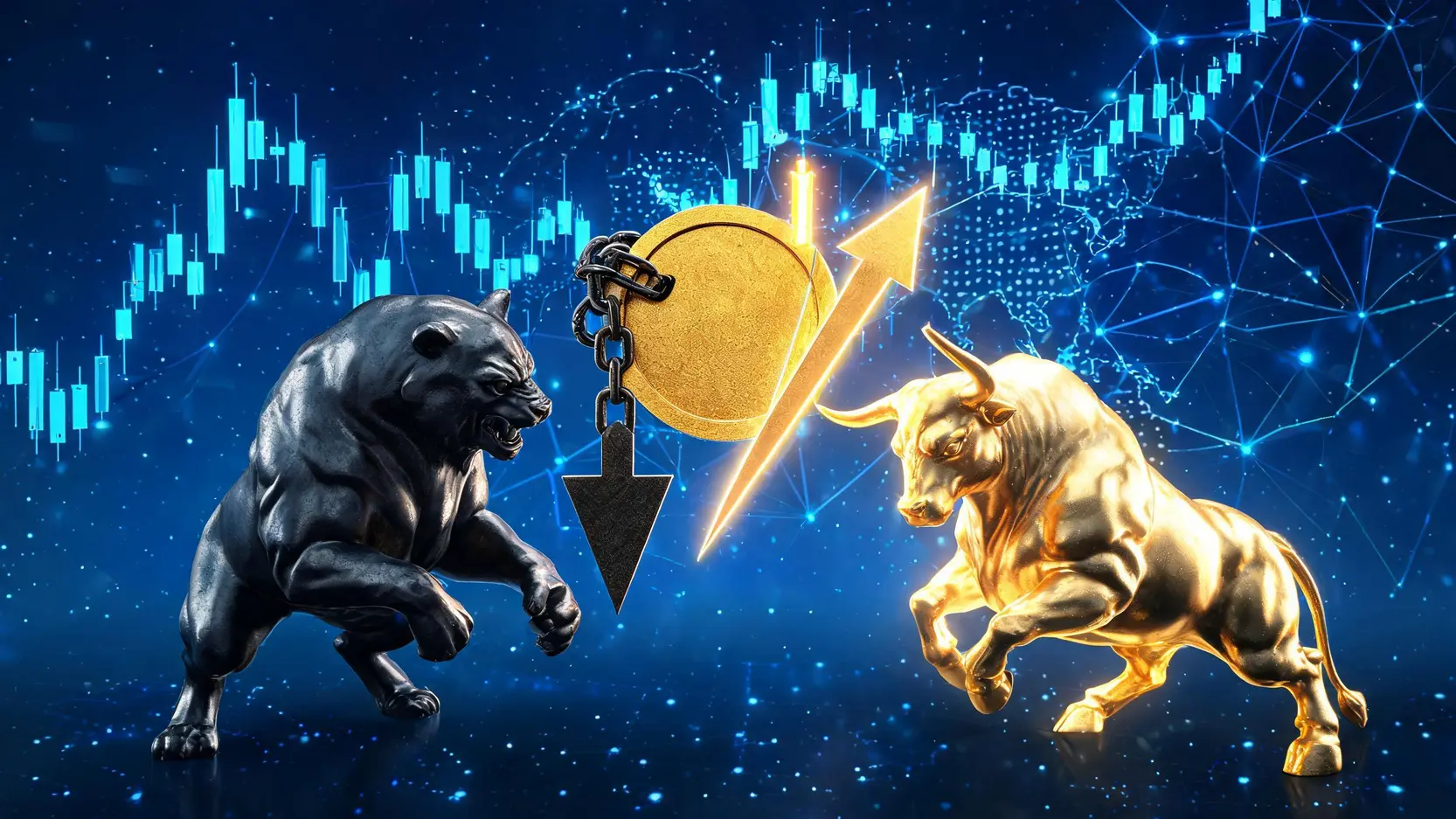
The Tug of War in the Gold Market: Short-Term Pressure vs. Long-Term Support
Short-Term Pressure Source: Why Have Rate-Hike Expectations Become a Cloud Over Gold?
As a non-yielding asset, gold prices are extremely sensitive to interest rate changes. When the market generally expects interest rates to remain high or rise further, gold prices often come under pressure. Behind this, there are mainly three transmission mechanisms at work.
Analysis of the Negative Correlation Between Interest Rates and Gold Prices
Gold itself cannot generate interest or dividends, so the “opportunity cost” of holding gold becomes a key factor affecting its appeal. When interest rates rise, investors can obtain higher risk-free returns through fixed-income instruments such as fixed deposits and bonds. In comparison, the appeal of holding gold, which generates no income, naturally declines. Funds will flow from the gold market into assets with higher interest rates, thereby creating direct pressure on gold prices. Simply put, when other assets become better at “making money”, gold’s shine appears relatively dimmer.
How a Stronger US Dollar Suppresses Gold Performance
The international gold market is usually priced in US dollars, making the dollar’s exchange rate another important variable affecting gold prices. Rate-hike expectations usually attract international capital into the US, pushing up the US dollar exchange rate. A stronger US dollar means that, for investors using other currencies, the cost of buying gold becomes higher, which suppresses part of physical gold demand. In addition, both the US dollar and gold have safe-haven asset attributes, and they compete with each other in certain market environments. When the US dollar strengthens due to its safe-haven status and high interest rates, it also weakens gold’s safe-haven appeal.
Market Expectations and Reactions to Federal Reserve Policy
Financial markets often operate on “expectations first”. According to the Federal Reserve’s latest interest rate decision, although inflation data has declined, officials remain cautious about cutting rates too early, and the dot plot shows that the expected number of rate cuts in 2026 has decreased. The market continuously adjusts its expectations for the future interest rate path based on each piece of economic data, such as employment reports and CPI inflation data, as well as public remarks from Federal Reserve officials. Any signal suggesting a “Higher for Longer” interest rate environment will be interpreted by the market as bearish news for gold, triggering a short-term price pullback. Traders and algorithms will quickly react to these changes in expectations, leading to sharp volatility in gold prices.
Long-Term Structural Support: Where Does Gold’s Solid Backing Come From?
Despite facing short-term interest rate headwinds, from a broader macro perspective, gold’s long-term value has not wavered. Several powerful structural forces are providing solid bottom support for gold prices, allowing it to continue occupying an important position in global asset allocation.
The Global De-Dollarization Trend and Central Bank Gold-Buying Wave
In recent years, changes in the global geopolitical landscape have prompted many countries to seek diversification of their foreign exchange reserves to reduce excessive reliance on the US dollar. This is the so-called “de-dollarization” trend. In this process, gold, as a reserve asset that is independent of any country’s sovereign credit and widely accepted globally, has been favored by central banks around the world. According to data from the World Gold Council (WGC), global central banks have maintained strong net gold purchases for several consecutive years. The buying behavior of these official institutions is usually long-term and stable. They place greater importance on gold’s strategic value than short-term price fluctuations, providing powerful “official buying” for gold demand and effectively offsetting part of the weakness in investment demand.
Analysis of Safe-Haven Demand Under Geopolitical Risks
From regional conflicts to trade disputes, global uncertainty continues to rise. In this environment, gold’s role as the ultimate safe-haven asset has once again become prominent. When panic appears in the market, investors seek a “safe haven” that can preserve capital. Unlike assets such as stocks and bonds, which may be affected by the economic or policy shocks of specific countries, gold’s value is recognized by global markets and can effectively hedge against systemic risks. Therefore, whenever geopolitical tensions escalate, the inflow of safe-haven funds becomes an important driver pushing gold prices higher
Inflation-Resistant Attribute: Gold’s Long-Term Value Storage Function
Fighting inflation and preserving purchasing power is one of gold’s oldest and most core functions. The value of fiat currencies can be diluted by government monetary easing policies, leading to a long-term decline in purchasing power. In comparison, gold’s supply is relatively stable and cannot be “printed” without limit. This makes it an ideal tool for hedging against currency depreciation. After the high-inflation era of previous years, global investors’ awareness of asset preservation has increased significantly, which has also consolidated gold’s position as a store of value in long-term investment portfolios.
Further Reading (Highly Recommended)
Recommendations: Experts Teach You 7 Gold Investment Tools to Expand Your Asset Safe Haven
A Comparison of the Pros, Cons, and Costs of 5 Major Channels: Physical Gold, Passbooks, ETFs, and Futures
Differentiated Highlight: Quantitative Analysis of the Influence Weightings of Short-Term Pressure and Long-Term Support
To gain a deeper understanding of the gold bull-bear tug of war, we cannot stop at qualitative analysis alone. Through data backtesting and model analysis, we can more clearly see how much influence short-term pressure and long-term support each have.
Historical Data Backtesting: Gold’s Real Performance During Rate-Hike Cycles
Many people intuitively believe that “rate hikes = gold prices fall”. But historical data tells us that the situation is not that simple. Looking back at the past several Federal Reserve rate-hike cycles, gold prices have shown an interesting pattern:
- Expectation stage: During the “expectation stage” before rate hikes officially begin, the market digests bearish news, and gold prices often perform the weakest.
- Initial stage: When the Federal Reserve officially pulls the trigger on rate hikes, uncertainty is removed, and the market may instead react as if the “bearish news has been fully priced in”, with gold prices usually seeing a rebound.
- Second half of the cycle: As rate hikes approach their end, the market begins to anticipate future rate cuts, and gold prices often start the next bull market.
This shows that the impact of short-term interest rate pressure on gold prices is reflected more at the expectation level, rather than in the rate hikes themselves. The current market is in a tug of war over the “timing of rate cuts”, which is why volatility is relatively high.
Model Analysis: How Strong Is the Bottom-Support Effect of Current Structural Support?
Structural support forces such as central bank gold buying provide an invisible “floor price” for gold prices. We can understand this through a simple model: split total gold demand into “investment demand”, which is highly affected by interest rates and highly volatile, and “structural demand”, such as central bank gold buying and jewelry consumption, which is relatively stable. In recent years, the proportion of structural demand has increased significantly, meaning that even if investment demand cools due to high interest rates, the overall demand base remains solid. This also explains why gold prices can still stay near historical highs in such a high-interest-rate environment, as strong structural buying has absorbed the selling pressure from speculative selling, playing an important “bottom-support” role.
Scenario Simulation: Gold Price Trend Forecasts Under Different Economic Data
Looking ahead, the direction of gold prices will depend on the contrast between short-term and long-term forces. We can imagine the following scenarios:
- Scenario 1 (soft landing): Inflation falls moderately, while the economy remains resilient. The Federal Reserve cuts rates slowly. In this scenario, interest rate pressure weakens, but safe-haven demand may also cool, and gold prices may move in a range-bound pattern with a slowly rising center of gravity.
- Scenario 2 (hard landing/recession): Economic data suddenly deteriorates, forcing the Federal Reserve to cut rates quickly. In this scenario, interest rate pressure is rapidly removed, while safe-haven demand surges, and gold prices may enter a main upward wave.
- Scenario 3 (inflation resurgence): Inflation proves unexpectedly stubborn, and the Federal Reserve maintains a hawkish stance. In this scenario, short-term interest rate pressure will become the dominant market factor, and gold prices may face relatively strong pullback pressure, while central bank gold buying will test the support below.
Understanding these scenarios helps investors prepare for different market changes.
Investment Strategy: How to Develop a Trading Plan in a Bull-Bear Tug of War?
Facing the current complex situation in the gold market, different types of investors need to adopt differentiated strategies. Clearly identifying your investment goals and risk tolerance is the prerequisite for developing an effective trading plan. You can refer to this article, Has Gold Peaked? Can You Still Buy Gold in 2026?, to clarify your own investor type.
How Short-Term Traders Can Respond to Volatility
For traders pursuing short-term price spreads, the current market environment is full of opportunities, but also comes with high risks.
- Focus on key data: Closely monitor the release of key US economic data such as CPI and nonfarm payrolls, as well as the Federal Reserve’s interest rate decision statements. The periods before and after these events are often when gold prices experience the sharpest volatility.
- Use technical analysis as support: Use technical indicators, such as Moving Average and Relative Strength Index (RSI), to judge whether the market is overbought or oversold, and look for short-term entry and exit points.
- Strict risk management: In a highly volatile market, setting a stop-loss is crucial. Ensure that the potential loss of any single trade remains within a controllable range.
How Long-Term Investors Can Position for Structural Opportunities
For investors who value gold’s long-term value, short-term price fluctuations instead provide good opportunities for positioning.
- Build positions in batches on dips: Use price pullbacks caused by rate-hike expectations to adopt a regular fixed investment or batch-buying strategy, gradually building a core gold position. This can smooth the purchase cost and avoid chasing highs and selling lows.
- Use diversified allocation tools: In addition to physical gold, you can also consider tools such as gold ETFs and gold passbooks. These tools have lower trading costs and better liquidity, making them suitable for long-term asset allocation.
- Maintain strategic patience: The core of long-term investing is believing in gold’s structural support factors, such as de-dollarization, safe-haven demand, and inflation resistance. Do not let short-term market noise shake your long-term positioning, and patiently wait for value to return.
Further Reading (Highly Recommended)
10-Year Gold Price Chart Analysis: Understand 2025 Investment Strategies Through Historical Prices
[2026 Gold Investment Method Cheat Sheet] Physical Gold, Gold ETFs, and Gold Passbooks
Frequently Asked Questions (FAQ)
Q: What is the main bearish factor in the current gold market?
A: The main bearish factor at present is the market’s expectation that major central banks, especially the US Federal Reserve, will keep interest rates high for a longer period. A high-interest-rate environment increases the opportunity cost of holding gold and may push up the US dollar, creating dual pressure on dollar-denominated gold. Any economic data or official remarks that reinforce this expectation may trigger a short-term pullback in gold prices.
Q: Can central bank gold buying really fully offset the negative impact of rate hikes?
A: It cannot be said to fully offset it, but it plays a very important buffering and support role. Central bank gold buying is a form of long-term and stable structural demand, while selling triggered by rate-hike expectations comes more from short-term speculative capital. In the short term, the latter may be stronger, causing prices to fall. But in the long run, continued central bank buying provides a solid demand floor for gold prices, limiting the depth of declines and allowing gold to show stronger resilience amid interest rate headwinds.
Q: Apart from rate hikes and central bank gold buying, what other factors affect gold prices?
A: Apart from these two core factors, variables affecting gold prices also include: 1. Inflation level: high inflation highlights gold’s value-preservation function. 2. Geopolitical risks: any international conflict or political instability will stimulate safe-haven demand. 3. US dollar exchange rate: usually negatively correlated with gold prices. 4. Global economic growth outlook: recession expectations are usually favorable for gold. 5. Physical demand: for example, jewelry and gold bar demand in India and China, especially during festive periods, can have an impact on prices.
Q: For ordinary investors, is now a good time to buy gold?
A: This depends on your investment time horizon. For short-term traders, market volatility is intense and risks are relatively high, so cautious operation is required. For long-term asset allocators, any price pullback caused by interest rate pressure at present can be seen as an opportunity to gradually build long-term core positions in batches. The key is not to invest all funds at once, but to adopt a gradual positioning strategy to manage risk.
Conclusion
In summary, the current gold market is in an exciting tug of war. One side is the short-term headwind from interest rate policy, while the other is the long-term structural tailwind from global macro trends. Investors need to clearly identify the main contradictions across different time horizons: in the short term, the tug of war over the interest rate path will continue to bring market volatility; but in the long run, the global central bank gold-buying trend, persistent geopolitical uncertainty, and gold’s position as the ultimate store of value together build a solid value floor for gold prices. A deep understanding of the internal logic behind this gold bull-bear tug of war is the key to cutting through the market fog and making informed investment decisions.