Choose the Most Suitable Gold Investment Strategy Based on Your Investor Profile
Self-Assessment: Are You a Long-Term Hedger, a Medium-Term Swing Trader, or a Short-Term Speculator?
Before investing, honestly answer the following questions:
- Investment Horizon: How long do you plan to hold gold? More than five years, several months, or just a few days?
- Investment Objective: Are you buying gold to hedge against inflation and diversify your assets, or are you seeking short-term price gains?
- Risk Tolerance: If gold prices fall by 20%, would you panic and sell, or view it as an opportunity to increase your position?
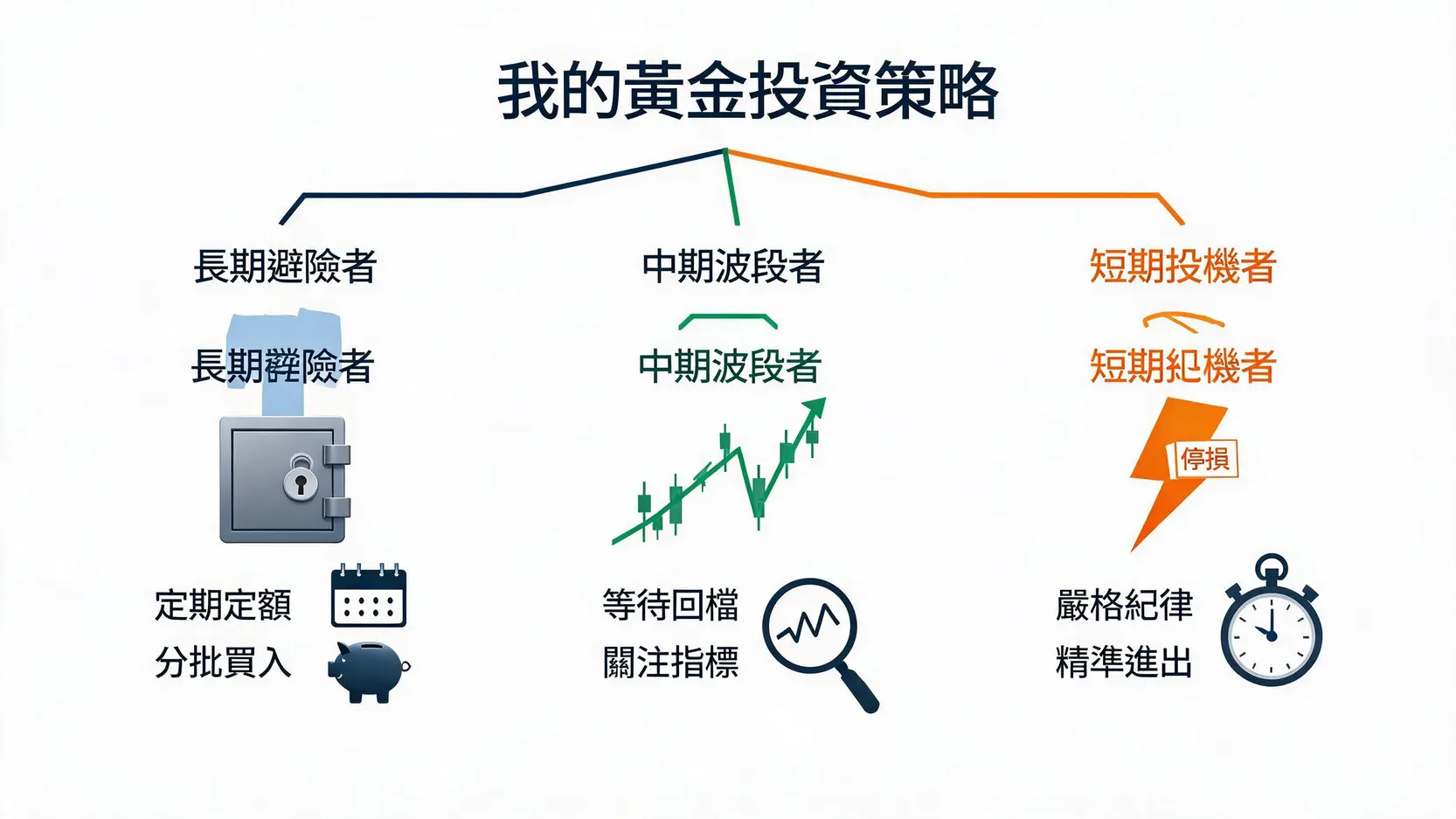
Based on your answers, you can classify yourself into one of the following three investor types:
Table: Characteristics of Different Types of Investors
| Investor Type |
Investment Horizon |
Primary Objective |
Risk Tolerance |
| Long-Term Hedger |
More Than 5 Years |
Wealth Preservation, Inflation Protection, Risk Diversification |
High (Views Price Declines as Buying Opportunities) |
| Medium-Term Swing Trader |
Several Months to 1-2 Years |
Capture Trends, Generate Swing Trading Profits |
Moderate (Sets Stop-Loss and Take-Profit Levels) |
| Short-Term Speculator |
Several Days to Several Weeks |
Maximize Short-Term Price Gains |
Low (Strictly Adheres to Trading Discipline) |
Recommendations for Long-Term Hedgers: Dollar-Cost Averaging or Phased Buying Strategies
If you view gold as a core component of your asset allocation and use it to hedge against the risk of fiat currency depreciation, then the “current price” should not be your primary concern. History has shown that holding gold over the long term is an effective way to combat inflation.
Best Strategies:
- Dollar-Cost Averaging: Whether through a gold savings account or a gold ETF, invest a fixed amount every month. This approach helps you achieve an average purchase cost and effectively reduces the risk of buying at a market peak.
- Phased Buying: If you have a larger amount of capital, avoid investing it all at once. Instead, divide it into three to five portions and invest one portion whenever gold experiences a meaningful pullback (such as a 5% or 10% decline).
Recommendations for Medium-Term Swing Traders: Focus on Technical Indicators and Key Support Levels
For medium-term traders seeking to capture the main upward trend, timing becomes relatively more important. Your goal is not to buy at the absolute bottom, but to identify favorable risk-reward opportunities after an uptrend has been confirmed.
Best Strategies:
- Wait for Pullbacks: Avoid chasing prices higher. Be patient and wait for the price to retest important technical support levels, such as the quarterly moving average (60-day moving average) or the semiannual moving average (120-day moving average).
- Monitor Indicators: Follow trend indicators such as MACD and KD. Consider entering when a Golden Cross appears or when these indicators reverse upward from lower levels.
- Capital Management: Build positions gradually using a pyramid-style or phased entry approach, and establish clear stop-loss levels. For example, exit decisively if a key support level is broken.
Recommendations for Short-Term Speculators: Strict Stop-Loss and Take-Profit Discipline
If your objective is simply to capture a short-term rebound or trade a breakout over a few days, discipline is everything. In a highly volatile market, even a moment of hesitation can lead to significant losses.
Best Strategies:
- Precise Entry and Exit Levels: Your trading plan should be highly detailed, specifying exactly where you intend to enter, take profits, and place stop-loss orders.
- Never Average Down: One of the biggest mistakes in short-term trading is adding to losing positions. This rapidly increases risk exposure.
- Use Trading Tools Wisely: Consider instruments such as Gold CFDs (Contract for Difference). These products provide leverage but also carry substantial risk and are suitable only for experienced traders who can strictly follow their trading discipline.
Gold Investment FAQ
Q: What if I buy gold now and the price falls?
A: This depends entirely on your investment strategy. For long-term hedgers, a decline can actually be beneficial because it allows you to continue dollar-cost averaging or phased buying at lower prices, reducing your overall cost basis. For medium-term and short-term traders, a stop-loss level should be determined before entering the trade. If the price reaches that level, the stop-loss should be executed without hesitation to prevent larger losses.
Q: Besides price, what other indicators can help determine a good entry point?
A: Several key indicators are worth monitoring: 1. US Dollar Index (DXY): Gold prices typically have an inverse relationship with the US dollar. A weaker dollar is generally supportive of gold. 2. US 10-Year Treasury Yield: Gold prices tend to move inversely to Treasury yields. Lower yields are generally favorable for gold. 3. VIX Volatility Index: When market fear rises, the VIX often surges, which can drive safe-haven capital into gold. 4. Gold-Silver Ratio: Comparing the price relationship between gold and silver can help assess their relative valuation and serve as a supplementary reference.
Q: Is now a good time for small investors to start buying gold?
A: Absolutely. The barriers to investing in gold are now very low. Small investors can begin with a gold savings account or a gold ETF. For example, investing NT$1,000 or NT$3,000 per month through a dollar-cost averaging plan can gradually build a meaningful gold position over time and add a stable safe-haven component to an investment portfolio.
Q: Which offers better protection, gold or Bitcoin?
A: Gold has been recognized as a store of value for thousands of years, and its safe-haven status has been tested throughout history. Its price volatility is also relatively lower. Bitcoin is often referred to as “digital gold” and has demonstrated safe-haven characteristics during certain periods of market stress, but its volatility is significantly higher and its risks far exceed those of gold. For most investors seeking stability, gold remains the more reliable core safe-haven asset, while Bitcoin may be viewed as a higher-risk satellite allocation.
Further Reading (Highly Recommended)
Beginner’s Guide to Gold Investing: A Complete Analysis of the Pros, Cons, Benefits, and Risks of 5 Major Investment Channels
What Is a Fixed Deposit? A Complete Guide to Interest-Only Savings, Types of Bank Interest, and a 2026 Beginner’s Introduction
Conclusion
In summary, there is no absolute right or wrong answer to the question, “Can you still buy gold?” At current price levels, risks and opportunities coexist. The key is to return to the essence of investing: understanding yourself. Using the analytical framework provided in this article, honestly assess your investment objectives, time horizon, and risk tolerance. Determine which type of investor you are and adopt the strategy that best aligns with your profile. If you are a long-term hedger, gradually building a position may be a reasonable choice. If you are a medium-term or short-term trader, patiently waiting for a more favorable risk-reward setup may be the wiser approach. Only investment decisions grounded in deep self-awareness can help you navigate the highly volatile gold market with greater confidence and long-term success.