Gold vs Inflation: USD & Gold Relationship Explained

Gold Inflation Hedge: Does It Really Work? 5 Key Insights Revealing the True Relationship Between the US Dollar and Gold
In an era of global economic uncertainty and inflation quietly eroding your wealth, gold’s role as a traditional safe-haven asset has once again come into the spotlight. Many investors are left wondering: is gold’s safe-haven function still reliable? How strong is its ability to hedge against inflation? More importantly, how should we understand the evolving relationship between the US dollar and gold? This article provides an in-depth analysis of gold’s value preservation logic, breaks down its complex relationship with the US dollar, and uses historical data backtesting to help you make more informed investment decisions in 2026.
The Core Value of Gold: Why Is It Considered the Ultimate Safe-Haven Asset?
For thousands of years, regardless of dynastic changes or currency evolution, gold has remained the undisputed king of value storage. Its core value does not come from industrial use, but from its unique monetary properties and global consensus. When markets panic, gold becomes the ultimate refuge for capital, and its status as a safe-haven asset is difficult to displace.
Capital’s Safe Haven: Gold’s Role During Market Turbulence
“Buy gold in troubled times” perfectly illustrates gold’s safe-haven function. When stock markets crash, geopolitical tensions rise, or the global economy enters recession, investors instinctively shift funds from higher-risk assets (such as equities) into perceived safer assets, with gold often being the first choice. This is because:

During market turbulence, gold becomes a safe haven for capital
- No credit risk: Gold is a physical asset and does not rely on any government or corporate credit. Unlike currencies or bonds, it cannot become worthless due to default risk.
- Globally recognized value: Wherever you are in the world, gold is universally accepted as valuable and can be easily exchanged into any currency.
- Low correlation with major assets: Gold prices typically have low or even negative correlation with stocks and bonds. This means that when equities fall, gold often rises, effectively hedging portfolio losses.
Scarcity as the Foundation of Gold’s Value Preservation
Gold’s value largely stems from its physical scarcity. The total supply of gold on Earth is finite, and mining becomes increasingly difficult and costly over time. According to estimates, all the gold ever mined in human history could roughly fit into a standard Olympic swimming pool. This “scarcity creates value” characteristic sharply contrasts with fiat currencies that can be printed indefinitely. When central banks expand money supply through quantitative easing, currency purchasing power declines, while gold’s scarcity enhances its value.
Further Reading (Highly Recommended)
2026 Forex Trading Beginner Guide: Master Risk Management and Broker Selection for Stable Profits!
Does Gold Really Hedge Against Inflation?
When discussing gold, one of the most commonly mentioned functions is its “inflation hedge” role. In theory, when prices rise broadly and currency purchasing power declines, gold as a physical asset should rise in value accordingly, preserving wealth. But is this function truly reliable in practice?
Understanding Gold’s Inflation Hedge: How It Protects Purchasing Power?
The logic behind gold’s inflation hedge is straightforward. Inflation means “currency depreciation and rising prices”. For example, if 1 ounce of gold equals 2000 US dollars today, and that amount buys a smartphone, then during severe inflation when the dollar loses half its purchasing power, the same phone may cost 4000 US dollars. In this case, gold may also rise to around 4000 US dollars per ounce. In other words, your 1 ounce of gold can still purchase the same smartphone over time, effectively preserving purchasing power. This is why in countries with hyperinflation, people prefer holding gold over local currency.
Historical Data: How Gold Performed During Inflationary Periods
Long-term historical data shows that gold has indeed demonstrated its inflation-hedging ability. A classic example is the US “stagflation” period in the 1970s. During this time, the US faced both high inflation and economic stagnation, while the Federal Reserve struggled to respond and stock markets performed poorly. However, gold prices surged from around 35 US dollars per ounce in 1971 to over 850 US dollars in early 1980, an increase of more than 20 times, making it one of the best-performing assets of that era. However, in the short term, the relationship between gold and inflation is not always synchronized. In certain periods, such as moderate inflation or when interest rate expectations dominate the market, gold prices may remain flat or even decline. Therefore, gold’s inflation-hedging function should be understood from a long-term perspective rather than short-term fluctuations.
The US Dollar and Gold “Seesaw”: Revealing Their Interdependent Relationship
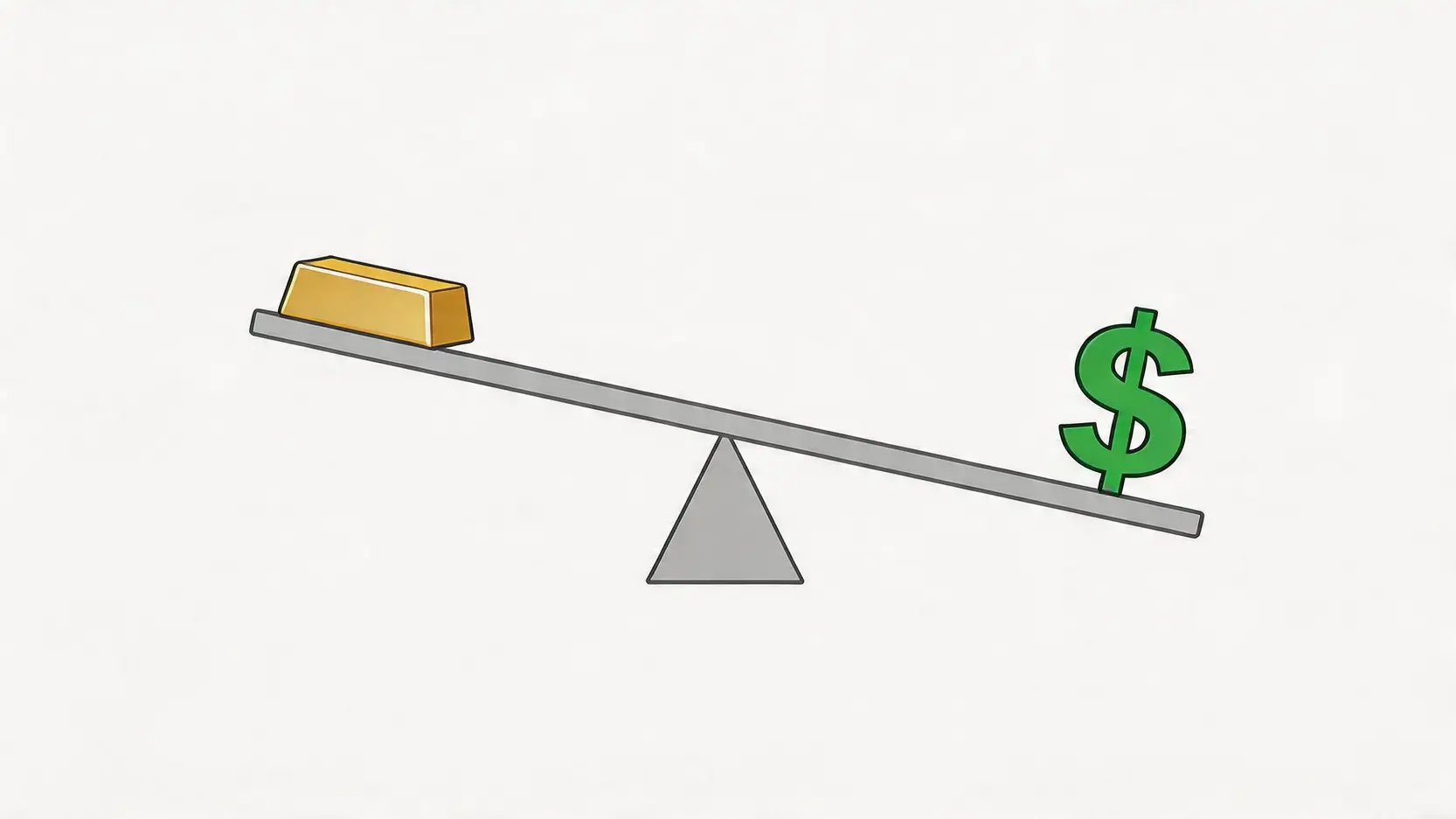
In the international market, gold is priced in US dollars. This makes the US dollar and gold relationship inseparable, and it is mostly characterized by a “you rise, I fall” negative correlation. For gold investors, understanding this seesaw effect is essential for assessing gold price movements.

The negative correlation between the US dollar and gold is like two ends of a seesaw.
Why a Stronger US Dollar Typically Puts Pressure on Gold Prices?
The negative correlation between the US dollar and gold is mainly driven by two mechanisms:
- Pricing effect: Since gold is priced in US dollars, when the dollar appreciates (strengthens), it becomes more expensive for investors holding other currencies (such as euros or yen) to buy gold. Higher costs suppress demand, thereby putting downward pressure on gold prices. Conversely, when the US dollar depreciates (weakens), gold becomes cheaper for foreign buyers, demand increases, and prices tend to rise.
- Substitution effect: The US dollar itself is also a globally recognized safe-haven asset. When the global economic outlook is uncertain but the US economy remains relatively stable, international capital flows into US dollar assets for safety, pushing up the dollar’s value. In such cases, the dollar’s safe-haven appeal can temporarily outweigh gold, reducing demand for gold and putting pressure on its price.
Exceptions: When the US Dollar and Gold Rise Together?
Although negative correlation is the norm, in certain extreme situations, the “rivalry” between the US dollar and gold can shift into synchronized upward movement. This typically occurs during major global systemic crises. For example:
- The 2008 Global Financial Crisis: In the early stage of the crisis, extreme panic led investors to indiscriminately sell all risk assets while simultaneously rushing into US dollar cash and gold, causing both to rise together.
- The 2020 COVID-19 outbreak: Global lockdowns and economic shutdowns created unprecedented uncertainty and triggered a liquidity crisis. Investors flocked massively into both US dollars and gold as ultimate safe havens.
In such “cash is king” panic periods, correlations across all assets tend to break down, and only the most fundamental safe-haven logic remains in play, holding highly liquid US dollars and non-credit-dependent gold.
Further Reading (Highly Recommended)
Gold Investment Beginner Guide: 5 Major Channels Explained, Understand Investment Benefits and Risks
Frequently Asked Questions (FAQ)
Q: Does investing in gold generate interest or dividends?
A: No. Gold is a precious metal commodity and does not pay dividends like stocks or generate interest like bonds or deposits. Therefore, the opportunity cost of holding gold is the return you forgo from other interest-bearing assets during the same period. This is also why gold prices often come under pressure during interest rate hiking cycles, as higher rates highlight the opportunity cost of holding gold.
Q: What other key factors affect gold prices?
A: In addition to inflation and the US dollar, key drivers of gold prices include global central bank gold demand (as countries diversify foreign reserves by continuously buying gold), real interest rates (nominal rates minus inflation, where lower real rates are generally positive for gold), geopolitical risks (wars or political instability increase safe-haven demand), and market speculation sentiment.
Q: Besides buying gold bars, what are other more convenient ways to invest in gold?
A: For general investors, buying physical gold (such as bars or coins) is straightforward but comes with disadvantages such as storage difficulty and wider bid-ask spreads. More convenient methods include gold savings accounts (bank accounts similar to virtual gold), gold ETFs traded on stock markets such as SPDR Gold Shares (GLD), gold futures (leveraged products with higher risk), and gold contracts for difference (CFDs).
Q: Does gold always act as a safe haven in all situations?
A: Not necessarily. Gold’s safe-haven function performs best during long-term economic recessions, severe inflation, or geopolitical crises. However, in sudden crises that trigger liquidity shortages (such as the early stage of the 2008 Global Financial Crisis or the March 2020 stock market circuit breakers), investors may indiscriminately sell all assets to raise cash, causing gold to fall temporarily. Typically, once liquidity conditions stabilize, gold tends to rebound quickly and enter a strong upward phase.
Conclusion
In summary, gold continues to play an indispensable stabilizing role in modern investment portfolios due to the global consensus it has built over thousands of years. Its core safe-haven function makes it a refuge for capital during market turmoil, while its long-term inflation-hedging capability helps preserve purchasing power. Understanding the seesaw relationship between the US dollar and gold is also key to grasping short-term price movements. Although gold does not generate yield and is influenced by multiple short-term factors, from a long-term asset allocation perspective, including a portion of gold remains an important strategy for navigating future economic uncertainty.
Related Articles
-
Does Gold Always Rise When the Fed Cuts Rates? Understanding the Complete Relationship Between Interest Rates and Gold Prices Through 3 Key Perspectives A popular market saying goes: "When the Fed cuts rates, gold rises." This phrase has become almost a standard answer for gold investors. But what is the...2026 年 6 月 16 日
-
Has Gold Reached Its Peak? Can You Still Buy Gold in 2026? 3 Key Risks and a Decision-Making Framework Every Investor Must Understand Before Investing As gold prices continue to hit new highs, are you also struggling with the age-old question: "Can you still buy gold?" Market sentiment is running...2026 年 6 月 16 日
-
Gold Short-Term Trading Strategies: Illustrated Guide to 3 High-Probability Techniques Used by Professional Traders Faced with gold's intense price volatility, short-term trading has become a popular choice for those seeking quick profits. However, without a solid gold short-term trading strategy, trading is little more than gambling. The market is flooded...2026 年 6 月 15 日