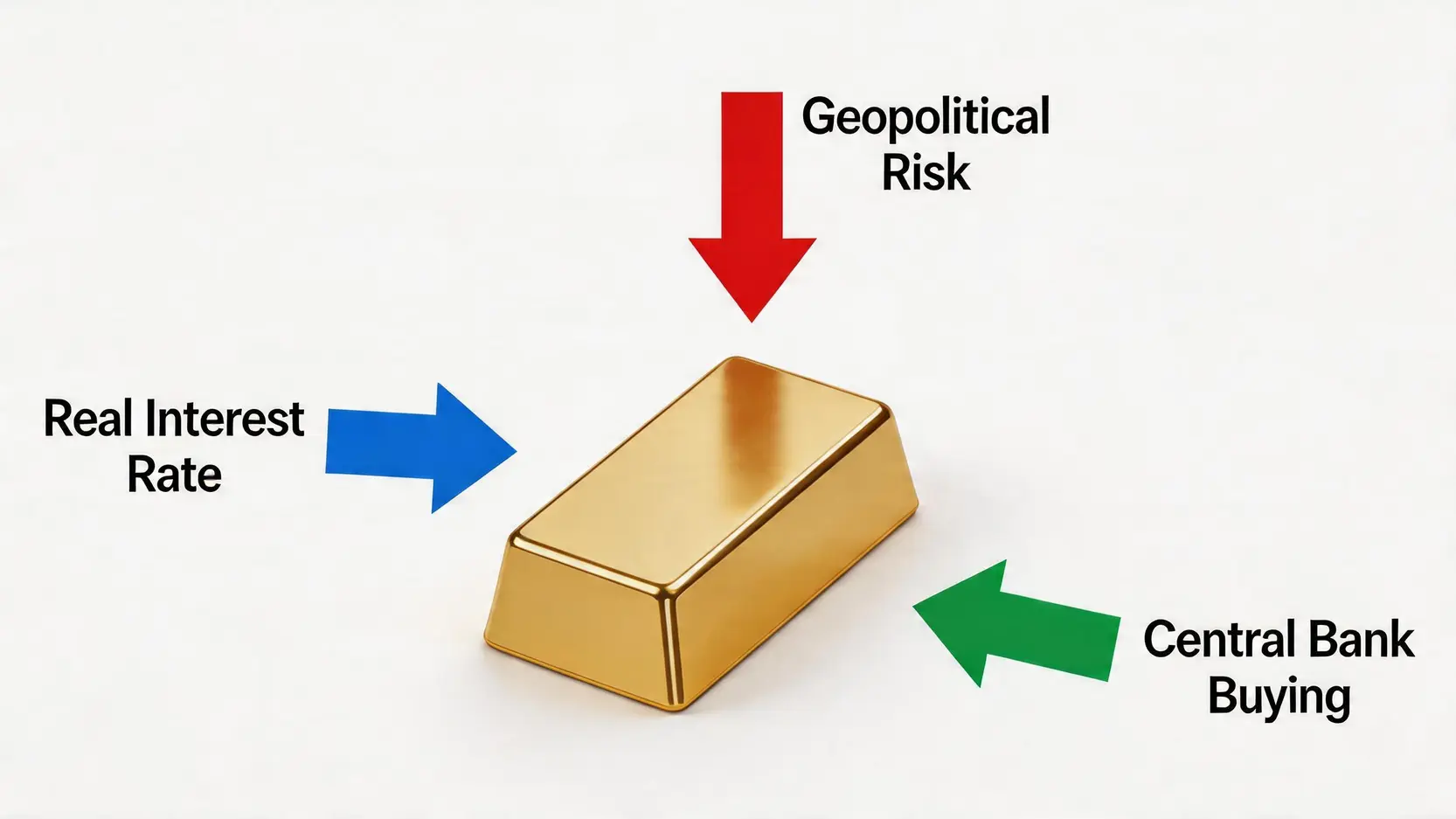
The seesaw relationship between gold prices and real interest rates: as one rises, the other falls.
This is why expectations of central banks such as the Federal Reserve (Fed) entering a rate-cutting cycle, or rising inflation expectations, typically lead to lower real interest rates and provide strong support for gold prices.
Case Study: Historical Gold Price Reactions to Fed Rate Cycles
Looking at historical data, we can clearly observe the negative correlation between gold prices and real interest rates (often represented by the US 10-year Treasury Inflation-Protected Securities (TIPS) yield).
| Period |
Federal Reserve Monetary Policy |
Real Interest Rate Trend |
Gold Price Reaction |
| 2008–2011 |
Post-financial crisis, implemented monetary easing (QE) and near-zero interest rates |
Continued decline, even turning negative |
Gold prices surged from around $800 per ounce to an all-time high above $1,900 per ounce |
| 2013–2018 |
Exit from QE and a gradual interest rate hiking cycle |
Gradual increase |
Gold entered a multi-year consolidation and decline phase |
| Early 2020–2022 |
Outbreak of COVID-19, massive global rate cuts and liquidity expansion by central banks |
Fell back into a deep negative territory |
Gold returned to levels above $2,000 per ounce |
| 2022–2023 |
To combat high inflation, the most aggressive interest rate hiking cycle in decades was launched |
Quickly turned from negative to positive and rose sharply |
Gold came under pressure at times, but showed resilience supported by other factors |
The table above clearly shows that the direction of real interest rates is a key compass for predicting long-term gold price trends.
Safe-Haven Sentiment: How Geopolitical Risk Ignites Gold Demand
When the world is stable, investors pursue returns and growth. However, when conflicts and uncertainty dominate the market, the primary objective of capital shifts to “survival”. At this point, gold’s role as the ultimate safe-haven asset becomes evident. There is a strong positive correlation between geopolitical risk and gold prices.
Gold’s Millennia-Long Safe-Haven Nature: Why Capital Flows Into Gold During Global Conflicts?
Gold has endured for thousands of years as a universally recognized safe haven due to its unique characteristics:
- No national boundaries: Gold is accepted and recognized globally and does not rely on the credit of any single country or government.
- Stable value: Unlike fiat currencies, which can depreciate due to excessive issuance, gold maintains relatively stable intrinsic value.
- High liquidity: It can be easily converted into any currency worldwide.
- Anonymity and physical form: Physical gold provides a way to store wealth outside the financial system.
In extreme situations such as war, political instability, or major terrorist attacks, traditional financial assets (like stocks and bonds) may suffer sharp declines due to economic stagnation or sovereign default risks. In such scenarios, gold becomes the preferred asset for capital flight and wealth preservation.
Recent Examples: How Major Geopolitical Events Immediately Affect Gold Prices
In recent years, frequent geopolitical conflicts have consistently acted as catalysts for gold price increases:
- Russia-Ukraine conflict in February 2022: After the outbreak of war, safe-haven sentiment surged rapidly. Gold rose from around $1,900 per ounce to approximately $2,070 per ounce within just two weeks, approaching historical highs.
- Israel-Palestine conflict in October 2023: The sudden escalation in the Middle East once again triggered market panic. Within one month of the conflict, gold rose from around $1,820 per ounce to as high as $2,000 per ounce.
These events clearly demonstrate that geopolitical risk is a key short-term driver of gold price movements. Whenever global headlines are dominated by conflict, gold demand tends to rise almost immediately.
Further Reading (Highly Recommended)
Forex Trading Beginner Guide 2024: Ultimate Guide From Zero to Mastery in Trading Skills!
How to Reduce Investment Risk? 5 Risk Management Strategies and Diversification Guide
Structural Support: Why Central Banks Continue to Accumulate Gold?
Beyond economic indicators and short-term safe-haven sentiment, a more persistent and structural force is providing long-term support for gold prices: the global central bank gold buying trend. The increasing accumulation of gold by central banks, especially in emerging markets, is reshaping the supply and demand dynamics of the gold market.
The “De-Dollarization” Wave: A New Trend in Reserve Diversification
Since the establishment of the Bretton Woods system after World War II, the US dollar has remained the world’s primary reserve currency. However, in recent years, particularly after the US began “weaponizing” the dollar through financial sanctions against multiple countries, many nations have become aware of the risks of over-reliance on a single currency.
As a result, “de-dollarization” and foreign exchange reserve diversification have become an irreversible trend. Central banks around the world are increasingly seeking to reduce their holdings of US dollar assets and shift toward other assets, with gold emerging as the preferred choice. This is because gold is the only global reserve asset that is not issued or controlled by any country. Holding gold helps enhance a country’s monetary policy independence and financial stability.
Analysis of Major Buyers: Strategic Positioning by China, India, and Other Emerging Markets
According to data from the World Gold Council, global central bank gold purchases have remained at elevated levels for several consecutive years. The main driving force comes from emerging market countries led by China:
- People’s Bank of China: In recent years, China’s central bank has become one of the largest gold buyers globally, continuously increasing its gold reserves over multiple months. This reflects both the need to diversify away from US dollar reserve risk and a strategic intention to enhance the international status of the renminbi.
- Reserve Bank of India: As a traditional major gold-consuming country, India has also steadily increased its official gold reserves.
- Turkey, Poland, Singapore, and others: These central banks have likewise been active buyers in the gold market in recent years.
Unlike speculative buying driven by market sentiment, central bank purchases are based on long-term strategic considerations. Once acquired, these holdings are typically kept for extended periods. This consistent and stable official demand forms a strong structural floor for gold prices, providing resilience even under pressure from rising real interest rates.
Conclusion
In summary, the future direction of gold prices will be determined by three powerful forces. First is the economic pressure represented by real interest rates, which determines the opportunity cost of holding gold. Second is safe-haven demand driven by geopolitical risk, which often acts as a catalyst for short-term price surges. Third is the structural trend of global central bank gold buying, which provides long-term and stable support for gold prices. For investors, analyzing any single factor in isolation can lead to misjudgment. Only by comprehensively understanding the complex interaction between these three forces can one more precisely grasp the pulse of the gold market and make more informed investment decisions in an ever-changing financial environment.
FAQ
Q: When nominal interest rates rise, will gold prices always fall?
A: Not necessarily. The key factor is “real interest rates” rather than “nominal rates”. If a central bank raises rates (nominal rates raises) to combat higher inflation, but the rate hike is smaller than the increase in inflation, real interest rates may still fall or remain low. In such cases, even if nominal rates rise, gold prices may still be supported or even increase.
Q: Besides these three factors, what other key drivers affect gold prices?
A: There are several other important factors:
1. US Dollar Index strength: Since gold is priced in US dollars, it is typically negatively correlated with the dollar. A stronger dollar puts pressure on gold, while a weaker dollar supports it.
2. Gold ETF fund flows: Changes in holdings of major gold ETFs (such as GLD) reflect institutional sentiment and serve as an important market indicator.
3. Physical supply and demand: Including mining output, recycled gold supply, and demand from jewelry and industrial sectors, especially consumption from China and India, which has a fundamental impact on gold prices.
Q: How can retail investors use this information to allocate gold?
A: Retail investors can use these factors as a macro framework for decision-making. For example, when expecting a rate-cutting cycle (declining real interest rates) or rising geopolitical tensions, they may consider increasing gold allocation as a hedge. Investment methods include physical gold, gold savings accounts, gold ETFs, or gold mining stocks, depending on individual risk tolerance and investment objectives.
Q: Will “de-dollarization” truly challenge the dominance of the US dollar?
A: This is a gradual and long-term process rather than an immediate shift. At present, “de-dollarization” mainly reflects reserve diversification by central banks to reduce reliance on a single currency, rather than an attempt to fully replace the US dollar. In the short term, the US dollar remains dominant due to its deep financial markets and entrenched global role. However, the trend itself is already structurally positive for gold, as gold is the most natural alternative asset when countries reduce dollar exposure.