AUD to TWD Exchange Guide: Best Rates in 2026

AUD to TWD Exchange Rate Guide: The Most Cost Effective Strategy to Exchange Taiwan Dollars for Australian Dollars in 2026, With Comparison of 5 Banks and Platforms and Trend Analysis
Planning to travel, study, or invest in Australia but feeling troubled by the constantly changing Taiwan dollar to Australian dollar exchange rate? Want to know where to exchange money at the best rate and how to interpret AUDTWD exchange rate trends? Do not worry, this one stop guide will walk you through real time exchange rate checking, historical trend analysis, and comparisons of exchange costs across major banks and online platforms, helping you easily master the best strategy for converting TWD to AUD while saving both money and time. Whether you are exchanging a small amount or handling a large investment transfer, you will be able to find the solution that suits you best.
Real Time AUD to TWD Exchange Rate and Recent Trend Analysis
Understanding the rhythm of exchange rates is the first step toward successful currency conversion. The Australian dollar (AUD), as a commodity currency, tends to fluctuate relatively frequently. Therefore, before exchanging money, it is essential to understand the current exchange level and recent trends.
Latest AUD/TWD Exchange Rate Lookup
To check the latest Australian dollar to Taiwan dollar exchange rate, you can use the exchange rate pages published by major banks or rely on professional financial websites and apps. These tools usually provide interactive currency conversion functions. Simply enter the amount in Taiwan dollars or Australian dollars, and the corresponding value in the other currency will be calculated instantly. Please note that quoted exchange rates are typically divided into a “cash selling rate” and a “spot selling rate”, and the difference between the two will be explained later.
90 Day Historical AUD Exchange Rate Chart: Highs, Lows, and Volatility Analysis
Looking at the exchange rate at a single moment is not enough. Smart currency exchangers usually observe at least three months (90 days) of historical exchange rate charts. Through these charts, you can easily identify the relative highs and lows during that period.
- Upward trend: If the overall chart is trending upward, it means the Australian dollar is appreciating (while the Taiwan dollar is relatively weakening), which means more Taiwan dollars are required to exchange for the same amount of AUD.
- Downward trend: If the overall chart is trending downward, it indicates the Australian dollar is weakening, which represents a relatively favorable moment to exchange currency.
- Volatility analysis: Observe the magnitude of price fluctuations. If volatility is strong, you may consider purchasing in batches to spread exchange rate risk. If the trend is relatively stable, you may select a relatively lower point and exchange the full amount according to your travel schedule.
Future AUD Trend Forecast: Three Key Factors Influencing the Exchange Rate
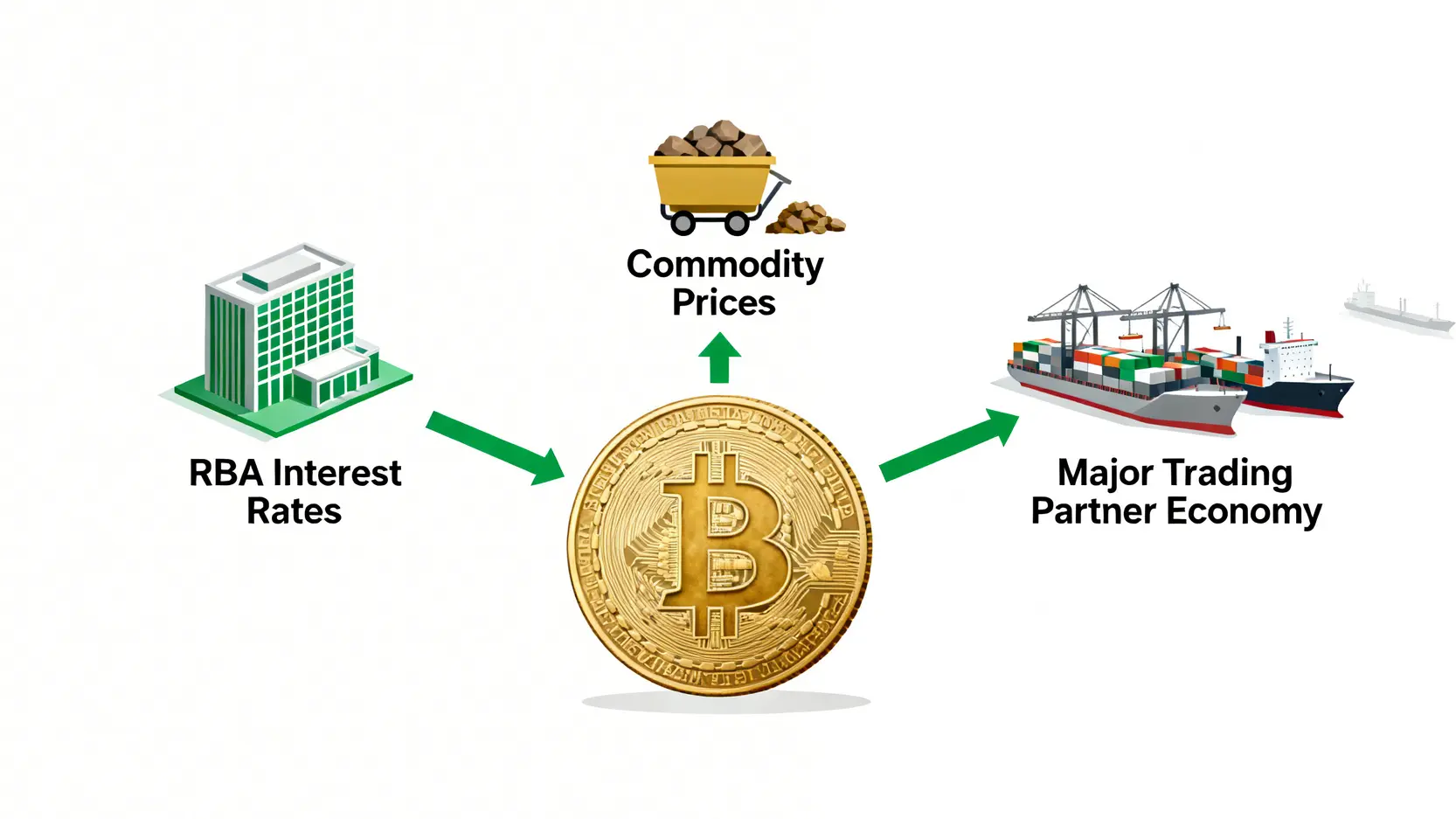
Predicting future exchange rates is difficult, but understanding the underlying drivers can help you make more informed decisions. Many factors influence the AUD to TWD exchange rate, with the following three being the most important:
- Reserve Bank of Australia (RBA) interest rate policy: When the RBA raises interest rates, international capital flows may increase, pushing the Australian dollar higher. Conversely, rate cuts may weaken the currency. RBA meeting minutes and official statements are closely watched by the market.
- Global commodity prices: Australia is a major exporter of raw materials such as iron ore and coal. Therefore, the Australian dollar is highly correlated with commodity price movements (especially iron ore). Rising commodity prices tend to support the Australian dollar.
- China’s economic performance: China is Australia’s largest trading partner. The strength or weakness of China’s economy directly affects demand for Australian raw materials and thus influences the Australian dollar. Strong Chinese economic data often supports AUD strength.

Further Reading (Highly Recommended)
Forex Trading Guide 2024: The Ultimate Beginner’s Guide to Master Forex Trading from Zero to One!
Where Is the Best Place to Exchange TWD for AUD? Comparison of Five Major Currency Exchange Channels
After understanding exchange rate trends, the next step is choosing the most suitable exchange channel. Different channels vary significantly in exchange rates, fees, and convenience. The following analysis compares the main options.
Channel One: Major Taiwanese Banks (For Example: Bank of Taiwan, E.Sun Bank)
Exchanging currency at bank counters in Taiwan remains the most traditional and secure method. Major banks all provide Australian dollar cash exchange services.
- Advantages: Safe and reliable, no risk of counterfeit currency, many branches providing convenience.
- Disadvantages: Exchange rates are usually the least favorable among all channels (cash selling rates are higher), some banks may charge service fees, and transactions must follow bank operating hours.
- Suitable for: People accustomed to in person transactions, those unfamiliar with online platforms, or individuals with urgent small exchange needs.
Channel Two: Professional Currency Exchange Companies or Money Changers
In Taiwan, aside from banks, there are also private licensed currency exchange businesses. Although smaller in scale, they may sometimes offer more competitive rates than banks.
- Advantages: Exchange rates may be better than banks, with more flexible operating hours.
- Disadvantages: Locations are fewer, requiring time to search. It is important to confirm that the exchange shop is legally licensed by the government.
- Suitable for: Individuals willing to compare prices and seek the best rates for small exchanges.
Channel Three: Online Transfer Platforms Such as Wise
For situations involving larger cross border transfers such as tuition payments, overseas living expenses, or international investments, fintech platforms like Wise are excellent options. They bypass the complicated processes of traditional banks and offer more transparent and cost efficient services. For detailed operational guidance, you can refer to the international transfer practical tutorial.
- Advantages: Exchange rates close to the market mid rate, low and transparent fees, fully online operation, convenient processing, and relatively fast transfer times.
- Disadvantages: Primarily designed for account to account transfers rather than physical cash withdrawals. If you require AUD cash, you will still need an Australian bank account to withdraw funds locally.
- Suitable for: Students paying tuition or living expenses abroad, or individuals conducting overseas investments or property purchases.
Channel Four: Australian Airport or City Currency Exchange Counters
After arriving in Australia, exchanging Taiwan dollars for Australian dollars at airport or city currency exchange counters is typically the last resort option.
- Advantages: Extremely convenient, allowing you to obtain cash immediately upon arrival.
- Disadvantages: Exchange rates are the least favorable among all options and are often accompanied by high service fees.
- Suitable for: Emergency situations only, such as arriving late at night and needing cash immediately for transportation. It is recommended to exchange only a minimal amount.
Summary Comparison Table: A Quick Overview of Fees, Exchange Rates, and Convenience Across Channels
| Exchange Channel | Exchange Rate Competitiveness | Service Fees | Convenience | Suitable Scenarios |
| Major Taiwanese Banks | Relatively Poor | May Be Charged (Around NT$100) | High | Small Cash Exchanges, Safe and Reliable Choice |
| Professional Currency Exchange Companies | Better | Usually None | Medium | Those Seeking the Best Exchange Rate |
| Wise and Similar Online Platforms | Best (Mid-Market Rate) | Low and Transparent | Very High (Fully Online) | Large Transfers, Study Abroad, Investment |
| Local Currency Exchange in Australia | Worst | High | Medium (Emergency Use) | Urgent Small Cash Needs |
Further Reading (Highly Recommended)
Frequently Asked Questions (FAQ)

Q: When exchanging Australian dollars, should I look at the “cash exchange rate” or the “spot exchange rate”?
A: It depends on how you exchange the currency. If you bring Taiwan dollar cash to a bank counter and exchange it for Australian dollar cash, you need to look at the “cash selling rate”. If you exchange funds through online banking or a banking app, converting money from your TWD account into your foreign currency account, that is based on the “spot exchange rate”. Generally speaking, the “spot exchange rate” is more favorable than the “cash exchange rate”, because banks do not need to bear the cost of handling and storing physical cash.
Q: When during the year is the best time to exchange AUD against TWD?
A: Exchange rates do not follow a fixed seasonal pattern. The so-called “best timing” is simply a relative low point, which cannot be predicted precisely. Rather than trying to guess the best month, it is better to develop the habit of monitoring exchange rate trends regularly, understand the three key factors that influence the Australian dollar, and purchase in batches when the rate reaches your target level. This approach is more effective for managing exchange costs.
Q: Do I need to make a reservation to exchange Australian dollars in Taiwan? Is there a limit on the amount?
A: For small exchanges (for example, amounts equivalent to tens of thousands of Taiwan dollars), most banks keep sufficient foreign currency on hand and reservations are usually unnecessary. However, if you need to exchange a large amount (for example, more than the equivalent of NT$500,000), it is strongly recommended to contact the branch in advance to ensure sufficient AUD cash is available. In addition, according to Taiwan regulations, large counter cash transactions may require registration, and individuals have an annual foreign exchange limit, which should also be taken into consideration.
Q: Can I directly use a Taiwan credit card in Australia?
A: Absolutely. Credit card payments are very common in Australia. When you use a Taiwan credit card for purchases, the bank will convert the AUD amount into TWD for billing and charge an overseas transaction fee (usually around 1.5%). It is recommended to use a credit card that offers high cashback for overseas spending, as the rewards may offset the fee or even generate extra savings, making it more convenient and safer than carrying large amounts of cash.
Conclusion
In summary, the key to finding the best timing for exchanging Taiwan dollars to Australian dollars is closely monitoring AUDTWD exchange rate trends and choosing the most suitable exchange channel based on your needs. For large transfers such as tuition or living expenses, online platforms like Wise are clearly the preferred option due to their competitive exchange rates and low fees. For smaller cash needs during travel, using a bank’s online foreign exchange service combined with withdrawals from foreign currency ATMs, or comparing exchange rates between banks, is often the most practical solution. Hopefully this comprehensive guide will help you handle TWD to AUD exchanges with greater confidence while saving more money.
Related Articles
-
Practical Applications of Volatility Surfaces: From Options Modeling to Advanced Skew Trading Strategies In options markets, implied volatility is never a flat line. Instead, it forms complex "smile" or "skew" surfaces. For advanced traders, mastering the practical applications of volatility surfaces is equivalent to possessing a lens that reveals market...2026 年 6 月 3 日
-
Building a Foreign Capital Flow Copy Trading Model: A Stock Market Indicator for Accurately Tracking Institutional Positioning In Asia-Pacific stock markets, foreign capital inflows and outflows often determine the direction of the index. However, simply looking at daily net buy and sell data is no longer enough. Only by building...2026 年 6 月 3 日
-
Options Buyer Strategies During Extreme Market Conditions: Black Swan Hedging and Cross-Market Arbitrage During Volatility Surges The most terrifying aspect of financial markets is not a gradual decline, but overnight flash crashes and cross-market capital withdrawals accompanied by volatility surges. In the highly unpredictable global macroeconomic environment of 2026, geopolitical...2026 年 6 月 3 日