Decode 5 Central Bank Signals for Forex Trading

Updated: 2026/06/23  |  CashbackIsland

central-bank-forex-catalysts

Decode Central Bank Signals: Anticipate the Next Major Forex Market Move From 5 Key Tightening Signals

Have you ever wondered why the forex market sometimes experiences massive volatility even when a central bank leaves interest rates unchanged? The reason is that the true catalysts in the forex market are often not the rate hikes or cuts themselves, but the tightening signals hidden within central bank policy statements, officials’ remarks, and other subtle policy cues. Many traders focus solely on the interest rate decision while overlooking these deeper market drivers, causing them to miss trading opportunities or face significant central bank policy risk.

If you want to establish yourself in the forex market, you need to learn to interpret every subtle signal released by central banks like a professional trader. This article explains the five major central bank catalysts that drive the global forex market beyond interest rate changes and shows you how to identify potential trading opportunities while managing risk.


Catalyst 1: The Combination of Interest Rate Decisions and Forward Guidance

Interest rate decisions are undoubtedly the market’s primary focus, but their impact extends far beyond the headline figure. The central bank’s post-meeting statement, especially its “forward guidance”, is often what the market pays the closest attention to, as it provides critical clues about the future path of monetary policy.


Why Is Forward Guidance So Important?

Forward guidance is a tool central banks use to communicate their future policy intentions to the market. Simply put, it is how a central bank “previews” the actions it may take over the coming months. For example, the Federal Reserve (Fed) may state that it intends to “keep interest rates unchanged over the next several meetings” or indicate that “it may consider further policy tightening if inflation remains above target”.

The importance of forward guidance lies in the following:

  • Reducing market uncertainty: Clear guidance helps investors develop more stable expectations and reduces excessive volatility caused by speculation.
  • Influencing long-term interest rates: By shaping expectations for future short-term rates, central banks can indirectly influence long-term bond yields and, in turn, the broader economy.
  • Managing market sentiment: Even a slight change in wording can be interpreted as a shift in policy stance, triggering significant currency fluctuations. For example, the removal of the word “patient” from a policy statement was once interpreted by the market as a strong signal that interest rate hikes were approaching.

Therefore, understanding the forward guidance in the Federal Reserve Meeting Schedule: FOMC Interest Rate Decision Calendar and Investment Opportunities is the first step toward identifying the central bank’s true intentions. 


How the Dot Plot Signals the Future Interest Rate Path

For investors following the US dollar, the Federal Reserve’s “Dot Plot” is one of the most important documents to watch. This chart anonymously displays each Federal Open Market Committee (FOMC) member’s projections for the federal funds rate over the coming years. Although it is not an official policy commitment, it clearly reveals the distribution of hawkish and dovish views within the committee, as well as the median interest rate expectation.

How to interpret the Dot Plot:

  • Identify the trend: Observe changes in the median projection. If the median in the latest Dot Plot is higher than the previous one, it suggests the committee’s overall expectation for higher interest rates has strengthened, which is bullish for the US dollar. The opposite is bearish.
  • Assess internal differences: The more widely dispersed the dots are, the greater the disagreement within the committee regarding the future interest rate path, indicating higher policy uncertainty.
  • Compare with market expectations: Compare the Dot Plot with market pricing, (such as interest rate futures). If the Dot Plot is more “hawkish” (expecting higher interest rates) than market expectations by projecting higher future rates, it generally supports the US dollar.

Investors can find the latest Summary of Economic Projections, including the Dot Plot, on the Federal Reserve’s official website to access first-hand information.


Catalyst 2: The Impact of Quantitative Easing (QE) and Quantitative Tightening (QT)

When interest rates approach zero, central banks rely on unconventional monetary policy tools, the most important being Quantitative Easing (QE) and Quantitative Tightening (QT). These policies directly affect the money supply and serve as powerful catalysts in the forex market.


How QE and QT Affect the Money Supply and Exchange Rates?

These two tools can be viewed as the valves central banks use to regulate the market’s “liquidity”:

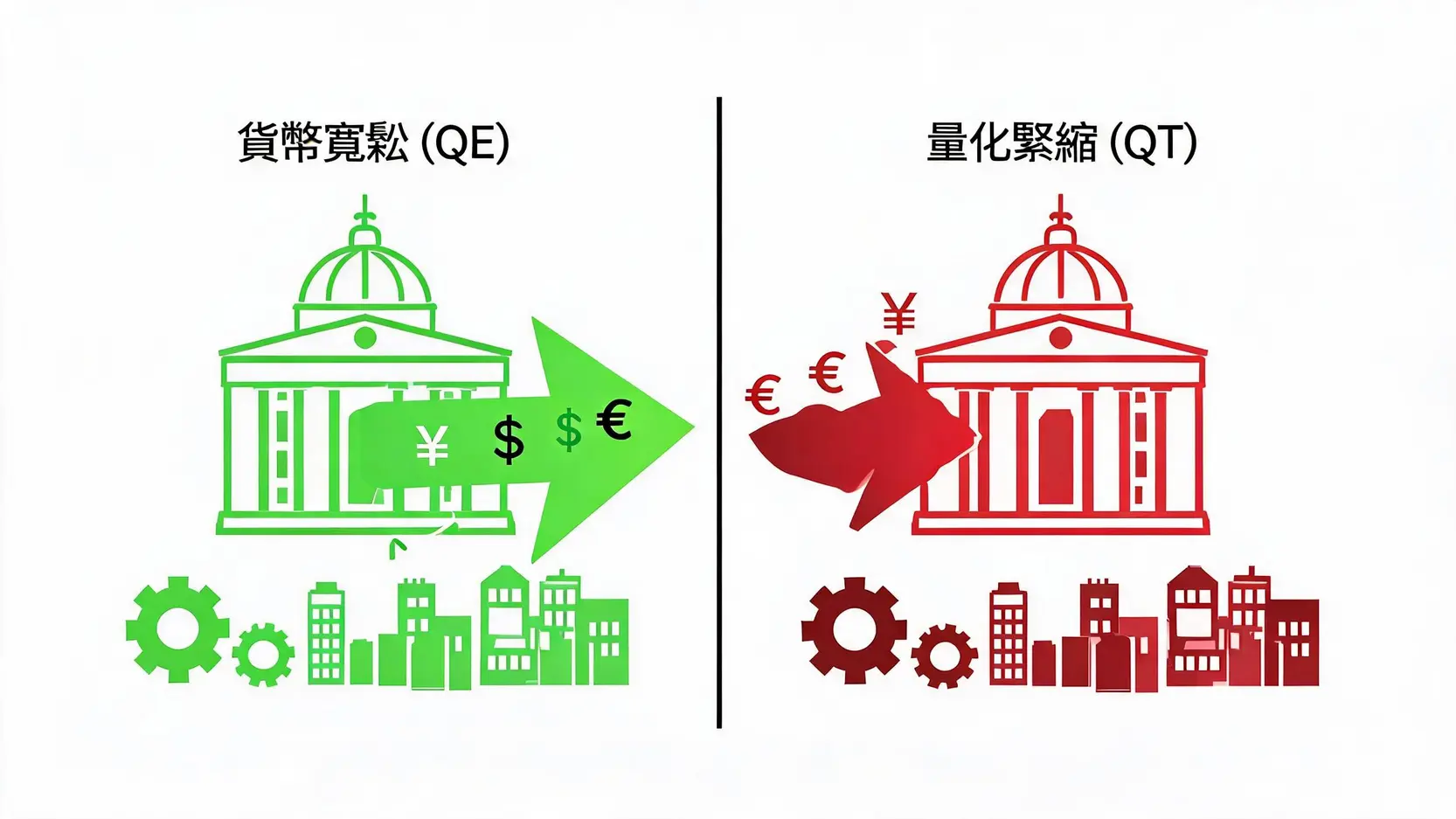
  • Quantitative Easing (QE): Commonly referred to as “money printing”. The central bank injects liquidity into the financial system by purchasing large amounts of government bonds and other assets in the open market. This increases the money supply, lowers long-term interest rates, and, in theory, causes the country’s currency to depreciate.
  • Quantitative Tightening (QT): Commonly referred to as “balance sheet reduction”. This is the reverse of QE. The central bank withdraws liquidity by allowing maturing bonds to roll off without reinvestment or by selling assets directly. This reduces the money supply, raises long-term interest rates, and, in theory, causes the country’s currency to appreciate.

量化寬鬆(QE)與量化緊縮(QT)的對比圖,展示央行如何影響貨幣供給。

QE vs. QT: Two Central Bank Tools for Managing Market Liquidity

The transition from QE to QT represents an important tightening signal. When a central bank begins discussing tapering asset purchases or launching QT, it generally signals the end of an accommodative monetary policy cycle, creating expectations for stronger currency appreciation.


Understanding Central Bank Intentions Through Balance Sheet Size

A central bank’s balance sheet is the most direct indicator of the scale of its QE or QT programs. If the balance sheet continues to expand, QE remains in progress. If the pace of expansion slows, it signals tapering. If the balance sheet begins to shrink, QT has officially begun.

Traders should closely monitor the balance sheets of major central banks (including the Fed, the European Central Bank (ECB), and the Bank of Japan (BoJ)). Trends in these figures often provide a more reliable indication of policy direction than officials’ occasionally ambiguous remarks.


Catalyst 3: Public Speeches by Central Bank Officials

Public speeches by central bank officials, particularly governors and chairpersons, provide another important window into future policy direction. Every remark can be magnified by the market, triggering exchange rate movements. This also represents a major source of central bank policy risk.


Hawkish vs. Dovish: How to Read Between the Lines of Central Bank Speeches

When analyzing officials’ speeches, distinguishing between “hawkish” and “dovish” views is essential.

  • Hawkish:
    Focus: Prioritizes controlling inflation.
    Policy preference: Favors raising interest rates or ending accommodative policies through QT, sending tightening signals.
    Impact on exchange rates: Hawkish remarks generally support the domestic currency.
  • Dovish:
    Focus: Prioritizes economic growth and employment.
    Policy preference: Favors lowering interest rates or maintaining accommodative policies through QE.
    Impact on exchange rates: Dovish remarks generally weigh on the domestic currency.

鷹派與鴿派立場對比圖,顯示鷹派關注通膨而鴿派關注經濟增長。

Hawkish vs. Dovish: Understanding Central Bank Officials’ Policy Stance at a Glance

The “subtext” that traders need to listen for includes: Views on inflation (whether it is “temporary” or “persistent”), assessments of the economic outlook, and descriptions of the labor market. Changes in this wording often signal an impending shift in policy stance.


Which Officials’ Remarks Have the Greatest Market Impact?

Not all officials’ speeches carry the same weight. The following officials’ remarks are generally regarded as key market indicators:

  • Federal Reserve (Fed): Chair, Vice Chair, and the President of the Federal Reserve Bank of New York.
  • European Central Bank (ECB): President and Executive Board members.
  • Bank of England (BoE): Governor.
  • Bank of Japan (BoJ): Governor.

Their scheduled speeches, congressional testimony, and even impromptu media interviews deserve close attention from forex traders.


A Unique Perspective: How to Quantify and Manage Central Bank Policy Risk

After understanding the catalysts above, the next step is learning how to manage potential central bank policy risk in actual trading. This is not simply about predicting market direction, but about adopting a systematic approach to risk management.


Use an Economic Calendar to Set Risk Event Alerts

Professional traders never enter the market unprepared. Using an economic calendar is the first step and also the most important one. You can mark all major central bank interest rate decisions, meeting minutes releases, and speeches by key officials on the calendar.

  • Plan ahead: Before major events are announced, assess the risk of your existing positions and decide whether to reduce exposure in advance to avoid volatility or set protective stop-loss orders in preparation for potential market opportunities.
  • Monitor expectations: Economic calendars typically provide the market’s “expected” figures for economic data or policy decisions. The difference between the actual outcome and the expected result is what truly drives market volatility.
  • Set reminders: Use reminders on your mobile phone or trading platform to ensure you never miss an event that could trigger significant market volatility.


The Basic Principles of an “Event-Driven” Trading Strategy

An event-driven trading strategy involves placing trades based on expectations of, or reactions to, major economic events such as central bank decisions. Its basic principles include:

  1. Scenario analysis: Before the event, analyze every possible outcome (for example, a hawkish rate hike, a dovish rate hike, or an unchanged interest rate accompanied by hawkish signals) and prepare a corresponding trading plan for each scenario.
  2. Wait for confirmation: Do not place trades before the announcement. The market’s knee-jerk reaction is often full of false signals. Wait for a clear trend to develop after the announcement (such as a breakout above a key resistance level or below a key support level) before entering the market.
  3. Trade with the trend: When a central bank releases a strong tightening signal that triggers a clear appreciation trend, trade in the direction of that trend instead of trying to catch a reversal.


Set Stop-Loss Orders to Control Potential Losses During Central Bank Decisions

During “high-volatility” events such as central bank decisions, risk management is the only rule for survival. A Stop-Loss is your most important safety net.

  • Widen your stop-loss range: Since spreads may widen sharply when announcements are released, your stop-loss should be placed farther away than usual to avoid “being stopped out” by temporary market noise.
  • Reduce position size: During high-risk periods, you should proactively reduce your trade size. This ensures that even if your stop-loss is triggered, your actual financial loss remains within an acceptable range.
  • Never trade without a stop-loss: This is the number one rule for trading during high-volatility events. Extreme market movements can lead to catastrophic losses within seconds.

By applying the risk management techniques above, you can turn central bank policy risk from a threat into a trading opportunity.


Conclusion

In summary, central bank policy is the most important and enduring catalyst driving the forex market. Successful traders never focus solely on interest rate decisions. Instead, they act like detectives, piecing together the full picture of future policy from multiple signals, including forward guidance, changes in central bank balance sheets, and hawkish or dovish remarks by policymakers. By understanding and mastering these tightening signals and potential policy risks, while combining disciplined event-driven trading principles with sound risk management techniques, you can navigate the forex market with greater confidence and uncover trading opportunities that others fail to see.


Frequently Asked Questions (FAQ)

Q: What are the typical early signs that a central bank is about to change its policy direction?

A: The signs are usually gradual. First, central bank officials begin to change their wording, for example, shifting from emphasizing downside economic risks to focusing on rising inflationary pressures. Next, meeting minutes may show that more members support policy normalization. Finally, the central bank may begin discussing tapering, which is one of the clearest signals of a policy shift.

Q: How should beginner traders respond to major central bank announcements?

A: For beginners, the safest strategy is to “stay on the sidelines”. During the 30 minutes before and after a major announcement, market volatility is extremely unstable, and spreads may widen significantly. Rather than taking unnecessary risks, it is better to observe the market’s reaction from the sidelines and look for opportunities once the trend stabilizes. If you decide to trade, be sure to use a very small position size and set a stop-loss.

Q: Why does the market sometimes react only mildly to “hawkish” central bank remarks?

A: This is usually because the expectations have already been “priced in”. If the market has widely anticipated hawkish remarks from the central bank, the exchange rate may show little reaction when those remarks are actually made. In some cases, the market may even follow the “Buy the rumor, sell the fact” pattern, where the currency falls instead of rising.

Q: Besides the US dollar, are other currencies also affected by central bank policy?

A: Absolutely. Every country’s currency is directly influenced by its own central bank’s policy. For example, the euro (EUR) is highly sensitive to European Central Bank (ECB) policy, the Japanese yen (JPY) is driven by the Bank of Japan (BoJ), and the British pound (GBP) is influenced by the Bank of England (BoE). When trading cross-currency pairs, you need to analyze the differences between the monetary policies of both countries.

If you liked this article, please share it!

Related Articles

  • Japan Investment Risks: 5 Hidden Risks Beyond the Yen
    Essential Reading on Japan Investment Risks: Five Potential Risks You May Not Know Besides Yen Depreciation Driven by the historic depreciation of the yen, global capital is flowing into Japan with unprecedented enthusiasm. Both the stock market and the real estate market are showing a thriving picture. The market is...
    2026 年 6 月 23 日
  • Gold Price Outlook 2026: Will the Bull Market Continue?
    Will the Gold Price Bull Market Continue? 2026 XAUUSD Trend Analysis, Experts Reveal Three Key Drivers Recently, gold prices have repeatedly hit new highs, and the market is actively debating whether gold has entered a new historic gold price bull market. Many investors are both excited and concerned, wondering how...
    2026 年 6 月 23 日
  • XAUUSD Trading Guide: Trends & Beginner Strategies
    Ultimate Guide to Trading XAUUSD Trends: From Candlestick Teaching to Practical Strategies for Stable Profits for Beginners XAUUSD (spot gold against the US dollar), as one of the world’s most popular trading instruments, offers abundant profit opportunities through its sharp price fluctuations, but also comes with considerable risk. Many beginners...
    2026 年 6 月 23 日
返回顶部