BlackRock AI Strategy: Computing Power Investment Guide

BlackRock’s AI Strategy Revealed: CEO Strongly Promotes “Computing Power Investment”! A Complete Guide to BlackRock’s Stock Selection Strategy and Future Outlook
The AI revolution is already happening, and “computing power” is the engine driving it forward. Are you unsure how to capture the massive opportunities created by AI? The world’s largest asset management company, BlackRock, has already positioned BlackRock computing power investment as a core strategy. This article provides an in-depth analysis of BlackRock’s AI strategy, from the forward-looking vision of its CEO to its actual portfolio allocation strategy, revealing how this investment giant views the future of computing power investment, while also exploring whether a so-called BlackRock Computing Power ETF exists in the market to help guide your next investment decision.
Why Has “Computing Power Investment” Become the Core of BlackRock’s Strategy?
Before examining BlackRock’s specific holdings, we must first understand the thinking behind its top-level strategy. Why would a giant managing more than US$10 trillion in assets elevate the seemingly technical term “computing power” to such strategic importance? The answer lies in the forward-looking vision of its leadership and its deep understanding of the future economic landscape.
BlackRock CEO Larry Fink’s Vision: Seeing the Future Through “Computing Power Futures”
The key figure behind BlackRock, CEO Larry Fink, has long been known for his macroeconomic vision. One disruptive concept he recently introduced, “Computing Futures”, precisely reveals BlackRock’s ambitions. He believes that future computing power will become a standardized and tradable infrastructure asset, just like oil, gold, or agricultural commodities today.
The logic behind this idea is straightforward: as AI models become increasingly complex, breakthroughs in cutting-edge fields such as drug development, climate simulation, and financial market analysis all rely heavily on massive computing capabilities. Computing power is no longer merely an IT expense, but a critical engine driving corporate innovation and growth. Fink regards it as an entirely new asset class, meaning the value of computing power will be redefined, with importance comparable to energy and capital.
The “New Oil” of the AI Era: How Computing Power Drives Global Economic and Corporate Growth
If oil was the lifeblood of the industrial era, then computing power is undoubtedly the “new oil” of the AI era. Consider the following:
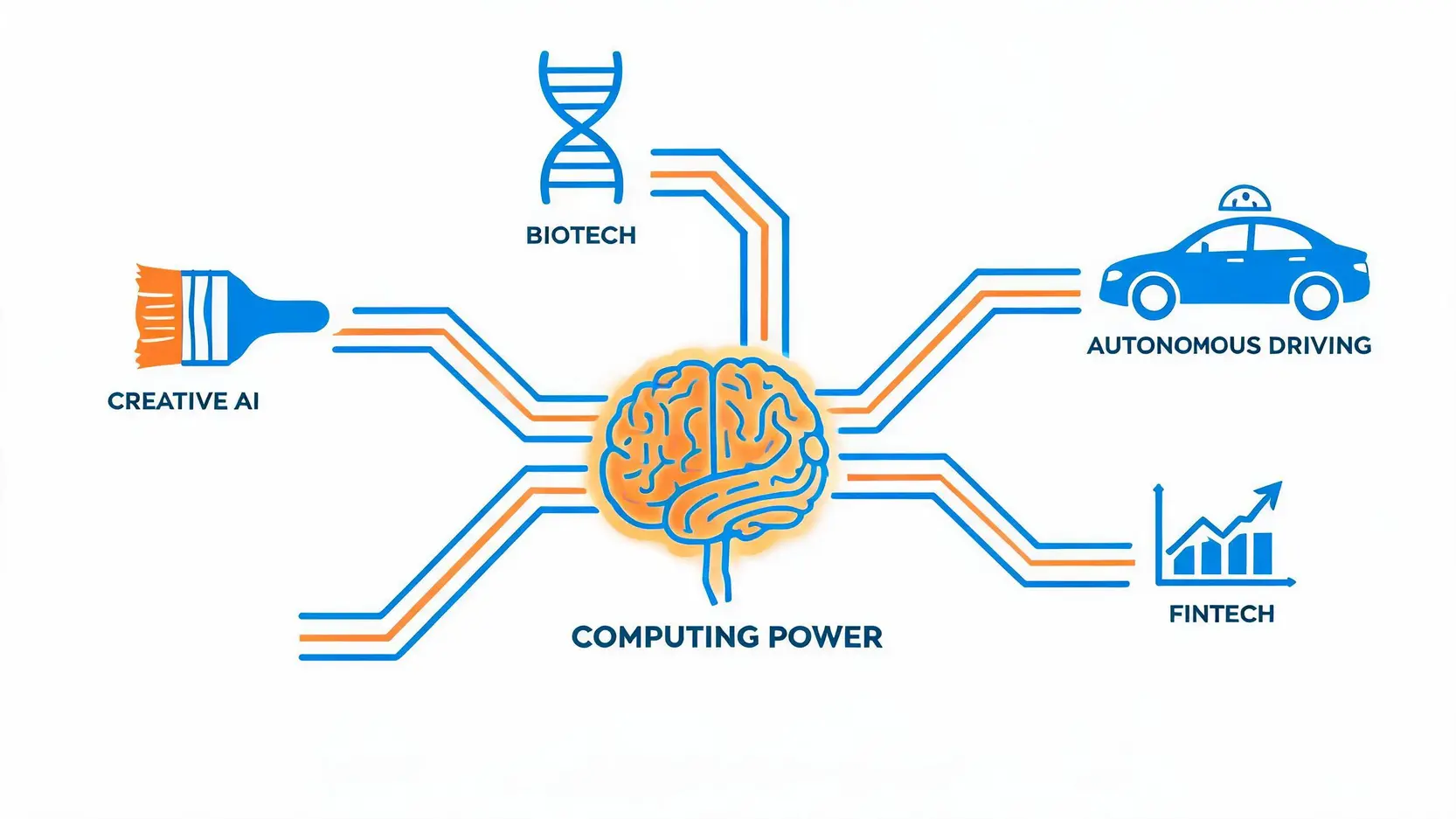
- Autonomous Driving: Every self-driving vehicle is essentially a mobile data center, requiring real-time processing of enormous amounts of sensor data, supported by cloud and edge computing capabilities.
- Biotechnology: AI accelerates drug discovery and protein structure analysis, requiring the simulation of massive molecular interactions and driving exponential growth in demand for computing power.
- Financial Technology: High-frequency trading, risk assessment, and anti-fraud systems all rely on powerful computing capabilities to make decisions within milliseconds.
- Content Creation: From text generation to image and video creation, every advancement in generative AI is accompanied by surging demand for GPU computing power.

Computing Power: The “New Oil” Driving the Future Economy
Computing power has already become a key indicator of the core competitiveness of both countries and corporations. Stronger and more cost-efficient computing power means faster model training, quicker market insights, and faster product innovation. Therefore, BlackRock’s decision to place computing power investment at the center of its AI strategy is not merely about being optimistic on a few technology companies, but represents a critical bet on the underlying infrastructure of the future global economy.
Further Reading (Highly Recommended)
Inside BlackRock’s AI Strategy: Which Companies Has BlackRock Invested In?
After understanding the importance of the strategy at a macro level, the next question becomes: how has BlackRock transformed this ambitious vision into an actual investment portfolio? By examining its regularly disclosed 13F filings, we can gain insight into the company’s specific AI investment strategy and stock selection logic.
Analyzing Holdings Through 13F Filings: Weighting of Technology Giants Such as Nvidia and Microsoft
Within BlackRock’s portfolio, several companies repeatedly appear with extremely high weightings, forming the foundation of its computing power investment strategy:
- Nvidia: This is almost the core holding of every AI-themed investment strategy. Nvidia’s GPUs (Graphics Processing Units) are currently the dominant force behind AI model training and inference, earning the company the title of the “AI arms dealer”. BlackRock’s heavy allocation reflects its confidence in the upstream core of AI infrastructure.
- Microsoft: As the key partner of OpenAI and a provider of powerful AI computing services through its Azure cloud platform, Microsoft has successfully integrated AI capabilities into its vast enterprise software ecosystem. Investing in Microsoft means simultaneously betting on cloud infrastructure and the real-world deployment of AI applications.
- Other Magnificent Seven Companies: Beyond Nvidia and Microsoft, BlackRock also holds substantial positions in Apple, Amazon, Alphabet (Google), Meta Platforms, and Tesla. These companies are not only major consumers of computing power, but are also aggressively investing in AI chip development and platform infrastructure, forming a complete AI ecosystem.
Beyond Chip Design: Comprehensive Coverage Across the Semiconductor Supply Chain (Including TSMC)
Sophisticated investors understand that the success of an industry is never dependent on just one or two star companies. BlackRock’s AI strategy demonstrates its deep understanding of the entire semiconductor supply chain. In addition to chip design companies such as Nvidia (Fabless), its investments also extend into other critical areas of the industry:
- Foundries: TSMC is the most representative example. Whether it is Nvidia’s H100 chips or Apple’s M-series processors, both rely heavily on TSMC’s advanced manufacturing technology. Holding TSMC effectively means indirectly investing in all leading chip design companies.
- Semiconductor Equipment: Companies such as ASML and Applied Materials provide the production tools for the entire industry. They are effectively the “tool suppliers to the tool suppliers”, forming one of the industry’s strongest competitive moats.
Combining Software and Hardware: A Dual-Track Strategy Across Cloud Infrastructure and AI Platforms
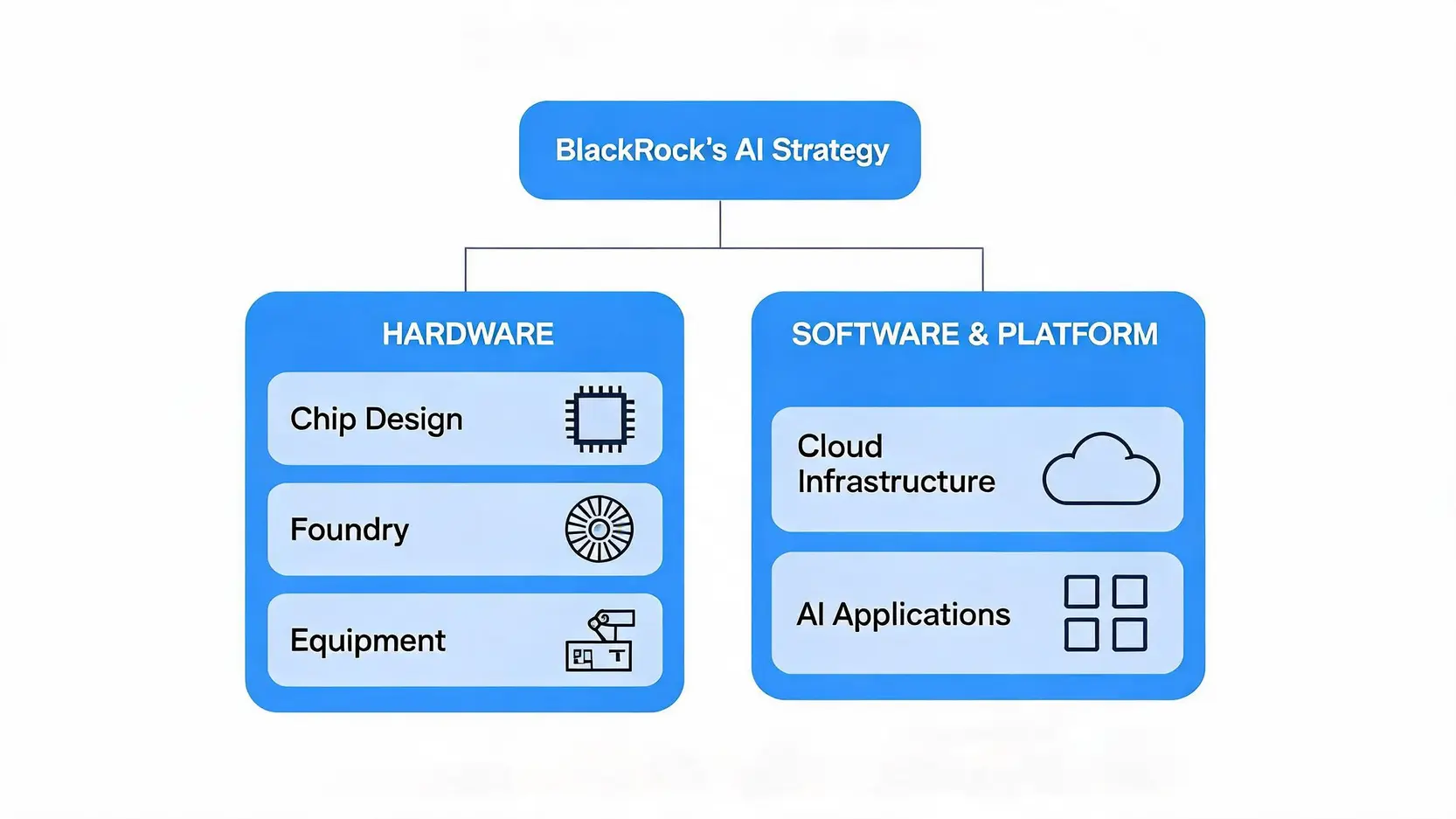
BlackRock’s strategy combines both “software and hardware”, achieving comprehensive exposure across the computing power industry.
Hardware Layer: Represented by chip design, manufacturing, and semiconductor equipment companies, ensuring exposure to the source of computing power supply.
Software and Platform Layer: Centered around the three cloud giants, Microsoft Azure, Amazon AWS, and Google Cloud. These companies transform hardware into globally accessible “computing utilities” for developers and enterprises. In addition, investments in companies such as Salesforce and Adobe, which integrate AI into their SaaS services, allow BlackRock to capture value from the AI application layer. This comprehensive BlackRock AI strategy ensures that regardless of how profits shift across the value chain, it remains positioned to benefit.

BlackRock’s “Software and Hardware Combined” AI Investment Ecosystem
Can I Directly Invest in a BlackRock Computing Power ETF?
After understanding BlackRock’s large-scale strategy, the question many investors care about most is: can I use a simple tool, such as a “BlackRock Computing Power ETF”, to replicate the moves of this investment giant with a single investment? It is a good question, but the answer may be more complicated than expected.
Current Market Situation: Does a Dedicated “BlackRock Computing Power ETF” Currently Exist?
The answer is very clear: as of now, there is no ETF issued by BlackRock that is directly named a “Computing Power ETF”.
There may be several reasons for this. First, “computing power” is still a relatively new concept with somewhat unclear boundaries, making it difficult to standardize into an index. Second, BlackRock may prefer to gain exposure to this sector through actively managed funds or broader technology-themed ETFs in order to maintain investment flexibility. Therefore, searching for a product called the “iShares Computing Power ETF” is currently futile.
Alternative Solutions: How to Indirectly Invest in the Computing Power Industry Through BlackRock’s Existing AI-Themed ETFs
Although there is no direct computing power ETF, investors can still indirectly participate in BlackRock’s computing power investment strategy through other thematic ETFs under BlackRock. The holdings of these ETFs overlap significantly with the AI strategy we analyzed earlier.
For example, BlackRock’s iShares Robotics and Artificial Intelligence Multisector ETF (Ticker: IRBO or BOTZ), as well as its technology sector ETFs such as the iShares US Technology ETF (Ticker: IYW), all include core computing power concept stocks such as Nvidia and Microsoft among their top holdings. Investing in these ETFs may not perfectly match the “computing power” theme, but to a large extent, it allows your portfolio to align with BlackRock’s overall AI investment direction. This is also an effective strategy for participating in AI investment opportunities.
Selected Comparison: Other Computing Power and Semiconductor ETFs Worth Watching in the Market
Of course, BlackRock is not the only player in the market. If your goal is to focus more precisely on computing power-related hardware sectors, particularly the semiconductor industry, there are many high-quality ETFs available on the market. Below are several widely followed ETF comparisons:
| ETF Ticker | ETF Name | Issuer | Expense Ratio | Tracking Index/Features |
| SMH | VanEck Semiconductor ETF | VanEck | 0.35% | Focused on Global Semiconductor Leaders, With Concentrated Weightings and High Exposure to Nvidia and TSMC. |
| SOXX | iShares Semiconductor ETF | BlackRock | 0.35% | Also Issued by BlackRock, With More Diversified Holdings Covering the Entire US-Listed Semiconductor Supply Chain. |
| SOXQ | Invesco PHLX Semiconductor ETF | Invesco | 0.19% | Lower Expense Ratio, Tracking the Philadelphia Semiconductor Index, With More Traditional Constituent Stocks. |
*Note: The above information is for reference only. Please refer to the official announcements from issuers for specific holdings and expense ratios.
By investing in these ETFs, you can build a portfolio focused on semiconductors and computing power infrastructure, serving either as a supplement to or a core allocation alongside BlackRock’s broader AI strategy.
Frequently Asked Questions (FAQ)
Q: Does BlackRock believe there is an AI investment bubble?
A: BlackRock executives, including CEO Larry Fink, have repeatedly acknowledged that valuations in the AI sector are indeed elevated in the short term, and that the market contains a certain degree of excitement. However, they place greater emphasis on AI’s long-term disruptive impact on productivity. They believe this is not a short-term technology hype cycle, but a structural transformation that will last for decades. Therefore, while portfolio weightings in individual companies may be adjusted strategically, their long-term bullish outlook on the overall AI and computing power sector remains firm.
Q: Besides chip giants, what other computing power concept stocks are worth considering?
A: A complete computing power ecosystem extends far beyond chip companies and also includes many “hidden champions”. Investors may consider the following sectors:
- Data Center REITs: Such as Equinix (EQIX) and Digital Realty (DLR), which effectively act as the “landlords” of computing power.
2. Thermal Management and Cooling Technology: As chip power consumption continues to rise, companies such as Vertiv (VRT), which provide high-efficiency cooling solutions, are becoming increasingly important.
3. Networking Equipment: Such as Arista Networks (ANET), which provides critical high-speed data switching equipment within data centers.
4. Power Infrastructure: AI data centers consume enormous amounts of electricity, meaning utility companies and renewable energy firms that provide stable power supply are also likely to benefit.
Q: How can ordinary investors replicate or reference BlackRock’s AI investment strategy?
A: Completely replicating BlackRock’s massive and dynamic investment portfolio is nearly impossible, but investors can learn from its core principles:
1. Core Holdings: Allocate the core part of your portfolio to platform companies with strong competitive moats, such as Nvidia, Microsoft, and TSMC.
2. ETF Support: Use the technology or semiconductor ETFs mentioned earlier (such as IYW, SOXX, and SMH) to achieve broad exposure across the entire industry chain while reducing single-stock risk.
3. Long-Term Perspective: Understand that AI and computing power are long-term trends, and avoid frequent trading driven by short-term market volatility.
4. Continuous Learning: Regularly follow BlackRock’s 13F filings and market commentary to understand changes in its outlook.
Q: What are “Computing Power Futures”? Will they really emerge?
A: “Computing Power Futures” is a forward-looking concept referring to the standardization of cloud computing resources (such as GPU hours with specific configurations), into futures contracts that can be traded on futures exchanges like crude oil or wheat. This would allow companies with large computing power demands to lock in costs in advance, while also creating trading opportunities for speculators. Although challenges related to pricing, settlement, and standardization still exist, the emergence of similar financial derivatives is not impossible as the computing power market matures.
Q: Is BlackRock’s AI investment strategy mainly concentrated in the US?
A: Although US technology giants dominate its holdings, BlackRock’s AI strategy is global in nature. The clearest examples are its substantial holdings in Taiwan’s TSMC and the Netherlands’ ASML. This demonstrates that BlackRock clearly recognizes that leading computing power technologies rely on a globally collaborative supply chain, where every critical regional component is indispensable. This global perspective is also one of the sources of stability behind its investment strategy.
Conclusion
In summary, BlackRock’s AI strategy clearly demonstrates that “computing power” will be an indispensable key asset over the next decade. Its strategy goes beyond simply buying several popular technology stocks. Instead, it has established a comprehensive and deeply integrated investment ecosystem covering the generation of computing power (semiconductors), its transmission (network equipment), and its application (cloud platforms). Although there is currently no product directly named the “BlackRock Computing Power ETF”, investors can still find ways to follow the steps of this investment giant by understanding its broad investment strategy, from core chips to the entire ecosystem. Conducting in-depth research into BlackRock’s holdings and related thematic funds is a smart first step toward executing effective computing power investment strategies in the AI era.
Related Articles
-
2026 Gold Price Forecast Roundup: Where Do Goldman Sachs and Bank of America See It? The Gold Bull Market Is Not Over Yet! Wall Street Consensus: Gold Prices Are Generally Bullish in 2026, Where Is the Target Price Range? After an epic rally, gold’s recent high-level volatility has left many...2026 年 6 月 24 日
-
Global Asset Repricing: Why Has Japan’s Property Market Become a Safe Haven for Smart Money Amid Yen Depreciation? What Is “Global Asset Repricing”? Why Has Japan Become the Main Focus? While investment forums around the world are heatedly discussing yen depreciation pressure, the real smart money has already begun positioning...2026 年 6 月 23 日
-
Farewell to Negative Interest Rates! The Truth Behind Japan Meeting Its Inflation Target: Why Has Yen Depreciation Pressure Increased Instead of Easing? The Japanese economy is staging an extremely contradictory drama: after waiting for thirty years, it has finally welcomed the long-awaited Japan inflation, yet the market’s response has been...2026 年 6 月 23 日