Overcoming Revenge Trading: 5 Calm Trading Strategies

Overcoming Revenge Trading: 5 Practical Strategies to Help You Stay Calm After Losses
Have you ever experienced a loss that left you unwilling to accept defeat and filled with anger, making you desperate to immediately “win it back”, only to fall into a vicious cycle of losing even more? This kind of “Revenge Trading” is the nightmare of countless traders and one of the main causes of blown accounts. It stems from emotions spiraling out of control, completely overriding rational analysis. To truly overcome revenge trading, you must first understand the psychological traps behind it and the disastrous consequences of emotional trading. This article provides an in-depth breakdown of this destructive behavior and offers 5 proven practical strategies to help you stay calm after losses, let go of the urge to recover losses immediately, and build rock-solid trading psychology.
What Is Revenge Trading? Understanding Its Destructive Consequences
Revenge trading, simply put, is the irrational behavior where traders, after experiencing a series of losses or one major loss, become driven by anger and frustration, attempting to recover losses quickly through more aggressive and reckless trades. At this stage, you are no longer “trading”, but rather “fighting” against the market, desperately trying to prove yourself right and win back the money you lost.
Definition and Characteristics: The “Win It Back” Mentality You May Not Notice
If you find yourself displaying the following behaviors, you may already be trapped in the mentality of trying to “win it back”:
- Increasing Position Size: Normally trading 1 lot, but impulsively opening 5 or 10 lots after a loss in hopes of recovering everything in one trade.
- Frequent Trading: Constantly opening and closing positions within a short period, losing your original trading rhythm and desperately chasing imaginary opportunities through nonstop trading.
- Ignoring Rules: Throwing away the trading plan and stop-loss principles you carefully established, and placing trades entirely based on “feelings”.
- Overtrading: Forcing yourself to find trading opportunities even when there are no clear signals in the market, unable to tolerate staying out of the market and waiting.

Revenge Trading Is a Self-Reinforcing Vicious Cycle, and the Only Way Out Is to Break It.
The core of this mentality is treating the market as an opponent that must be defeated, rather than an objective environment filled with probabilities and uncertainty. This mindset is one of the most destructive psychological biases in trading. Learning more about trading psychology can help you understand it more deeply.
The 4 Major Disastrous Consequences of Emotional Trading (Not Just Financial Losses)
The damage caused by emotional trading goes far beyond shrinking account balances. It can destroy your trading career on multiple levels:
- Catastrophic Financial Losses: This is the most direct consequence. Revenge trading is often accompanied by oversized positions and abandoned stop-losses. One loss of control can easily blow up your account and wipe out all your previous efforts.
- Collapse of Trading Confidence: Repeated emotional mistakes and losses will make you doubt your analytical ability and trading system, leading to severe self-doubt. Even when excellent opportunities appear in the future, you may no longer dare to enter the market.
- Damage to Mental Health: Constant anxiety, anger, and regret from trying to recover losses can place tremendous pressure on your mental well-being and even affect your daily life and relationships.
- Complete Loss of Trading Discipline: Once you become accustomed to trading based on emotions, it becomes extremely difficult to return to disciplined, structured trading. It is like opening Pandora’s box, with endless consequences afterward.
According to behavioral finance research, the impulse to quickly recover losses after losing money is a common cognitive bias. Recognizing this is the first step toward change.
How to Stay Calm After Losses: 3 Key Steps to Reset Your Mindset
When you realize you are already falling into, or about to fall into, revenge trading, taking immediate action is critical. The following three steps can effectively help you break the emotional cycle and regain control.
Step 1: Stop Trading Immediately and Remove Yourself From the Market Environment
This is the most important step and also the one that requires the greatest discipline. Once you feel your emotions rising, no matter how tempting the market looks, you must immediately:
- Close all trading software.
- Walk away from your computer or phone.
- Do something completely unrelated to trading: take a walk, exercise, listen to music, or talk with friends.
Physical separation effectively interrupts the brain’s impulsive response cycle and gives you time to cool down. Remember, the market will always be there, but your capital can disappear because of one impulsive decision. Stepping away temporarily is not a weakness, but rather protecting your most important asset.
Further Reading (Highly Recommended)
Step 2: Objectively Review the Loss Instead of Emotionally Blaming Yourself
Once you have calmed down, return to your trading desk, not to trade, but to review your actions. Open your trading journal and objectively analyze the losing trade like a detective:
- Was this loss part of the plan? Was it a normal stop-loss based on strategy execution, or an impulsive trade that violated your rules?
- Was the reason for entry still valid? Did you ignore any important technical or fundamental signals?
- Was your exit (stop-loss) executed decisively? Did hesitation cause the loss to grow larger?
The key is transforming emotional self-blame such as “I’m so stupid” into systematic analysis such as “Which part of my strategy failed?”. This allows you to learn from mistakes instead of drowning in self-criticism.
Step 3: Follow Your Plan and Accept That Losses Are a Normal Part of Trading
The greatest difference between top traders and amateurs lies in how they view losses. You must deeply accept that losses are an unavoidable part of trading. They are simply the cost of doing business, not a judgment of your personal ability. No strategy can achieve a 100% win rate. As long as your trading system has a positive expectancy, strictly following the system, accepting small losses, and letting profits run is the only path toward long-term profitability. Effective trading risk management is built upon fully accepting losses as part of the process.
5 Practical Strategies to Overcome Revenge Trading
After understanding how to respond to revenge trading, the next step is building a long-term systematic approach to prevent it at the root. This requires discipline and continuous practice.

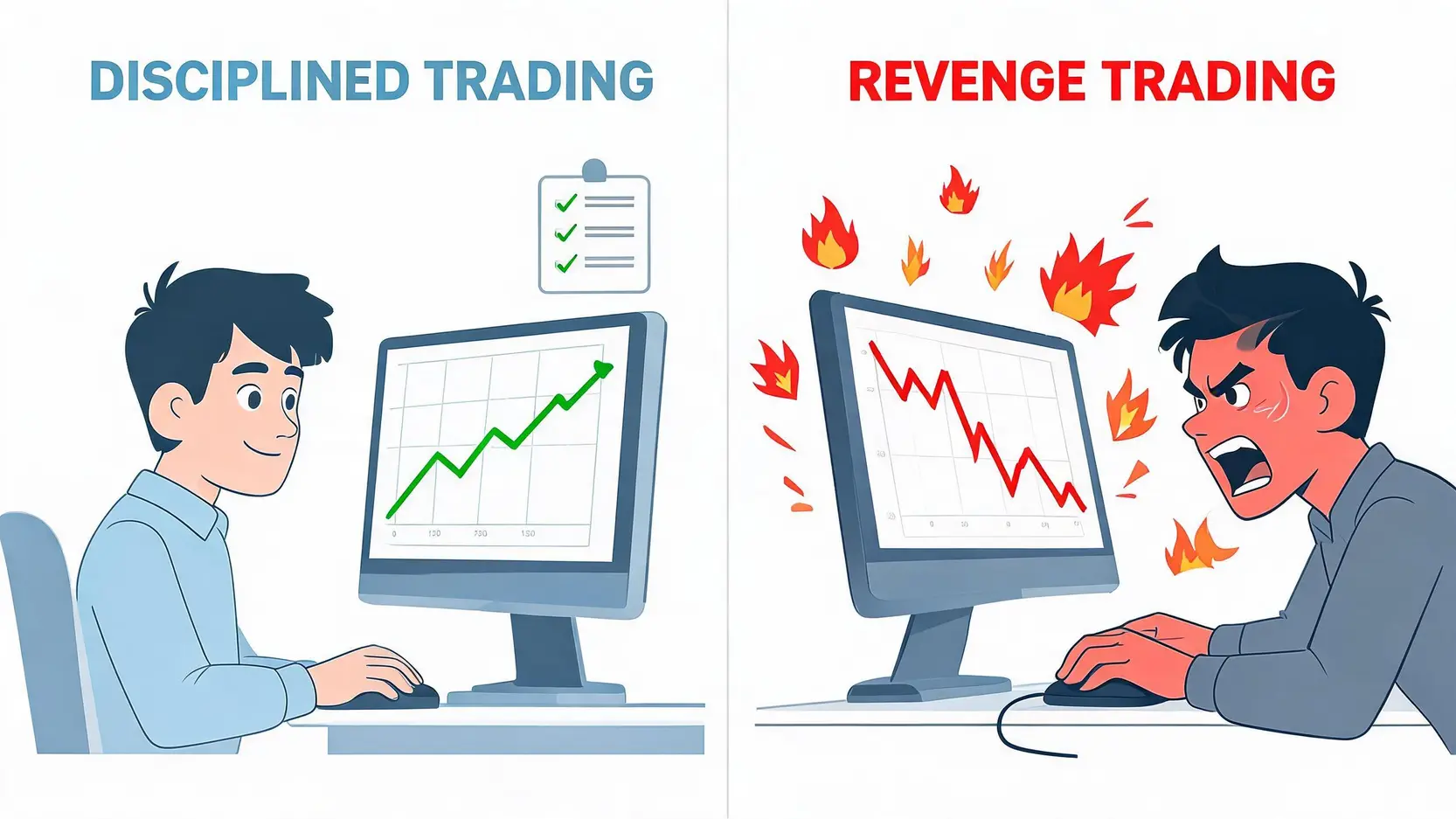
Which Path Will You Choose? The Left Side Leads to Discipline and Stability, While the Right Side Leads to Emotional Chaos.
Strategy 1: Create and Strictly Follow Your Trading Plan and Iron Discipline
Trading without a plan is gambling. Your trading plan should resemble a business plan, detailed and specific, including at minimum:
- Trading Instruments and Timeframes
- Entry Conditions (Checklist)
- Exit Conditions (Take Profit and Stop Loss)
- Position Management Rules
Write it down and place it beside your screen. Review it step by step before every trade. Your trading plan is your strongest weapon against emotional impulses.
Strategy 2: Set a Clear “Maximum Daily Loss” Limit
This is one of the simplest and most effective risk control mechanisms. Set a maximum daily loss percentage your account can tolerate (for example, 2%). Once your total loss for the day reaches that limit, no matter what happens, immediately close all positions, shut down your trading software, and continue another day. This “circuit breaker mechanism” forcibly prevents irreversible losses caused by emotional decision-making.
Strategy 3: Practice Mindfulness Meditation and Breathing Techniques to Interrupt Emotional Triggers
Trading is largely a psychological game. Learning to manage your physical and mental state is crucial. When feeling stressed or impulsive, try the following:
- 4-7-8 Breathing Technique: Inhale for 4 seconds, hold your breath for 7 seconds, and exhale for 8 seconds. Repeating this several times can quickly calm your heart rate.
- Mindfulness Meditation: Spend 10-15 minutes daily focusing on your breathing and observing thoughts as they come and go without judgment. This increases emotional awareness so that when impulsive thoughts appear, you can “observe” them instead of immediately “becoming” them.
Strategy 4: Build a Detailed Trading Journal and Quantify Your Emotional Fluctuations
A trading journal should not only record numbers. After each trade, add an “emotion column” and rate your psychological state on a scale from 1-5 (1 = very calm, 5 = extremely impulsive/greedy/fearful). Over time, you will discover a surprisingly strong correlation between your emotional scores and your trading results. This data allows you to clearly see how emotions affect your decision-making, enabling targeted improvement.
Strategy 5: Seek Support From a Trading Community to Break Free From Isolation
Trading is a lonely journey, and isolation often intensifies emotional problems. Find a community or mentor made up of disciplined traders. When experiencing losses, having people to talk to, exchange ideas with, and receive objective feedback from can greatly reduce psychological pressure and prevent you from becoming trapped in your own thoughts and making irrational decisions.
Conclusion
In summary, overcoming revenge trading does not happen overnight. It is a process of developing discipline, self-awareness, and emotional control. The key lies in accepting losses as normal, learning to stay calm during adversity, and treating your trading plan as an unshakable principle. Starting today, integrate the strategies mentioned in this article into your daily trading routine and replace the emotional urge to recover losses with rationality and discipline. You will discover that when you stop trying to defeat the market and instead learn to move with it, the path toward consistent profitability will naturally unfold before you. Start improving your trading journal today and take the first step toward becoming a disciplined trader.
Frequently Asked Questions (FAQ)
Q: How long should I take a break after consecutive losses?
A: This depends on your personal tolerance and trading rules. A common guideline is the “three-strike rule”: if you experience three consecutive losing trades, you should stop trading for the day. As for how long to rest, you should at least wait until the next day to ensure your emotions have fully settled and you have objectively reviewed the losing trades. If the losses are significant, you may even consider stepping away from the market for 2-3 days or a full week to completely reset your mindset.
Q: How can I distinguish between a rational strategy adjustment and irrational “revenge trading”?
A: The key difference lies in the “motivation” and the “basis”. Rational strategy adjustments are based on objective data after a review process. For example, you may notice increased market volatility and therefore decide to reduce position size or adjust stop-loss distances. Such adjustments are planned and logical. Irrational “revenge trading”, on the other hand, is emotionally driven, with the sole motivation being “recovering lost money”. It often appears in the form of suddenly increasing position size, ignoring existing rules, and lacking any data or strategic support.
Q: How can beginner traders build a healthy trading mindset from the start?
A: Beginners should focus on learning and process rather than profits from the very beginning. First, trade using a demo account or extremely small amounts of real capital. The goal is to become familiar with the process and validate strategies, not to make money. Second, treat maintaining a trading journal as the most important task, carefully documenting every step. Finally, genuinely accept that losses are part of the learning process, and do not become discouraged by small early losses or rush to recover them. Developing these habits will build a strong psychological foundation.
Q: What is the best risk-reward ratio?
A: There is no absolute “best” risk-reward ratio, as it depends on your trading strategy and win rate. Generally speaking, high win-rate strategies (such as scalping) may work with lower risk-reward ratios (such as 1:1 or lower), while lower win-rate strategies such as trend following require higher risk-reward ratios (such as 1:2, 1:3, or even higher) to offset multiple small losses. The key is ensuring that your (average profit × win rate) is greater than your (average loss × loss rate), meaning your expectancy remains positive.
Related Articles
-
How to Get Started with Bitcoin? The Complete 2026 Bitcoin Buying Guide for Beginners After watching Bitcoin repeatedly reach new highs in recent years and successfully pass spot ETF reviews in the US and Hong Kong in 2024, officially entering mainstream financial markets, many investors have turned their attention to...2026 年 7 月 20 日
-
Is Gold’s V-Shaped Rebound a Bottom-Fishing Signal? A Complete Guide to Trading Strategies Amid “$100 Price Swings” What Is a Gold V-Shaped Rebound? More Than Just a Technical Pattern The gold market has recently experienced sharp rises and falls, with prices frequently displaying dramatic “gold V-shaped rebounds”. Single-day “$100 price...2026 年 7 月 20 日
-
What Is PPI Data? 2026 Latest Analysis: Understand the Differences from CPI and How It Affects Stock Market Trends With market information constantly changing, do you always hold your breath while waiting for CPI data to be released? But did you know that a more forward-looking inflation indicator, PPI data...2026 年 7 月 20 日