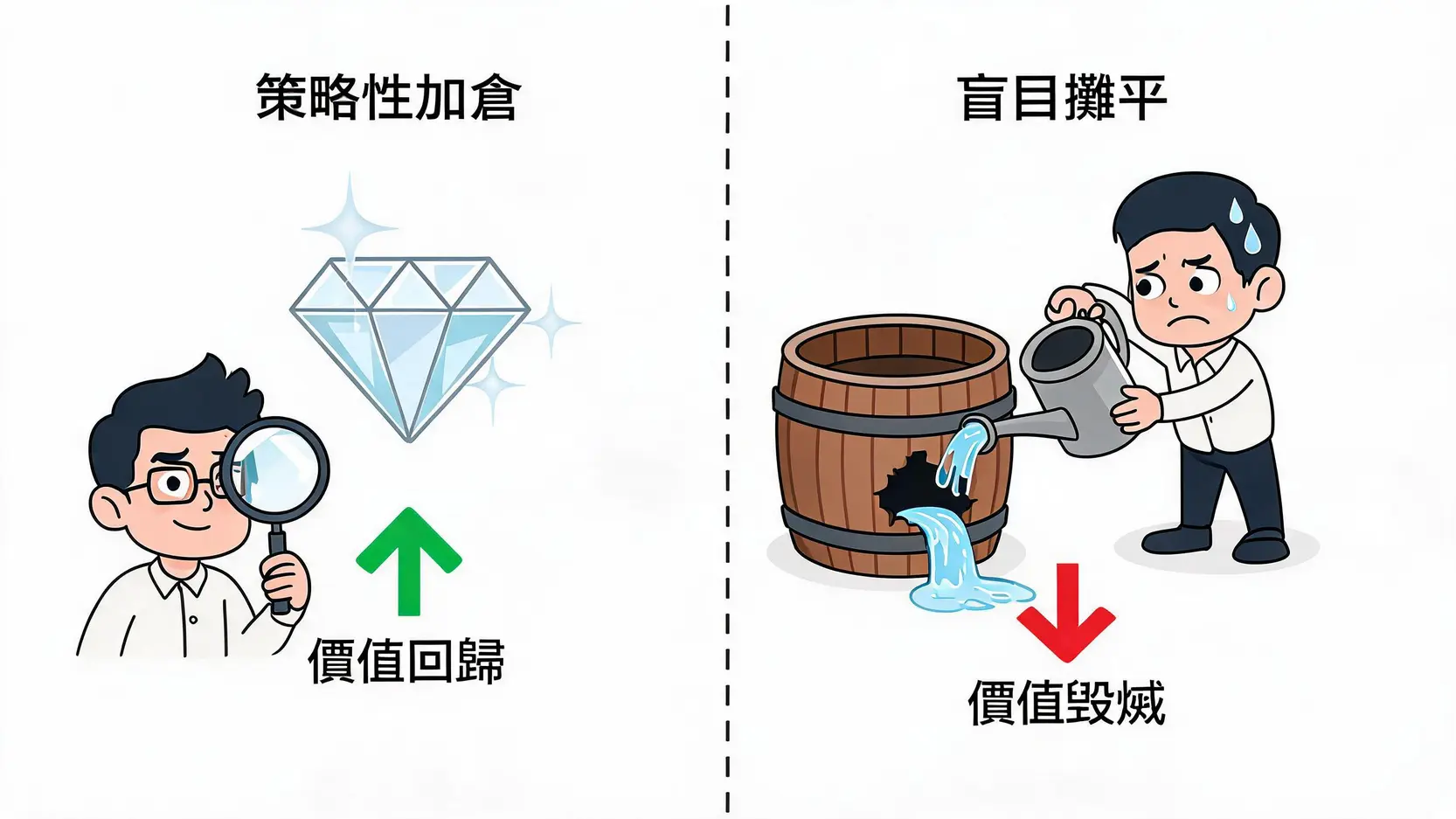
Figure One: Strategic Position Adding vs. Blind Averaging Down, Core Thinking Is Very Different
Simply put, averaging down is passive and mechanical; adding positions is active and strategic. The former focuses on “book cost”, while the latter focuses on “future value”.
The Validity Period of a Position-Adding Window: Once Missed, It Is No Longer a Good Opportunity
A position-adding window is time-sensitive. It closes under the following two situations:
- Price returns to value: When market sentiment returns to rationality, and the asset price rebounds back to its reasonable valuation range, the “discount” advantage of adding positions disappears, and the window closes.
- Fundamentals deteriorate: If, after the decline, the asset’s internal operations or external environment experiences permanent negative changes, proving that the initial decline was reasonable, then this is not a position-adding window, but a “value trap”. At this point, what should be considered is not adding positions, but stop-loss.
Therefore, continuously tracking the asset’s fundamental condition is an important task in judging whether the position-adding window remains valid.
How to Judge Whether a Position-Adding Window Has Emerged? Three Key Indicators
Now that you understand the definition of a position-adding window, the next question is: how do you know it has appeared? Relying on feelings alone is unreliable. You must learn to use objective indicators to make a comprehensive judgment. The following three major indicators can help you improve the accuracy of your judgment from different dimensions.
Technical Indicators: Observe Signals From RSI, KD, and Bias Ratio
Technical indicators can help us find market oversold signals from historical price and trading volume data, making them practical tools for judging short-term buying points.
- Relative Strength Index (RSI): RSI is a momentum indicator, with values ranging from 0 to 100. Generally speaking, when the RSI value falls below 30, it means the market has entered the “oversold zone”, indicating that selling pressure may have been excessively released, and prices may rebound at any time. This is an initial observation signal for a position-adding window. To learn more about the application of RSI, refer to Futures Technical Analysis Teaching: RSI and MACD Dual-Indicator Application.
- Stochastic Oscillator (KD): The KD indicator is also used to judge overbought and oversold conditions. When both the K value and D value fall below 20 into the oversold zone, and the K line crosses above the D line from below to form a “golden cross”, this is usually regarded as a more reliable buying signal, confirming that the short-term trend may reverse.
- Bias Ratio (BIAS): The bias ratio is used to measure how far a stock price deviates from its moving average. When a stock price falls rapidly due to panic selling pressure, it can cause an excessive negative bias ratio (such as below -10%). This means the stock is oversold in the short term, and there is a high probability that it will correct toward the moving average (meaning a rebound). This also provides supporting evidence for the emergence of a position-adding window.
Market Sentiment Indicators: Seeing Opportunities From the Fear and Greed Index
Warren Buffett has a famous saying: “Be greedy when others are fearful, and fearful when others are greedy.” Market sentiment indicators are tools that quantify this philosophy. When the entire market is enveloped in extreme pessimism, it is often when high-quality assets are most severely mispriced.
One of the most well-known market sentiment indicators is the “Fear and Greed Index” compiled by CNN Business. This index integrates multiple indicators, including market momentum, safe-haven demand, and stock price breadth, with values ranging from 0 to 100.
- Index below 25: Enters the “Extreme Fear” zone.
- Index above 75: Enters the “Extreme Greed” zone.
Historical data shows that when the index is in extreme fear, it usually corresponds to a staged market bottom, which is precisely an excellent time for long-term investors to look for a position-adding window. Conversely, when the market is extremely greedy, investors should remain cautious.
Fundamental Changes: When High-Quality Assets Experience Irrational Declines
This is the most core and important part of judging a position-adding window. Technical indicators and market sentiment can both produce false signals, but solid fundamentals are the stabilizing force that supports the eventual return of asset value. An ideal position-adding opportunity usually has the following characteristics:
- The reason for the decline is unrelated to the company’s core competitiveness: For example, the entire technology sector is sold off because of Federal Reserve rate hikes, but the leading company you hold has not seen any change in its market position, patent moat, or customer loyalty.
- Financial condition remains healthy: Key financial data such as the company’s cash flow, debt ratio, and gross margin show no signs of deterioration.
- Long-term trend has not been reversed: The outlook for the industry in which the company operates remains bright, and demand for its products or services is still growing in the long run.
Before adding positions, be sure to re-examine the company’s financial reports and public statements, and ask yourself: “Do the reasons I bought this company in the first place still hold?” If the answer is yes, then this decline is an excellent opportunity for you.
Practical Strategies: Applying the Position-Adding Window for Different Investment Styles
Different investors define and operate position-adding windows differently. Only by understanding your own investment style can you find the most suitable position-adding strategy.
Long-Term Investors’ Position-Adding Strategy: Focus on Value Emergence
Long-term investors, also known as value investors, focus more on a company’s intrinsic value. Their position-adding window opens when “price is far below value”.
- Core operation: They conduct valuations on a company and calculate the stock price range they believe is reasonable. When the market price falls below this range due to short-term factors and provides a sufficient “margin of safety”, it becomes the time for them to add positions in batches.
- Focus indicators: They place greater emphasis on fundamental analysis, such as price-to-earnings ratio (P/E), price-to-book ratio (P/B), return on equity (ROE), and others, while combining market sentiment indicators to judge entry timing.
- Mindset: They do not care whether prices continue to fall in the short term, because what they are buying is the company’s earning power over the next many years.
Swing Traders’ Position-Adding Strategy: Focus on Trend Reversal Points
Swing traders pursue profits from medium-term trends, and their holding period may range from a few weeks to a few months. For them, a position-adding window is more like a “technical reversal signal”.
- Core operation: After a stock price has declined for a period of time, they add positions when oversold signals appear and are accompanied by confirmation of reversal from technical indicators, such as a KD golden cross or MACD histogram turning from negative to positive.
- Focus indicators: They rely heavily on technical analysis, including trendlines, support and resistance levels, as well as momentum indicators such as RSI, KD, and MACD.
- Mindset: They need stricter risk control. Once their trend judgment is wrong, they will decisively stop loss, instead of switching to “long-term investment”.
The Risks and Returns of Pyramid Position Adding vs. Inverted Pyramid Position Adding
Once you have decided to add positions, the next question is “how to add?” Pyramid and inverted pyramid are the two most common capital allocation strategies:
| Position-Adding Method |
Operation Method |
Advantages |
Disadvantages
|
Suitable Style |
| Pyramid Position Adding |
The largest amount of capital is used for the first purchase, and as the price falls later, the amount of capital added each time gradually decreases. |
Lower risk, with better control over the initial cost. Even if the price continues to fall later, the overall loss remains relatively controllable. |
The average cost declines more slowly. If the stock price rebounds quickly, the profit potential is relatively smaller. |
Stable and conservative investors. |
| Inverted Pyramid Position Adding |
A smaller amount of capital is used for the first purchase, and as the price falls later, the amount of capital added each time gradually increases. |
It can significantly lower the average cost. Once the stock price rebounds, the profit can be very substantial. |
The risk is extremely high. If the stock price continues to break lower without turning back, it will cause serious losses. It requires a large amount of capital and strong psychological resilience. |
Aggressive investors who have strong confidence in the underlying asset. |
Further Reading (Highly Recommended)
The More You Average Down on Stocks, the Deeper the Losses? Understand Averaging Down Calculations, Pros and Cons, and Risks in One Article
How to Read the RSI Indicator? A Complete Guide to Parameter Settings, Pros and Cons, Flattening, and Divergence
Frequently Asked Questions (FAQ)
Q: When a position-adding window appears, should I invest all my funds at once?
A: Absolutely not! This is a major taboo in investing. No matter how confident you are in this position-adding opportunity, uncertainty always exists in the market. The correct approach is to adopt a “staggered investment” strategy. Divide the funds you plan to invest into 3 to 5 batches, and gradually build positions as prices decline or signals are confirmed. This not only helps manage risk better, but also gives your average cost a greater advantage. Good capital control and asset allocation are more important than accurately catching the buying point.
Q: What should I do if my judgment is wrong and prices continue to fall after adding positions?
A: This is an issue every investor must face. First, before adding positions, you should set a “stop-loss point” or “reassessment point”. For example, you can set a rule that when the price falls another 15%, or when a key fundamental indicator, (such as revenue) falls short of expectations, you must reassess your investment logic. If you find that the basis for your original judgment has disappeared, you should decisively execute the stop-loss, admit the mistake, and preserve capital while waiting for the next opportunity. Never let one strategic position addition evolve into an unlimited averaging-down disaster.
Q: Does the position-adding window apply to all types of investment products?
A: In theory, it applies, but the effects and risks vary greatly. The position-adding window strategy is most suitable for assets that have “intrinsic value” and whose value is relatively easy to estimate, such as high-quality blue-chip stocks and ETFs that represent broad market indices. This is because these assets have long-term upward trends and a higher probability of value returning. For highly speculative products, such as some cryptocurrencies or meme stocks without stable profit models, their price fluctuations are mainly driven by market sentiment and lack solid value support. The risks of adopting a position-adding strategy are extremely high, and it is easy to lose everything.
Q: For beginners, which indicator should they focus on most when judging a position-adding window?
A: For beginners, placing “fundamental changes” first is the safest and most important method. Technical indicators and market sentiment can serve as supplementary references for entry and exit timing, but the final decision on whether you should add positions should be based on your confidence in the “long-term value” of the asset. First ask yourself: “Will this company or this market be better five years from now than it is today?” If the answer is uncertain, then even if the technical indicators look impressive, you should still proceed cautiously.
Conclusion
In summary, understanding and correctly identifying the “position-adding window” is a key skill for improving long-term investment performance. It is by no means blind buying when the market falls, but a rigorous decision-making process that combines a deep understanding of asset value, contrarian thinking toward market sentiment, and the comprehensive use of technical indicators. The next time the market is once again filled with panic and fear, please remain calm, let go of the old mindset of “averaging down”, and use the three major indicators mentioned in this article, technicals, sentiment, and fundamentals, to examine the high-quality assets in your investment portfolio. You will be able to seize real opportunities more calmly and lay a successful foundation for your wealth growth.