Gold Pullback: Crisis or Buying Opportunity?

Updated: 2026/06/25  |  CashbackIsland

gold-pullback-strategy

Is a Gold Pullback a Crisis or a Turning Point? 3 Major Investment Strategies and Mindsets for Facing Falling Gold Prices

Watching gold prices slide from their highs as the market faces a sharp gold pullback, do you also feel anxious and worry that the gold bull market has come to an end? In fact, within gold’s long-term upward trend, price pullbacks are an entirely normal market phenomenon. For many experienced investors, this is not only not a crisis, but may instead be an excellent opportunity to position. Want to know whether a gold price pullback is a buying opportunity? The key lies in whether you have mastered the right gold investment strategies to respond. This article will take you from the perspective of a seasoned investor to deeply analyze the essence of a gold pullback, teach you how to distinguish between a “healthy pullback” and the warning signals of a “trend reversal”, and provide three practical strategies to help you stay steady amid market volatility, and even turn a pullback into a turning point for wealth growth. 


What Is a Gold Pullback? How Is It Different From a Bear Market?

Before discussing response strategies, you must first understand the true definition of a “pullback”. Many beginner investors panic as soon as they see prices fall, confusing a pullback with a bear market, which is often the first step toward making wrong decisions. The two are fundamentally different.


Definition: The Definition and Common Range of a Technical Pullback

In technical analysis, a “pullback” (Pullback or Retracement) refers to a temporary decline or correction in price during a major upward trend. This can be seen as the market “breathing” or “resting”.

  • Common range: Generally speaking, a decline of 5% to 10% from the most recent high can be regarded as a technical pullback.
  • Market psychology: This usually means that after the market has digested the previous rapid rise, bullish forces are taking a brief rest, rather than the trend fundamentally changing.

A pullback is one of the characteristics of a strong market. It can cool down overheated market sentiment and build more energy for subsequent gains.


Cause Analysis: What Are the Reasons Behind Gold’s Decline?

A pullback in gold prices is usually triggered by some short-term factors, rather than a deterioration in long-term fundamentals. Common reasons behind gold’s decline include:

  • Profit-taking: After gold prices rise sharply within a short period, investors who bought earlier may choose to sell part of their positions to lock in profits, and this selling pressure can cause prices to temporarily fall back.
  • Short-term negative news: Certain short-term positive economic data (such as strong employment data), a temporary easing of geopolitical tensions, or hawkish remarks from central bank officials may all put short-term pressure on gold prices.
  • US dollar rebound: Gold is priced in US dollars, and the two usually have a negative correlation. When the US dollar rebounds strongly in the short term due to certain factors, gold prices naturally come under pressure and pull back.

These factors are usually temporary, and their impact will fade over time.


Key Difference: A Pullback Is a Temporary Correction, While a Bear Market Is a Long-Term Reversal

This is the most important conceptual distinction. Once you understand this, you will be able to view how to respond to a sharp gold sell-off more rationally. The table below clearly shows the differences between the two:

Characteristics

Gold Pullback (Pullback)

Gold Bear Market (Bear Market)
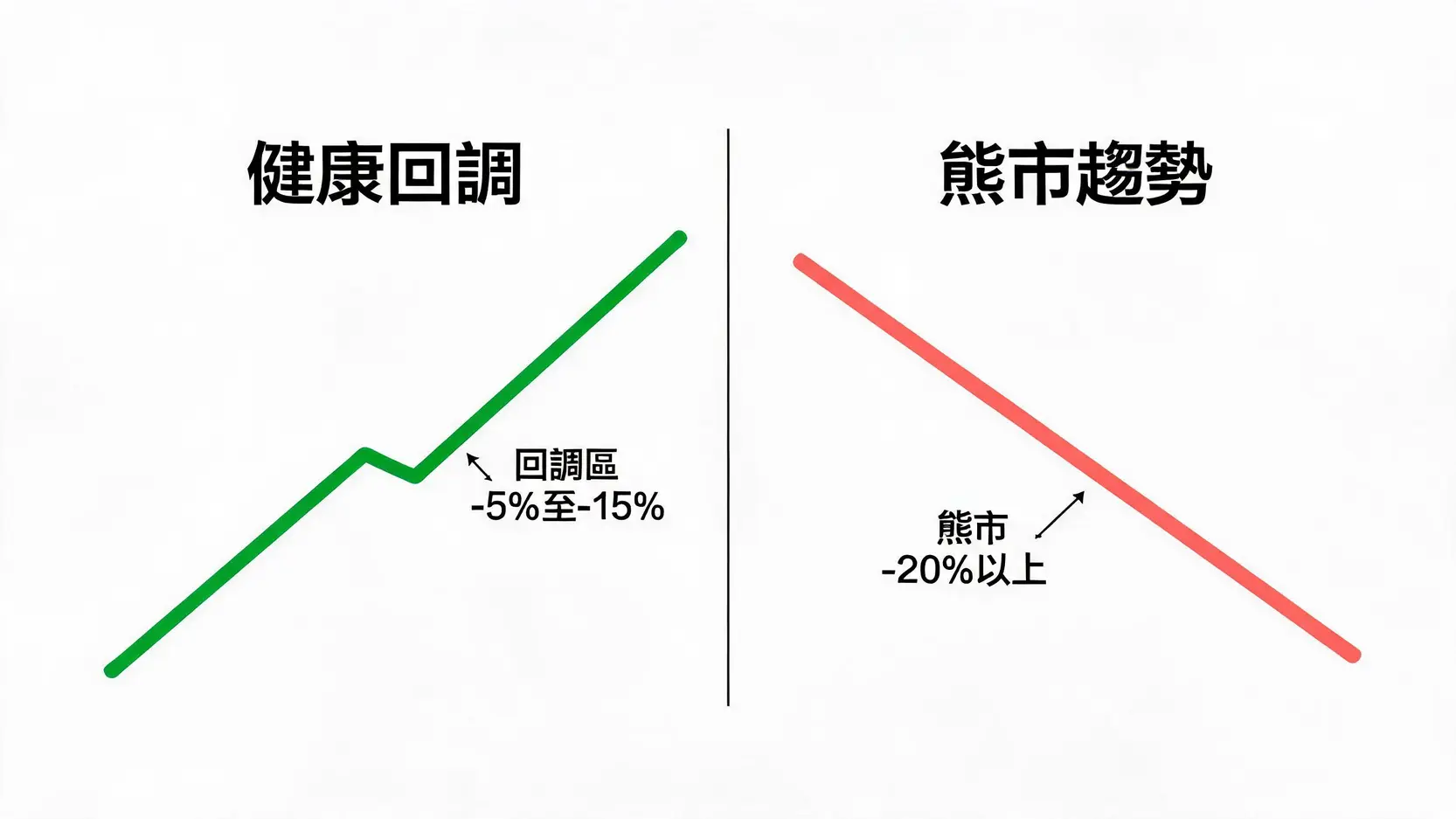
Decline Usually refers to a 5% – 15% decline from the high Usually refers to a decline of more than 20% from the high
Duration Shorter, possibly a few days to a few weeks Longer, possibly lasting several months or even years
Trend A temporary correction within the main upward trend

The main trend has shifted to a long-term decline

Trading Volume Trading volume may shrink during declines and expand during rebounds Trading volume usually expands during declines, while rebounds are weak
Trading Volume Long-term bullish fundamentals remain unchanged Long-term fundamentals show structural deterioration

Simply put, a pullback is like taking one or two steps back while “going upstairs”; a bear market is when the whole person starts “going downstairs”.

一張對比圖,展示了黃金健康回調與熊市趨勢的區別。回調是上漲趨勢中的短暫下跌,而熊市是長期的下跌趨勢。

Figure One: Healthy Pullback vs. Bear Market Trend Diagram


How to Judge the Nature and Potential Bottom of a Gold Pullback?

Now that we know a pullback is an opportunity, the next question is: how far will prices fall? How can we judge whether this pullback is healthy, rather than the beginning of a bear market? We can combine technical analysis and fundamental analysis to make a comprehensive judgment.


Technical Analysis Method: Using Moving Averages (MA) to Find Support

Moving averages (Moving Average, MA) are commonly used tools for judging trends and finding dynamic support levels. In an upward trend, some key moving averages become potential “floors” when prices pull back.

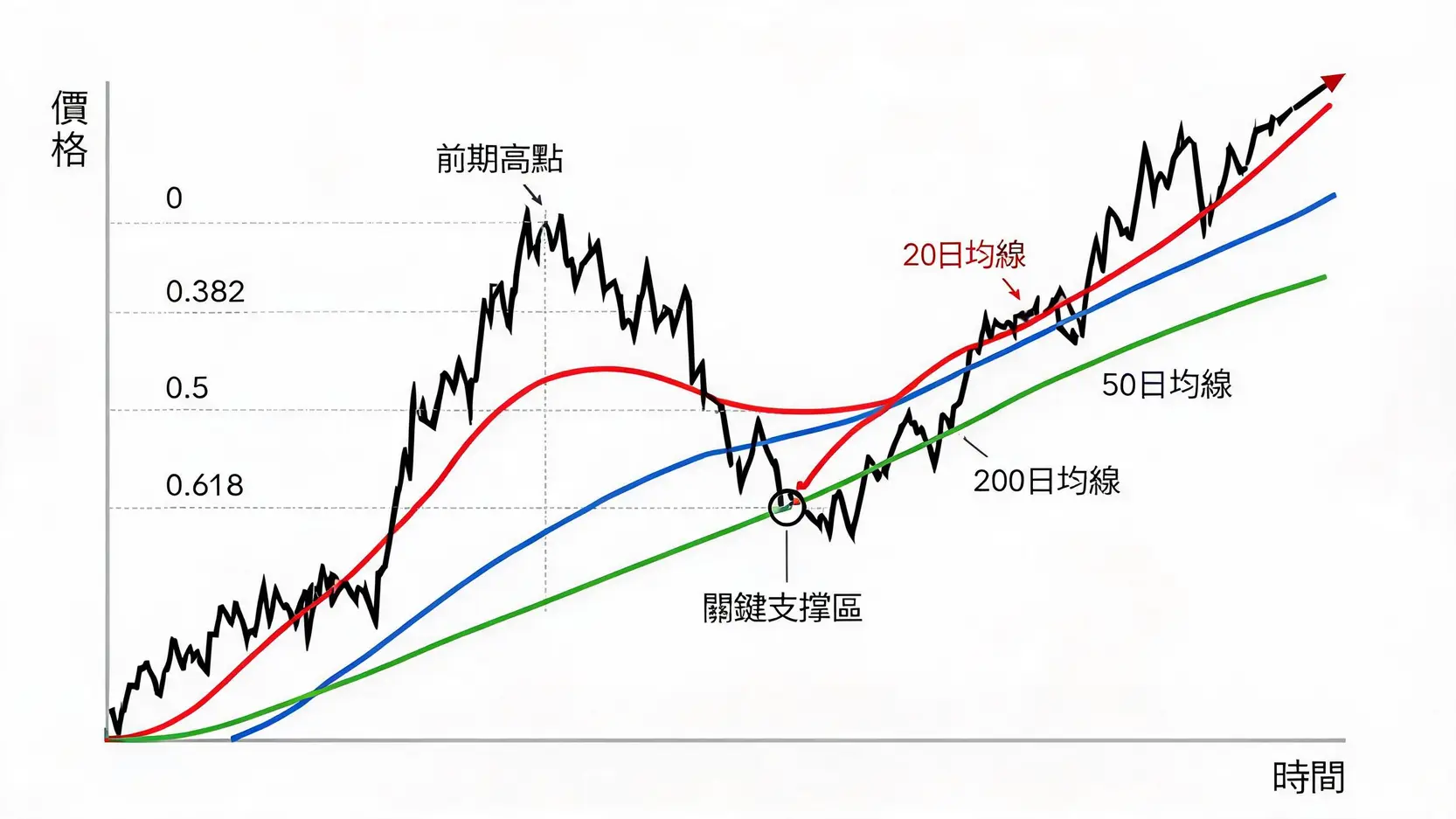
  • Short-term support: The 20-day moving average (20MA), or monthly line, is key to short-term strength or weakness.
  • Medium-term support: The 50-day or 60-day moving average (quarterly line) is an important support for the medium-term trend. In a healthy pullback, prices usually find support here and rebound.
  • Long-term support: The 200-day moving average (annual line) is regarded as the “lifeline” between a bull market and a bear market. As long as prices remain above the 200-day moving average, the long-term trend is considered healthy.

When gold prices pull back near these moving averages, you can closely watch whether signals such as shrinking trading volume and price stabilization appear.


Technical Analysis Method: The Golden Ratio Levels of Fibonacci Retracement

Fibonacci Retracement is another powerful tool for predicting the bottom of a pullback. It uses golden ratio levels to identify potential support zones. In practice, draw it from the lowest point to the highest point of the previous upward move, and the system will automatically generate several key retracement levels:

  • 0.382 (38.2%): A common target level for a strong pullback.
  • 0.5 (50%): The target level for a moderate pullback, and also an important psychological threshold.
  • 0.618 (61.8%): Known as the “golden ratio level”, it is the extreme support zone for a pullback. If this level is effectively broken, it may mean the trend is at risk of reversal.

When Fibonacci retracement levels are used together with moving averages, if both overlap in a certain price zone, the support in that area will be stronger.

一張技術分析圖表,展示了黃金價格在上漲趨勢中回調時,如何利用移動平均線和斐波那契回撤線來尋找潛在的支撐區域。

Figure Two: Using Technical Indicators to Identify Potential Support Zones


Fundamental Analysis: Are the Factors Causing the Pullback Short-Term in Nature?

Technical analysis tells us “where to buy”, while fundamental analysis tells us “why to buy”. During a pullback, you must calmly assess whether the long-term reasons that initially supported your purchase of gold still exist.

  • Inflation expectations: Have long-term high inflation expectations changed?
  • Monetary policy: Has the long-term monetary policy direction of major global central banks (especially the Federal Reserve) shifted from easing to sharp tightening?
  • Geopolitics: Has global geopolitical uncertainty disappeared, or has it only temporarily eased?
  • Central bank gold purchases: Are central banks around the world still continuously increasing their gold reserves? You can refer to official data from the World Gold Council.

If these long-term bullish factors have not changed, then a price pullback triggered by short-term news instead provides a more attractive entry price.


Further Reading (Highly Recommended)

Gold Investment Beginner’s Guide: A Full Analysis of the Pros and Cons of 5 Major Channels, Understanding Investment Benefits and Risks

How to Reduce Investment Risk? 5 Major Risk Management Strategies and Practical Diversification Teaching


3 Practical Response Strategies for Facing a Gold Pullback

Once you can judge the nature of a pullback, the next step is action. Different investors can adopt different strategies based on their own risk tolerance and investment style.


Strategy One: Buying in Batches (Pyramid Position Building)

This is the most stable strategy, and also the most suitable one for most people. Do not try to guess the market’s “absolute bottom”, because no one can predict it accurately. Buying in batches can help you average down costs and reduce the risk of buying all at once near a high.

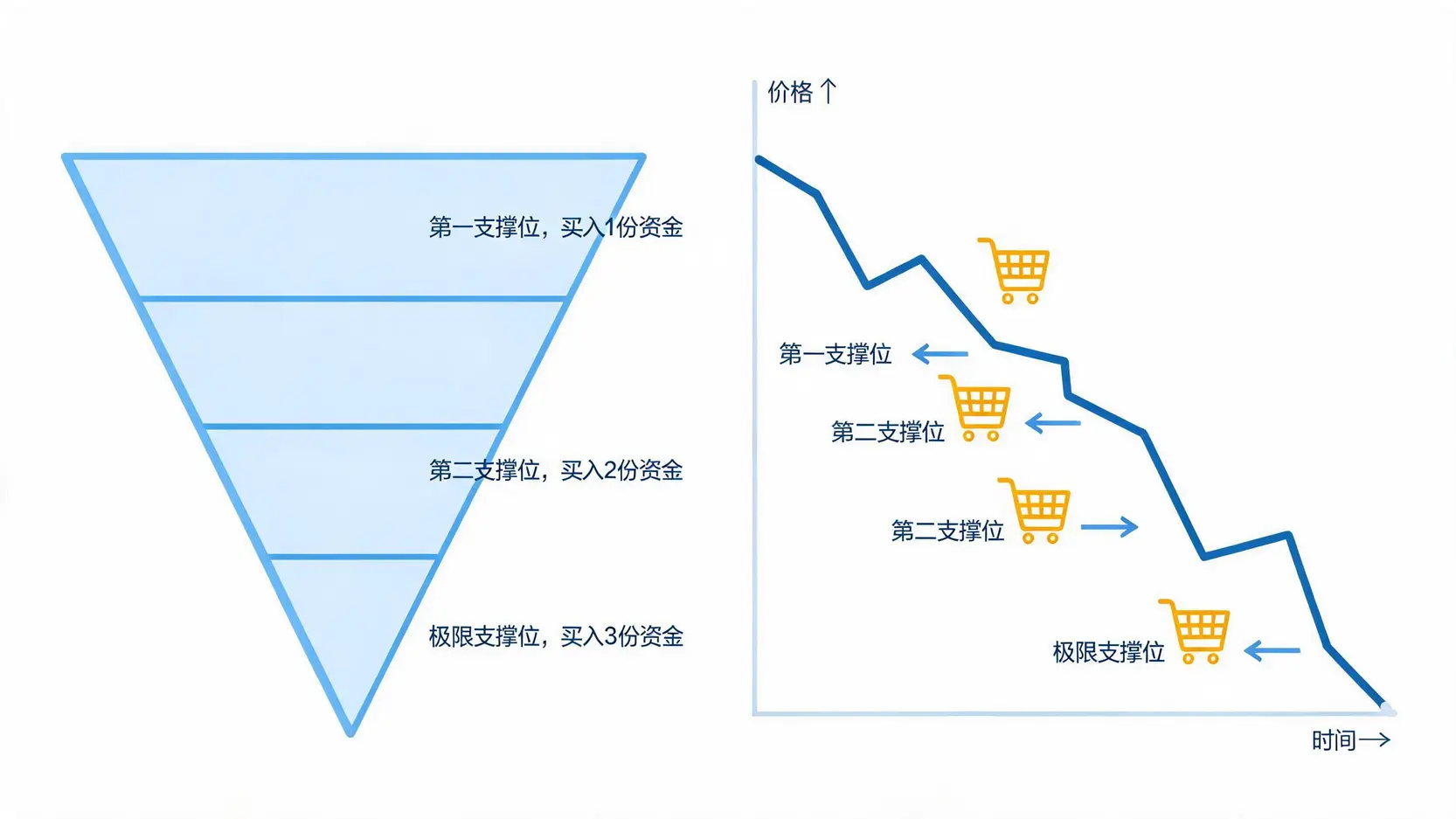
  • Operation method: Divide the funds you plan to invest into 3-4 portions. When gold prices touch the first support level you have set (for example, the 50-day moving average or the 38.2% retracement level), buy the first portion.
  • Timing for adding positions: If the price continues to fall to the next key support level (for example, the 200-day moving average or the 61.8% retracement level), buy the second portion, or even the third portion.
  • Capital allocation: You can use an “inverted pyramid” approach, meaning the lower the price, the larger the portion you buy. For example, buy 10% in the first portion, 20% in the second portion, and 30% in the third portion.

The core of this strategy is “buying more as prices fall”, provided that you have confidence in gold’s long-term trend.

一張示意圖,解釋了金字塔式分批買入策略。隨著黃金價格下跌至不同的支撐位,投入的資金份額逐漸增加。

The core of this strategy is “buying more as prices fall”, provided that you have confidence in gold’s long-term trend.


Strategy Two: Set Key Support Levels and Strictly Execute Stop-Losses

For investors with extremely high risk-control requirements, or those conducting short- to medium-term trades, setting stop-losses is essential. Even if you believe this is only a pullback, uncertainty always exists in the market.

  • Set a stop-loss point: Set a clear stop-loss price below the key support level where you buy. For example, if you buy near the 200-day moving average, you can set the stop-loss at 3%-5% below the 200-day moving average.
  • Avoid emotional decisions: Once the price touches the stop-loss point, you must strictly execute it. Do not hold on to the wishful thinking that “it will rise back immediately”. This can help you avoid huge losses during a real trend reversal.
  • Error-tolerance mechanism: Exiting with a stop-loss does not mean you judged the trend incorrectly. It is only a mechanism to protect your principal. If the price later regains firm support, you can enter the market again at any time.

Remember, the first rule for staying in the market is “survive”, and a stop-loss is your “lifeline”.


Strategy Three: Reassess Asset Allocation and Confirm Gold’s Safe-Haven Role

A market pullback is also an excellent time to review your investment portfolio. You should ask yourself: what was my original purpose in allocating gold?

  • Safe-haven function: If your purpose is to hedge stock market risk or currency depreciation, is gold still playing this role during the pullback? For example, when the stock market falls sharply, does the gold price show relatively stronger downside resistance?
  • Allocation ratio: Is gold’s current proportion of your total assets appropriate? If the proportion is too low, a pullback may be a good opportunity to increase allocation. If the proportion is already too high, you can consider delaying additional buying, or even reducing part of your position when prices rebound, to maintain portfolio balance. You can refer to asset allocation teaching to build a more stable investment portfolio.

Rational investors use market volatility to optimize their asset structure, instead of passively being led by prices.


Major Gold Pullback Events in History and Subsequent Trends

History does not simply repeat itself, but it is always strikingly similar. Reviewing several major gold pullback events in the past can provide us with valuable experience and confidence.


Case Analysis: Gold’s Trend During the 2008 Global Financial Crisis

When the global financial crisis broke out in 2008, gold, which was regarded as the ultimate safe-haven asset, also experienced a sharp pullback in the early stage. From its high of around USD 1,032 in March 2008, it once pulled back nearly 30% to a low of around USD 700 in October. At that time, the market was extremely panicked, and investors were forced to sell gold for liquidity in order to offset losses in other assets such as stocks. However, after the Federal Reserve launched large-scale monetary easing (QE), gold’s monetary attributes and inflation-hedging value became prominent. It then soared all the way from its low and reached a historical high of USD 1,920 in 2011.


Case Analysis: The Pullback and Rebound in the Early Stage of the COVID-19 Outbreak in 2020

A similar script played out again in March 2020. The COVID-19 pandemic triggered panic across global markets, and gold also fell rapidly from around USD 1,700 to near USD 1,450 due to a liquidity crisis, a decline of more than 14%. Similarly, after global central banks introduced unlimited easing policies, gold prices quickly rebounded and broke above USD 2,075 in August of the same year, setting a new historical high.


Historical Lessons: How Long-Term Holders Should View Short-Term Price Volatility

These two cases tell us:

  1. In the early stage of extreme systemic risk, gold may be sold off due to liquidity needs, resulting in a simultaneous decline with risk assets.
  2. After a crisis truly develops, rescue measures by governments and central banks (usually money printing) instead become the strongest fuel driving long-term gold price increases.
  3. For long-term investors, these deep pullbacks caused by panic, in hindsight, were all extremely rare “golden pits”.

Therefore, when facing a pullback, having a long-term perspective and firm holding confidence is crucial.


Frequently Asked Questions (FAQ)

Q: How long does a gold pullback usually last?

A: There is no fixed answer, as the duration depends on the cause that triggered the pullback. A pullback caused by short-term profit-taking may only last a few days to one or two weeks. If it is due to a strong rebound in the US dollar or a shift in market expectations for monetary policy, the pullback may extend to several weeks or even one or two months. The key is to observe whether prices can find effective support at key long-term support levels (such as the quarterly line or annual line).

Q: What should I do if gold pulls back by more than 20%?

A: From a technical definition perspective, a decline of more than 20% enters the “bear market” category. At this point, you should be more cautious. You need to: 1. Strictly review whether your original stop-loss setting has been triggered. 2. Reassess in depth whether gold’s long-term fundamentals have undergone fundamental deterioration. 3. If a trend reversal is confirmed, you should consider significantly reducing your position or exiting the market to wait and observe, rather than blindly “buying more as prices fall”. It is not too late to wait for clear bottom signals to appear before repositioning.

Q: Besides gold spot (XAUUSD), do these strategies also apply when physical gold pulls back?

A: Yes, the basic principles are the same, but the operational details are different. Physical gold (such as gold bars and gold coins) has wider bid-ask spreads and lower liquidity, making it unsuitable for frequent trading. Therefore, for physical gold investors, the strategies of “buying in batches” and “long-term holding” are more applicable. When gold prices experience a significant pullback (such as a decline of more than 10%), you can purchase part of your physical gold as a long-term asset allocation, instead of trying to catch short-term support rebounds.

Q: When gold prices pull back, what reference value does the US dollar trend have?

A: The US Dollar Index (DXY) is an important reference indicator for observing gold price pullbacks. Since gold is priced in US dollars, the two usually have an inverse relationship. If a gold price pullback is accompanied by a strong rise in the US Dollar Index, you need to closely watch whether the US dollar’s upward momentum can continue. Once the US Dollar Index is blocked at a key resistance level and pulls back, it is often a signal that gold prices have ended their pullback and restarted their upward trend.


Conclusion

In summary, a gold pullback is a normal market occurrence. It is both a test of investor psychology and a test of investment strategy. When facing falling gold prices, the key is to remain rational and avoid panic. Learning to use tools such as moving averages and Fibonacci retracement to judge the potential support of a pullback, combined with analysis of long-term fundamentals, can help you see through the short-term market fog more clearly. Whether you choose to buy in batches, set strict stop-losses, or reassess asset allocation, the core lies in establishing a response script that suits you and executing it strictly. Please remember that any investment decision should be based on your own risk tolerance. Only by viewing every market fluctuation as an opportunity to learn and optimize your strategy can you go further and more steadily on the path of gold investment.

If you liked this article, please share it!

Related Articles

  • FedWatch Guide: Predict Rate Hikes Before the Market
    Rate Hike Expectations Trading Guide: Use FedWatch to Predict Rate Hikes and Position Ahead of the Market Core Concept: Why Trade “Expectations” Instead of “Facts”? After spending enough time in the financial markets, you will notice an interesting phenomenon: the market often completes a major move before the Federal Reserve...
    2026 年 6 月 25 日
  • Monetary Policy Shifts: Hawkish vs Dovish Guide
    What Is a Monetary Policy Shift? Understand Hawkish and Dovish Signals to Position Ahead of the Market Why does the market always hold its breath for the results of Federal Reserve (Fed) meetings? Why can every interest rate decision, and even a slight “shift” in wording, always trigger sharp volatility...
    2026 年 6 月 25 日
  • 2026 Australian Dollar Trading Strategy Guide
    Ultimate Guide to 2026 Australian Dollar Trading Strategy: Master the 3 Key Factors Affecting the Australian Dollar From Scratch The Australian dollar (AUD), due to its unique attributes as both a commodity currency and a risk currency, has become an excellent choice in the forex market where volatility and opportunities...
    2026 年 6 月 25 日
返回顶部