What Is a Spread? Forex Calculation & Hidden Costs

Updated: 2026/03/02  |  CashbackIsland

點差是什麼?5分鐘學會外匯點差計算,看懂你的隱形交易成本

What Is a Spread? Learn Forex Spread Calculation in 5 Minutes and Understand Your Hidden Trading Costs

Just entered the forex market and feel confused about the various fees? Why does your trade show a small loss the moment it is executed? All of this is closely related to the core concept of “what a spread is”. A spread is a trading cost that every trader cannot avoid, yet it is also the easiest to overlook. For investors beginning their forex journey, thoroughly understanding how to calculate forex spreads is the foundation of risk control and profit improvement. This article will thoroughly explain what a spread is, from its basic definition to practical calculation, so you can clearly grasp the secrets behind trading cost spreads and make more informed investment decisions. 


What Is a Spread? Understand the Core Definition in One Minute

Simply put, a spread is the difference between the “ask price” and the “bid price” of a financial instrument (such as a currency pair). It is the primary source of profit for forex brokers in providing quotes and also the hidden cost that investors must pay when executing any trade.


Ask vs Bid: The Source of the Spread

On any trading platform, you will always see two prices for a currency pair:

  • Ask Price: This is the price at which you, as a trader, “buy” the base currency from the broker. It is always the higher price.
  • Bid Price: This is the price at which you “sell” the base currency to the broker. It is always the lower price.

You can imagine exchanging foreign currency at an airport. There is always a difference between the “buying rate” and the “selling rate”. That difference is their service fee. In the forex market, this price difference is the “spread”.

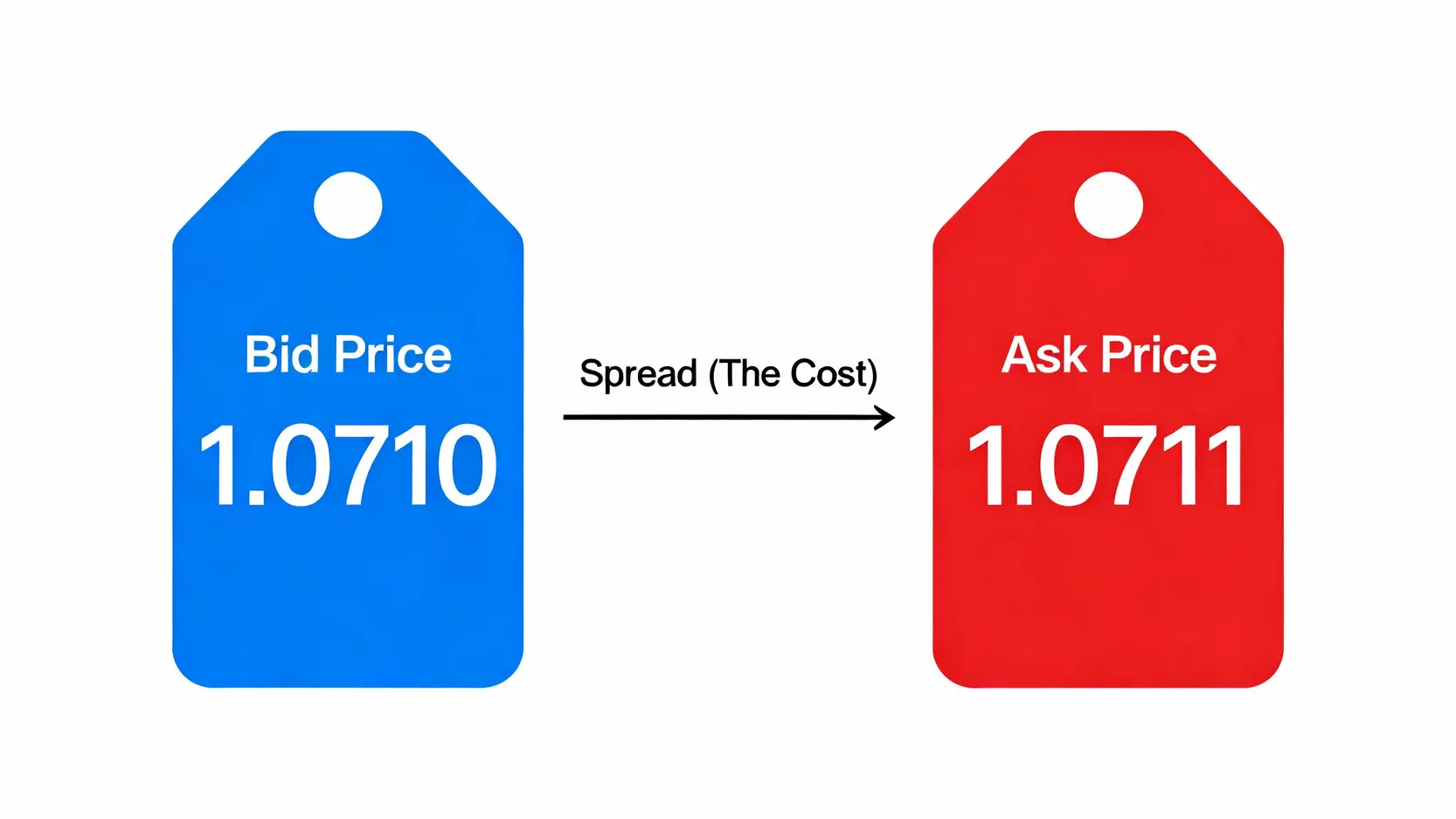
The formula for the spread is very simple: Spread = Ask Price – Bid Price一張概念示意圖,解釋外匯點差是買入價與賣出價之間的差額。

Spread Illustration: The ask price is always higher than the bid price, and the difference between them is your trading cost.


Why Is the Spread Your Primary Cost in Forex Trading?

The spread is the most direct and fundamental cost in trading. Whether you go long (buy) or short (sell), the trade is executed at a price that is less favorable to you at the outset. That means when you buy, you execute at the higher ask price, and when you sell, you execute at the lower bid price. This implies that your position must first overcome the spread before it can begin to generate a real profit. This is why your trade shows a negative figure immediately after it is opened. That negative figure represents the spread fee you have paid to the broker.


How to Calculate Forex Spreads? A Practical Example

After understanding the definition of a spread, the next step is to learn how to convert this abstract “price difference” into a concrete monetary amount. Mastering the method of calculating forex spreads allows you to accurately assess the potential cost of each trade. 

Understanding “Pip”: The Basic Unit for Calculating Spreads

A “pip” (short for Price Interest Point) is the smallest unit of price movement in a forex quote. For most currency pairs (such as EUR/USD and GBP/USD), 1 pip refers to a change in the fourth decimal place. For example, if the price moves from 1.0710 to 1.0711, it has increased by 1 pip.

Special note: For currency pairs involving the Japanese yen, 1 pip refers to a change in the second decimal place. For example, if USD/JPY moves from 145.50 to 145.51, it has increased by 1 pip.


Spread Cost Calculation Formula: Lot Size x Spread x Pip Value

To calculate the actual monetary cost of the spread, you need to use the following formula:

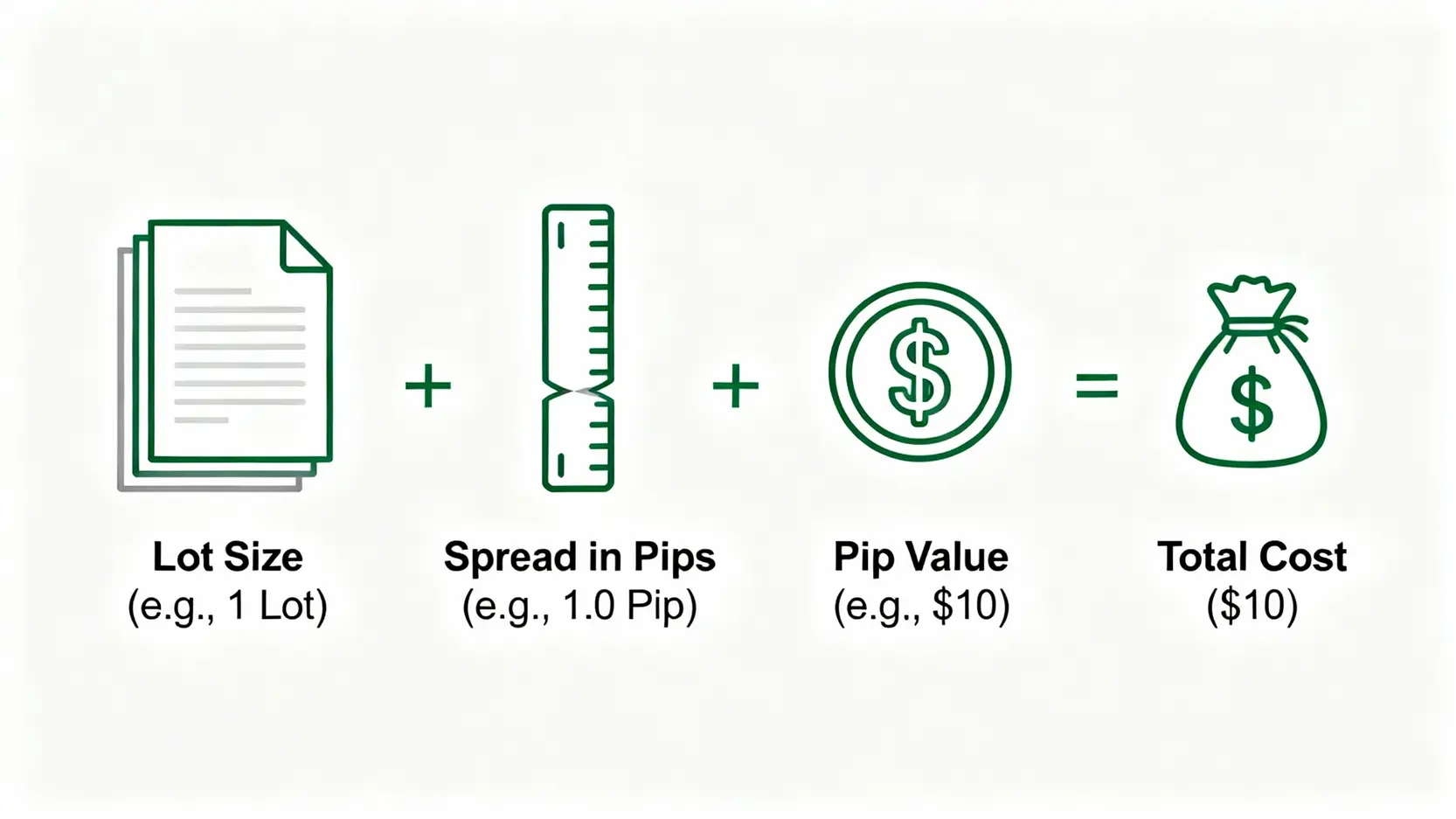
Total Spread Cost = Lot Size x Spread (Pips) x Pip Value

一張解釋外匯點差費用計算公式的圖表,顯示交易手数、點差和點值如何相乘得出總成本。

Three Key Elements of Spread Cost Calculation: Trade size, spread size, and pip value together determine the final cost.

The variables are explained as follows:

  • Lot Size: Refers to your trading volume, measured in “lots”. One standard lot typically represents 100,000 units of the base currency.
  • Spread: The bid-ask difference measured in “pips”.
  • Pip Value: The monetary value represented by a 1 pip price movement. This value depends on your lot size and the quote currency. For a standard lot where the quote currency is US dollars, the pip value is typically 10 US dollars.


Detailed Calculation Steps Using EUR/USD as an Example

Let us go through a practical example:

Suppose you see the following quote for EUR/USD on the platform:

  • Ask: 1.07110
  • Bid: 1.07100

And you plan to trade 1 standard lot (1 lot).

Step One: Calculate the Spread (Pips)
Spread = 1.07110 – 1.07100 = 0.00010
Since 1 pip for EUR/USD refers to the fourth decimal place, 0.00010 represents a spread of 1.0 pips.

Step Two: Determine the Pip Value
For a 1 standard lot trade of EUR/USD, the pip value is fixed at 10 US dollars.

Step Three: Calculate the Total Cost
Total Spread Cost = 1 (lot) × 1.0 (pip) × 10 (US dollars per pip) = 10 US dollars

This means that when you place a trade of 1 lot of EUR/USD, you need to pay a spread cost of 10 US dollars. The market price must first rise or fall beyond this cost before your trade begins to generate a profit.


Further Reading (Highly Recommended)

Start With Forex Trading Fee Analysis and Protect Every Dollar of Your Profit

【2025 Forex Broker Recommendations】A Must-Read for Beginners! Five Key Factors to Help You Choose the Best Forex Trading Platform


The Key to Trading Costs: Comparing Different Spread Types

Different forex brokers offer different types of spread accounts, mainly divided into “fixed spreads” and “floating spreads”. Understanding their differences helps you choose the most suitable platform based on your trading style, which is also an important part of managing trading cost spreads

Fixed Spreads vs Floating Spreads: Which Is More Suitable for You?

Each type of spread has its own advantages and disadvantages and is suitable for different traders:

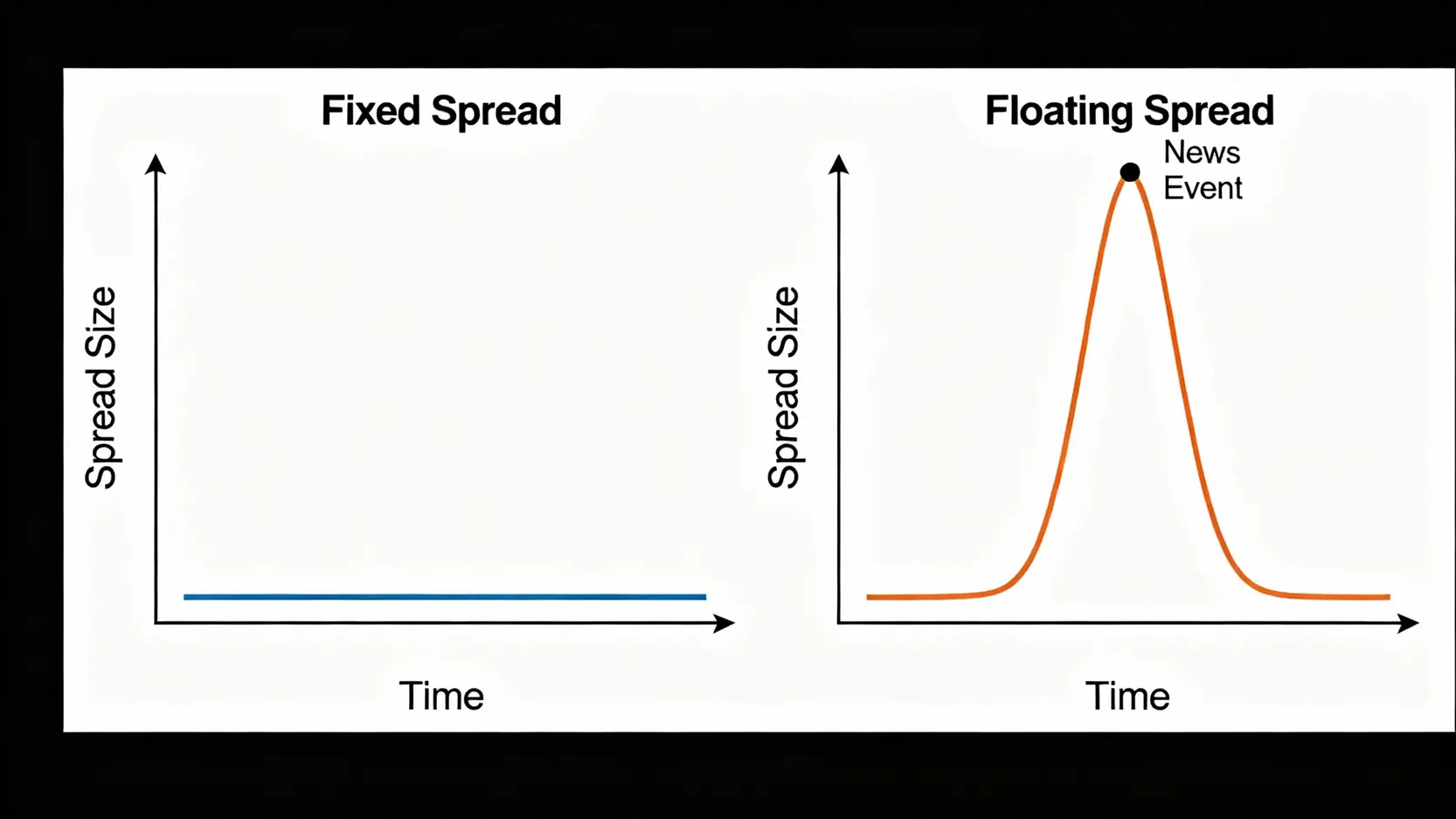
一張對比圖,顯示固定點差在任何市場條件下保持不變,而浮動點差會因市場波動而擴大或縮小。

A fixed spread (left) provides predictable costs, while a floating spread (right) increases in cost during periods of market volatility.

Type Advantages Disadvantages Suitable For
Fixed Spread ✅ Costs are predictable and not affected by market volatility ✅ Easier to plan trading strategies ❌ Usually higher than the average floating spread ❌ Re-quotes may occur Beginner traders, news traders, those who prefer stable costs
Floating Spread ✅ Spreads can be extremely low when the market is calm, even approaching zero ✅ Potentially lower trading costs and greater transparency ❌ Spreads can widen sharply during periods of high market volatility

❌ Trading costs are not fixed, making it difficult to budget precisely

Scalpers, day traders, algorithmic traders


The Truth About Zero-Spread Accounts: Are They Really Completely Cost-Free?

Many brokers launch “zero spread” or “ECN” accounts to attract clients. However, there is no such thing as a free lunch. Although these accounts offer extremely low spreads (close to zero), they extra charge a fixed commission on each trade.

Therefore, the total trading cost structure of a zero-spread account is:

Total Cost = Extremely Low Spread + Fixed Commission

This model is more transparent because the cost structure is broken down. For traders who trade frequently or with larger capital, this account type may be more cost-effective. But remember, it is not “zero cost”.


Three Major Factors That Affect Forex Spreads

Understanding which factors influence spreads can help you choose the best trading timing, thereby effectively reducing your trading cost spread. The size of the spread is mainly determined by market liquidity. 

Market Volatility: Spread Changes During Major News Releases

When major economic data, (such as the US Non-Farm Payrolls (NFP) report), or central bank interest rate decisions are released, market uncertainty increases sharply. At such times, many large financial institutions (liquidity providers) may temporarily withdraw from the market or widen their quoted price differences to avoid risk. This causes market liquidity to dry up instantly, and spreads can widen by several times or even dozens of times compared with normal conditions. Experienced traders typically avoid trading at these moments to guard against high trading costs and slippage risk.


Trading Sessions: Liquidity Differences at Different Market Open Times

The forex market operates 24 hours a day, but activity levels vary significantly across different time periods. The period with the highest liquidity and the lowest spreads is usually the overlap between the London and New York sessions (approximately 8:00 pm to 12:00 am Hong Kong time). During this period, the world’s two largest financial centers are active at the same time, trading volume peaks, bid and ask quotes are most dense, and spreads are naturally the tightest. In contrast, during the early morning hours of the Asian session or around weekends when global markets are closed, liquidity is weaker and spreads tend to be wider. 

Currency Pair Popularity: Why Do Major Pairs Have Lower Spreads?

The “popularity” of a currency pair directly reflects its trading volume and liquidity. Traders need to understand the characteristics of different currency pairs to better control trading costs.

  • Major Pairs: Such as EUR/USD, USD/JPY, and GBP/USD. These pairs involve the world’s major economies, have enormous trading volumes, and offer ample liquidity. Therefore, their spreads are the lowest among all currency pairs.
  • Cross Pairs: Currency pairs that do not involve the US dollar, such as EUR/GBP and AUD/JPY. Their liquidity is slightly weaker, and spreads are slightly higher than those of major pairs.
  • Exotic Pairs: Such as USD/TRY (US dollar/Turkish lira) and EUR/ZAR (euro/South African rand). These pairs have low trading volume, high market volatility, and elevated political and economic risk, resulting in the weakest liquidity and the highest spreads.

For beginners, starting with major pairs is a more sensible choice because their lower trading cost spreads are more beginner-friendly.

Frequently Asked Questions About Spreads (FAQ)

Q: What is the difference between spreads and fees?

A: A spread is an embedded cost between the bid and ask prices, and it exists across all account types. A fee (or commission) is an explicit charge added on top of the spread and is commonly seen in ECN or zero-spread accounts. The main cost of a standard account is the spread, while the cost of an ECN account is “extremely low spreads + fees”.

Q: What counts as a “low spread”?

A: “Low spread” is a relative concept that depends on the currency pair and the market session. Generally, during normal trading hours, for major pairs such as EUR/USD, a spread below 1.0 pip can be considered relatively low. For cross pairs, 2 to 3 pips may already be quite good. The benchmark is to compare the platform’s spreads with the industry average.

Q: How do I choose a forex trading platform that offers low spreads?

A: When choosing a low-spread platform, you should not focus only on the advertised “minimum spread”. You should pay attention to the “average spread”, because it better reflects the real trading cost. In addition, you should also consider the platform’s regulatory credentials, fund security, order execution speed, and customer service. A reliable platform will offer competitive spreads within the industry and will not widen them excessively during market volatility.

Q: Is the spread the only trading cost?

A: No. The spread is one of the main trading costs, but it is not everything. Other potential costs include commissions (for certain account types), overnight interest (swap rates, incurred when holding positions overnight), and possible deposit and withdrawal fees. A well-rounded trader needs to consider all these factors to assess total trading costs.


Conclusion

In summary, thoroughly understanding “what a spread is” and becoming proficient in “forex spread calculation” is an essential path for every forex trader, from beginner to advanced. It is not merely a term, but a key cost that directly affects your trading profits and losses. A savvy trader not only analyzes macro market trends and technical charts, but also knows how to manage every spread-related expense as meticulously as running a business. I hope this guide helps you build a clear cost framework and gain an edge on your trading journey ahead. Review the spreads on your current platform now and take the first step in practicing cost management!

If you liked this article, please share it!

Related Articles

  • Fed Rate Hikes & Crypto Liquidations Explained
    How Do Federal Reserve Interest Rate Hikes Trigger Waves of Cryptocurrency Liquidations? Understanding the Logic Behind It in One Article Introduction Late at night, alarm bells ring across the market. The prices of Bitcoin and other cryptocurrencies suddenly plunge, causing hundreds of thousands of investors to be liquidated within moments....
    2026 年 6 月 12 日
  • Interest Rates vs Exchange Rates: Taiwan’s Policy Guide
    The Interest Rate and Exchange Rate Seesaw: How Does the Central Bank Use the "Dual-Rate Policy" to Stabilize Taiwan's Economy? Interest rates and exchange rates are the two lifelines of a country's economy. Any movement in either one directly affects the stock market, property market, corporate profitability, and even the...
    2026 年 6 月 12 日
  • US-Japan Rate Gap: The Real Cause of Yen Weakness
    US-Japan Interest Rate Differential Out of Control? Uncovering the Root Causes of Yen Depreciation and the Bank of Japan's Policy Dilemma Recently, even though Japan's Ministry of Finance has repeatedly deployed large-scale intervention measures, the yen has only enjoyed brief periods of relief before returning to its depreciation trend. This...
    2026 年 6 月 9 日
返回顶部