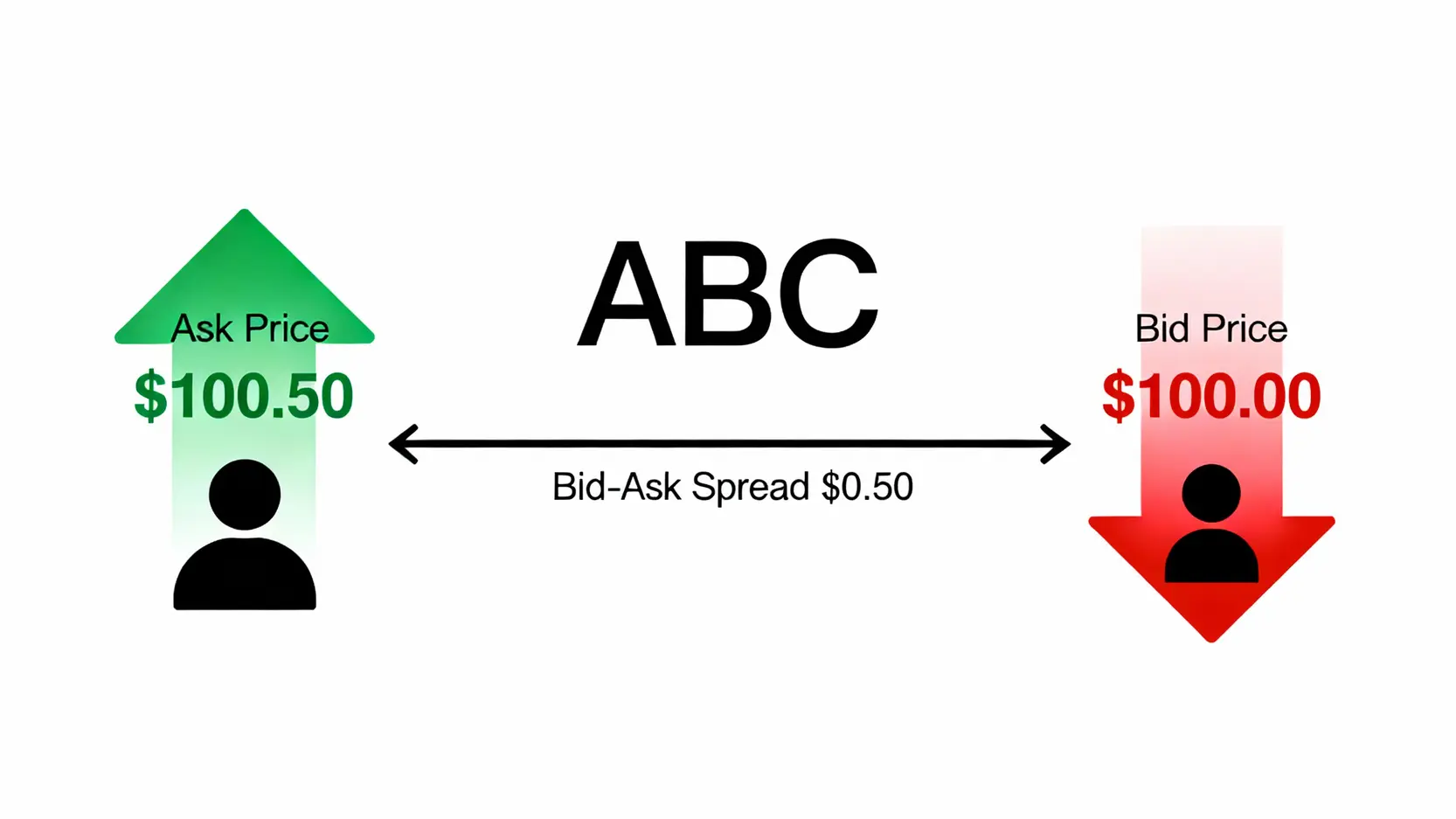
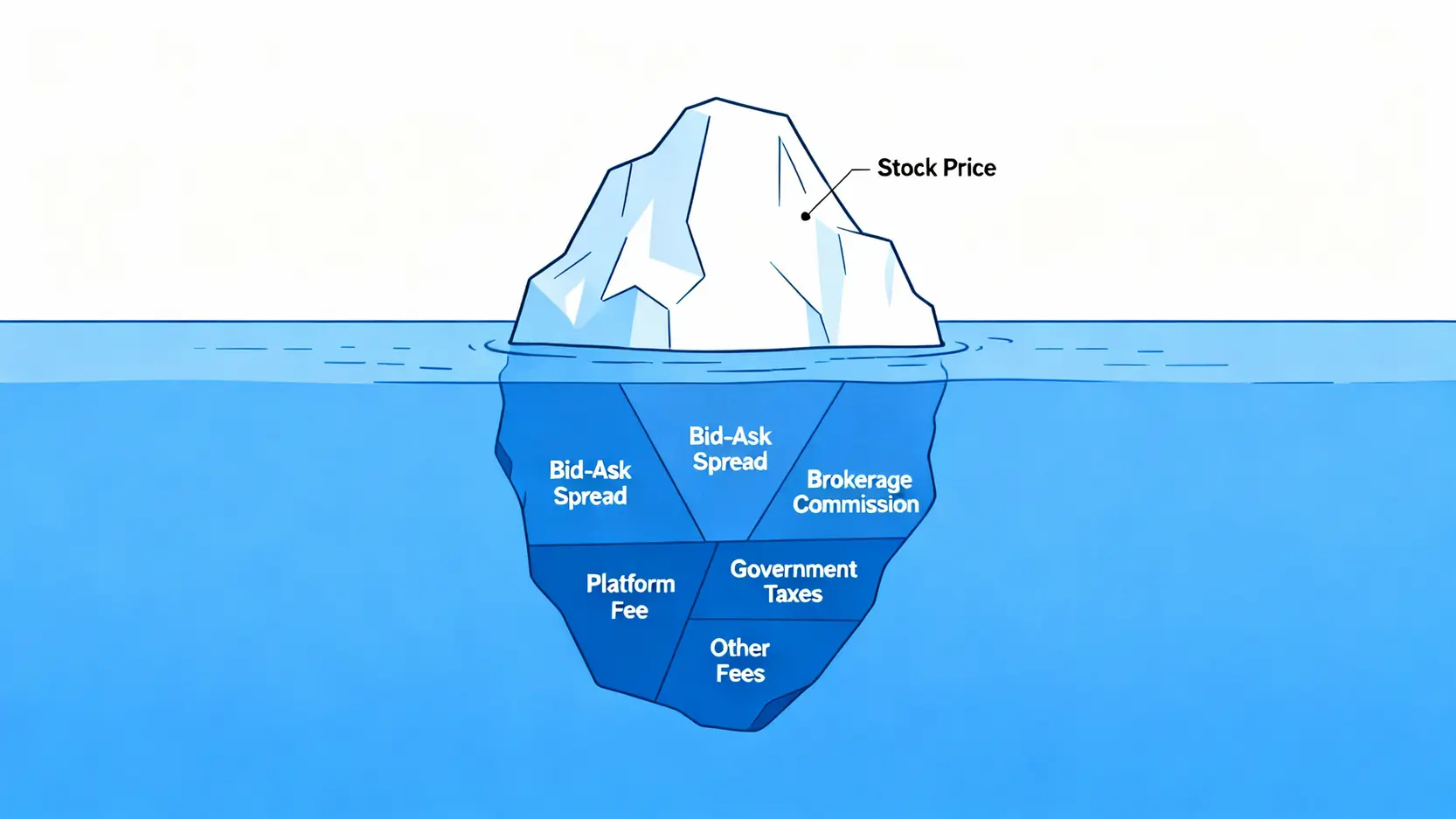
The total cost of trading goes far beyond the stock price itself. Hidden costs such as spreads, commissions, and taxes account for a larger portion.
Beyond the stock spread, there are several other “invisible killers” on your trading cost list. Especially when you see promotions for “zero commission”, you must stay vigilant, because that does not mean zero cost. Below are the three major hidden stock trading costs you must understand when investing in Hong Kong stocks.
Hidden Cost One: Brokerage Commissions and Platform Fees
This is the most widely known trading cost, but the fee structures vary greatly. Traditional banks or brokers usually charge commissions as a percentage of the transaction amount, often with a minimum fee. In recent years, new internet brokers have emerged, operating mainly on a “platform fee” or fixed-fee model.
- Trading Commission: Charged as a certain percentage of the transaction amount, for example 0.03%, with a minimum charge of HK$3.
- Platform Fee: A fixed fee charged per order regardless of transaction amount, for example HK$15 per order.
⚠️ Note: “Zero commission” does not mean “zero platform fee”. Many platforms use commission-free promotions to attract clients but still charge platform usage fees. For small-amount traders, this fixed fee may be higher than the commission itself. When choosing a broker, be sure to carefully review its fee details and calculate which model is more advantageous for your trading style.
Hidden Cost Two: Government Charges (Stamp Duty, Transaction Levy)
This portion of the fees is unavoidable for all investors and is collected by the Hong Kong government and regulatory authorities. Regardless of which broker you use, these charges must be paid.
| Fee Item |
Charged By
|
Fee Schedule (Payable by Both Buyers and Sellers) |
| Stock Stamp Duty |
Hong Kong Government |
0.1% of the transaction amount (minimum HK$1 even if less than HK$1) |
| Transaction Levy |
Securities and Futures Commission (SFC) |
0.0027% of the transaction amount |
| AFRC Transaction Levy |
Financial Reporting Council (FRC) |
0.00015% of the transaction amount |
| Trading Fee |
Hong Kong Exchanges and Clearing Limited (HKEX) |
0.00565% of the transaction amount |
Although these fees add up to a relatively low percentage, because they are fixed costs for every single trade, they can have a significant impact on short-term trading that targets thin profit margins.
Hidden Cost Three: Custody Fees, Dividend Collection Fees, and Other Miscellaneous Charges
Beyond fees incurred at the time of trading, other charges may also arise during the period you hold a stock. These are hidden stock trading costs that are easily overlooked.
- Custody Fee/Depository Fee: Some traditional banks or brokers charge custody fees monthly or annually for stocks held on their platforms.
- Dividend Collection Fee: When a listed company distributes dividends, the broker collects them on your behalf and deducts a handling fee, usually around 0.5% of the total dividend amount.
- Corporate Action Fee: For corporate actions such as rights issues, placements, share consolidations/splits, brokers may also charge handling fees when processing the related administrative work.
Before opening an account, be sure to understand these potential miscellaneous charges clearly to avoid having your profits eroded without you realizing it.
Unique to Hong Kong Stocks! How the “Minimum Price Movement” Affects Bid-Ask Differences
When discussing Hong Kong stock bid-ask differences, it is impossible not to mention a unique mechanism: the “minimum price movement” (Tick Size). It directly determines the smallest unit by which a stock price can move, thereby profoundly affecting the size of the stock spread.
What Is the “Price Table”? Why Is It Key to Hong Kong Stock Bid-Ask Differences?
The “price table” is a set of rules established by HKEX that specifies the minimum price increment for stocks across different price ranges. For example, for stocks priced between HK$0.25 and HK$0.50, the price can only move in increments of HK$0.005. For stocks priced between HK$20 and HK$100, the minimum increment is HK$0.05.
This mechanism directly restricts the prices that buyers and sellers can place, meaning the spread cannot shrink indefinitely. For instance, for a stock priced at HK$50, the minimum price movement is HK$0.05. Even if there are many buyers and sellers in the market, the smallest possible difference between the bid and ask prices can only be HK$0.05. This creates an institutional spread.
Interpreting HKEX’s Latest Spread-Narrowing Policy: What Are the Pros and Cons for Investors?
To enhance market liquidity and reduce trading costs, HKEX has in recent years begun implementing reforms to narrow the minimum price movement. For example, it has halved the minimum price movement for certain high-priced stocks, aiming to reduce their bid-ask differences.
Analysis of the Pros and Cons for Investors:
- ✅ Benefits: The most direct benefit is a lower stock spread, reducing the hidden cost of each trade, which is especially beneficial for high-frequency traders and institutional investors. At the same time, smaller price increments allow prices to reflect market supply and demand more accurately, improving price discovery efficiency.
- ⚠️ Potential Drawbacks: For certain stocks with relatively weaker liquidity, overly narrow price increments may reduce market makers’ willingness to provide liquidity because their profit margin is compressed, which may instead affect market depth at certain times.
Overall, this reform driven by Hong Kong Exchanges and Clearing is positive for the vast majority of investors. It signals that the Hong Kong stock market is moving toward greater efficiency and lower costs.
Further Reading (Highly Recommended)
【2025 Hong Kong Securities Company Rankings】Top 10 Broker Recommendations! Fees and Account Opening Promotions
How to Buy Apple Stock? A 5-Step Guide for Beginners: From Converting US Dollars to Placing an AAPL Order
Frequently Asked Questions About Stock Spreads and Hidden Costs (FAQ)
Q: How can I check the real-time spread of a stock?
A: Very simple. On any stock trading application or website you use, view the detailed quote page of the stock. You will see two figures: the “bid price” (or Bid) and the “ask price” (or Ask). Subtract the “bid price” from the “ask price” and the difference is the stock’s current real-time spread.
Q: Does a “zero commission” platform mean there are no trading costs at all?
A: Absolutely not. This is a common misconception. “Zero commission” only means the broker does not charge a percentage-based commission. You are still required to pay the stock spread, various government charges (such as stamp duty and transaction levies), as well as any platform usage fees that the broker may impose. When choosing a trading platform, you must compare all fees comprehensively, not just the commission.
Q: Why is there such a large difference in spreads between blue-chip stocks and penny stocks?
A: The main reasons are “liquidity” and “risk”. Blue-chip stocks (such as Tencent and Alibaba), have enormous trading volumes, with countless buyers and sellers in the market and intense competition, so their spreads are usually very narrow. In contrast, penny stocks have thin trading activity, with few buyers and sellers. Market makers need to use wider spreads to compensate for the risk of holding positions and the difficulty of execution, so their spreads are much wider.
Q: Is there any way to reduce the impact of spreads?
A: Although spreads cannot be completely eliminated, their impact can be reduced through certain strategies. First, try to trade stocks with high liquidity. Second, avoid trading during periods of high volatility such as market open or close, as spreads usually widen during these times. Finally, for non-urgent trades, consider using a “limit order” instead of a “market order”, setting your desired buy or sell price and waiting for execution, thereby avoiding transactions at unfavorable prices.
Conclusion
In summary, to enhance long-term investment returns, in addition to making precise buy and sell decisions, it is essential to thoroughly understand and manage every cost involved in trading. The stock spread is the most direct hidden cost in trading, while commissions, platform fees, and various government charges are also hidden stock trading costs that must not be overlooked. Choosing a brokerage with transparent fees and competitive spreads, and paying attention to market liquidity when trading, is the first step in safeguarding your hard-earned profits. Starting today, review your trading costs and become a truly prudent and meticulous investor.