US Dollar Outlook: 3 Assets to Watch Before Rate Cuts

Rising US Dollar Depreciation Expectations: Full Analysis of 3 Major Beneficiary Assets as the Rate Cut Countdown Begins
Recent market conditions have been tense, with the media frequently reporting on expectations for US Federal Reserve (Fed) rate cuts and unpredictable exchange rate movements, leaving many investors feeling anxious. The strength of the US dollar directly affects global capital flows and the purchasing power of our wallets. Frankly speaking, strong expectations for US dollar depreciation have gradually become a market consensus. Facing such a trend, rather than waiting passively, it is better to take the initiative. Understanding the impact of rate cuts on the US dollar and making asset allocations in advance is the key to protecting assets and even seizing the next round of wealth appreciation opportunities. This article will take you deep into the driving factors behind US dollar depreciation and provide a complete allocation strategy for three major beneficiary assets.
Why Is the Market Fully Converging on “US Dollar Depreciation Expectations”?
The market consensus is not unfounded, but is based on several core macroeconomic factors. The current weak US dollar landscape is mainly driven by two major forces: the US’s own monetary and fiscal policies, and structural shifts in the global economic landscape.
The Federal Reserve (Fed)’s Rate Cut Pace and Monetary Policy Pivot
After several years of aggressive rate hikes to fight inflation, the Fed’s monetary policy has reached a critical turning point. According to the Fed’s meeting minutes and market analysis, although inflation data remains sticky, signs of slowing economic growth have prompted the official stance to turn dovish. The market generally expects that, as early as the end of 2026 or the beginning of 2027, we will see interest rates fall back from their highs. When the Fed starts cutting rates, the appeal of the US dollar will decline, mainly for two reasons:
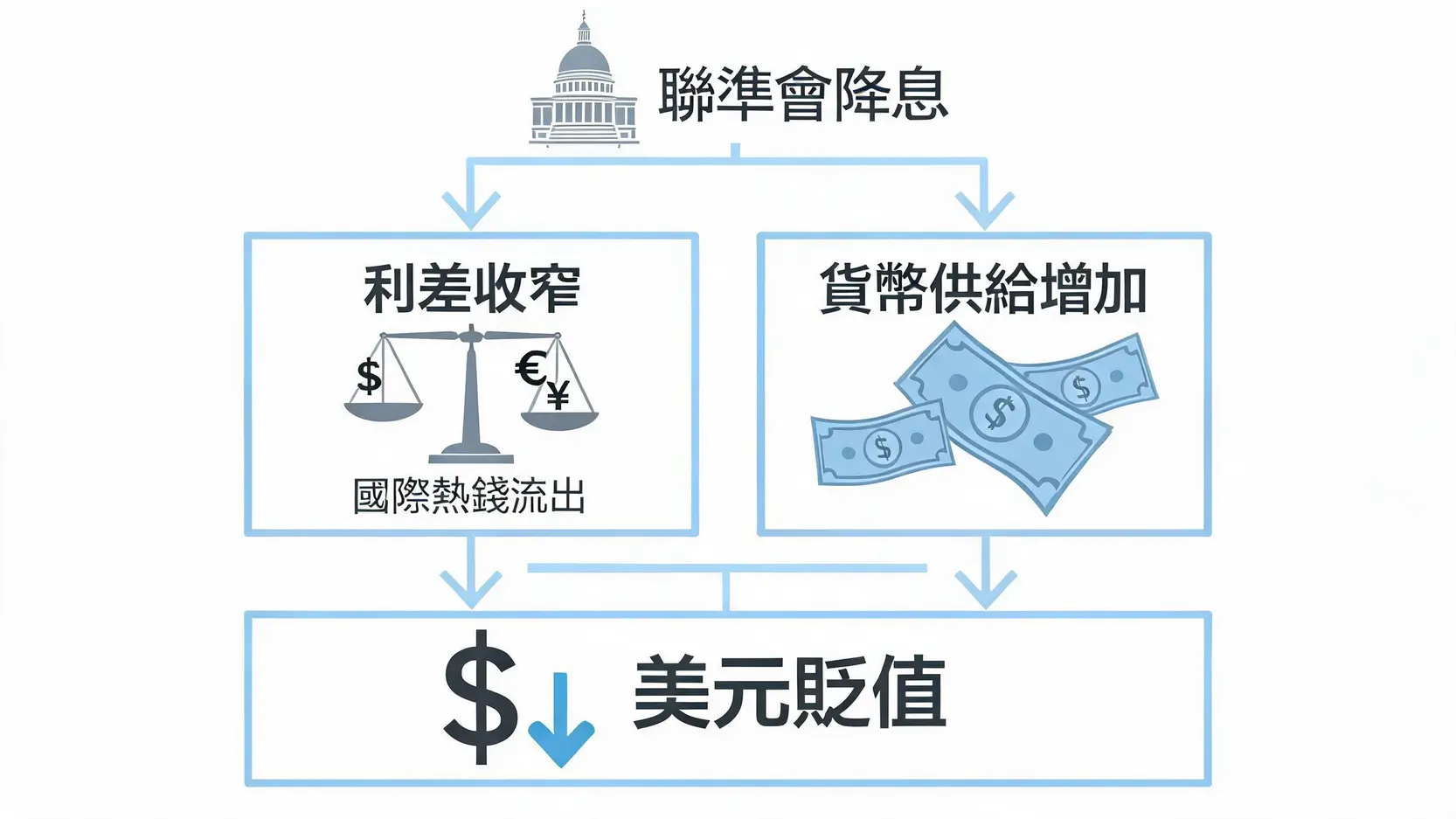
- Narrowing interest rate differentials: Rate cuts will narrow the interest rate gap between the US dollar and other major currencies (such as the euro and the Japanese yen). In the past, investors were attracted by the US dollar’s high interest rates and were willing to hold US dollar assets to earn interest. Once this interest rate advantage no longer exists, international hot money will look for places with higher returns, selling the US dollar and shifting to other currencies.
- Increased money supply: Rate cuts are usually accompanied by a loose monetary environment, which means the supply of US dollars in the market may increase. According to the law of supply and demand, an increase in supply will naturally put downward pressure on the price (namely the exchange rate).

The Transmission Path of Rate Cuts to the US Dollar
This policy shift from tightening to easing is the most direct and core trigger behind this round of US dollar depreciation expectations.
US Fiscal Deficit Issues and the Global De-Dollarization Trend
In addition to monetary policy, the US’s own “financial foundation” is also facing challenges. For a long time, the US government’s fiscal deficit has remained high, and the scale of national debt has continued to expand. To cover the deficit, the US Treasury needs to continuously issue new debt, which invisibly increases the long-term uncertainty of the US dollar. When a country’s debt continues to rise, international investors’ confidence in its currency will inevitably be shaken.
At the same time, changes in global geopolitics have also accelerated the process of “de-dollarization”. More and more countries, especially emerging markets, are beginning to seek ways to reduce their reliance on the US dollar in international trade and reserves:
- Reserve diversification: Central banks around the world are actively increasing holdings of gold, euros, and other non-US dollar assets to diversify risk.
- Bilateral trade settlement: More and more countries are trying to use their own currencies for trade settlement, bypassing the US dollar system.
Although the US dollar’s dominant position is unlikely to be completely replaced in the short term, this structural shift is a long-term trend. It will fundamentally weaken global demand for the US dollar and lay the groundwork for long-term US dollar depreciation.
Extended Reading (Highly Recommended)
The Chain Reaction of US Dollar Depreciation on the Global Forex Market

The See-Saw Effect Between the US Dollar and Global Assets
As the world’s reserve currency and pricing center, US dollar depreciation is by no means an isolated event. Instead, it will trigger a series of chain reactions across the global forex market. Smart investors need to understand this game in order to move with the trend.
The Appreciation Potential of Non-US Currencies Such as the Euro and Japanese Yen
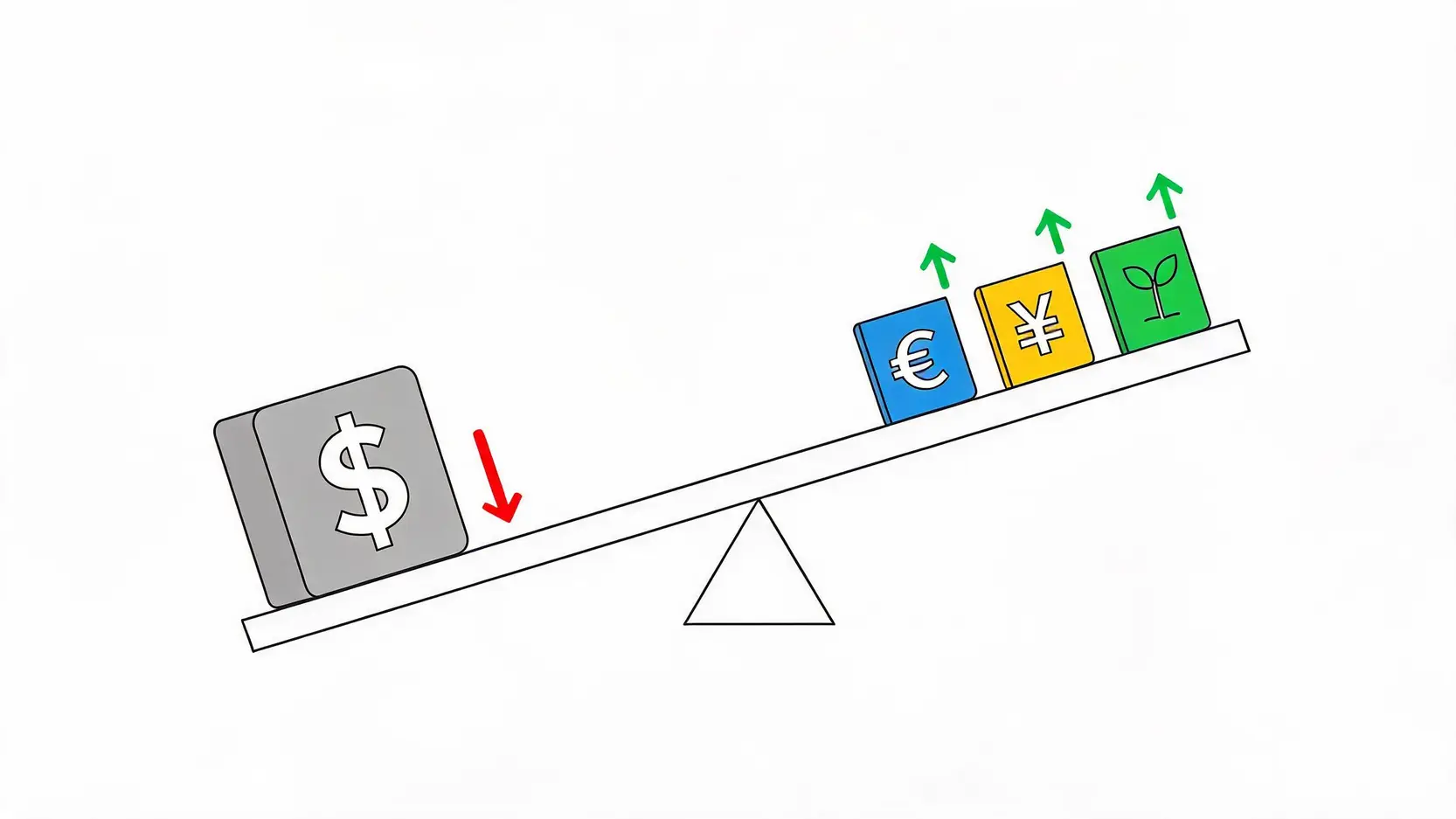
The US Dollar Index (DXY) is like a see-saw. When the US dollar side sinks, the currencies on the other side will naturally be lifted. In the DXY currency basket, the euro accounts for more than 57%, while the Japanese yen also holds an important share. Therefore, in an environment of US dollar depreciation expectations, the euro and Japanese yen are usually direct beneficiaries.
- Euro (EUR): If the European Central Bank (ECB) cuts rates more slowly than the US, or if the European economy shows stronger resilience, the euro’s exchange rate against the US dollar will have significant upside potential.
- Japanese yen (JPY): The Bank of Japan (BOJ) has gradually exited its negative interest rate policy, and monetary policy is moving toward normalization. If the BOJ adopts a more hawkish stance in the future while the Fed is cutting rates, the narrowing interest rate differential between the two countries will greatly boost the value of the Japanese yen. For investors familiar with forex operations, going long on non-US currencies is a direct strategy to respond to US dollar depreciation.
Capital Inflow Opportunities Facing Emerging Market Currencies
Historical experience shows that a weak US dollar is often accompanied by a global rise in “risk-on” sentiment. This means that international capital seeking higher returns will flow out of relatively safe US dollar assets and into emerging markets with greater growth potential. For investors in places such as Taiwan and Malaysia, this means:
- Appreciation of local currencies: Capital inflows will push up demand for currencies such as the New Taiwan dollar (TWD) and Malaysian ringgit (MYR), causing them to appreciate against the US dollar.
- Rising asset prices: The inflow of hot money not only affects the forex market, but will also push up the prices of local assets such as stocks and real estate, creating additional investment opportunities.
Of course, rapid capital inflows may also bring asset bubbles and inflationary pressure, which are challenges that central banks around the world need to face. However, for investors, this is undoubtedly a trend worth watching.
The Best Asset Allocation Strategy Under US Dollar Depreciation Expectations
After understanding the macro trend, the most important step is to put it into concrete investment action. Facing US dollar depreciation expectations, a diversified asset allocation strategy is crucial. The following three major asset classes are key areas to watch under this trend.
Top Choices for Inflation Resistance and Safe-Haven Protection: The Value Explosion of Gold and Bitcoin
When market confidence in fiat currencies (especially the US dollar) begins to waver, funds will naturally look for “hard assets” as a safe haven. Gold and Bitcoin are among the standout choices.
- Gold: As the ultimate store of value for thousands of years, gold has a high negative correlation with the US dollar. Since international gold prices are denominated in US dollars, US dollar depreciation means it takes more US dollars to buy the same ounce of gold, thereby pushing gold prices higher. In addition, Fed rate cuts will reduce the “opportunity cost” of holding gold, (because holding gold does not generate interest), further enhancing its appeal. Gold is a classic defensive asset against currency depreciation.
- Bitcoin: Known as “digital gold”, Bitcoin’s fixed total supply (21 million coins) gives it anti-inflation potential. Unlike fiat currencies controlled by the central bank of a single country, Bitcoin’s decentralized nature makes it a value storage option favored by a new generation of investors amid global monetary easing and US dollar depreciation. Its high volatility is a risk, but it also brings huge potential returns.
Multinational Companies Benefit: Analyzing FX Gains for US Stocks with High Overseas Revenue Exposure
Many people mistakenly believe that US dollar depreciation will definitely hurt US stocks, but this is not the case. For large US multinational companies with businesses around the world, a weak US dollar is actually a major positive. This is known as “FX gains”.
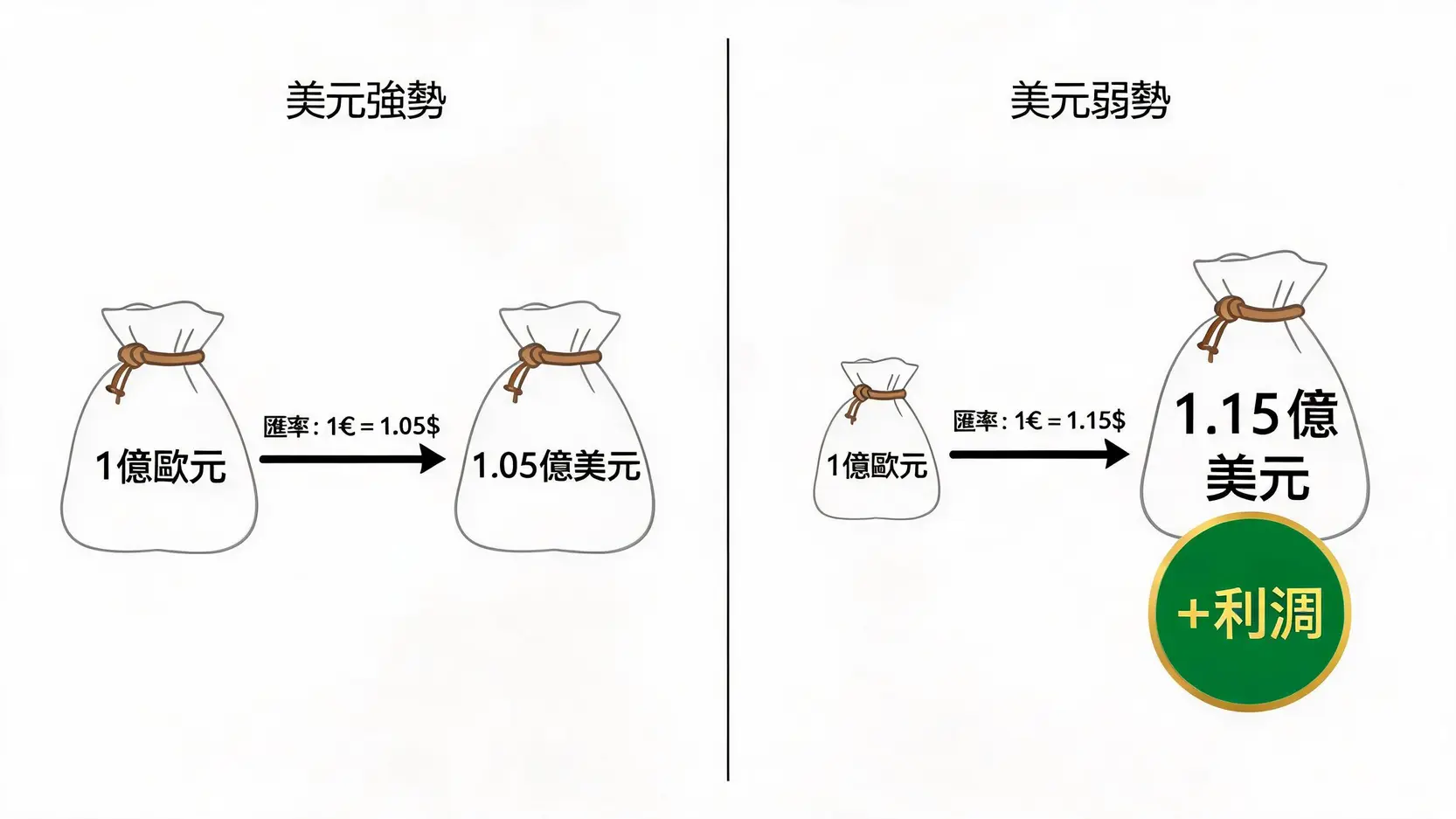
For example, a US tech giant earns EUR 100 million in profit in Europe. When the US dollar is strong, such as when EUR 1 equals USD 1.05, this profit converts back into USD 105 million. But after the US dollar depreciates (such as when EUR 1 equals USD 1.15), the same EUR 100 million profit can be converted into USD 115 million, creating an extra USD 10 million in accounting profit out of thin air!

How a Weak US Dollar Creates Additional Profits for Multinational Companies
This will directly improve the company’s financial statements and stimulate a rise in its stock price. Therefore, looking for US dollar depreciation beneficiary stocks, especially technology, consumer goods, and industrial giants with a relatively high share of overseas revenue, is an excellent offensive strategy at this stage.
How Ordinary Investors Can Easily Respond to Exchange Rate Risk Through ETFs
For ordinary investors who do not want to directly trade forex or select individual stocks, ETFs (exchange-traded funds) provide the simplest and most efficient solution.
- Gold/Bitcoin ETFs: You can directly buy gold ETFs such as SPDR Gold Shares (GLD), or some compliant spot Bitcoin ETFs, to easily participate in the precious metals and cryptocurrency markets without storing physical gold or managing complex wallets.
- Non-US market ETFs: You can invest in ETFs that track Europe, Japan, or global markets (excluding the US) such as Vanguard FTSE Developed Markets ETF (VEA) or iShares MSCI EAFE ETF (EFA). When the US dollar depreciates and non-US currencies appreciate, these USD-denominated overseas assets will automatically appreciate in value.
- Emerging market ETFs: If you are optimistic about the capital inflow effect in emerging markets, you may consider tools such as iShares MSCI Emerging Markets ETF (EEM), which provide basket exposure to multiple markets in countries with high growth potential.
Using ETFs for a globalized US dollar investment strategy can effectively diversify the risks of a single currency and a single market, helping investors calmly face the challenge of US dollar depreciation.
Extended Reading (Highly Recommended)
Frequently Asked Questions
Q: Will US dollar depreciation lead to higher import prices?
A: Yes, this is a direct impact. For residents of non-US dollar countries (such as Taiwan and Malaysia), if the US dollar depreciates relative to the local currency, imported goods priced in US dollars (such as crude oil, certain electronic products, and US-branded goods) will become cheaper when converted into the local currency. Conversely, if you are in the US, US dollar depreciation will make imported goods more expensive and may trigger imported inflation.
Q: Is now a good time to convert US dollars back into the local currency?
A: This depends on your personal needs and risk tolerance. If the market has strong expectations for US dollar depreciation, and you need to use your local currency in the future (such as for property purchases or consumption), then converting US dollars back into the local currency in batches is a reasonable way to lock in purchasing power. However, it is not recommended to convert everything at once, because exchange rate fluctuations are difficult to predict, and batch conversion can help average out exchange rate risk.
Q: How long will US dollar depreciation expectations last?
A: Currency cycles are usually medium- to long-term and may last for several years. This round of US dollar depreciation expectations is mainly driven by the Fed’s interest rate cycle. Generally speaking, from the end of rate hikes, to market expectations for rate cuts, to actual rate cuts and entry into an easing cycle, the entire process may last 2 to 4 years. However, any major economic data or geopolitical event may change these expectations, so it is necessary to continuously monitor global macroeconomic dynamics.
Q: Besides gold and Bitcoin, which other commodities will benefit when the US dollar depreciates?
A: Most commodities priced in US dollars, such as crude oil, copper, and silver, usually rise in price when the US dollar depreciates. The reason is similar to gold. A weaker US dollar means buyers holding other currencies can purchase these commodities with less money, and increased demand will push prices higher. Therefore, investing in commodity-related ETFs or stocks is also a viable strategy.
Q: If I hold a large amount of US stocks, is US dollar depreciation good or bad for my portfolio?
A: This needs to be viewed separately. As mentioned above, if your holdings are mainly large multinational companies with businesses around the world, such as Apple, Microsoft, and Coca-Cola, US dollar depreciation will bring FX gains, which is positive for their stock prices. However, if your holdings are mainly companies whose businesses are concentrated in the US domestic market and that rely on imported raw materials, then rising costs and potential inflationary pressure may negatively affect their profitability.
Conclusion
In summary, the current US dollar depreciation expectations spreading across the market mainly stem from expectations of future Fed rate cuts and concerns over the US’s long-term fiscal imbalance. This trend is not a short-term fluctuation, but may be a medium- to long-term structural shift. Facing this change, investors should not panic, but should see it as a good opportunity to adjust global asset allocation. By increasing holdings of hard assets such as gold and Bitcoin for safe-haven protection, positioning in multinational corporate stocks that benefit from FX gains, and using ETFs to diversify funds into strong non-US currency markets, investors can effectively hedge against the purchasing power risk brought by US dollar depreciation and even seize growth opportunities in this new round of capital rotation. Regularly reviewing your portfolio and ensuring it has sufficient global perspective and flexibility is the best approach to dealing with future market changes.
Related Articles
-
What Signal Does a Rebound in Non-USD Currencies Send? Understanding Investment Opportunities and Risks Amid a Weaker US Dollar Core Driver: Why Does a Rebound in Non-USD Currencies Occur? When the US Dollar Index (DXY) starts to weaken, the forex market often sees a wave of “non-USD currency rebound” movements....2026 年 6 月 29 日
-
How to Choose a Forex Platform? 5 Key Criteria to Avoid Scam Broker Traps When entering the fast-changing forex market, the first and most critical step is making the right forex platform selection. A good broker is your solid support in the market. Conversely, choosing the wrong platform may not...2026 年 6 月 29 日
-
Forex Carry Trade in Practice: A Complete Guide to Profiting From G10 Currency Interest Rate Differential Trades Amid Expectations of US Dollar Depreciation The 2026 forex market is highly unpredictable. For advanced investors seeking stable returns in volatile market conditions while effectively hedging exchange rate risk, simply holding a single...2026 年 6 月 29 日