2026 US-Iran Conflict: Can Gold Still Be a Safe Haven?

2026 US-Iran Conflict Escalates: Can Gold Really Serve as a Safe Haven? Understanding the True Relationship Between Gold Prices and War in One Article
As geopolitical tensions continue to escalate in 2026, global financial markets are once again overshadowed by uncertainty, instantly igniting investors’ demand for safe-haven assets. The classic topic of “gold as a safe haven” has once again become a key market focus. However, amid the current complex geopolitical and economic landscape, can gold truly perform its historical role as a perfect safe haven for capital? Many investors have questions: Does war inevitably drive gold prices higher? What is the true relationship between gold prices and war? This article provides an in-depth analysis of the latest developments in the conflict, examines the true impact of geopolitical risks on gold prices at a fundamental level, and offers specific investment strategy analysis to help you see the situation clearly and make informed decisions during turbulent times.
Regional Conflict Overview: How Has the Conflict Evolved in 2026?
To understand the current situation, we must review how the conflict has evolved. The tensions between the two sides are deeply rooted and have fluctuated between escalation and easing for decades. However, since the end of 2025, a series of events has caused relations between the two sides to deteriorate sharply, once again pushing the Middle East to the brink of war.
Conflict Timeline: Key Events from Diplomatic Deadlock to Military Confrontation
To assess the impact of geopolitical conflict on gold’s safe-haven value, it is essential to first understand how the conflict has evolved. The following outlines the key events since 2025 that have intensified tensions:
- Fourth Quarter of 2025: Negotiations over the relevant nuclear agreement once again reached a deadlock. One side imposed a new round of economic sanctions on the other, particularly targeting its oil exports and financial institutions, causing its currency to depreciate sharply and domestic economic pressure to increase significantly.
- First Quarter of 2026: Multiple drone attacks targeted oil facilities belonging to US allies in the Middle East. Although armed groups claimed responsibility, the US and its Middle Eastern allies accused a certain country of being behind the attacks and deployed additional naval patrols in the Persian Gulf. During this period, gold prices surpassed US$2,400 per ounce for the first time.
- Second Quarter of 2026: A US contractor was killed in an attack on a US military base in Iraq, and the US directly blamed a militia supported by a certain country. In retaliation, the US military launched airstrikes against multiple bases belonging to the group along the Syria-Iraq border. The country strongly condemned the action, and its Revolutionary Guard entered a state of high alert.
- June 2026: The country announced a “breakthrough” in the enrichment level of its uranium, further deviating from the restrictions of the nuclear agreement. The International Atomic Energy Agency (IAEA) expressed serious concern. The move triggered a strong response from Israel, which repeatedly suggested that military action could not be ruled out. Market expectations for gold prices rose further.
- July 2026 to Present: An oil tanker was seized near the Strait of Hormuz. The US accused the country of attempting to disrupt the global oil supply chain and announced the formation of an “escort coalition”. Confrontations between warships from both sides in the strait have become increasingly frequent, sharply increasing the risk of military miscalculation.
Future Scenario Analysis: Ceasefire, Shadow War, or Full-Scale Escalation?
Market experts currently have three main scenarios for the future direction of the conflict, each of which would have a very different impact on gold investment:

Three Possible Outcomes of the Geopolitical Conflict and Predicted Gold Price Reactions
- Scenario 1: Limited de-escalation through diplomacy. With third-party mediation, both sides return to the negotiating table and reach a temporary compromise (such as freezing certain nuclear activities in exchange for sanctions relief). If this scenario occurs, market demand for safe-haven assets will quickly subside, and gold prices may face significant correction pressure.
- Scenario 2: A prolonged “shadow war” (Proxy War). Both sides avoid direct military conflict but engage in low-intensity confrontations throughout the Middle East by supporting proxies (such as militias and cyber hackers). This prolonged and persistent instability would provide solid support for gold prices, keeping them fluctuating at elevated levels.
Why Can Geopolitics Move Gold Prices? The Underlying Logic of Gold as a Safe Haven
Whenever an international conflict occurs, gold is always the first asset to be mentioned. But why can geopolitical risks, particularly the threat of war from a regional conflict, directly move gold prices? There is a profound underlying logic behind this, rather than merely a knee-jerk market reaction.
Gold’s Monetary Characteristics: A Store of Value Unaffected by the Policies of Any Single Country
Gold is regarded as the ultimate safe-haven asset primarily because of its unique “supranational” monetary characteristics. Unlike fiat currencies such as the US dollar and euro, gold’s value does not depend on the credit or policy backing of any single national government.

Why Is Gold the Ultimate Safe-Haven Asset? Analysis of Three Core Characteristics
- No issuance risk: Governments can print unlimited amounts of money through monetary easing (causing currency depreciation), but the total supply of gold is limited and cannot be “created”. During wartime, governments often print large amounts of money to finance military expenditure, exposing the purchasing power of fiat currencies to substantial risks, while gold can effectively hedge against this risk.
- No default risk: Gold is a physical asset and does not carry the same default risk as sovereign bonds. When a country falls into war or a severe economic crisis, its sovereign debt credit rating may be downgraded, but the value of gold remains stable.
- Globally recognised: For thousands of years, gold has been regarded as a symbol of value across cultures and economic systems worldwide. Regardless of where a crisis occurs, gold can be quickly exchanged and widely accepted, giving it unparalleled liquidity.
Historical Data Backtesting: Gold’s Performance During Major Wars Over the Past 50 Years
History is the best teacher. Looking back at major geopolitical crises over the past half-century, we can clearly observe gold’s performance as a safe-haven asset. According to research by the World Gold Council (WGC) and major financial institutions, gold has shown a positive price response during most crisis events.
| Geopolitical Event | Time |
Gold Price Performance During the Event |
| Soviet Invasion of Afghanistan | 1979-1980 | Significant Increase (Reached a Record High at the Time) |
| First Gulf War | 1990-1991 | Significant Increase |
| 9/11 Terrorist Attacks | 2001 | Surged in the Short Term |
| Iraq War | 2003 | Steady Increase |
| Outbreak of the Russia-Ukraine War | 2022 | Sharp Increase (At One Point Approached a Record High) |
As shown in the table above, the outbreak of wars and conflicts, particularly events that could affect the global economic order and energy supplies, has almost always served as a catalyst for rising gold prices. This proves that when markets face extreme uncertainty, investors instinctively flock to gold for protection.
🆕 In-Depth Review: How Has the Regional Conflict Affected Gold Prices Step by Step in 2026?
Theory and history are certainly important, but it is even more crucial to understand how this regional conflict is specifically affecting current gold prices. Gold price movements are not simply a linear reaction, but the result of multiple interacting factors.
Empirical Analysis of Key Events and Gold Price Movements
By overlaying the gold price chart since the second quarter of 2026 with key events, we can identify a clear correlation:
- Early April (Reports of Attacks on Facilities Belonging to US Allies): Gold prices rose from approximately US$2,380 per ounce to US$2,410 per ounce within two days, an increase of around 1.2%.
- Mid-May (Attack on a US Military Base and Retaliation): Market demand for safe-haven assets intensified. In the week following confirmation of the news, gold prices rose from around US$2,400 per ounce to US$2,450 per ounce, an increase of more than 2%.
- Late June (A Certain Country Announced Progress in Uranium Enrichment): Concerns over nuclear risks caused gold prices to gap higher at the open, briefly reaching a new swing high of US$2,480 per ounce.
- July (Confrontation in the Strait of Hormuz): Oil and gold prices rose simultaneously as the market began pricing in the risk premium associated with disruptions to the energy supply chain. Gold prices continued to consolidate within the elevated range of US$2,460-US$2,490.
Each escalation of the conflict was like adding fuel to the flames of the gold bull market, making its upward momentum even stronger.
The Interaction Between Market Sentiment and the US Dollar Index
It is worth noting that gold and the US dollar usually have a negative correlation. However, during extreme geopolitical crises, this relationship may temporarily change. In the early stages of a regional conflict, market panic may cause investors to flock simultaneously to gold and the US dollar, the two major safe-haven assets, creating a situation in which “both strengthen”. However, over time, if concerns about the war remain concentrated in the Middle East and do not pose a direct threat to the US mainland, the safe-haven appeal of the US dollar may weaken. In particular, if the war causes oil prices to surge and raises global inflation expectations, it may instead weaken the long-term value of the US dollar, further highlighting gold’s advantage as an inflation hedge.
Expert Views: How Do Leading Analysts Interpret the Future Gold Price Trend?
Based on the latest reports from several leading investment banks, market analysts generally believe that as long as the regional conflict remains unresolved, the gold bull market will not easily reverse.
- Goldman Sachs analysts stated: “The geopolitical risk premium has become a core source of support for gold prices. We expect gold prices to challenge US$2,600 per ounce before the end of the year if the shadow war continues”.
- JPMorgan’s report was even more optimistic: “If direct military conflict unfortunately occurs and the Strait of Hormuz is blocked, we cannot rule out the possibility of gold prices reaching US$3,000 per ounce in the short term, driven by panic buying”.
- However, UBS also warned investors: “Investors must remain alert to the risk of ‘buy the rumour, sell the fact’. If the conflict reaches a dramatic resolution, or the scale and impact of the war fall short of expectations, gold prices could face intense profit-taking pressure”.
Is Now a Good Time to Invest in Gold? Opportunities and Challenges Amid the Conflict
Faced with an escalating regional conflict and continuously rising gold prices, many investors cannot help but ask: Is it still possible to buy gold after such a strong rise? This is indeed a question filled with both opportunities and challenges. Understanding the changing role of gold in modern investment portfolios is crucial.
Is Gold No Longer Purely a Safe Haven? Its Shift from a “Safe-Haven Asset” to a “Strategic Asset”
In the past, people mainly invested in gold for short-term risk avoidance. However, after the 2008 global financial crisis, worldwide monetary easing, and frequent geopolitical conflicts in recent years, an increasing number of institutional and individual investors have begun to view gold as a long-term “strategic asset”.
- Risk diversification: Gold has an extremely low or even negative correlation with mainstream assets such as stocks and bonds. Adding a certain proportion of gold to an investment portfolio can effectively reduce overall asset volatility during major market declines.
- Hedging against long-term inflation: As governments around the world continue to expand their balance sheets in response to economic challenges, the long-term depreciation of fiat currencies is difficult to reverse. As a scarce and tangible store of value, gold is an effective barrier against the erosion of purchasing power.
- Protection against “black swan” events: From pandemics to wars, unpredictable “black swan” events have occurred frequently in recent years. Gold is one of the few assets that can maintain or even increase its value under such extreme circumstances.
Therefore, even though gold prices are already at elevated levels, gradually building a gold position to address long-term uncertainty remains a reasonable strategy from an asset allocation perspective. It should not be regarded solely as short-term speculation on the regional conflict.
Further Reading (Highly Recommended)
Complete Analysis of Gold Investment Channels: Which Is Right for You, Gold ETFs, Physical Gold, or Gold Passbooks?
After understanding the importance of investing in gold, the next step is to choose the investment channel that best suits your needs. Different instruments each have their own advantages in terms of cost, convenience, and risk.

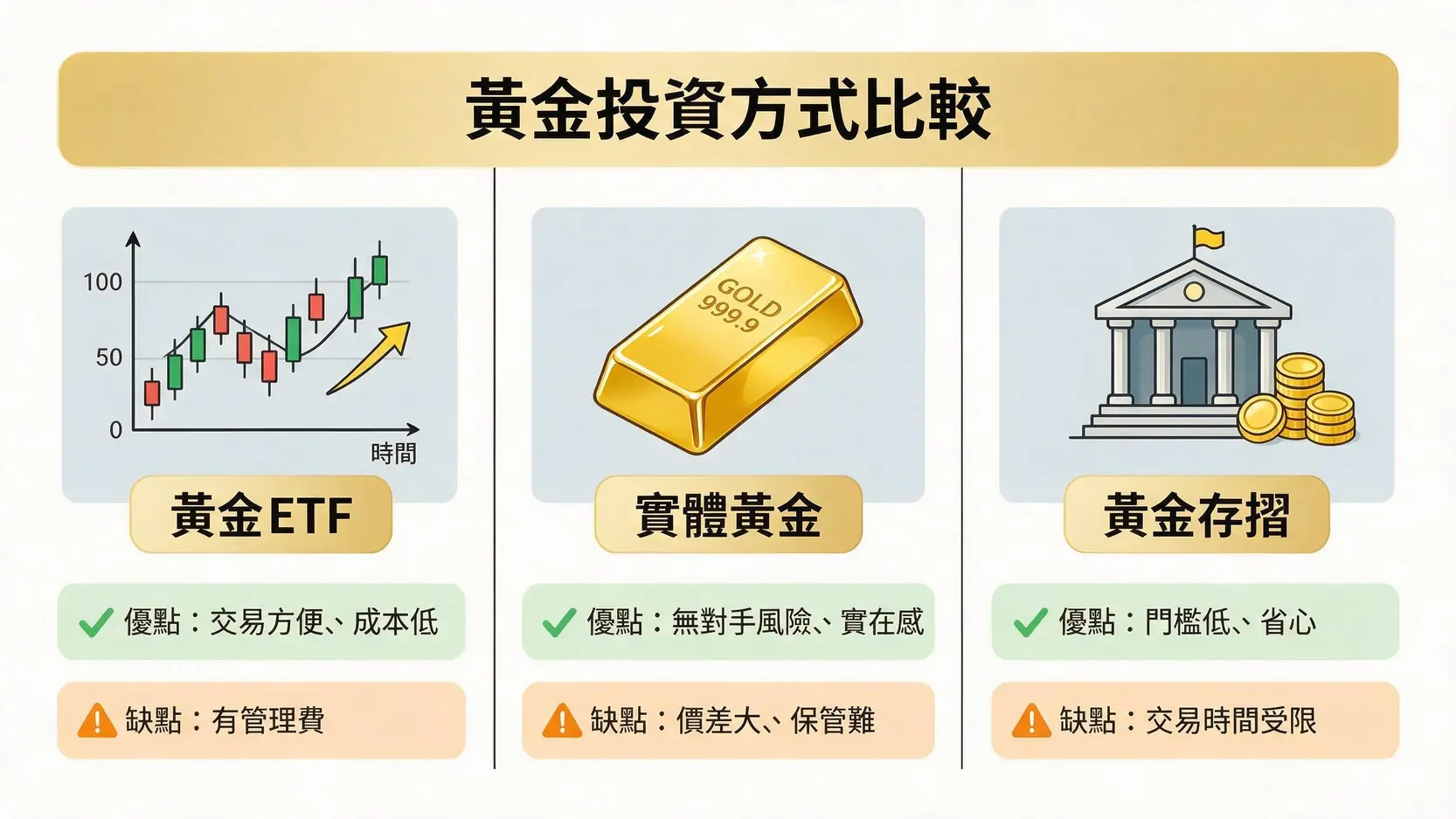
Three Major Gold Investment Channels: A Comprehensive Comparison of Gold ETFs, Physical Gold, and Gold Passbooks
- Gold ETFs (Exchange-Traded Funds): This is currently the most popular way to invest in gold. Just like trading stocks, investors can buy and sell them at any time on a stock exchange, such as GLD and IAU in the US market. The advantages are extremely high liquidity, low transaction costs, and no storage concerns. The disadvantages are annual management fees (which are deducted internally) and the possibility of slight premiums or discounts between ETF prices and actual gold prices. For investors seeking flexible trading and opportunities to capture price swings, gold ETFs are the preferred choice.
- Physical Gold (Gold Bars/Gold Coins): Directly holding gold bars or coins provides the strongest sense of tangible ownership. The advantages are no management fees, full personal control, and ultimate protection against systemic financial risks. The disadvantages are wider bid-ask spreads, storage and custody challenges (such as safe deposit box costs and theft risks) and relatively limited liquidity. It is suitable for investors with substantial capital whose goals are long-term wealth transfer or protection against extreme risks. 👑
- Gold Passbooks: This is a service offered by banks. After investors purchase gold, the bank records it in a passbook without involving physical delivery. The advantages are a low entry threshold (with purchases available from as little as one gram) and no storage concerns. The disadvantages are that trading hours are limited to banking hours, and bid-ask spreads are generally wider than those of gold ETFs. It is suitable for small investors who do not want to open a securities account and wish to gradually accumulate a gold position through regular fixed investments. 🏦
In summary, for most ordinary investors seeking to participate in the current gold market, gold ETFs are undoubtedly the best choice in terms of both efficiency and cost advantages.
Frequently Asked Questions (FAQ)
Q: If both sides enter a full-scale war, how high could gold rise?
A: This is a hypothetical question with no standard answer, but we can make projections based on historical experience and expert models. If a full-scale war breaks out, especially if it disrupts major global shipping routes (such as the Strait of Hormuz), triggering a global energy crisis and economic recession, market panic would be unprecedented. Under such an extreme scenario, most analysts believe that gold prices would have a high probability of breaking above US$3,000 per ounce in the short term, while more aggressive forecasts even point to US$3,500. However, investors should understand that such price surges are often accompanied by extremely high volatility, while developments in the conflict can change rapidly.
Q: Besides gold, are there other safe-haven assets worth considering?
A: Certainly. Gold is not the only safe-haven instrument. During periods of market turmoil, other common safe-haven assets include:
1. US Dollar: As the world’s dominant reserve currency, the US dollar is often sought after in the early stages of a crisis because of its liquidity.
2. US Treasury Bonds: Considered among the safest assets in the world and backed by the credit of the US government.
3. Japanese Yen and Swiss Franc: These two currencies have historically served as safe-haven currencies due to their countries’ low inflation, political stability, and substantial net foreign assets.
A mature safe-haven strategy should be diversified, combining safe-haven assets with different characteristics rather than putting all your eggs in the single basket of gold.
Q: Is it risky to chase gold prices and buy now?
A: Chasing prices and buying any asset at a high level always involves risk. Current gold prices have already reflected a considerable degree of expectations surrounding the regional conflict. The greatest risk is an “easing of tensions”. If both sides unexpectedly reach a settlement, or if the conflict proves to be less severe than anticipated, gold prices could fall rapidly and substantially, leaving investors who bought at high levels facing short-term losses. Therefore, it is advisable to use staggered purchases or regular fixed-amount investments to average costs, and to view gold as part of a long-term asset allocation rather than a short-term bet. At the same time, stop-loss levels should be set to control potential downside risk.
Q: What is the relationship between gold prices and the US dollar?
A: Traditionally, gold and the US dollar have a “negative correlation”. There are two main reasons. First, gold is priced in US dollars. When the US dollar appreciates, the cost of buying gold rises, which may reduce demand, and vice versa. Second, both possess safe-haven characteristics, creating a certain degree of competition between them. However, under certain extreme circumstances (such as the regional conflict in 2026), severe market panic may cause investors to sell risk assets such as stocks and shift into both US dollar cash and gold, resulting in a temporary simultaneous rise. In the long term, however, if the US expands its fiscal deficit and issues excessive currency because of war, confidence in the US dollar will be undermined, ultimately benefiting gold.
Conclusion
In summary, the regional conflict in 2026 is undoubtedly a key driver supporting the continued strength of current gold prices, once again perfectly demonstrating gold’s indispensable safe-haven value in modern investment portfolios. From historical patterns and underlying logic to current market reactions, we can clearly see how the threat of war gradually increases investor demand for gold.
However, as rational investors, we must clearly recognize that gold prices are not influenced by a single event alone. They are also jointly affected by multiple factors, including movements in the US dollar, global interest rate levels, and inflation expectations. More importantly, gold’s role is evolving from a purely short-term safe-haven instrument into a “strategic asset” for addressing long-term uncertainty.
Therefore, before investing in gold, be sure to assess your own risk tolerance and investment objectives. Rather than attempting to speculate by predicting every turning point in the conflict, it is better to regard gold as a “stabilizer” and an “insurance policy” within an overall asset allocation, and to build positions gradually and with discipline. In this way, no matter how the fog of turbulent times shifts, your vessel of wealth can navigate more steadily.
Related Articles
-
Binance Margin Trading Guide: Differences Between Cross and Isolated Margin Modes and Illustrated Borrowing Instructions Short on funds but expect a particular cryptocurrency to surge? Besides the commonly used futures trading, you can also use “Binance Margin” to borrow funds and purchase spot assets, amplifying your investment returns. This Binance...2026 年 7 月 14 日
-
2026 Euro Exchange Rate Forecast: Is Now the Best Time to Buy Euros? Planning a trip to Europe or considering foreign currency investments? As the world’s second-largest reserve currency, fluctuations in the euro directly affect your currency exchange costs and investment returns. As we enter 2026 and face changes in...2026 年 7 月 14 日
-
【2026 In-Depth Analysis】Trump’s Major Shift in Middle East Policy: How Will It Trigger a New Round of Correlated Oil and Gold Price Movements? In 2026, global markets are once again focusing on the Middle East. As the Trump administration makes a significant shift in foreign policy, from maximum pressure on...2026 年 7 月 14 日