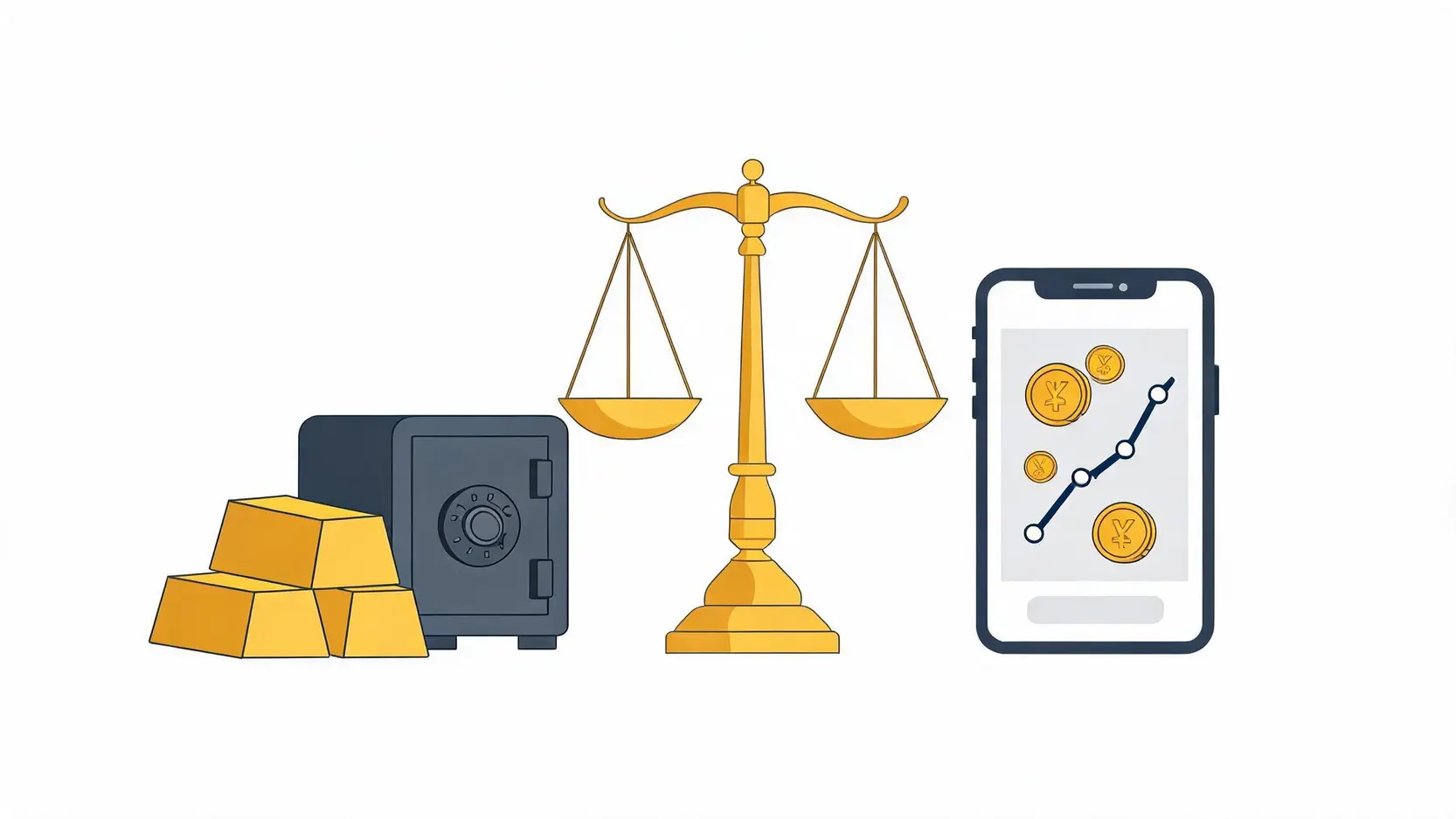
Comparison of Physical Gold and Paper Gold (Passbooks, ETFs) Investment Methods
Physical Gold (Gold Bars, Gold Coins, Gold Jewelry)
The most traditional way to invest in gold is to directly purchase physical gold. You can go to banks or gold shops to buy gold bars or commemorative gold coins. The biggest advantage of this method is that it is “visible and tangible”, offering the highest liquidity and sense of security when an extreme crisis occurs. However, the disadvantages of physical gold are also very obvious, including extremely high storage risks, the possibility of loss or theft, and a very large bid-ask spread when buying and selling, making it difficult to profit in the short term.
Bank Gold Passbooks and Gold ETFs (Such as GLD)
For modern investors who do not want to worry about storage issues, gold passbooks and gold ETFs are excellent choices. Gold passbooks allow investors to buy and sell gold through a bank account in NT dollars or US dollars, with transaction records directly recorded in the passbook. They can even set up regular fixed-amount deductions, making them very suitable for small-capital investors. On the other hand, gold ETFs (such as GLD in the US market or gold ETFs in the Taiwan market) are bought and sold directly in the stock market through a securities account. They offer extremely high liquidity and low transaction costs, making them the preferred tool for many professional investors. If you want to further understand the long-term trends of the gold market, you can refer to 10-Year Gold Price Chart Complete Analysis: Understanding Investment Strategies from Historical Prices.
Hidden Costs Revealed: Comparing Bid-Ask Spreads and Storage Fees Between Physical Gold and Paper Gold
Before deciding on a gold investment channel, you must not ignore “hidden costs”. Many beginners only look at gold price rises and falls when calculating profits, but forget the various fees incurred during the transaction process. These are often the biggest culprits that eat into profits.
The Surprising Design Fees and Bid-Ask Spread Traps of Physical Gold
When buying gold jewelry, in addition to the weight value of the gold itself, you also need to pay high “workmanship fees” and design fees. When you want to cash out the gold jewelry by selling it back to a gold shop, these workmanship fees will not be refunded, and the shop will also deduct a certain “wastage fee”. Therefore, if the purpose is purely investment, you should try to avoid buying gold jewelry and instead focus on gold bars or gold coins. Even for gold bars, however, the bid-ask spread remains far higher than that of gold products in the financial market.
Analysis of Gold Passbook Exchange Rate Risk and Handling Fees
Although gold passbooks eliminate the trouble of storing physical gold, they still come with hidden costs. First, there is a certain spread between the bank’s buying and selling prices. Second, international gold is usually priced in US dollars. If you use an NT dollar account for deductions and purchases, investors will also bear both gold price volatility and the “exchange rate risk” of the US dollar against the NT dollar. To gain a more comprehensive understanding of the pros and cons of each tool, it is highly recommended to read Comparison of the Pros, Cons, and Costs of 5 Major Channels: Physical Gold, Passbooks, ETFs, and Futures, to build a more complete investment logic.
Evaluation of Gold ETF Management Fees and Tracking Error
Although gold ETFs have extremely low trading fees (equivalent to buying and selling ordinary stocks), the fund company issuing the ETF charges an internal management fee each year. In addition, due to exchange rate fluctuations or market mechanisms, the ETF’s market price and the actual net asset value of gold may occasionally show a “premium or discount” or tracking error. Before entering the market, be sure to pay attention to the premium or discount of the ETF to avoid overpaying. If you want to gain a more diversified market perspective, you can also refer to Mr.Market’s Gold Investment Summary to further enrich your investment knowledge.
Further Reading (Highly Recommended)
10-Year Gold Price Chart Complete Analysis: Understanding 2026 Investment Strategies from Historical Prices
Comparison of the Pros, Cons, and Costs of 5 Major Channels: Physical Gold, Passbooks, ETFs, and Futures
Frequently Asked Questions About Gold Investment
Q: If I do not have much capital, can I buy gold?
A: Of course. Modern financial tools are highly developed. If capital is limited, it is very suitable to use a bank gold passbook for regular fixed-amount investment, or to buy fractional shares of gold ETFs. These tools have very low entry thresholds, usually requiring only a few thousand or even a few hundred dollars to start building a gold position and accumulate gradually over time.
Q: What is the difference between buying gold at a gold shop and buying gold at a bank?
A: Buying at a gold shop usually involves trading gold jewelry or gold bars, with an emphasis on physical ownership and wearing. The bid-ask spread is larger, and there is a risk of theft; buying through a bank means opening a gold passbook (paper gold), with the bank holding it on your behalf. Buying and selling are based on the bank’s quoted prices and do not involve physical delivery (unless you pay an additional handling fee to withdraw it). It offers better liquidity and is suitable for investors who trade more frequently.
Q: Does gold investment pay interest or dividends?
A: No. Gold itself is a non-interest-bearing asset. Holding gold does not generate interest like depositing money in a bank, nor does it pay dividends like buying stocks. The profit from gold investment depends entirely on capital gains from “buying low and selling high”. This is also why gold’s appeal may sometimes become relatively weaker in a high-interest-rate market environment.
Q: Is now a suitable time to enter the market and buy gold?
A: Evaluating the timing of market entry requires observing global real interest rates, inflation data, and geopolitical conditions. As part of asset allocation, rather than trying to predict highs and lows, it is better to adopt a staged entry and regular fixed-amount strategy, using gold as a defensive asset in the investment portfolio and holding it long term to achieve risk diversification.
Conclusion and Asset Allocation Summary