Quantitative Trading Guide: Indicators & Backtesting

Updated: 2026/04/07  |  CashbackIsland

quantitative-trading-strategy-guide

Quantitative Trading Strategy Guide: From Common Indicators to Strategy Backtesting, Understand the Core of High-Frequency Trading

In an information-overloaded financial market, have you ever made trading decisions you later regretted due to emotional fluctuations? Quantitative trading strategies provide a data-driven solution that helps you overcome human weaknesses and build a systematic investment approach. This article will guide you from the ground up, offering a comprehensive analysis of the core concepts of quantitative trading, covering the application of commonly used quantitative indicators, key methods of strategy backtesting, and an introduction to the world of high-frequency trading, helping you build a robust trading system and move toward rational decision-making. 


What Is Quantitative Trading? Why Do You Need It?

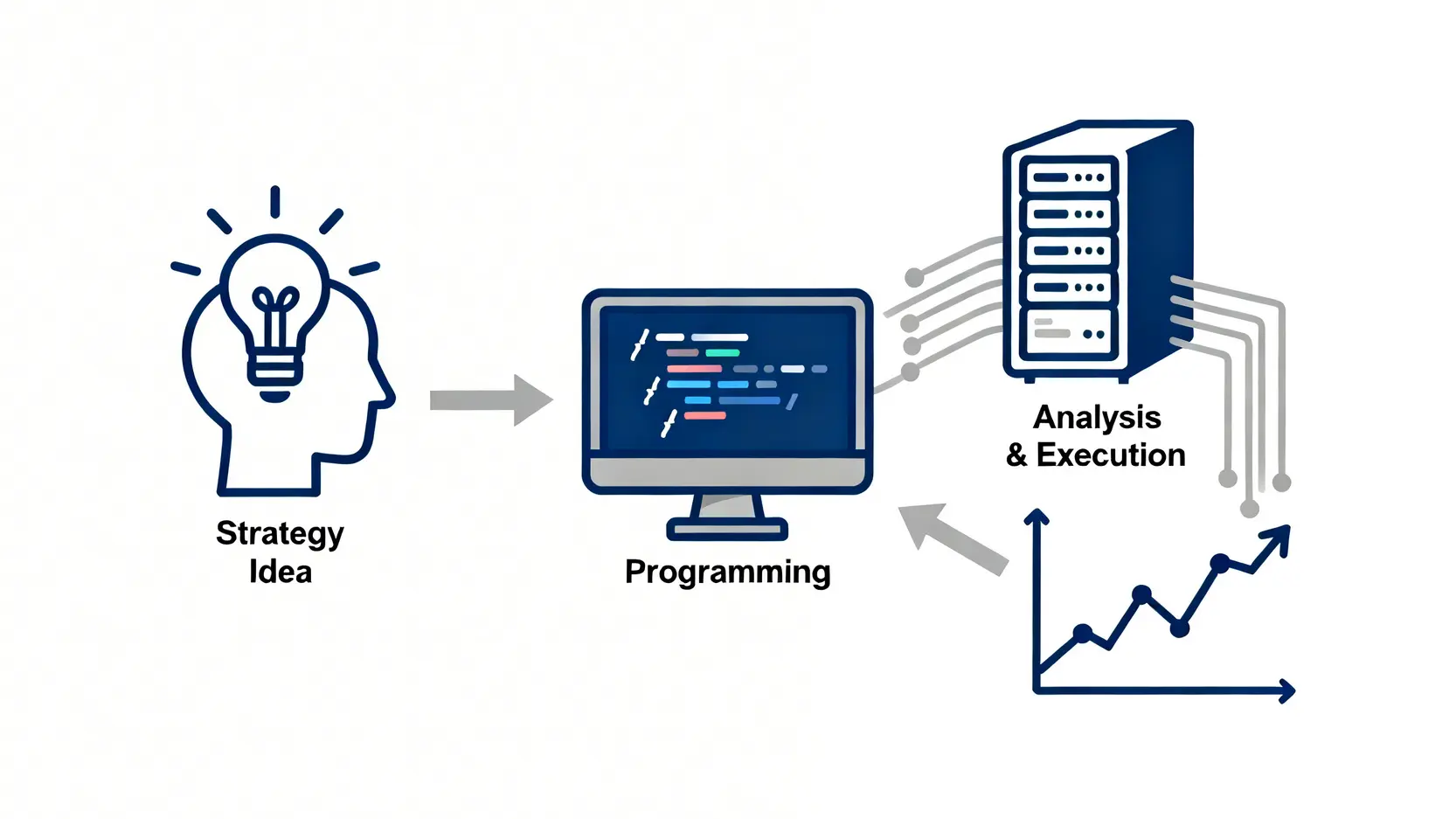
Simply put, quantitative trading is the process of using computer programs and mathematical models to execute trading decisions. It transforms human trading ideas and logic into precise code, allowing computers to analyze market data, identify trading opportunities, and automatically execute buy and sell orders. This entire process eliminates the interference of human emotions and ensures strict adherence to trade discipline. For investors seeking stability and systematic trading, this is undoubtedly a powerful tool. Especially in highly volatile markets, a rigorously backtested quantitative strategy demonstrates even greater value.

量化交易流程圖,從人類策略思想到電腦程式化,再到自動化分析與執行。

Quantitative Trading: Transforming Trading Ideas Into Systematic Execution


Eliminating Human Weaknesses: The Core Advantages of Quantitative Trading

  • Objective discipline: Once a strategy is set, the computer executes it strictly, completely eliminating fear and greed-driven behaviors such as chasing highs and selling lows.
  • Efficient execution: Computers can monitor hundreds of instruments simultaneously and capture market opportunities at the millisecond level, far beyond human capability.
  • Systematic validation: Any trading idea can be backtested using historical data, allowing you to evaluate its potential performance and risk before committing real capital, avoiding decision-making based on intuition.
  • Strategy diversification: Multiple uncorrelated strategies can run simultaneously, reducing the risk of a single strategy failing and improving overall portfolio stability.


Quantitative Trading vs. Traditional Trading: Key Differences Comparison Table

To help you better understand the differences between the two, the following comparison table has been prepared:

Characteristics

Quantitative Trading

Traditional Trading
Basis of Decision-Making Data, mathematical models, algorithms Personal experience, market sentiment, fundamental/technical analysis
Execution Method Automated execution by computer Manual order placement
Emotional Influence Extremely low, almost unaffected High, easily influenced by market sentiment
Trading Speed Millisecond-level, extremely fast Second-level to minute-level, relatively slow
Reproducibility High, strategies can be systematically replicated and optimized Low, relies on personal subjective judgment, difficult to replicate


Further Reading (Highly Recommended)

[Forex Tutorial 2024] Ultimate Beginner Investment Guide: Master Forex Trading Skills From 0 to 1!

MACD, Explanation of Stock Golden Cross, Three Techniques to Avoid False Signals


The Foundation of Building a Successful Strategy: Analysis of Five Common Quantitative Indicators

Technical indicators are the language of quantitative trading, transforming complex price and volume relationships into intuitive data. Familiarity with the principles and applications of these indicators is the first step in building an effective quantitative trading strategy. A good strategy does not rely on a single indicator, but rather combines different types of indicators to form cross-validation of signals, thereby improving the success rate. Among the many indicators, the following five are the most commonly used tools for strategy developers due to their stability and versatility. To learn more about indicator combinations, you can refer to this guide on the most powerful technical indicator combinations

Trend Indicators: Moving Average (MA) and Moving Average Convergence Divergence (MACD)

Trend is a trader’s best friend. Trend indicators are designed to help identify the primary direction of the market.

  • Moving Average (MA): MA is the most basic and widely used trend indicator. It calculates the average closing price over a specific period and plots it as a smooth curve to determine the direction of price trends. For example, when the price is above the MA line, it is considered a bullish trend; otherwise, it is bearish. Crossovers between short-term MAs (such as 5-day, 10-day) and long-term MAs (such as 20-day, 60-day), (known as golden cross and death cross) are classic trading signals.
  • Moving Average Convergence Divergence (MACD): MACD can be regarded as an enhanced version of MA. It consists of a fast line (DIF), a slow line (MACD/DEM), and a histogram (OSC/Histogram). It not only identifies trend direction but also measures the strength and momentum of the trend. When DIF crosses above the MACD line (golden cross), it is considered a buy signal; conversely, it is a sell signal. When the histogram turns from negative to positive, it also indicates strengthening bullish momentum.


Momentum Indicators: Relative Strength Index (RSI) and Stochastic Oscillator (KD)

Momentum indicators measure the speed and strength of price movements, mainly used to determine whether the market is in an “overbought” or “oversold” state, helping to capture turning points in trends.

  • Relative Strength Index (RSI): RSI ranges from 0 to 100. It is generally believed that when RSI is above 70 or 80, the market is overbought and prices may correct; when below 30 or 20, the market is oversold and prices may rebound.
  • Stochastic Oscillator (KD): The KD indicator also ranges from 0 to 100 and consists of the %K line and %D line. It reflects the position of the current closing price within the price range over a certain period. When the K value is above 80, it is considered overbought; below 20, it is considered oversold. Crossovers of the KD lines are also commonly used as trading signals.


Volatility Indicator: Application of Bollinger Bands

The market constantly shifts between calm and intense volatility. Volatility indicators help measure the degree of market fluctuation and identify relative price highs and lows.

  • Bollinger Bands: Composed of a middle band (usually a 20-period MA) and two outer bands (the middle band plus or minus two standard deviations). The width of the bands reflects the level of market volatility. When the price touches the upper band, it may face resistance; when it touches the lower band, it may find support. A “widening band” indicates increasing volatility and a potential trend, while a “narrowing band” suggests consolidation and signals the buildup for the next market movement.


Validate Your Ideas: Practical Guide to Strategy Backtesting

A trading strategy that has not been backtested is like an unverified treasure map, and blindly following it can lead to disaster. Strategy backtesting is an essential core component of quantitative trading. It allows strategies to be continuously optimized through historical “simulation tests”, improving their performance in future “real trading”.


Why Is Backtesting Crucial Before Trading? The First Step to Avoid Catastrophic Losses

Imagine having a trading strategy you believe is perfect, entering the market directly, only to suffer significant losses within a few days. This is the consequence of not backtesting. The purpose of backtesting is to:

  • Strategy feasibility validation: Test whether your trading logic can generate positive returns under past market conditions.
  • Risk assessment: Understand risk metrics such as maximum loss (maximum drawdown) and the longest loss period the strategy may face.
  • Parameter optimization: By testing different parameter combinations (such as MA periods or RSI overbought levels), identify the most suitable settings for the strategy.
  • Confidence building: A rigorously backtested and well-performing strategy allows you to maintain confidence during real trading, preventing you from abandoning it due to short-term market fluctuations.


Simple 5 Steps to Perform Your First Strategy Backtest

交易策略回測的五個步驟流程圖,包括定義規則、準備數據、選擇工具、執行回測和分析報告。

Five Steps of Strategy Backtesting: The Essential Path From Theory to Validation

  1. Define Strategy Rules: Clearly write down your entry, exit, stop loss, and take profit conditions. For example, “Buy when the 5-day MA crosses above the 20-day MA, sell when it falls below”.
  2. Prepare Historical Data: Obtain historical price data (open, high, low, close, volume) of the asset you want to trade. The longer and more complete the data, the better.
  3. Choose a Backtesting Tool: You can use existing backtesting platforms (such as TradingView or QuantConnect) or write your own backtesting scripts using programming languages (such as Python).
  4. Execute Backtesting: Load your strategy rules and historical data into the tool to simulate trades, recording every entry, exit, and profit or loss.
  5. Analyze the Backtest Report: Review the performance report generated to evaluate the strengths and weaknesses of your strategy.


How to Interpret a Backtest Report: Key Performance Metrics (Sharpe Ratio, Maximum Drawdown)

A professional backtest report includes many performance metrics, among which the two most important are:

夏普比率與最大回撤的解釋圖實。夏普比率顯示為平衡風險與回報的天秤,最大回撤則標示出資產淨值從最高點到最低點的最大跌幅。

Two Key Metrics for Evaluating a Strategy: Sharpe Ratio (Cost Performance) and Maximum Drawdown (Risk)

  • Sharpe Ratio: This is the core metric for measuring “risk-adjusted returns”. Simply put, it tells you how much excess return you earn for each unit of risk taken. The higher the Sharpe Ratio, the better the risk-return efficiency. Generally, a value above 1 is considered good, and above 2 is excellent.
  • Maximum Drawdown (MDD): This is one of the most important indicators for assessing strategy risk. It represents the largest decline in portfolio value from a peak to a trough during the backtesting period. For example, an MDD of 20% means your account could potentially lose 20% from its highest point in the worst-case scenario. This helps you understand the strategy’s risk limit and whether you can afford such fluctuations.


Advanced Exploration: Introduction to High-Frequency Trading (HFT)

When the speed of quantitative trading is pushed to the extreme, it enters the realm of High-Frequency Trading (HFT). This is a battlefield driven by top-tier algorithms, powerful hardware, and ultra-low latency networks. It is generally inaccessible to retail traders, but understanding how it works can broaden your perspective.


Speed Is Everything: How HFT Operates

The core of HFT lies in “speed advantage”. Trading decisions and execution are completed within microseconds (one-millionth of a second). To achieve maximum speed, HFT firms place their servers directly inside exchange data centers to minimize network latency. They use complex algorithms to detect tiny price discrepancies or liquidity changes and execute a large number of trades within extremely short timeframes to generate profits.


Common Types of HFT Strategies and Examples

HFT strategies vary widely, but they can generally be categorized into the following types:

  • Market Making: Simultaneously placing buy and sell orders in the market to profit from the bid-ask spread.
  • Arbitrage: Exploiting small price differences of the same asset across different exchanges. For example, if Bitcoin is 0.1% cheaper on Exchange A than on Exchange B, the system buys on A and sells on B instantly.
  • Event-Driven: Automatically analyzing news feeds, earnings reports, and announcements to trade before the broader market reacts.

These strategies require extremely high levels of technology and capital, making them exclusive to institutional investors.


Risks and Entry Barriers for Beginners

For most investors, directly participating in HFT is unrealistic. The barriers include:

  • High Technical Costs: Requires top-tier hardware, dedicated networks, and continuous research and development investment.
  • Advanced Mathematical and Programming Skills: Requires expertise in statistics, algorithms, and low-latency programming.
  • Intense Competition: The HFT space is highly competitive, where even minor speed differences can render a strategy ineffective.

Beginners should instead focus on medium- to low-frequency quantitative trading strategies, building a solid foundation and a stable trading system rather than pursuing extreme speed prematurely.


Conclusion

In summary, a successful quantitative trading strategy begins with understanding core concepts, mastering commonly used quantitative indicators, and validating and optimizing through rigorous strategy backtesting. It is not a guaranteed profit-making “holy grail”, but rather a scientific investment methodology that helps us identify relatively consistent patterns in an uncertain market. While high-frequency trading strategies may seem out of reach, by mastering the fundamentals, you can gradually build your own automated trading system. Start learning and backtesting your first quantitative trading strategy today, and move toward more rational investment decision-making.


Quantitative Trading Strategy FAQ

Q: Do I need to write code for quantitative trading?

A: Not necessarily. For beginners, there are many no-code backtesting platforms available (such as TradingView’s strategy tester and MultiCharts) which allow you to build and test strategies through clicks or simple scripting. However, if you want to develop more complex and customized strategies, learning a programming language (such as Python) will be highly beneficial, allowing you to implement any trading idea without platform limitations.

Q: Are quantitative trading strategies guaranteed to be profitable? What are the risks?

A: Absolutely not. All investments involve risk, and quantitative trading is no exception. The main risks include model failure risk (a strategy that worked in the past may fail in the future), overfitting risk (a strategy performs extremely well in backtests but fails in live trading), technical risk (such as network interruptions or program bugs), and black swan risk (unpredictable events). Therefore, continuous monitoring, regular optimization, and strict risk management are essential.

Q: What should beginners prepare when starting quantitative trading?

A: Beginners should focus on three aspects: knowledge preparation (learning basic statistics, becoming familiar with common technical indicators, and understanding market rules), tool preparation (choosing a suitable backtesting platform or learning a programming language), and mindset preparation (quantitative trading is a combination of science and art, requiring patience, continuous learning, and the ability to accept drawdown periods). It is recommended to start with simple strategies, such as moving average crossover strategies, and gradually build your own knowledge system.

Q: What pitfalls should I be aware of during backtesting?

A: The biggest pitfall in backtesting is “overfitting”. This means your strategy is overly optimized to fit historical data, making it appear perfect but ineffective in real markets. To avoid this, you can use “out-of-sample testing”, where part of the data is used to develop the strategy and the remaining unseen data is used for validation. Additionally, you should consider real trading factors such as transaction costs and slippage.

If you liked this article, please share it!

Related Articles

  • Volatility Surface Guide: Skew Trading Strategies
    Practical Applications of Volatility Surfaces: From Options Modeling to Advanced Skew Trading Strategies In options markets, implied volatility is never a flat line. Instead, it forms complex "smile" or "skew" surfaces. For advanced traders, mastering the practical applications of volatility surfaces is equivalent to possessing a lens that reveals market...
    2026 年 6 月 3 日
  • Foreign Capital Flow Model: Track Institutional Money
    Building a Foreign Capital Flow Copy Trading Model: A Stock Market Indicator for Accurately Tracking Institutional Positioning In Asia-Pacific stock markets, foreign capital inflows and outflows often determine the direction of the index. However, simply looking at daily net buy and sell data is no longer enough. Only by building...
    2026 年 6 月 3 日
  • Options Buying Strategies for Extreme Market Risks
    Options Buyer Strategies During Extreme Market Conditions: Black Swan Hedging and Cross-Market Arbitrage During Volatility Surges The most terrifying aspect of financial markets is not a gradual decline, but overnight flash crashes and cross-market capital withdrawals accompanied by volatility surges. In the highly unpredictable global macroeconomic environment of 2026, geopolitical...
    2026 年 6 月 3 日
返回顶部