Quantitative Trading: Profit Tool or Risk Trap?

Updated: 2026/04/07  |  CashbackIsland

quantitative-trading-risks-and-advantages

The Truth About Quantitative Trading: An Automatic Money-Making Tool or a Trap That Wipes Out Your Capital? A Guide to Avoiding Pitfalls

Have you ever been attracted by slogans like “automated trading, stable profits”, yet worried about the unknown risks behind them? Quantitative trading may seem like the holy grail of modern investing, but many people fall into endless automated trading traps due to a lack of understanding of quantitative trading’s full advantages and disadvantages, ultimately resulting in serious losses. To avoid potential quantitative trading risks, it is essential to build a comprehensive understanding. This article will provide an in-depth analysis of the true nature of quantitative trading, teach you how to leverage its advantages effectively, and precisely avoid fatal risks, so that you can become a truly smart investor before deploying automated strategies. 


What Is Quantitative Trading? Why Is It So Attractive?

Quantitative trading, sometimes also referred to as program trading or algorithmic trading, is essentially the process of automating investment strategies using computer technology and mathematical models. It transforms complex market data into executable trading instructions, aiming to identify patterns within large datasets that can generate excess returns.


Core Concept: Replacing Human Nature With Data and Discipline

Traditional trading relies heavily on traders’ experience, intuition, and emotional judgment. However, human emotions such as greed, fear, and hesitation are often the main causes of losses. The core idea of quantitative trading is to eliminate these uncertain human factors from trading decisions. Through pre-defined mathematical models and computer programs, quantitative strategies can objectively and calmly analyze market data and execute buy and sell orders without hesitation when conditions are met. This “iron discipline” is one of its most appealing aspects.


Overview of How Automated Trading Works

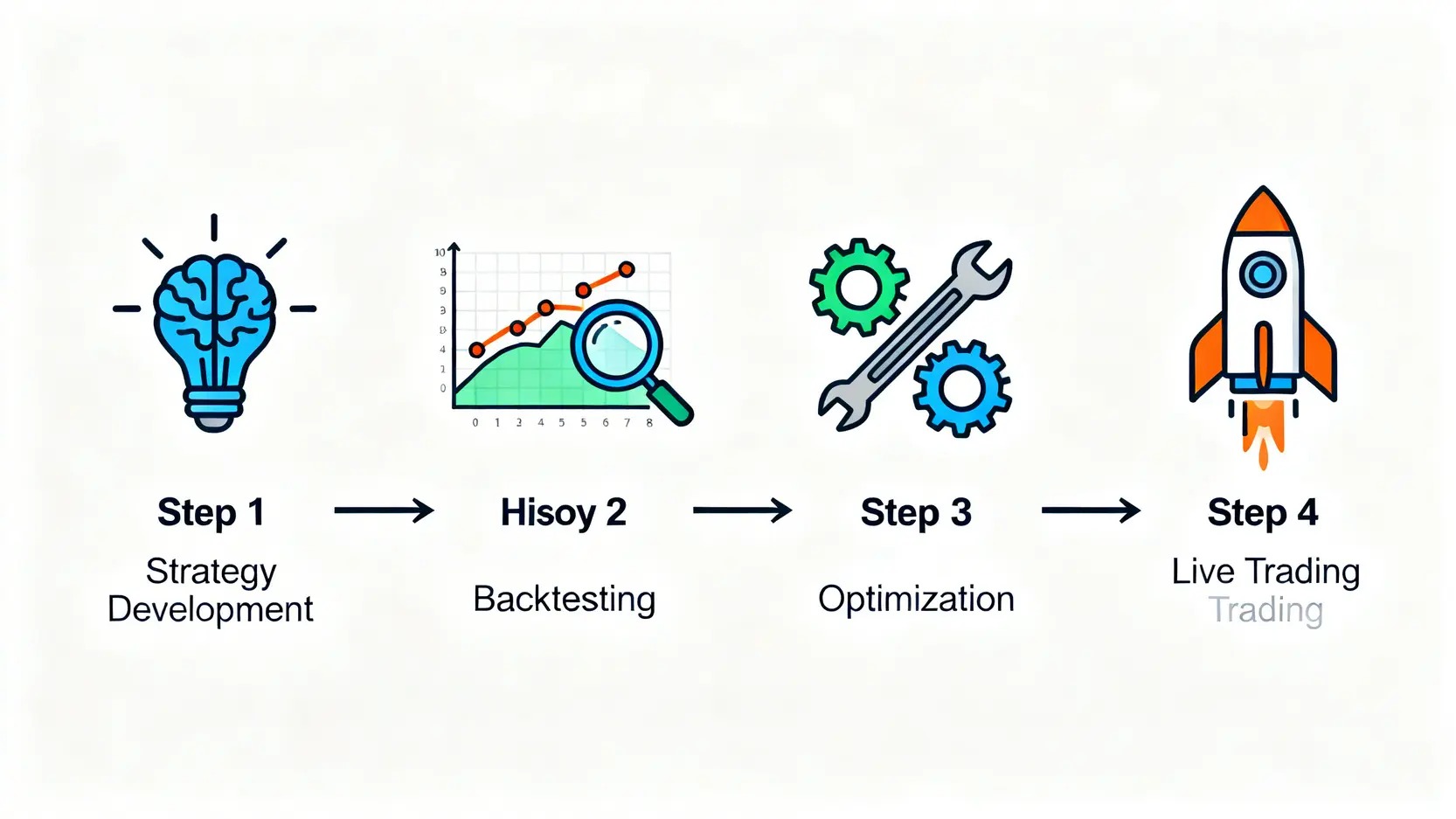
A typical quantitative trading system operates as follows:

  1. Strategy Development: Researchers build mathematical models based on certain market patterns or hypotheses. For example, “buy when indicator A crosses above indicator B”.
  2. Backtesting: Historical data is used to evaluate how the model performed in the past, assessing metrics such as profitability and maximum loss.
  3. Strategy Optimization: Model parameters are adjusted based on backtesting results to improve performance.
  4. Live Trading: The finalized strategy is deployed in the real market, where the computer program automatically monitors market conditions and executes trades.

量化交易運作流程圖,包含策略開發、數據回測、策略優化和實盤交易四個步驟。

The Standard Workflow of Quantitative Trading: From Concept to Execution


Further Reading (Highly Recommended)

How to Check Historical Currency Pair Prices? 5 Forex Historical Exchange Rate Tools and Chart Tutorials

Futures Stop-Loss Techniques: 5 Risk Management and Capital Control Strategies That Let You Sleep at Night…


[Advantages Section] Leveraging the 4 Core Advantages of Quantitative Trading

A deep understanding of the advantages of quantitative trading is the first step to successfully using this tool. It is not just about automated order execution, but also a systematic investment philosophy. The following are its four core advantages:


Advantage 1: Overcoming Human Weaknesses and Strictly Enforcing Trading Discipline

This is the most fundamental advantage of quantitative trading. During periods of extreme market volatility, human traders tend to “chase highs and sell lows”, or refuse to cut losses when losing, resulting in “holding losing positions”. Quantitative strategies have none of these emotional burdens, as they strictly follow predefined rules. Once conditions are triggered, regardless of how chaotic or tempting the market appears, the system will execute decisively, ensuring strict adherence to trading discipline. This helps overcome psychological barriers and avoid catastrophic losses caused by emotional decisions.

對比圖顯示人類交易員受情緒影響與量化交易機器人嚴守紀律的差異。

Human Nature vs. Discipline: The Core Advantage of Quantitative Trading


Advantage 2: 24/7 Monitoring to Capture Fleeting Opportunities

Global financial markets (especially forex and cryptocurrency markets) operate around the clock. Human traders cannot monitor the market continuously and will inevitably miss opportunities that occur late at night or in the early morning. Computer programs, however, can monitor market conditions tirelessly 24/7. Once a trading signal that meets the model criteria appears, they can react instantly and capture profit opportunities that may last only seconds or minutes.


Advantage 3: Efficient Backtesting to Scientifically Validate Strategy Feasibility

Before committing real capital, being able to scientifically evaluate a trading strategy is the foundation of professional investing. Quantitative trading allows us to conduct large-scale backtesting using historical data. Through backtesting, we can objectively understand how a strategy has performed over the past years or even decades, including key metrics such as total return, Sharpe ratio, and maximum drawdown. Although this method does not guarantee future results, it significantly improves the probability of success and filters out many unrealistic ideas.


Advantage 4: Diversifying Risk by Managing Multiple Strategies Simultaneously

A single program can monitor dozens or even hundreds of different trading instruments simultaneously and run multiple uncorrelated strategies across them. For example, it can simultaneously run a trend-following strategy for EUR/USD, a range-trading strategy for gold, and a hedging strategy for the S&P 500 index. This multi-market, multi-strategy approach effectively diversifies the risk of any single strategy or market failure, improving the overall stability of the investment portfolio.


[Risks and Pitfalls Section] 5 Major Automated Trading Traps Beginners Must Beware Of

Although quantitative trading offers many advantages, there are also numerous hidden traps behind its appealing facade. Ignoring these quantitative trading risks can turn your “automatic money-making tool” into a capital-destroying machine. The following are five major pitfalls that beginners are most likely to encounter:


Pitfall 1: The Illusion of Over-Optimization – Perfect Backtesting Results

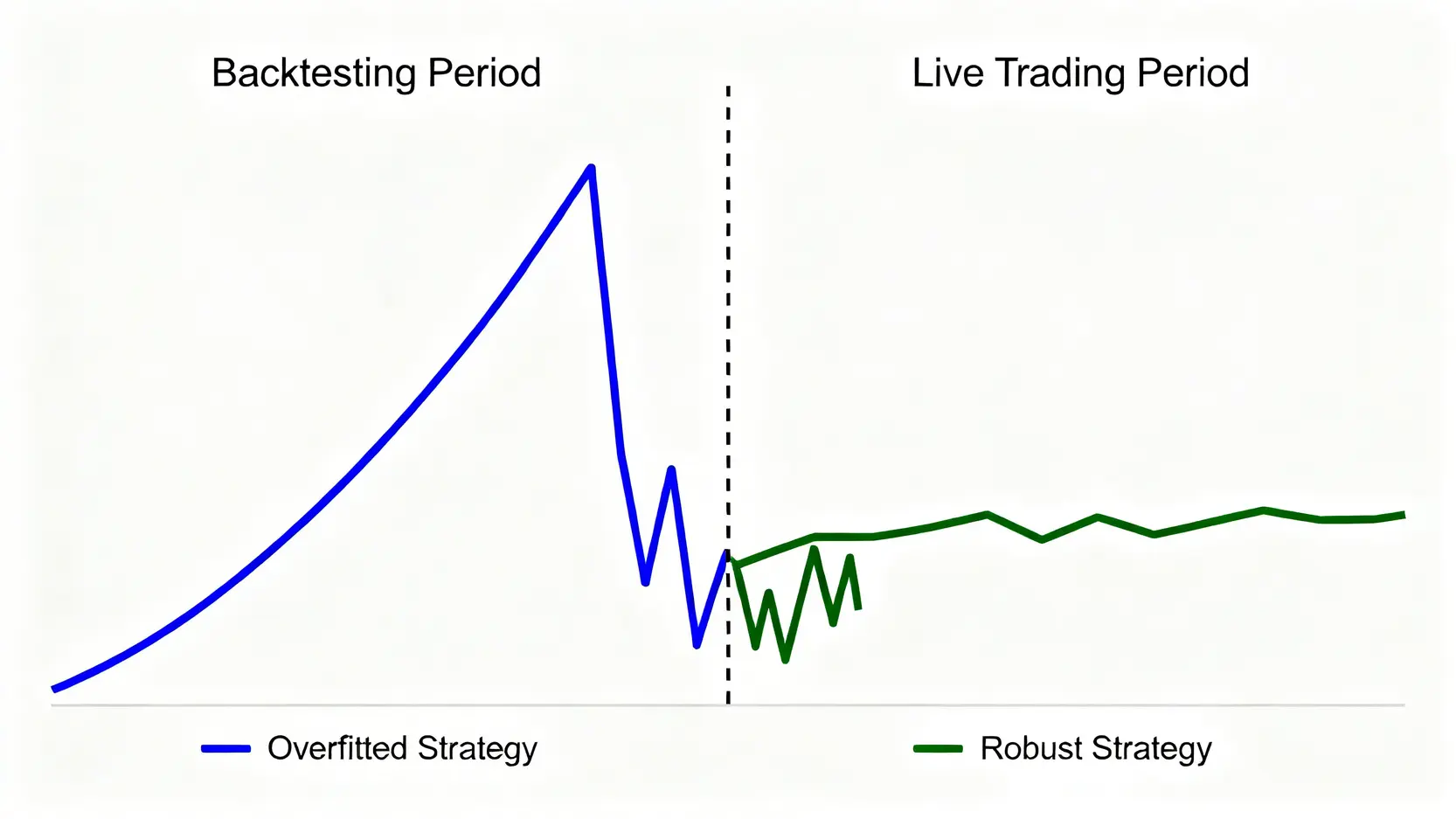
Overfitting is one of the most common and deadly mistakes in quantitative trading. It refers to repeatedly adjusting strategy parameters during the backtesting phase to perfectly fit a specific segment of historical data, resulting in an extremely smooth and attractive equity curve. However, such strategies often merely “memorize” past market behavior without truly learning its underlying patterns. Once deployed in live trading, even slight changes in market conditions can cause these over-optimized strategies to fail immediately, leading to significant losses.

說明過度優化陷阱的圖表,顯示一條回測完美的策略在實盤交易中表現急劇下滑。

The Over-Optimization Trap: A “Perfect” Backtest Curve Does Not Equal Future Profitability


Pitfall 3: Black Swan Events – Unpredictable Market Shocks

All quantitative models are built based on historical data, meaning they can only respond to patterns that have occurred in the past or are similar to them. However, financial markets inevitably experience unprecedented extreme events, known as “black swan events” such as the 2008 financial crisis or the global crash triggered by the COVID-19 pandemic in 2020. These events can break existing market structures, causing all models based on previous patterns to fail collectively and resulting in unpredictable and significant risks.


Pitfall 3: Technical Risks – Platform Latency, API Errors, and Data Repainting

Quantitative trading relies heavily on the stability of technical infrastructure. The following technical risks should not be ignored:

  • Platform Latency: Server delays or network interruptions may prevent your orders from being executed in time, causing you to miss optimal prices.
  • API Errors: The API (Application Programming Interface) provided by trading platforms may contain bugs or sudden changes, leading to incorrect order execution or data retrieval.
  • Data Repainting: Some technical indicators continuously change before a candlestick is completed, known as “data repainting”. If your strategy depends on such indicators, signals observed during backtesting may differ significantly from those in live trading, leading to incorrect decisions.


Pitfall 4: Blindly Trusting “Guaranteed Profit” Scam Promotions

The market is filled with advertisements selling trading strategies or EA (Expert Advisor), often showcasing astonishing backtesting results and using enticing slogans such as “AI intelligent trading” or “stable monthly profits of 30%”. Remember, any claim that guarantees profits or zero risk is a scam. Genuine quantitative trading is a rigorous scientific process filled with uncertainty and is far from a one-time solution for endless profits. Always stay vigilant when encountering such promotions.


Pitfall 5: Ignoring Transaction Costs and Slippage as Hidden Killers

Many beginners overlook the impact of trading costs during backtesting. Every trade incurs commissions and spreads, and for high-frequency strategies, these costs accumulate and significantly erode profits. Additionally, slippage is another hidden cost, referring to the difference between the expected execution price and the actual execution price. In highly volatile markets, slippage can be severe. A strategy that appears slightly profitable in backtesting may turn into a loss once these real-world costs are included.


Further Reading (Highly Recommended)

[2025 Forex Broker Recommendations] A Must-Read for Beginners! 5 Key Factors to Help You Choose the Best Forex…

How to Check Historical Currency Pair Prices? 5 Forex Historical Exchange Rate Tools and Chart Tutorials


Common Questions (FAQ)

Q: Do you need to write your own programs for quantitative trading?

A: Not necessarily. For investors without a programming background, there are many ready-made quantitative trading platforms on the market (such as TradingView and MetaTrader 4/5) that provide graphical or simple syntax tools for strategy development, and you can even directly purchase or rent strategies developed by others. However, if you want to implement more complex and unique strategies, having programming skills such as Python will be a significant advantage.

Q: Is quantitative trading suitable if the capital is small?

A: The size of capital is not an absolute limitation, but it does affect the choice of strategies. Small capital may struggle to withstand the normal drawdowns of certain strategies and may find it difficult to achieve effective diversification. It is recommended that beginners with small capital start with micro contracts or low-leverage instruments and prioritize lower-risk strategies for initial attempts.

Q: How to choose a reliable automated trading platform?

A: When selecting a platform, several key factors should be considered: 1. Regulatory credentials: Ensure the platform is regulated by authoritative institutions (such as FCA and ASIC). 2. Execution speed and stability: Check user reviews to understand server latency and disconnection issues. 3. Trading costs: Compare spreads, commissions, and overnight interest across different platforms. 4. API support: If you plan to develop your own programs, confirm that the API is stable and well-documented. You may refer to a detailed trading platform selection guide.

Q: Will quantitative trading strategies remain effective forever?

A: No. Markets are dynamic, and any strategy based on historical patterns may gradually become ineffective due to changes in market structure, which is known as “strategy decay”. Therefore, successful quantitative traders need to continuously monitor strategy performance and keep researching and developing new strategies to adapt to the ever-changing market environment.


Conclusion

In summary, quantitative trading is a double-edged sword. It offers powerful advantages such as overcoming human weaknesses, enforcing discipline, and enabling efficient backtesting, but it is also accompanied by unpredictable risks such as model failure, technical issues, and black swan events. The key to success lies in deeply understanding how it works and learning to identify and avoid the automated trading traps mentioned above. Only by maintaining a clear mindset, avoiding blind reliance on backtesting data, and establishing a robust risk management framework can you truly harness the power of quantitative trading and turn it into an efficient tool in your investment portfolio rather than a source of accelerated losses. 

If you liked this article, please share it!

Related Articles

  • Volatility Surface Guide: Skew Trading Strategies
    Practical Applications of Volatility Surfaces: From Options Modeling to Advanced Skew Trading Strategies In options markets, implied volatility is never a flat line. Instead, it forms complex "smile" or "skew" surfaces. For advanced traders, mastering the practical applications of volatility surfaces is equivalent to possessing a lens that reveals market...
    2026 年 6 月 3 日
  • Foreign Capital Flow Model: Track Institutional Money
    Building a Foreign Capital Flow Copy Trading Model: A Stock Market Indicator for Accurately Tracking Institutional Positioning In Asia-Pacific stock markets, foreign capital inflows and outflows often determine the direction of the index. However, simply looking at daily net buy and sell data is no longer enough. Only by building...
    2026 年 6 月 3 日
  • Options Buying Strategies for Extreme Market Risks
    Options Buyer Strategies During Extreme Market Conditions: Black Swan Hedging and Cross-Market Arbitrage During Volatility Surges The most terrifying aspect of financial markets is not a gradual decline, but overnight flash crashes and cross-market capital withdrawals accompanied by volatility surges. In the highly unpredictable global macroeconomic environment of 2026, geopolitical...
    2026 年 6 月 3 日
返回顶部