MPF Offsetting Abolition 2025: Severance Guide

[MPF Offsetting Abolition Guide] 2025 Severance Payment Calculation Method and Labour Department New Regulations Explained in One Article
The Hong Kong government has officially announced that it will abolish the long-implemented MPF offsetting arrangement on May 1, 2025. This major reform directly affects the retirement protection of employees across Hong Kong, particularly the method of calculating severance payment. Are you concerned that your rights may be affected under the new legislation? Or as an employer, are you confused about the new Labour Department guidelines on severance payment? Do not worry. This article consolidates all key information for you and provides an in-depth analysis of the specific impact following the abolition of MPF offsetting in the clearest manner, together with detailed calculation steps and examples, enabling you to fully understand the differences between the old and new systems and the corresponding response strategies in one go.
What Is MPF Offsetting? Why Is It Being Abolished?
Before understanding the new method for calculating severance payment, it is necessary to first understand the previous rules. The so-called “MPF offsetting”, also known as MPF offsetting, has long been a controversial mechanism directly related to your retirement savings.
Background of the MPF Offsetting Mechanism: How Did It Previously Affect Your Severance Payment?
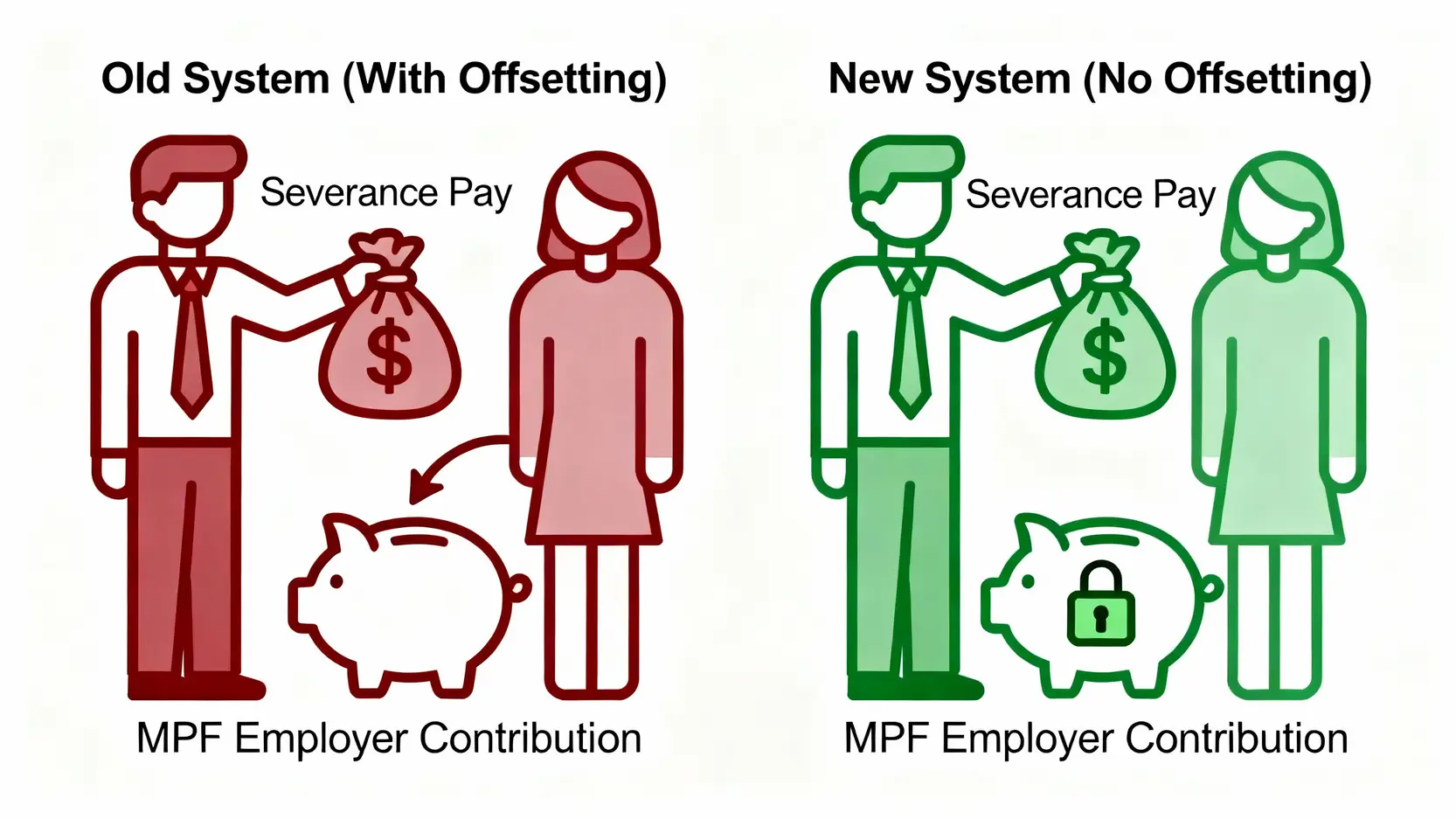
Under the previous legislation, when an employer was required to pay severance payment or long service payment to an employee, the employer could withdraw the accrued benefits derived from the “employer contribution” portion in the employee’s MPF account to offset the payment. In simple terms, the employer effectively “recovered” part of the MPF contributions already made to pay severance costs that should have been borne by the company.
Under the previous legislation, when an employer was required to pay severance payment or long service payment to an employee, the employer could offset that amount by withdrawing the accrued benefits derived from the “employer’s contributions” in the employee’s MPF account, that is, to “offset” the payment. In simple terms, the employer effectively “recovered” part of the MPF contributions already made and used them to pay severance costs that should have been borne by the company.
The impact on employees was significant:
- Retirement savings were eroded: Savings originally intended for retirement were withdrawn in advance upon involuntary termination, directly weakening employees’ retirement protection.
- Rights were effectively reduced: Although the employee received severance payment, the corresponding amount was simultaneously deducted from the MPF account, in substance amounting to “taking from one hand to give to the other”, without providing additional protection.

This practice had long been criticized as “eroding employees’ hard-earned money” and failing to truly fulfill the retirement protection function of the MPF system.
History and Reasons for Abolishing Offsetting: How the New Policy Strengthens Employees’ Retirement Protection
After years of social discussion and advocacy, the government has finally decided to abolish the MPF offsetting mechanism. The core objective of this reform is clear: to strengthen the retirement protection framework for employees. After the abolition of offsetting, employers will no longer be allowed to use their mandatory provident fund contributions made for employees to offset severance payment or long service payment. This means:
- Severance payment and long service payment are additional compensation: The amount received by employees upon termination will be additional compensation independent of the MPF.
- MPF funds are dedicated for retirement: Employer contributions will be fully retained in the employee’s MPF account and continue to accumulate value until retirement, when they may be withdrawn, thereby restoring their original purpose as retirement savings.
This reform is regarded as a major advancement in Hong Kong labor rights, ensuring that when employees are unfortunately laid off, they can receive both immediate financial support (in the form of severance payment) and long-term retirement savings (in the form of MPF).
Official Labour Department Severance Payment Calculation Method (Under the 2025 New System)
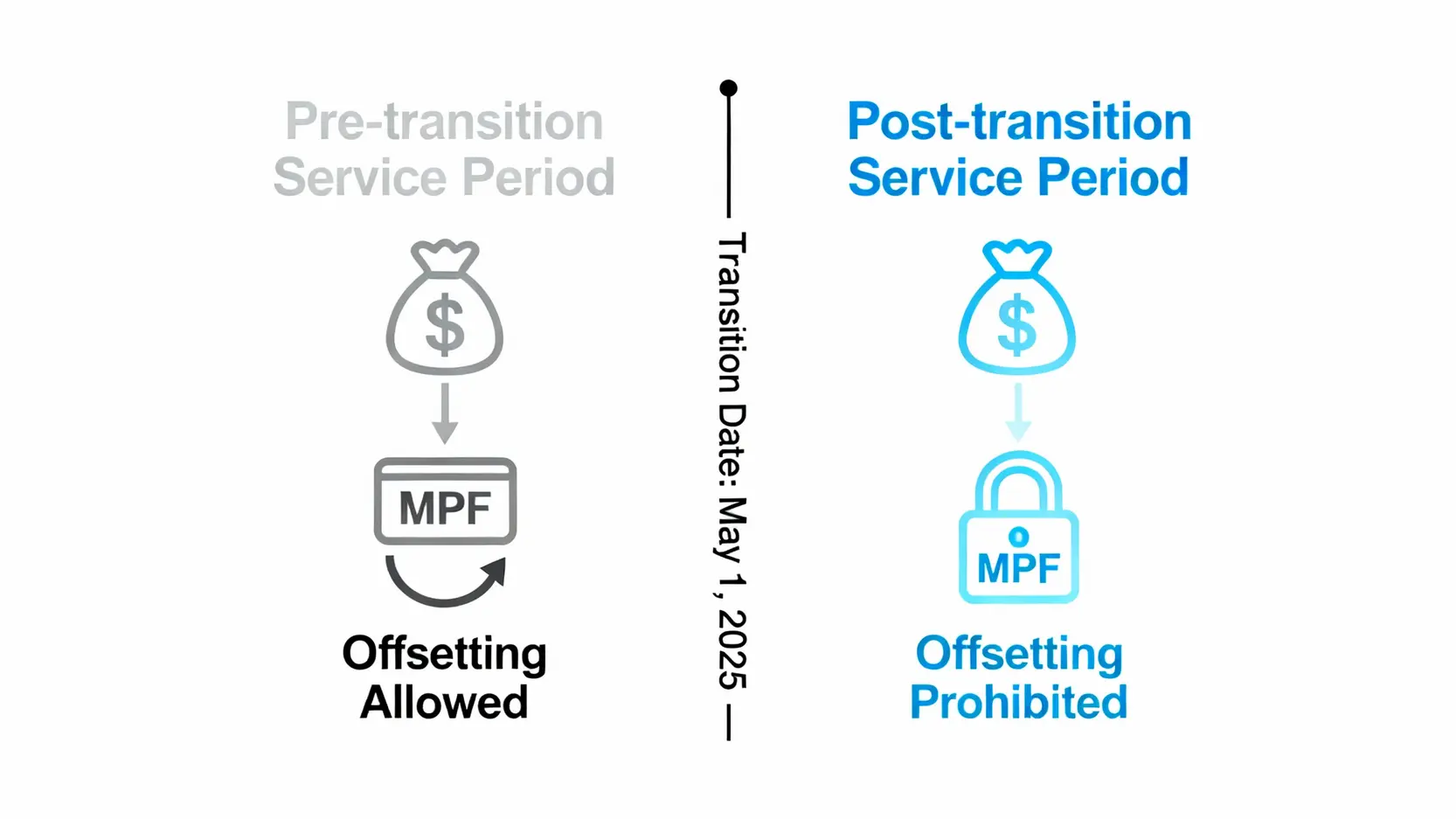
To accurately calculate severance payment after the abolition of MPF offsetting, the key lies in understanding a core concept: the “transition date”. The government has clearly designated May 1, 2025 as the “transition date”, using this date as the dividing line to split an employee’s length of service into two parts for calculation purposes.
Division by the “Transition Date”: How Is Length of Service Calculated Before and After May 1, 2025?
In simple terms, your total length of service will be divided into two segments:
- Pre-transition service period (under the old system): This refers to all service years before May 1, 2025. For this portion of severance payment or long service payment, the employer may still use the accrued benefits from MPF contributions to offset the payment.
- Post-transition service period (under the new system): This refers to all service years on or after May 1, 2025. For this portion of severance payment or long service payment, the employer is completely prohibited from using MPF for offsetting and must pay the amount separately from company funds.

Therefore, for senior employees who leave employment after the transition date, the final amount they receive will be the sum of the amounts calculated for both the “pre-transition” and “post-transition” periods.
Severance Payment Calculation Formula and Cap Under the New System (With Practical Example)
Whether it is severance payment or long service payment, the calculation formula itself has not changed. What has changed is the right of offsetting. The calculation formula is as follows:
(Last month’s wages × 2/3) × Years of service
Important Caps to Note:
- Wage cap: The monthly wage cap for calculation purposes is HK$22,500. Therefore, the monthly amount used for calculation is capped at HK$15,000 (that is, $22,500 × 2/3).
- Overall cap: The total amount of severance payment or long service payment is capped at HK$390,000.
[Case Analysis]
Assume Mr. Chan earns a monthly salary of HK$30,000. He commenced employment on May 1, 2020 and was dismissed due to redundancy on April 30, 2028, with a total service period of 8 years.
- Division of service period:
- Pre-transition service period (2020/5/1 – 2025/4/30): 5 years
- Post-transition service period (2025/5/1 – 2028/4/30): 3 years
- Calculation of severance payment (in two parts):
- Pre-transition portion: (HK$22,500 [wage cap] × 2/3) × 5 years = HK$75,000
👉 This portion may be offset by the employer using MPF contributions. - Post-transition portion: (HK$22,500 [wage cap] × 2/3) × 3 years = HK$45,000
👉 This portion must be paid by the employer from company funds and cannot be offset.
- Pre-transition portion: (HK$22,500 [wage cap] × 2/3) × 5 years = HK$75,000
- Summary:
- Mr. Chan is entitled to a total severance payment of HK$75,000 + HK$45,000 = HK$120,000.
- The employer may offset up to HK$75,000 only, and the remaining HK$45,000 must be paid separately.
- Mr. Chan’s MPF account (employer contribution portion), after offsetting, will still retain all contributions made after the transition date, as well as his own contributions.
Long Service Payment vs Severance Payment: What Is the Difference in Calculation?
Many people confuse severance payment and long service payment. Their calculation method and caps are exactly the same, but the triggering conditions differ, and an employee cannot receive both simultaneously.
- Severance payment: Applicable when an employee is dismissed due to redundancy or lay-off and has been employed under a continuous contract for not less than 24 months.
- Long service payment: Applicable to employees who have been employed under a continuous contract for 5 years or more and are dismissed for reasons other than redundancy or serious misconduct, not renewed upon contract expiry, die during employment, or resign due to health reasons.

In simple terms, severance payment is specifically for “redundancy” while long service payment covers various other qualifying termination circumstances.
As an Employer, How Should You Respond to the Abolition of MPF Offsetting?
The abolition of MPF offsetting undoubtedly increases the potential financial burden on employers. In response, the government has introduced corresponding support measures to assist enterprises (especially small and medium enterprises) in achieving a smooth transition.
Details of the Government Subsidy Scheme: Who Is Eligible? How Is the Subsidy Calculated?
The government has established a 25-year scheme with a total funding amount of tens of billions, known as the “Designated Savings Account Scheme”, to subsidize employers in paying severance payment and long service payment after the abolition of offsetting. The subsidy amount will decrease gradually over the years, with a higher subsidy ratio in the early stage to encourage employers to plan ahead.
- Eligibility: All employers (especially small and medium enterprises) are eligible to apply.
- Subsidy calculation: The subsidy amount is linked to the number of employees, wage levels, and the severance payment or long service payment amount in each dismissal case. In the initial stage of the scheme, the subsidy cap per case can reach tens of thousands of dollars.
- Purpose: To alleviate employers’ cash flow pressure during the initial transition period, rather than to fully exempt them from payment obligations.
Employers should closely monitor the application details and procedures issued by the Labour Department to ensure that they can make full use of this resource when necessary.
Can Early Dismissal Help Employers Avoid the New Legislation?
This is a sensitive but realistic question. In theory, dismissals occurring before the “transition date” of May 1, 2025 will be handled entirely under the old system, and employers may still carry out MPF offsetting. However, if an employer intends to circumvent the long-term financial responsibility under the new legislation through large-scale “early dismissals”, the following risks may arise:
- Legal risk: If proven to be malicious or unreasonable dismissal, it may trigger labor disputes and legal proceedings.
- Reputational damage: Large-scale layoffs may seriously affect corporate image and employee morale.
- Talent loss: Outstanding employees may voluntarily resign due to a lack of security, leading to higher long-term operating costs.
Prudent employers should adopt proactive planning measures, such as making provisions and understanding the government subsidy scheme, rather than engaging in short-sighted avoidance behavior.
Frequently Asked Questions (FAQ)
Q: After the abolition of offsetting, are employers completely prohibited from using MPF to pay severance payment?
A: Not entirely. The key lies in the “transition date” (May 1, 2025). For severance payment or long service payment arising from an employee’s service years before the transition date, the employer may still use the accrued benefits derived from MPF contributions to offset the payment. However, for service years after the transition date, offsetting is absolutely prohibited.
Q: If I commenced employment before May 1, 2025, how will my severance payment be calculated?
A: Your severance payment will be calculated in two parts. The first part is based on your service years before May 1, 2025, and this portion may be offset. The second part is based on your service years after that date, and this portion cannot be offset. Ultimately, you will receive the total of these two parts, but the employer is only required to pay cash separately for the second part.
Q: Where can I find the Labour Department’s official calculator?
A: To facilitate estimation for employers and employees, the government has launched an official online calculation tool. You can visit the Abolition of “Offsetting” website to access this practical calculator. Simply enter the relevant information to obtain an estimate of severance payment, long service payment, and the government subsidy amount.
Q: What Is the Maximum Amount for Severance Payment and Long Service Payment?
A: Under the current “Employment Ordinance”, regardless of your wage level or length of service, the maximum amount of severance payment or long service payment is capped at HK$390,000. This cap applies to both pre-transition and post-transition calculations.
Conclusion
In summary, the abolition of MPF offsetting marks a significant step forward in safeguarding labor rights in Hong Kong, as it rectifies the previous system loophole that eroded employees’ retirement savings. Whether you are an employee or an employer, you must thoroughly understand the new severance payment calculation method, especially the principle of division before and after the “transition date”. Remember the key date of May 1, 2025, and make good use of the Labour Department’s official resources and calculator on severance payment to accurately plan for and safeguard your rights. In the face of this major reform, clear understanding and adequate preparation are the best responses.
Related Articles
-
What Experts Are Watching! A Guide to Using Contango and Backwardation to Judge Taiwan Stock Market Trends and Futures-Spot Spread Arbitrage Contango and backwardation are not only tools used to execute arbitrage trades, but also important leading indicators that reflect the sentiment of major market players and institutional investors. When...2026 年 7 月 8 日
-
How to Trade Gold During Volatility: 4081 to 4100 Guide As gold prices surge to a historic high of USD 4,000, market sentiment has become as volatile as a roller coaster. One moment, gold has just broken strongly above the 4081 level, and the next, it encounters short selling pressure...2026 年 7 月 8 日
-
Practical Guide After a Gold Plunge: 5 Gold Investment Strategies and Safe-Haven Asset Allocation Fully Revealed Facing the uncertainty of the global economy in 2026, as well as a market environment where gold prices frequently plunge and remain under pressure, blindly following the crowd often only leads to unnecessary losses....2026 年 7 月 3 日