HK Algo Trading Guide: Dark Pools & HFT Risks

Updated: 2026/04/24  |  CashbackIsland

香港程式交易終極指南:由暗池、算法交易到高頻交易風險全解析

Hong Kong Algorithmic Trading Ultimate Guide: A Comprehensive Analysis from Dark Pools to Algorithmic Trading and High-Frequency Trading Risks

Are you curious and confused about terms like “what is dark pool trading” and “algorithmic trading strategies”? In today’s data-driven financial markets, programmatic trading has become a standard tool for institutions and even advanced retail investors, especially in the highly developed algorithmic trading Hong Kong market. This article will comprehensively break down these complex concepts, from the operation of dark pool trading, core algorithmic trading strategies, to the potential risks of high-frequency trading, combined with the realities of the Hong Kong market, helping you master the key knowledge for future investing success. 


Unveiling the Mystery: What Is Dark Pool Trading?

Imagine you are a fund manager who needs to sell a large block of shares, but you do not want to alert the market with a large sell order that could cause the stock price to drop significantly before your position is fully exited. In this case, a “dark pool” is your best option. Dark pool trading is a private, non-public securities trading platform that allows institutional investors to execute large block trades without disclosing their trading intentions to the public market.


Definition and Mechanism of Dark Pools: Why Are Trades Not Conducted in the Open Market?

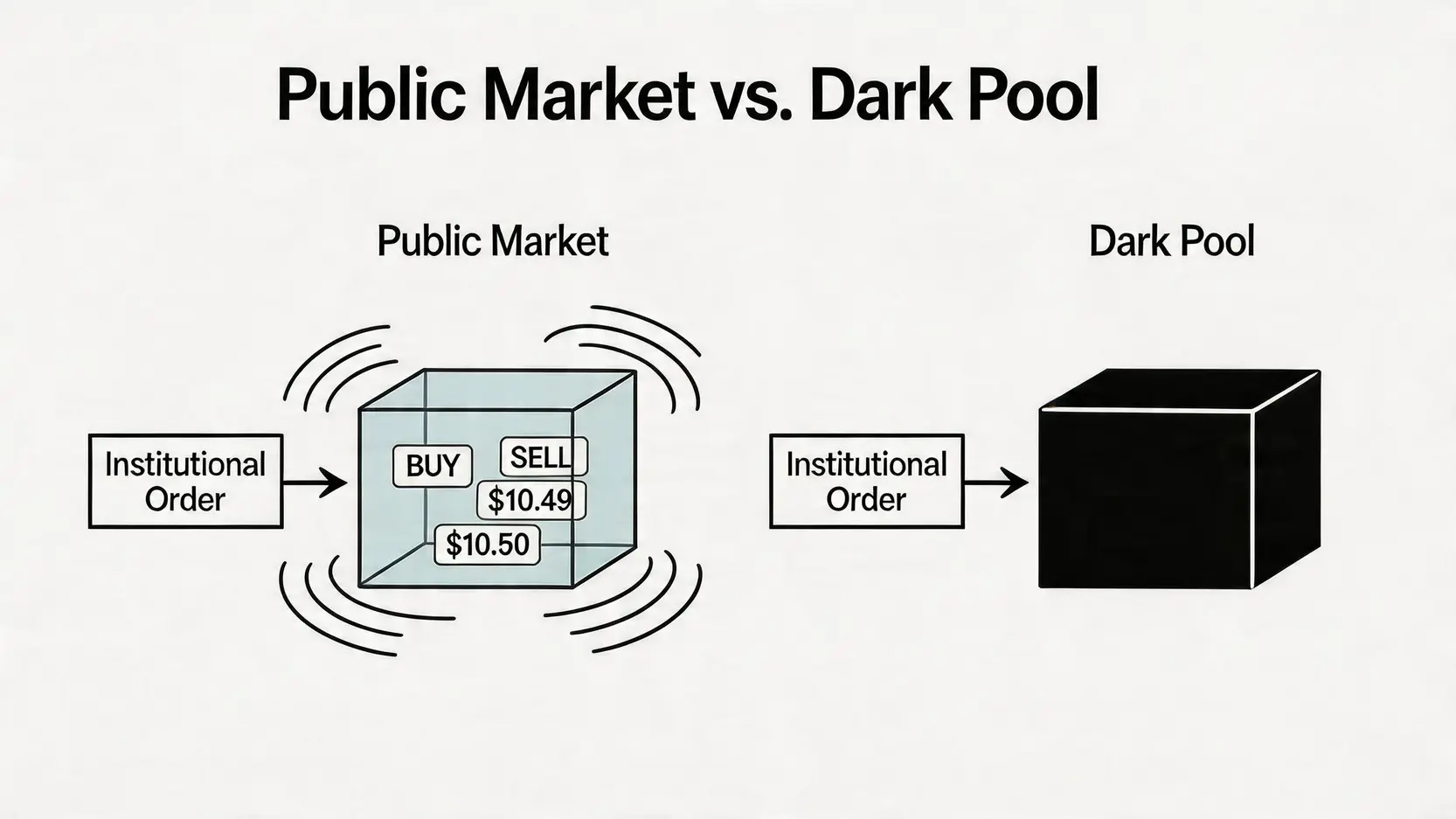
The public market (such as the Hong Kong Stock Exchange) operates on “open bidding” and “order book trading” principles, where all bid and ask prices and volumes are transparent. This transparency is fair for retail investors, but it can be a disadvantage for institutional investors. Once their large orders (for example, millions of shares) appear in the market, they can easily be detected by other traders, triggering significant price volatility and increasing their trading costs, known as “market impact costs”.

The mechanism of dark pools is designed to solve this problem. It functions like a private club that is not open to the public, where trade details are completely confidential before execution. Only after the transaction is completed will the relevant information be reported to regulators and disclosed with a delay. This effectively conceals the movements of large players, allowing them to execute trades close to the market mid-price.

一張對比圖,展示公開市場的透明交易與暗池交易的非公開執行方式。

Public market vs. dark pool: Comparison of transparency and market impact


The institutional investors’ secret weapon: Analysis of the 3 major advantages and potential disadvantages of dark pool trading

For institutional investors, dark pool trading is a double-edged sword, with its advantages and disadvantages being very distinct:

Advantages

Disadvantages

Reduced market impact: The biggest advantage. It avoids directly impacting the public market due to large orders and helps stabilize execution prices. Lack of transparency: The trading process is opaque, which may lead to risks of unfair price discovery or potential exploitation.
Potentially better prices: Both trading parties can negotiate prices, offering the possibility of executing trades at better prices than in the public market. Information asymmetry risk: Some dark pools may be exploited by high-frequency traders, who use “probing” orders to detect large institutional orders and engage in predatory trading.
High level of anonymity: Trading intentions are completely hidden, protecting institutional trading strategies. Market fragmentation: Excessive trading volume shifting from the public market to dark pools may weaken overall price discovery efficiency and market liquidity.


Smart Trading Core: An Analysis of Mainstream Algorithmic Trading Strategies

If dark pools are the institutions’ “secret venues”, then algorithmic trading is the “smart weapon” they use across different markets. Algorithmic trading refers to a method of trading that uses pre-set computer program models to automatically execute buy and sell decisions. It helps eliminate human greed and fear, strictly following predefined strategies, and is a core component of modern algorithmic trading in the Hong Kong market.


Common Algorithmic Trading Strategy Models: TWAP, VWAP, and Market-Neutral Arbitrage

Algorithmic trading strategies vary widely, but several core models are widely used in the industry:

  • Time-Weighted Average Price (TWAP – Time-Weighted Average Price): This is a relatively simple strategy. It splits a large order into equal portions over a specified time period and executes them at fixed intervals. For example, a buy order of 1 million shares may be split into 3,333 shares per minute over 5 hours. Its goal is to ensure the final average execution price closely matches the market average price over that period, making it suitable for relatively stable liquidity markets.
  • Volume-Weighted Average Price (VWAP – Volume-Weighted Average Price): This is an upgraded version of TWAP. The VWAP strategy splits large orders based on historical trading volume distribution. During periods of high market activity (such as market open or midday), it places more orders, while during quieter periods it reduces order size. The goal is to achieve an execution price close to the day’s volume-weighted average price, and it is considered a more intelligent algorithm that better adapts to market rhythm.
  • Market-Neutral Arbitrage (Market-Neutral Arbitrage): This strategy aims to profit from small pricing inefficiencies in the market while neutralizing overall market risk. For example, simultaneously buying an undervalued stock A and shorting an overvalued related stock B or index futures. Regardless of whether the overall market rises or falls, as long as stock A outperforms stock B, the strategy can generate profit.

圖表對比 TWAP 與 VWAP 算法交易策略,顯示 TWAP 按時間均分訂單,而 VWAP 根據成交量分佈訂單。

TWAP vs. VWAP: Different order-splitting logic


Recommended Reading (Highly Recommended)

Quantitative Trading Strategy Guide: From Common Indicators to Strategy Backtesting, Understanding the Core of High-Frequency Trading

How Do Stocks Make Money? Investment Beginner’s Guide: From Market Trend Analysis to a Complete Guide to Bull and Bear Markets


The Speed Race: Operating model of High-Frequency Trading (HFT) and Risk Assessment

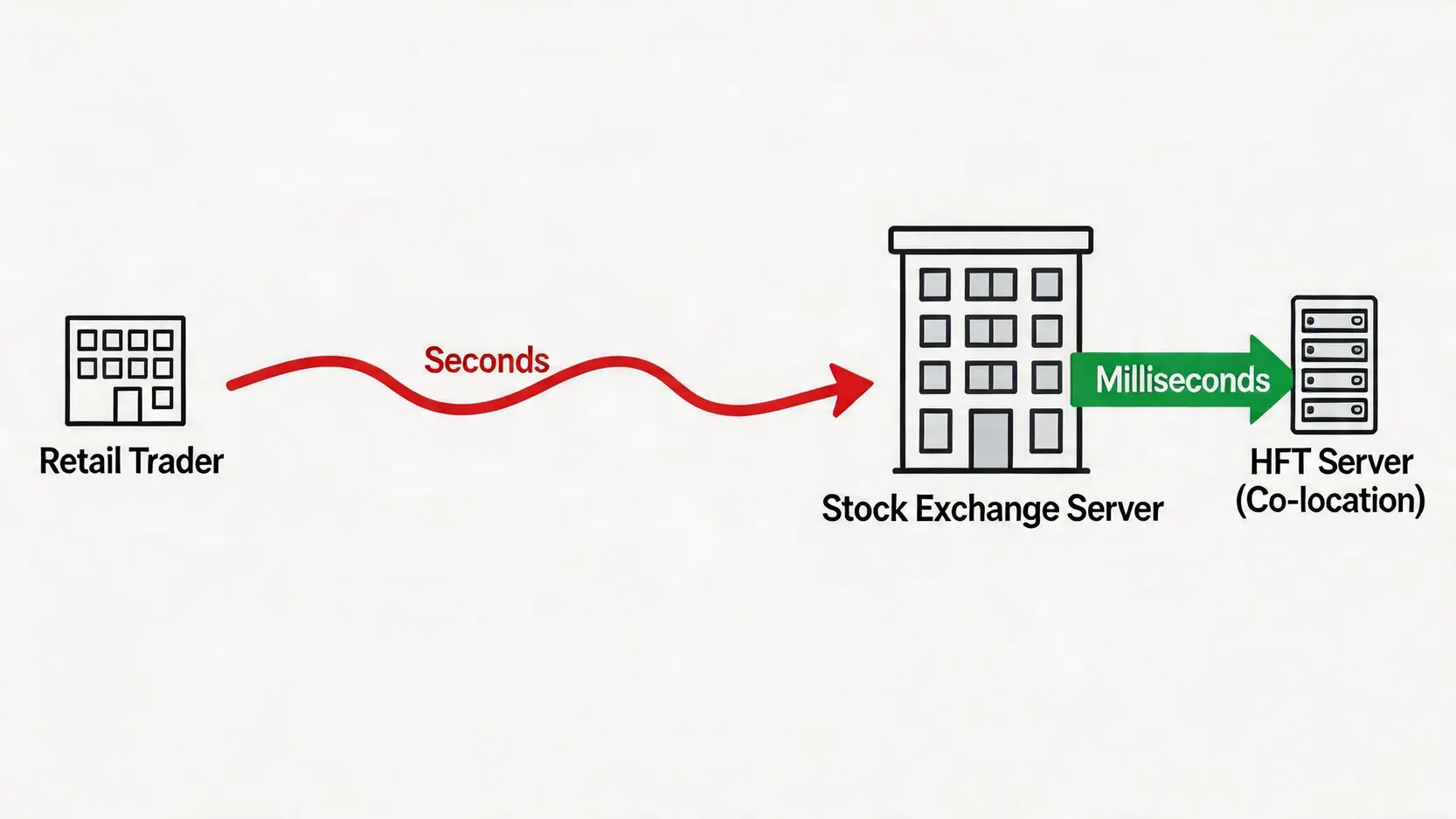
High-Frequency Trading (HFT) is an extreme branch of algorithmic trading that pursues ultra-fast execution at the millisecond or even microsecond level. HFT firms spend heavily to place their servers inside exchange data centers (known as “co-location”) to minimize network latency and execute trades ahead of other market participants.

示意圖解釋高頻交易 (HFT) 透過將伺服器放置在交易所旁邊(主機托管)來獲得毫秒級的速度優勢。

The speed secret of high-frequency trading: Co-location

Operating model: HFT mainly relies on ultra-fast information access and order execution capabilities to perform strategies such as “market making arbitrage” or “cross-market arbitrage”, extracting profits from extremely small price differences. These profits accumulate over a large number of trades, as they may execute millions of trades per day, while holding positions for only very short durations.

High-frequency trading risks:

  • Flash crash risk: Multiple HFT algorithms may be triggered by certain market signals, causing a chain reaction of rapid sell-offs in a very short time, leading to sudden market crashes and seriously threatening market stability.
  • Technical failure risk: Any minor programming error or hardware malfunction can be amplified within milliseconds, resulting in significant losses.
  • Market fairness controversy: HFT is criticized for using its technological advantages to “exploit” ordinary investors, creating an unfair competitive environment.


Based in Hong Kong: How to Start Your Algorithmic Trading Journey?

For investors in Hong Kong interested in algorithmic trading, the local market provides relatively mature infrastructure and tools. To take the first step, you can start by choosing suitable platforms and continuing to learn.


Mainstream Algorithmic Trading Platforms and Tools in Hong Kong

Choosing a broker platform that supports APIs (Application Programming Interface) is the foundation of algorithmic trading. This allows your trading programs to connect directly with the broker’s servers for automated order execution and position management. Below are some popular options in Hong Kong:

Platforms/Tools Key Features Suitable Users
Interactive Brokers Provides a powerful TWS API, supports multiple programming languages (Python, Java, C++), offers a wide range of products (global stocks, futures, forex), and is the preferred choice for professional traders. Professional investors with programming skills, small institutions
Futu Securities / Tiger Brokers Provides a relatively easy-to-use Open API, with more localized documentation and community support, making it suitable for beginners to get started. Algorithmic trading beginners, quantitative trading enthusiasts
MetaTrader 5 (MT5) Mainly used for forex and CFD trading, with a large EA (Expert Advisor) community and a mature MQL5 programming language. Forex and CFD traders
TradingView

A powerful chart analysis and strategy backtesting platform that allows users to write indicators and strategies using its Pine Script language, and can connect with selected brokers for automated trading.

Strategy developers and backtesters, technical analysis enthusiasts


Resources and Learning Pathways for Algorithmic Trading in Hong Kong (Courses and Communities)

  • Online course platforms: Websites such as Coursera, Udemy, and edX offer a wide range of courses on algorithmic trading and Python applications in finance, covering everything from beginner to advanced levels.
  • Local universities and institutions: Some universities in Hong Kong offer short courses or certificate programs related to fintech or quantitative finance, which are worth following.
  • Online communities: GitHub is a valuable resource for finding open-source trading strategies and code. In addition, platforms such as QuantConnect and Quantopian (now transitioned) also provide extensive learning resources and backtesting engines.


Important Considerations Under Hong Kong’s Financial Regulatory Environment

When conducting algorithmic trading in Hong Kong, one must comply with relevant regulations set by the Securities and Futures Commission (SFC). The SFC has clear guidelines on risk management, system testing, and monitoring for algorithmic trading. In particular, licensed corporations providing algorithmic trading services must ensure system stability and fairness. Although retail investors are subject to less direct regulation, it is important to understand that any trading strategy intended to manipulate the market is strictly prohibited. For more details on local regulations, you can refer to the relevant guidelines and announcements issued by the SFC.


Frequently Asked Questions (FAQ)

Can retail investors participate in dark pool trading?

In general, retail investors cannot directly access dark pool trading. Dark pools are primarily designed for institutional clients to execute large orders that are not suitable for public markets. Participants typically include mutual funds, pension funds, investment banks, and other large institutions.

Does algorithmic trading guarantee profits? What is the biggest risk?

It does not guarantee profits. Algorithmic trading is only a tool for executing strategies, and the quality of the strategy itself determines profit or loss. The biggest risk comes from “model risk”, meaning the trading model fails in real market conditions. Markets are dynamic, and historical data does not guarantee future performance. In addition, technical failures, network latency, and unexpected “black swan” events are all significant risks in high-frequency trading.

Do you need a programming background to learn algorithmic trading in Hong Kong?

Not necessarily, but it is highly recommended. Beginners can start with Pine Script on TradingView or no-code strategy-building platforms to understand strategy logic. However, to implement complex and unique algorithmic trading strategies and gain greater flexibility, learning at least one mainstream programming language (such as Python) is essential. Python is widely used in quantitative finance due to its rich financial and data analysis libraries (such as Pandas and NumPy).

What is the difference between algorithmic trading and high-frequency trading?

High-frequency trading (HFT) is a subset of algorithmic trading. In other words, all HFT is algorithmic trading, but not all algorithmic trading is HFT. The main differences lie in “speed” and “strategy”. HFT focuses on ultra-fast, microsecond-level execution for extremely short-term arbitrage, while algorithmic trading is broader and includes strategies like VWAP and TWAP, which aim to optimize execution cost and do not necessarily involve high trading frequency.


Conclusion

In summary, from the secrecy of dark pool trading, to the systemization of algorithmic trading, and the ultra-fast nature of high-frequency trading, programmatic trading is continuously reshaping the financial landscape in Hong Kong and globally. It is not a magic tool for guaranteed profits, but a scientific framework based on data, logic, and discipline. Understanding how these tools work and their inherent risks is an essential lesson for every modern investor. It is hoped that this guide will help you find your own position and strategy in this intelligent investing revolution, and move forward steadily on your journey into algorithmic trading in Hong Kong.

编者
Evan Lin

Evan Lin

我是Evan Lin,从大学时期开始接触外汇交易,至今已有多年实战经验,熟悉技术分析与EA策略,热衷于研究市场脉动与风险管控,喜欢分享实战经验和交易技巧,和大家一起学习、一起进步!

If you liked this article, please share it!

Related Articles

  • Trading Drawdown Recovery: Psychological Adjustment Guide
    The Taiwan Dollar Surges Past 31.5! With Hot Money and Foreign Capital Inflows, Is This an Opportunity or a Risk? An In-Depth Analysis The Capital Frenzy: The Three Major Drivers Behind the Taiwan Dollar Breaking Above 31.5 The New Taiwan dollar has recently become the absolute focal point of the...
    2026 年 6 月 10 日
  • Taiwan Dollar Surge: Stocks, Bonds, or USD?
    Taiwan Dollar Appreciation and Hot Money Inflows! An Investor's Action Guide: Should You Buy Stocks, Bonds, or Exchange for US Dollars at This Stage? One of the hottest topics in the market recently has been the capital-driven rally fueled by foreign investors' consecutive net buying of Taiwan stocks, pushing the...
    2026 年 6 月 10 日
  • Hot Money Flows Into Taiwan Bonds: What It Means
    Hot Money Flows Into Taiwan's Bond Market: Understanding the Causes, Impact, and Investor Response Strategies in One Article One of the hottest topics in the market recently is "hot money flowing into Taiwan's bond market". Why have these fast-moving international funds, which come and go like the wind, chosen the...
    2026 年 6 月 10 日
返回顶部