CNY vs CNH Guide: Save Costs with FX Differences

CNY vs CNH Cheat Sheet: Understand Onshore and Offshore Renminbi in One Article, and Use Exchange Rate Differences to Save Costs
Frequently engaged in cross-border transactions or investments, but still unsure what the difference between CNY and CNH is? Seeing two different Renminbi quotes can often feel confusing, right? You are not the only one with this question. A deeper understanding of the differences between onshore Renminbi (CNY) and offshore Renminbi (CNH), as well as the underlying “Renminbi central parity mechanism” is crucial for controlling exchange costs and capturing investment opportunities. This article will use the simplest and most easy-to-understand approach to fully explain the differences between the two, and show you how to respond intelligently while avoiding currency exchange pitfalls.
What Are Onshore Renminbi (CNY) and Offshore Renminbi (CNH)?
First, we need to understand that Renminbi (RMB) is the official currency of China, but it has different codes and trading methods in different markets. This gives rise to the two concepts of CNY and CNH.
Onshore Renminbi (Onshore Yuan, CNY): China Mainland’s Official Currency
CNY is the abbreviation for “Chinese Yuan” and refers to Renminbi traded within mainland China. Its exchange rate is strictly controlled by the People’s Bank of China (PBoC, equivalent to China’s central bank). Every day, the central bank publishes a “Renminbi central parity”, and the trading price of CNY can only fluctuate within a 2% range above or below this central parity. This design is mainly intended to maintain stability in the domestic financial market and prevent sharp impacts from international capital flows.
Offshore Renminbi (Offshore Yuan, CNH): Freely Circulating Renminbi Outside Mainland China
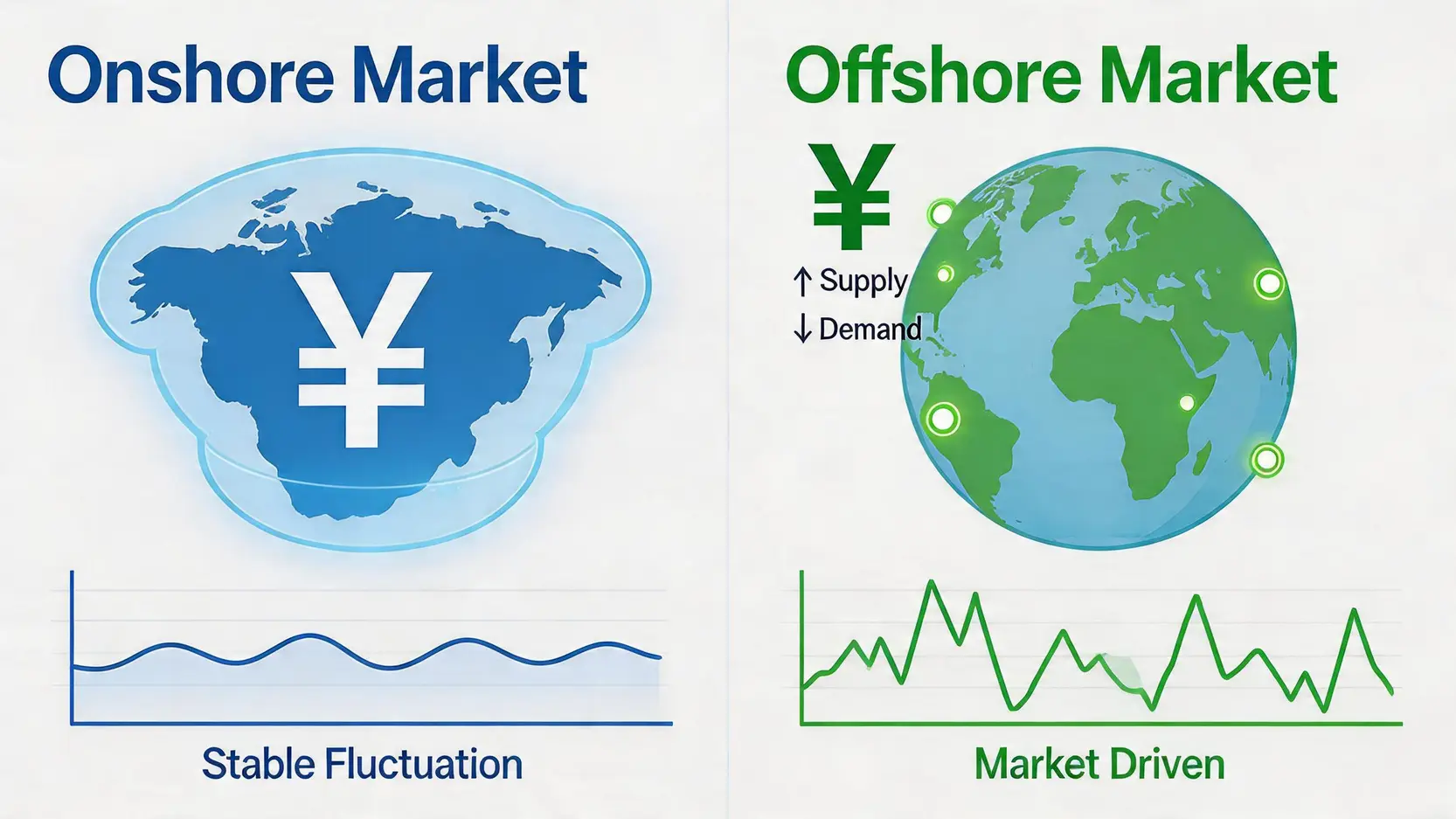
The “H” in CNH originally stands for Hong Kong, as Hong Kong was the first and is still the largest offshore Renminbi center. Today, CNH refers to Renminbi traded outside mainland China, such as in markets like London, Singapore, and Taiwan. The key difference from CNY is that the CNH exchange rate is mainly determined freely by market supply and demand, with much less direct intervention from the Chinese central bank. As a result, its price fluctuations often better reflect international market expectations and confidence in the Chinese economy.

Onshore Renminbi (CNY) Regulated vs. Offshore Renminbi (CNH) Market-Driven
Understand at a Glance: The Four Key Differences Between CNY and CNH
To help you more clearly understand the difference between CNY and CNH, we have compiled a comparison table analyzing four core dimensions:
| Comparison Dimension | Onshore Renminbi (CNY) | Offshore Renminbi (CNH) |
| Exchange Rate Formation Mechanism | Determined by the “Renminbi central parity mechanism” with fluctuations limited to within ±2% of the central parity | Mainly determined by market supply and demand, with free floating |
| Level of Regulation | Strictly regulated by the People’s Bank of China, with capital controls and limits on fund inflows and outflows in mainland China | Relatively relaxed and flexible, with higher capital mobility |
| Trading Location | Limited to mainland China | Major global financial centers such as Hong Kong, London, and Singapore |
| Main Function | Domestic general trade settlement and personal consumption | International trade settlement, international financial investment, and hedging tools |
Extended Reading (Highly Recommended)
Revealing the RMB Central Parity Mechanism: How Does It Affect Your Daily Exchange Rate?
To fully understand the difference between onshore and offshore RMB, one must mention the underlying “RMB central parity mechanism”. This mechanism is the core of understanding CNY exchange rate fluctuations.
What Is the “Central Parity”? The Official Daily “Reference Benchmark” of the Exchange Rate
The RMB central parity rate can be understood as the “official guidance price” set daily by the People’s Bank of China for the RMB exchange rate. The China Foreign Exchange Trade System publishes this price at 9:15 a.m. on each trading day, and it becomes the benchmark for that day’s onshore RMB (CNY) trading. As mentioned earlier, the CNY spot exchange rate can only fluctuate within a range of ±2% around this central parity.
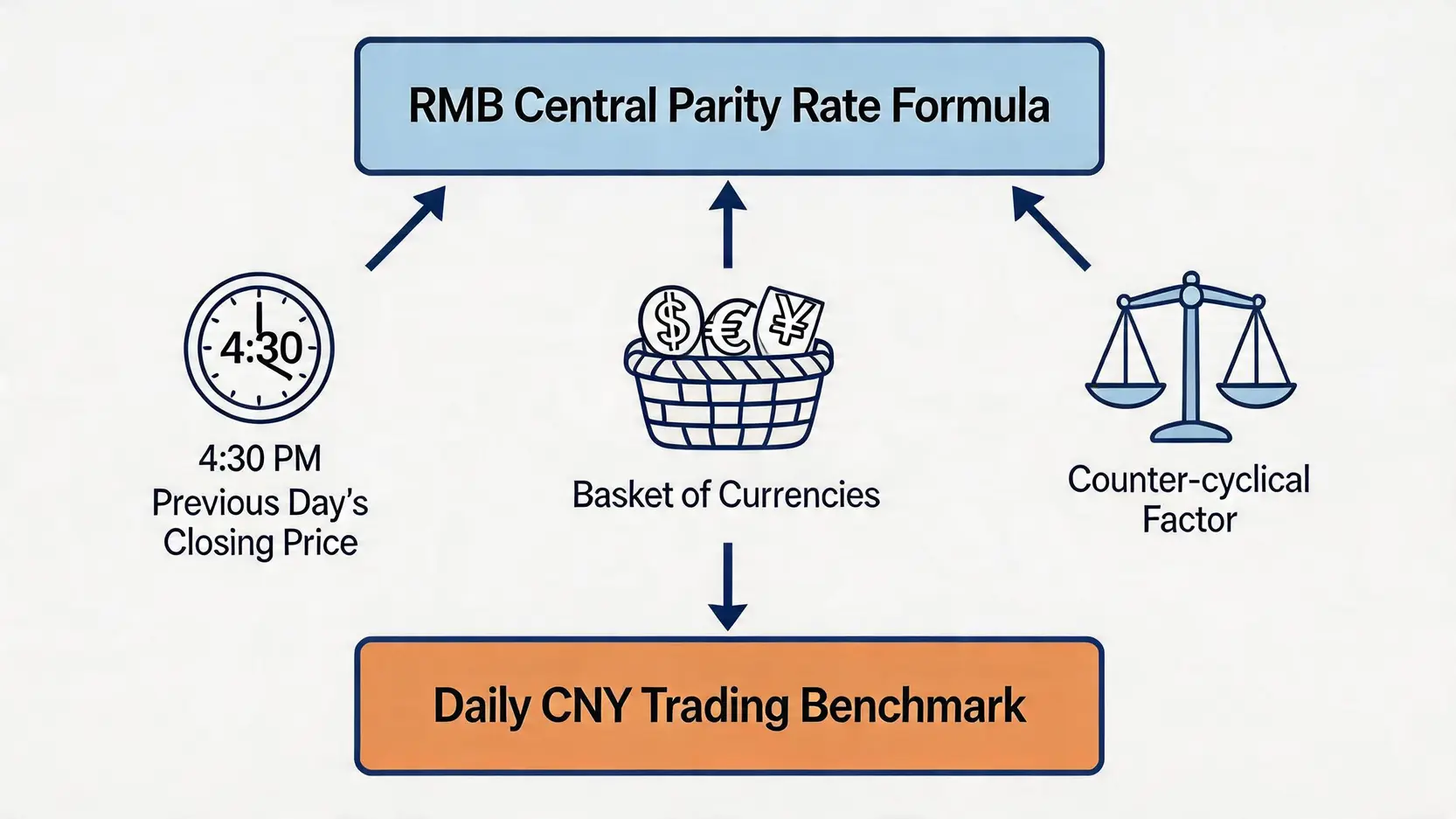
The Three Components of the Central Parity: Closing Price, Basket of Currencies, Counter-Cyclical Factor
This seemingly mysterious central parity is mainly calculated based on three components, aiming to balance market forces and official intent:
- Closing price: It refers to the onshore market closing price at 4:30 p.m. on the previous trading day. This reflects the supply and demand conditions of the market on the previous day.
- Basket of currencies exchange rate changes: To maintain the stability of the RMB against a basket of major trading partner currencies (such as the US dollar, euro, yen, etc., which form the CFETS currency basket), adjustments are required. If the US dollar strengthens in the international market, even if the supply and demand for RMB against the US dollar remain unchanged, this component will moderately depreciate the RMB central parity to maintain stability against the overall basket. To learn more about factors affecting exchange rates, you can refer to this tutorial.
- Counter-cyclical factor: This is a tool used by quoting banks based on macroeconomic data and subjective judgment to moderately offset pro-cyclical market behavior (i.e., excessive bullish or bearish sentiment). When irrational one-sided market movements occur, the central bank can guide quoting banks to activate this factor to smooth exchange rate movements and prevent “herd effect” from causing exchange rate overshooting.

Three key components of the RMB central parity
How Does the Central Parity Affect the Movement of CNY and CNH?
The setting of the central parity directly anchors the trading range of CNY. When the central parity is set stronger than expected (i.e., RMB appreciation), it usually leads to a stronger CNY. Although CNH is not directly constrained by the central parity, it closely follows the policy signals it releases. If the central parity continues to strengthen, indicating the Chinese central bank’s intention to “stabilize the exchange rate”, this will boost international confidence in the RMB, thereby pushing CNH higher and narrowing the spread between the two. The opposite is also true.
Impact on Individuals and Businesses
Understanding the difference between CNY and CNH is not only an academic discussion but also has important practical value, whether you are a business owner, investor, or ordinary consumer.
Cross-Border Traders: How to Use the CNY and CNH Spread to Reduce Costs?
For import and export companies, the spread between CNY and CNH is a key factor affecting profits. For example:
- Importers (who need RMB to pay for goods): When CNH is lower than CNY (i.e., CNH is weaker), buying CNH with US dollars in offshore markets such as Hong Kong, and then remitting it into mainland China through cross-border payment platforms to pay suppliers, will be more cost-effective than directly converting USD to CNY onshore.
- Exporters (who receive US dollars and need to convert them into RMB): When CNH is higher than CNY (i.e., CNH is stronger), converting US dollars into CNH in offshore markets can obtain more RMB.
Savvy traders constantly monitor the spread between the two markets and choose the most favorable settlement location and timing, thereby achieving exchange gains or cost savings.
Investors: How to Interpret Dual Exchange Rate Signals to Capture Market Sentiment
The spread between CNY and CNH is an important indicator for international markets to observe China’s economy and capital flows. Typically:
- CNH > CNY (positive spread): This usually indicates stronger overseas demand for RMB, optimism about China’s economic outlook, or expectations of RMB appreciation.
- CNH < CNY (negative spread / inversion): This may indicate increased capital outflow pressure, cautious sentiment among international investors toward China’s economy, or active shorting of the RMB.
Investors can use changes in the spread to help assess market sentiment and adjust their asset allocation strategies.
Extended Reading (Highly Recommended)
Personal Currency Exchange: Which Price Should be Used for Travel or Remittance?
For the general public, currency exchange is the main concern. If you are outside mainland China (such as Hong Kong, Taiwan, or Malaysia), when exchanging RMB cash at banks or money changers, or making wire transfers, you are dealing with the offshore RMB (CNH) exchange rate. As these transactions occur in the “offshore” market, financial institutions price them based on CNH market rates. Therefore, when exchanging money before traveling abroad, or remitting funds to China from overseas, you should refer to CNH quotes.
FAQ: Frequently Asked Questions About Onshore and Offshore RMB
Q: What is the relationship between RMB, CNY, and CNH?
A: RMB (Renminbi) is the general term for the Chinese currency, similar to “Hong Kong dollar” or “US dollar”. CNY and CNH are trading codes for RMB in different markets. CNY refers to the onshore market (mainland China), while CNH refers to the offshore market (outside mainland China). In simple terms, RMB is the currency, while CNY and CNH are its “identifiers” in two different markets.
Q: Is the RMB I exchange at banks in Hong Kong CNY or CNH?
A: The RMB you exchange at banks or money changers in Hong Kong, whether in cash or deposited into an account, is offshore RMB (CNH). This is because the transaction takes place outside mainland China, so it follows offshore market exchange rates and rules.
Q: What time is the RMB central parity published daily, and where can it be checked?
A: The People’s Bank of China, authorized by the China Foreign Exchange Trade System (CFETS), publishes the RMB central parity against a basket of major foreign currencies at 9:15 a.m. on each trading day. You can check the latest daily data on major financial websites’ exchange rate pages or directly on the official website of the China Foreign Exchange Trade System.
Conclusion
In summary, the main difference between CNY and CNH lies in regulatory control and the degree of marketization. CNY is strictly managed by the People’s Bank of China through the RMB central parity mechanism, and its movements mainly reflect official policy intentions, primarily serving domestic economic stability. CNH, on the other hand, more freely reflects international supply and demand and serves as a window for global investors to observe the Chinese economy. Understanding the differences and interaction between the two is not only fundamental financial knowledge but also a key factor in protecting one’s interests and making more informed financial decisions when dealing with RMB-related transactions.
Related Articles
-
The Taiwan Dollar Surges Past 31.5! With Hot Money and Foreign Capital Inflows, Is This an Opportunity or a Risk? An In-Depth Analysis The Capital Frenzy: The Three Major Drivers Behind the Taiwan Dollar Breaking Above 31.5 The New Taiwan dollar has recently become the absolute focal point of the...2026 年 6 月 10 日
-
Taiwan Dollar Appreciation and Hot Money Inflows! An Investor's Action Guide: Should You Buy Stocks, Bonds, or Exchange for US Dollars at This Stage? One of the hottest topics in the market recently has been the capital-driven rally fueled by foreign investors' consecutive net buying of Taiwan stocks, pushing the...2026 年 6 月 10 日
-
Hot Money Flows Into Taiwan's Bond Market: Understanding the Causes, Impact, and Investor Response Strategies in One Article One of the hottest topics in the market recently is "hot money flowing into Taiwan's bond market". Why have these fast-moving international funds, which come and go like the wind, chosen the...2026 年 6 月 10 日