HK Market Makers: Pricing & Block Trade Guide

【Hong Kong Stocks Unveiled】How Do Market Makers Operate? A Complete Guide to the Market Maker Pricing Mechanism and Block Trade Hidden Rules
Why do stock prices often move sharply in places you cannot see? How do institutional trades actually take place behind the scenes? In reality, this often involves the operation of “block trades” and “market makers”. To truly understand the market, you must grasp the meaning of block trades and the core logic of the market maker pricing mechanism. This article will fully decode the mysterious role of market makers in the Hong Kong stock market, helping you understand the deeper flow of institutional capital.
What Is a Block Trade? Understanding Institutional Trading Behavior
In the stock market, aside from retail investors trading on the open market during trading hours, there is also a mechanism designed specifically for large transactions, known as “block trades” or large block trades.
The Exact Meaning of “Block Trade”: How Is It Different From Normal Intraday Trading?
A “block trade” refers to a securities transaction involving a very large quantity or value, usually conducted between institutional investors (such as funds, insurance companies, and investment banks). The key difference from normal trading is that these transactions are negotiated privately outside the exchange’s automatic matching system. After both parties agree on price and volume, the trade is then reported to the exchange for recording and settlement.
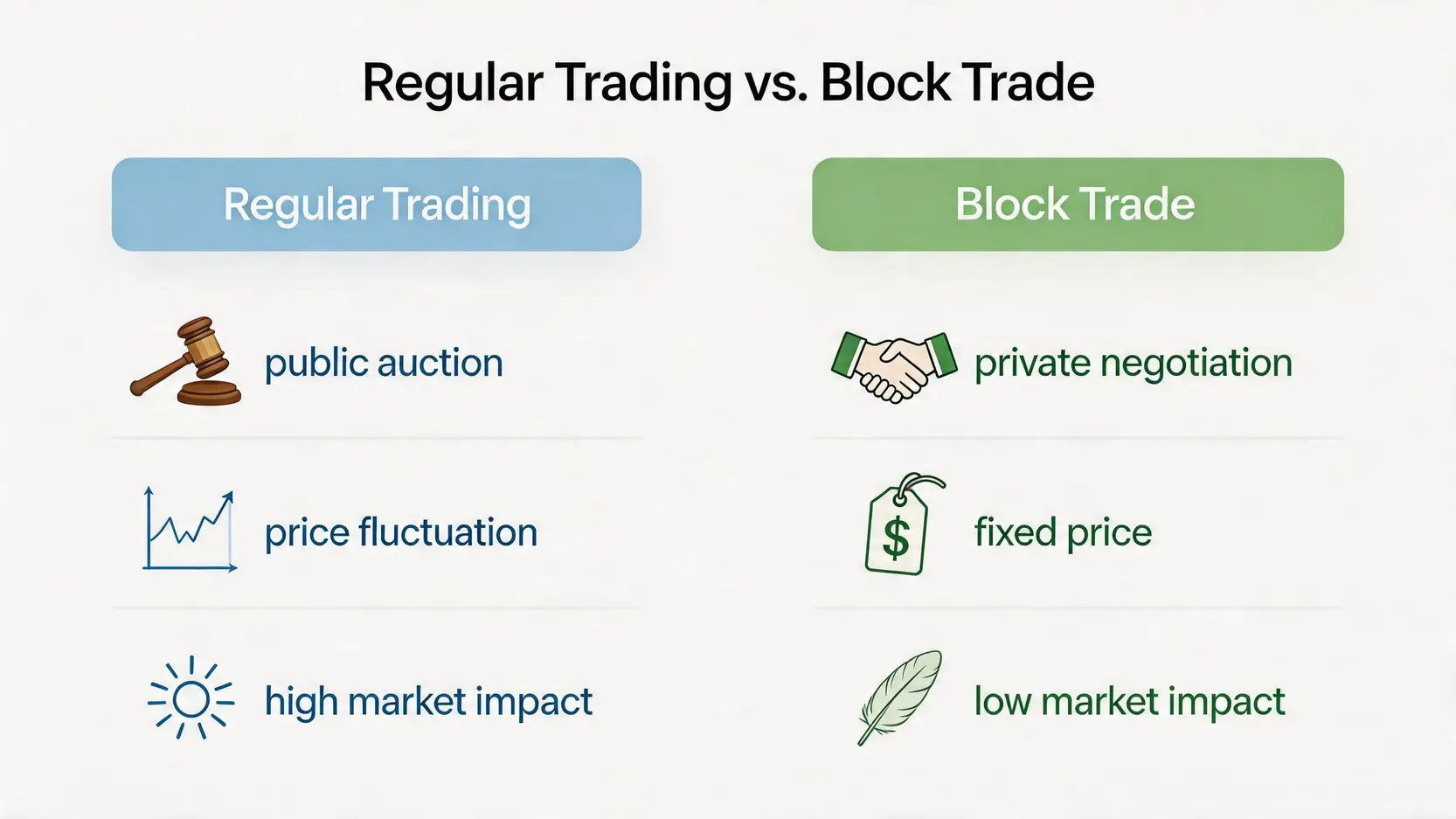
In simple terms, normal trading is like “posting an order in the open market for bidding” while Hong Kong stock block trades are more like “private negotiation”, where both parties agree on terms before execution to avoid direct market impact. This method is more efficient and more discreet.

Block Trade vs. Normal Intraday Trading
Why Do Institutional Investors Prefer Block Trades? Three Key Advantages
Institutional investors favor block trades mainly due to the following advantages:
- Reduced market impact: If a fund sells millions of shares directly in the open market, it may trigger a sharp price drop. Block trades allow them to privately match with a buyer at an agreed price, avoiding panic-driven price movements.
- Price certainty: In the open market, large orders may be split into multiple trades at different price levels, making the final average price uncertain. Block trades allow both parties to lock in a specific price, providing high price certainty.
- Higher efficiency: For large transactions, private negotiation is much faster than gradually placing orders in the open market, which is crucial for fund managers who need to adjust portfolios quickly.
Process and Rules of Hong Kong Block Trades
Although block trades are negotiated off-market, they are still regulated by the Hong Kong Stock Exchange. The general process is as follows:
- Finding a counterparty: The seller (or buyer) typically uses investment banks or brokers (often market makers) to locate the opposite trading interest.
- Private negotiation: Both parties negotiate the quantity and price. The agreed price may be above, below, or equal to the market close, depending on supply and demand, liquidity, and bargaining power.
- Execution and reporting: Once an agreement is reached, the trade is executed. According to Hong Kong Exchange rules, these off-market trades must be reported within a specified timeframe for market transparency. The “block trades” or “U trades” records you see on quotation software often fall into this category.
Recommended Reading (Highly Recommended)
The Core of Market Liquidity: Market Makers and the Pricing Mechanism
When discussing block trades, one key role cannot be ignored: the “market maker”. “Market makers” are the gears that keep the market running smoothly, and their pricing mechanism is the foundation of market liquidity.
Who Are “Market Makers”? Understanding Their True Role in the Hong Kong Market
Many retail investors view “market makers” negatively, associating them with price manipulation. However, in modern financial systems, market makers are neutral or even positive participants. They are licensed financial institutions responsible for continuously providing buy and sell quotes for specific instruments (such as stocks, warrants, and structured products), thereby ensuring market liquidity.
Main responsibilities of market makers include:
- Providing two-way quotes: Market makers always provide both a bid price and an ask price.
- Facilitating transactions: Investors can trade directly with market makers based on their quotes, even in low-liquidity conditions.
- Stabilizing the market: During high volatility, market makers absorb buying or selling pressure, acting as a stabilizing force.
How Does the Market Maker Pricing Mechanism Work? How Do Two-Way Quotes Provide Market Liquidity?
The essence of the market maker pricing mechanism lies in “two-way quotes” and the “bid-ask spread”.
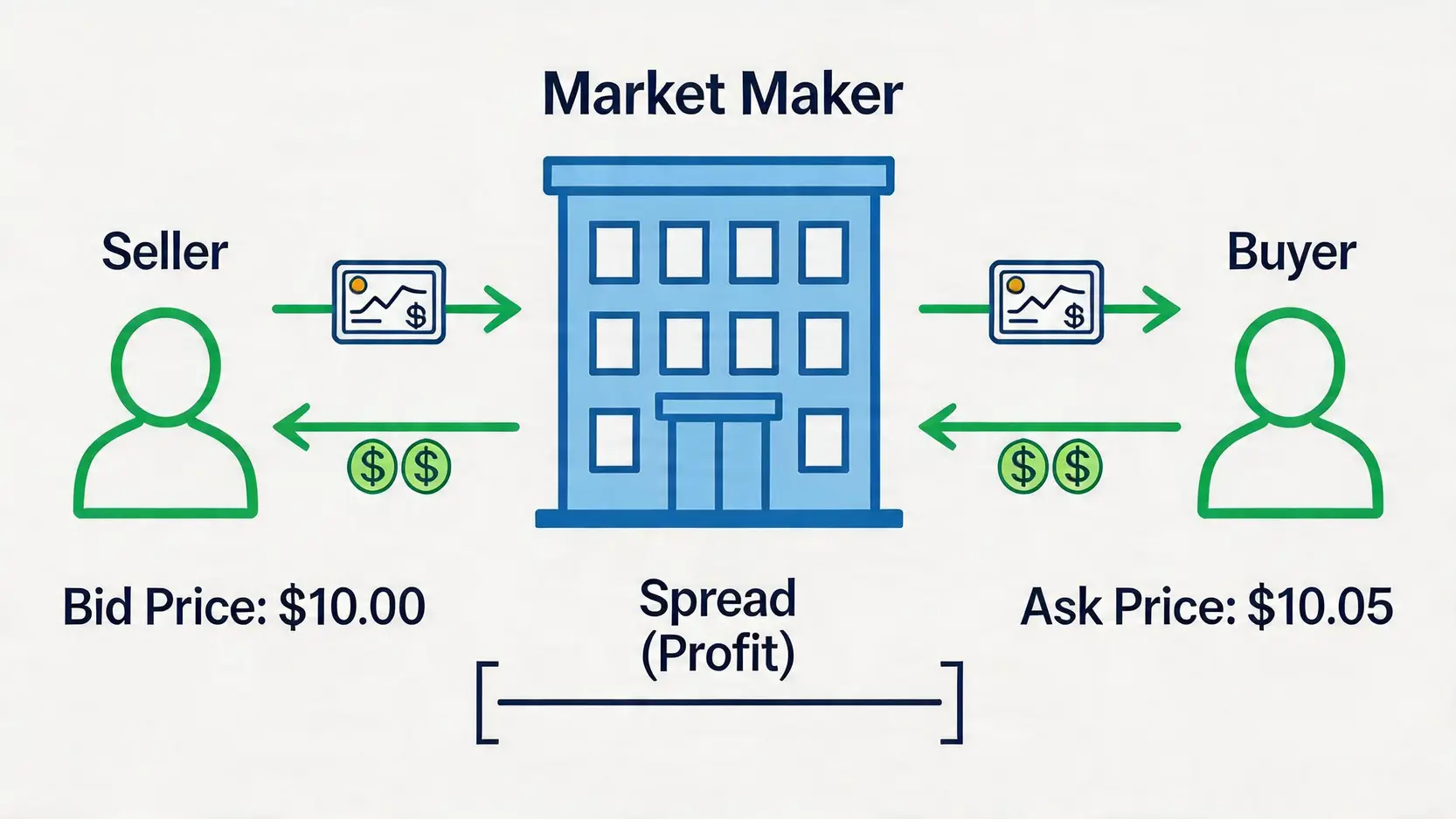
For example, a market maker quotes Stock A as follows:
- Bid: $10.00
- Ask: $10.05
This means the market maker is willing to buy Stock A from you at $10.00 and also willing to sell Stock A to you at $10.05. The $0.05 spread is the main source of profit for providing liquidity services. When you want to sell stocks but cannot find a buyer, you can sell to the market maker; when you want to buy but no one is selling, you can buy from the market maker. This ensures that there is always a counterparty in the market, preventing a situation where “there is a price but no liquidity”.

Market makers provide liquidity and generate profit through the bid-ask spread
How Do Market Makers Profit From Block Trades and Pricing Mechanisms?
Market makers do not only profit from the bid-ask spread; they also play a key role as “intermediaries” and “facilitators” in Hong Kong block trades. When a fund wants to sell a large volume of shares, the market maker may directly take on the trade. They are able to do this based on several profit models:
- Price discount: When taking on large sell orders, market makers usually require a price discount. For example, if the market price is $100, they may acquire it at $98.
- Inventory management and hedging: After acquiring the position, market makers use professional trading systems and risk management models to gradually sell the shares in the market, or hedge using derivatives (such as futures and options) to lock in profits.
- Information advantage: As core market participants, they have more sensitive insights into capital flows and market sentiment.
How Can Retail Investors Observe and Use Block Trade Information?
Although retail investors cannot directly participate in block trades, learning how to interpret publicly available information can help identify market direction and understand institutional fund flows.
How to Identify Block Trade Signals From Trading Records?
Many trading platforms or software provide “time & sales” or “trading logs”. Retail investors should focus on the following signals:
- Non-automated matching trades: Look for trades marked as “D” or “U” records, which are usually delayed block trade reports.
- Large trades at specific times: Sudden large-volume trades during pre-market, lunch break, or after market close often indicate block trades.
- Round numbers or special price levels: Trades often occur at round figures or unusual price points rather than normal intraday tick movements.
What Do Block Trade Prices Imply About Stock Trends?
Analyzing the relationship between block trade execution price and market price can provide useful insights:
- Premium trades: If the block trade price is significantly higher than the market price, it may indicate strong bullish sentiment from the buyer, suggesting a positive signal.
- Discount trades: If the price is significantly lower than the market price, it may suggest large shareholders are exiting positions or concerns about future outlook, which can be a bearish signal.
- At-par trades: If the price is close to market value, it usually indicates neutral turnover with limited market impact.
However, interpreting these signals requires combining fundamentals, market conditions, and subsequent price action. Relying on a single block trade alone is not sufficient for making trading decisions. Advanced stock analysis techniques are essential for informed decision-making.
Recommended Reading (Highly Recommended)
Frequently Asked Questions About Block Trades and Market Makers
Q: Is the price of a block trade always better than the market price?
A: Not necessarily. The price of a block trade is the result of negotiation between the buyer and the seller. For the buyer, being able to acquire a large number of shares at a price below the market price (a discount) is naturally advantageous. However, if the buyer has a strong demand for shares, the trade may also be executed at a price above the market price (a premium). The price depends on the stock’s liquidity, the urgency of both parties, and overall market sentiment.
Q: Can retail investors directly participate in block trades?
A: Generally, no. Block trades have high entry requirements, typically involving a minimum number of shares or transaction value (for example, several million to tens of millions of Hong Kong dollars). They are primarily designed for institutional investors. Retail investors mainly trade through the exchange’s automated matching system.
Q: Are market makers and market manipulators the same in the Hong Kong market?
A: In modern financial terminology, they can largely be considered the same concept. “Market maker” is the official and professional term, referring to licensed institutions that provide liquidity to the market. “Market manipulator” is a more colloquial term that sometimes carries a negative connotation, but the core role and function are essentially the same as market makers.
Q: Do block trades directly affect stock prices?
A: Block trades are executed off-market at pre-agreed prices, so they do not directly impact intraday prices at the moment of execution. However, after the transaction is completed and disclosed, the market may interpret the signal behind it. For example, a large premium buy block trade may boost market confidence and attract follow-up buying, indirectly pushing the stock price higher. Conversely, a large discount sell block trade may trigger market concern and indirectly lead to price declines.
Conclusion
In summary, block trades are an efficient tool for institutional investors to execute large transactions, while market makers play a key role in maintaining market liquidity through their unique pricing mechanisms. Understanding how both operate is an important step for every Hong Kong stock investor to better interpret capital flows and make more informed decisions. From today onward, start paying attention to block trade signals in the market and incorporate them into your analysis framework to enhance your investment perspective.
Related Articles
-
US-Japan Interest Rate Differential Out of Control? Uncovering the Root Causes of Yen Depreciation and the Bank of Japan's Policy Dilemma Recently, even though Japan's Ministry of Finance has repeatedly deployed large-scale intervention measures, the yen has only enjoyed brief periods of relief before returning to its depreciation trend. This...2026 年 6 月 9 日
-
The Ultimate Guide to Yen Carry Trade Unwinding: The Chain Reaction That Triggers Global Market Turmoil Recent violent fluctuations in the Japanese yen exchange rate, including the frequent intraday "flash crashes" and "surges", all point to one key term: the "carry trade unwinding chain reaction". This seemingly technical concept is...2026 年 6 月 9 日
-
Japanese Yen Futures Trading Volume Surges! Is Smart Money Flowing In? A Complete Guide to Positioning for the Opportunity Fundamentals: What Are Japanese Yen Futures? To understand the significance behind a surge in Japanese yen futures trading volume, we first need to answer a basic question: "What are Japanese yen...2026 年 6 月 5 日