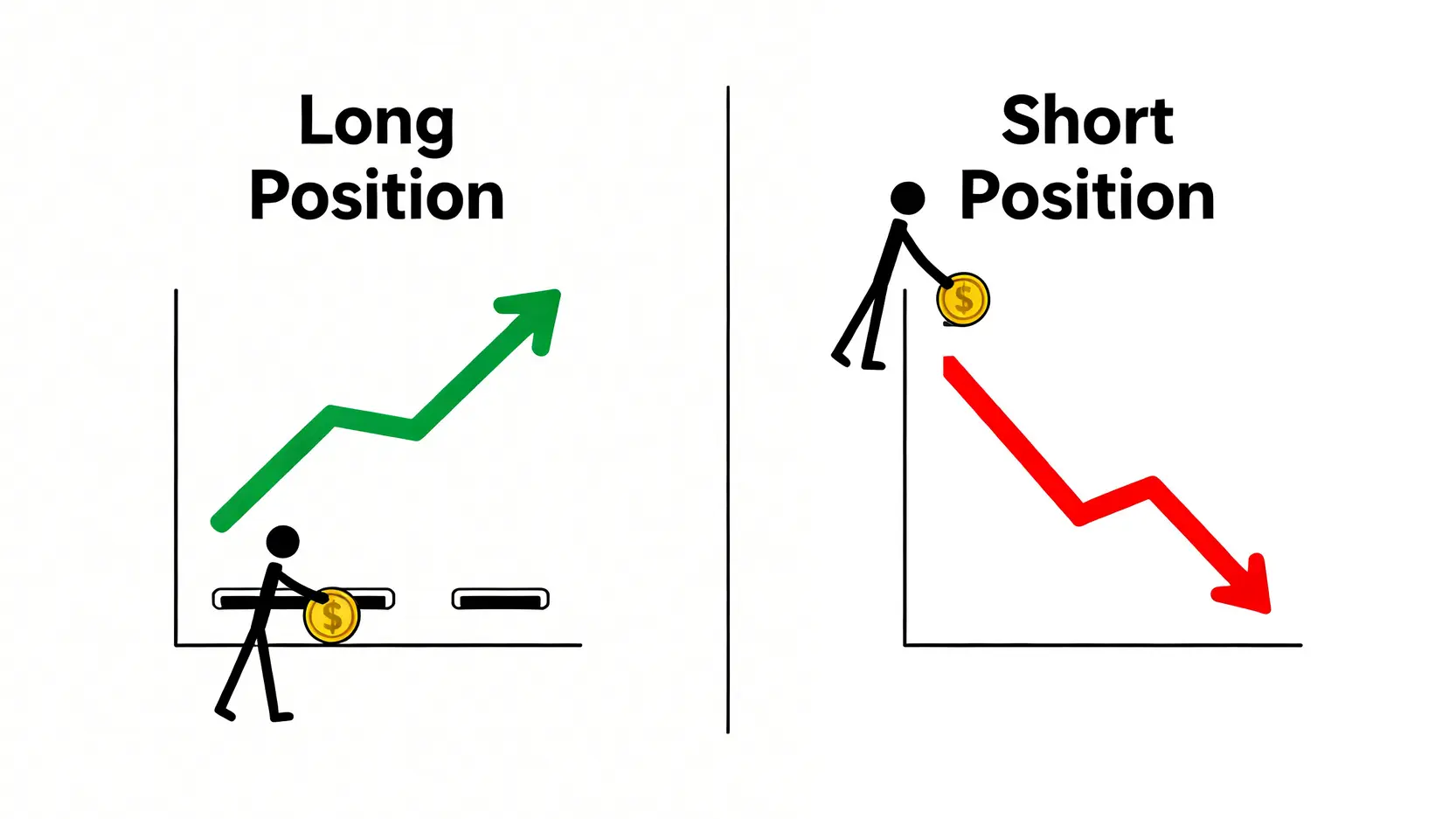
The “Long/Short” Strategy of Hedge Funds: Taking long positions (Long) and short positions (Short) simultaneously in the market, aiming to profit regardless of whether the market rises or falls.
- Global Macro: Investing based on global macroeconomic trends, such as interest rates, exchange rates, commodity prices, or changes in national policies. Fund managers may trade various assets including stock index futures, currencies, and government bonds.
- Event-Driven: Focusing on specific corporate events such as mergers, acquisitions, restructurings, or bankruptcies, and seeking investment opportunities from them.
- Leverage Operations: Expanding investment scale through borrowing in pursuit of higher returns, while also amplifying the risk of potential losses.
These complex hedge fund investment strategies allow them to profit in different market environments, but they also require extremely high professional competence from fund managers.
Advantages and Disadvantages: High Potential Returns, but High Entry Barriers and Risks as Well
Advantages:
- Pursuit of Absolute Returns: Not constrained by the performance of market indices, with the goal of delivering positive returns to investors under any market conditions.
- Flexible Investment Strategies: Able to use short selling, leverage, derivatives, and various other methods to capture more diversified profit opportunities.
- Portfolio Diversification: Because its strategies have relatively low correlation with traditional stock and bond markets, it helps diversify the overall investment portfolio risk.
Disadvantages:
- Extremely High Entry Barriers: Usually open only to “professional investors” (In Hong Kong, this generally refers to individuals with an investment portfolio of at least HKD 8 million). The minimum investment amount is often hundreds of thousands or even millions of US dollars.
- Risk and Leverage: High leverage operations may result in massive losses or even total loss of capital.
- High Fees: Generally adopting a “2 and 20” fee structure, which charges a 2% annual management fee plus 20% of profits as a performance fee.
- Low Transparency: As private funds, their holdings and operating strategies do not need to be disclosed in detail like public funds.
- Liquidity Restrictions: Usually subject to longer lock-up periods and redemption notice periods, meaning funds cannot be withdrawn at any time.
Which Type of Investors Is It Suitable For?
Hedge funds are tools designed for professional investors with high net worth, high risk tolerance, and a pursuit of alternative investment returns. For ordinary retail investors, this is a distant and extremely high-risk field.
[Stable Cash Safe Haven] What Is a Money Market Fund (Money Market Fund)?
If your goal is capital safety and high liquidity, then a Money Market Fund is definitely an ideal choice. It is regarded as a cash management tool with extremely low risk and is often used as a parking place for short-term funds or emergency reserves.
Definition and Investment Targets: Mainly Investing in Short-Term Instruments With Extremely Low Risk
A Money Market Fund is a mutual fund that mainly invests in high-quality short-term debt instruments (that mature within one year). Its investment targets include:
- Treasury Bills: Issued by governments and considered risk-free investments.
- Commercial Paper: Issued by large corporations for short-term financing.
- Banker’s Acceptances: Short-term instruments guaranteed by banks.
- Certificates of Deposit (Certificates of Deposit, CDs): Large-denomination time deposits issued by banks.
Because these assets have high credit quality and short maturities, the net asset value of Money Market Funds fluctuates very little. Their objective is to maintain the net asset value (NAV) of each fund unit at a stable level of 1.
Extended Reading (Highly Recommended)
Silver Investment Guide: Is Investing in Silver Good? A Complete Analysis of Five Major Advantages, Disadvantages, and Investment Channels
What Are ETF Risks? A Comprehensive Analysis of ETF Risk Levels and Investment Management Strategies
Advantages and Disadvantages: High Liquidity and Extreme Safety, but Relatively Low Returns
Advantages:
- Extremely High Safety: The risk of default in its investment targets is extremely low, and the possibility of capital loss is negligible.
- High Liquidity: Subscriptions and redemptions are usually available at any time (T+0 or T+1), allowing very flexible capital allocation.
- Low Entry Barrier: Low investment thresholds make it suitable for parking small amounts of capital.
- Returns Slightly Higher Than Demand Deposits: The yield is usually slightly higher than bank demand deposit rates.
Disadvantages:
- Low Return Rate: Its main objective is capital preservation rather than appreciation, so returns cannot be compared with assets such as stocks or bonds.
- Inflation Risk: In a high inflation environment, its return rate may not keep up with inflation, resulting in an actual decline in purchasing power.
What Is the Difference Compared With Bank Time Deposits?
Both Money Market Funds and bank time deposits are low-risk investment tools, but the main differences lie in liquidity and interest calculation methods.
- Liquidity: Money Market Funds can be redeemed at any time, while time deposits have fixed terms, and early withdrawal may result in the loss of part or all of the interest.
- Interest Calculation Method: Money Market Funds accrue interest daily and distribute income monthly, while time deposits pay principal and interest in a lump sum at maturity.
- Floating Returns: The yield of Money Market Funds fluctuates with market interest rates, while the interest rate of time deposits is locked in at the time of deposit.
Simply put, if you require extremely high flexibility in capital usage, Money Market Funds are the preferred choice. If you are certain that a sum of money will not be used for a period of time, time deposits may provide more stable returns.
[New Opportunities in Cryptocurrency] A Complete Guide to Hong Kong Bitcoin ETFs
In recent years, the cryptocurrency market has surged with activity, and the launch of Hong Kong Bitcoin ETFs has undoubtedly opened a door for traditional investors to access this emerging asset class. It allows investors to participate in the Bitcoin market without worrying about complex technical issues such as private keys and wallets.
Definition and Operation: How to Trade Bitcoin Through a Hong Kong Stock Account?
A Bitcoin exchange-traded fund (Bitcoin ETF) is a fund listed and traded on a securities exchange whose value closely tracks the price of Bitcoin. Investors can conveniently buy and sell shares of Bitcoin ETFs through their Hong Kong stock securities accounts, just like trading ordinary stocks.
Its operating model is that the fund management company buys and holds physical Bitcoin as the underlying asset and then issues corresponding fund units for trading on the exchange. This means that every ETF share you purchase is backed by real Bitcoin.
Comparison Between Spot ETFs and Futures ETFs
Bitcoin ETFs in the market are mainly divided into “Spot ETFs” and “Futures ETFs”, which have fundamental differences:
- Hong Kong Bitcoin Spot ETF: The fund directly holds physical Bitcoin. Its advantage is a smaller tracking error, enabling it to more accurately reflect the spot price of Bitcoin. The Hong Kong Securities and Futures Commission (SFC) has approved several virtual asset spot ETFs, marking an important step for Hong Kong in compliant cryptocurrency investment.
- Bitcoin Futures ETF: The fund does not hold physical Bitcoin but instead invests in Bitcoin futures contracts traded on commodity futures exchanges (such as CME). Its disadvantages include the existence of “rollover costs” and “futures premium or discount”, which may cause significant deviation between its long-term performance and the spot price of Bitcoin.
For investors who wish to closely track Bitcoin price movements, spot ETFs are a more direct and transparent choice.
Risks and Considerations When Investing in Hong Kong Bitcoin ETFs
Although Bitcoin ETFs provide convenience, investors must clearly understand their inherent risks:
- Extreme Price Volatility Risk: Bitcoin is a well-known high-volatility asset whose price may fluctuate dramatically within a short period.
- Regulatory Risk: Cryptocurrency regulatory policies worldwide are still evolving, and any unfavorable policy may impact the market.
- Market Sentiment Risk: The cryptocurrency market is heavily influenced by news, public figures’ statements, and sentiment-driven factors.
- Custody and Cybersecurity Risk: Although assets are held in custody by professional institutions, extreme risks such as hacking attacks or technical failures cannot be completely ruled out.
For beginner investors, it is recommended to start with ETF introductory tutorials and fully understand their operating mechanisms and risks.
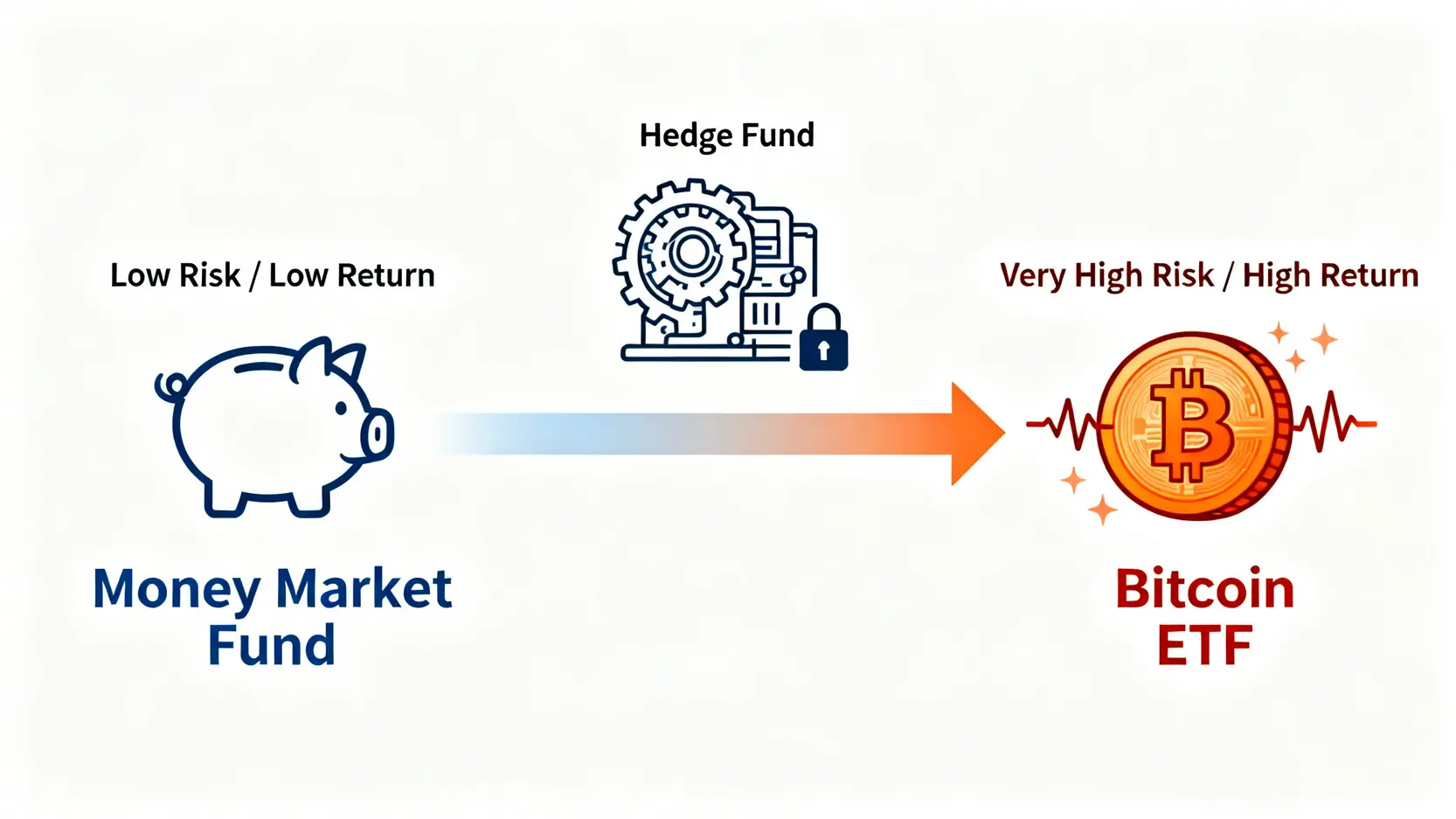
Ultimate Comparison: Hedge Funds vs Money Market Funds vs Bitcoin ETFs