Fund Investment Guide: Risk, NAV & Performance

Fund Investment Guide: Understand Fund Risk Levels, NAV Lookup, and Performance Rankings in One Article!
Want to invest in funds to grow your wealth but feel overwhelmed by the wide variety of options and do not know where to start? Worried about choosing the wrong fund and suffering unnecessary losses because you do not understand investment fund risks? This article is your comprehensive fund evaluation guide. It will walk you through the key indicators, teaching you how to assess fund risk levels, check the latest fund NAV, and interpret fund performance rankings so you can make investment decisions with greater confidence and avoid common investment traps.
The First Step: Understanding Fund Risk Levels (RR1-RR5)
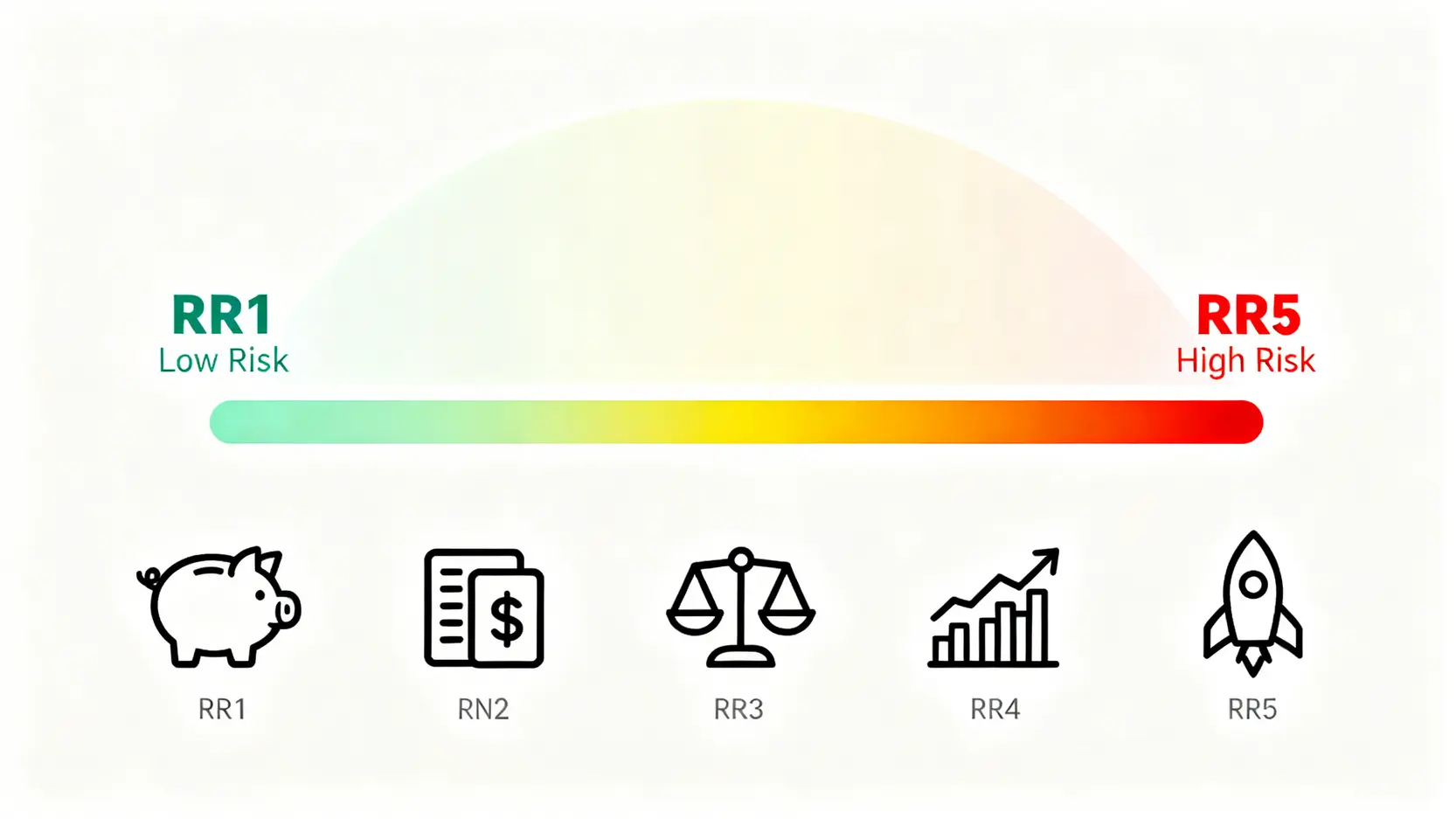
When entering the world of fund investing, the first concept you often encounter is the “Risk Rating” (RR). This is a standardized indicator established by regulators to protect investors, designed to help you quickly understand the potential risk level of a fund at a glance.
What Is a Fund Risk Rating?
A fund risk rating is a system that quantifies the potential risk of a fund into numerical levels, usually divided into five categories, ranging from RR1 (lowest risk) to RR5 (highest risk). This rating is primarily determined based on factors such as the volatility of the fund portfolio, the type of investment assets (such as equities, bonds, or money market instruments) and the investment regions. In simple terms, it acts as the fund’s “risk identity”, helping investors quickly match products that align with their own risk tolerance.
What Do RR1 to RR5 Represent? A Table Explaining Which Type of Investor Each Level Is Suitable For
Funds with different risk levels have significantly different potential returns and possible losses. Understanding the characteristics of each level is the foundation for building a personalized investment portfolio. The following table clearly explains the differences between RR1 and RR5:
| Risk Level | Risk Level Degree | Primary Investment Assets | Suitable Investor Type |
| RR1 | Low | Mainly invests in cash and money market instruments (such as short-term deposits and treasury bills). | Extremely conservative investors who prioritize capital safety and can hardly tolerate any loss of principal. |
| RR2 | Medium Low | Mostly invests in highly rated government or corporate bonds. | Conservative investors who seek stable returns and can accept slight price fluctuations. |
| RR3 | Medium | A mix of equities and bonds, or investments in relatively stable blue-chip stocks and investment-grade corporate bonds. |
Balanced investors seeking a balance between capital appreciation and income, willing to accept a moderate level of market fluctuations. |
| RR4 | Medium High | Mainly invests in equities from developed markets, or equity and bond portfolios from emerging markets. | Aggressive investors aiming for long-term capital appreciation and able to tolerate significant market fluctuations and potential losses. |
| RR5 | High | Concentrated investments in a single emerging market, specific industries (such as technology or biotechnology) or derivatives. | Aggressive investors seeking high returns who fully understand and are able to bear the risk of significant capital losses. |

In-Depth Understanding: 4 Major Investment Fund Risks You Must Know Beyond Risk Levels
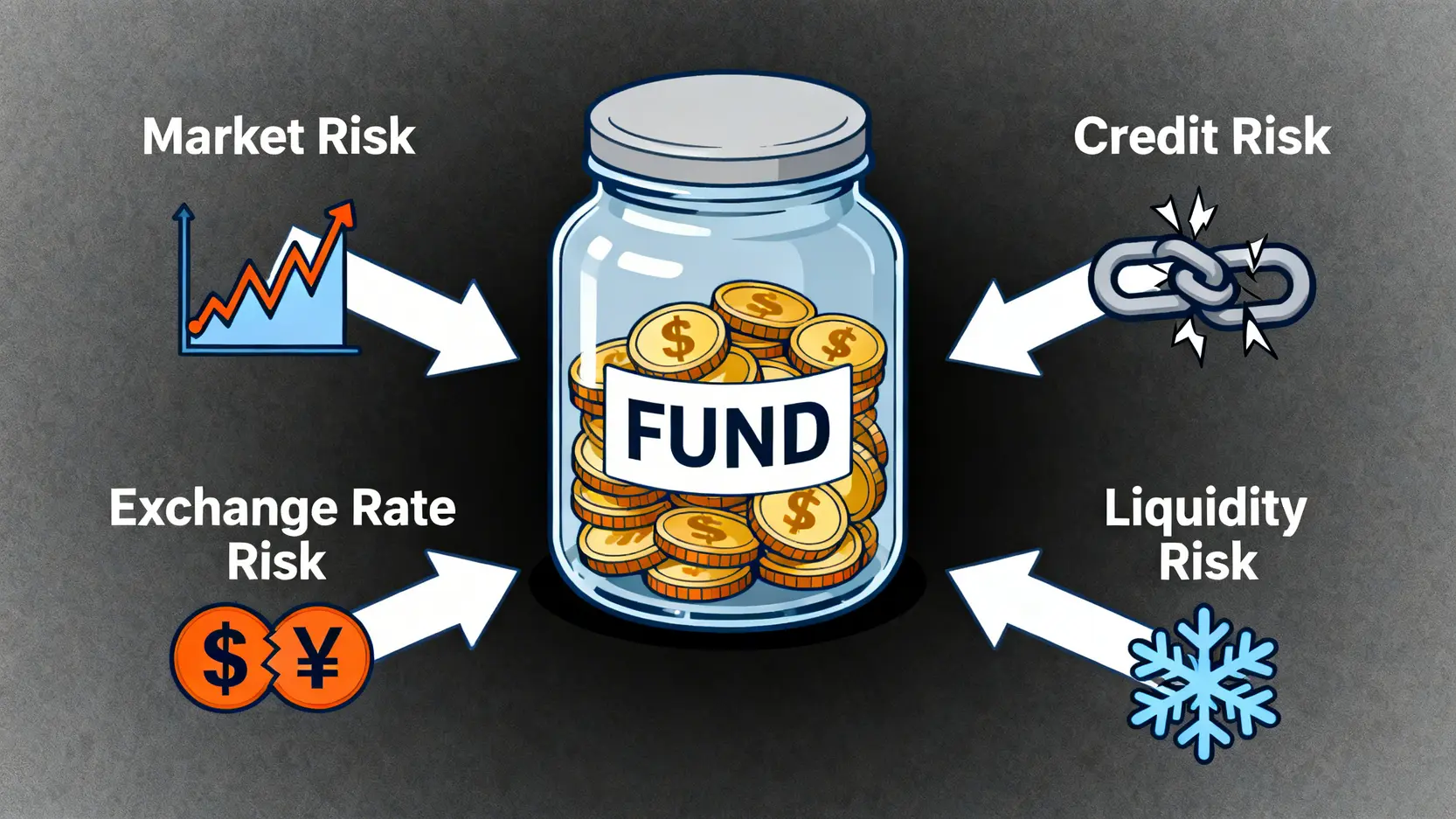
Fund risk levels are a good starting point, but they are far from a complete evaluation. Skilled investors look deeper and understand the various potential investment fund risks hidden behind the numbers. Below are four core risk types you must understand.

Market Risk: The Inevitable Challenge of Economic Fluctuations
Market risk is the most common risk and is also known as systematic risk. It originates from changes in the overall economic environment, such as interest rate movements, economic recessions, inflation pressures, and political instability. When the broader market environment deteriorates, even the strongest company stocks or bonds may decline, affecting the fund NAV. This type of risk cannot be completely eliminated through diversification within a single asset class and is something all investors must face.
Credit Risk: A Hidden Concern Particularly for Bond Funds
Credit risk mainly exists in bond funds. It refers to the risk that the bond issuer (which may be a government or a corporation) fails to pay interest or repay the principal on time, also known as “default risk”. If a bond held by a fund defaults, its value will decline significantly. Generally, government bonds have extremely low credit risk, while high-yield bonds (also known as junk bonds) carry relatively higher credit risk. Therefore, before investing in a bond fund, it is important to review the credit rating distribution of its portfolio. To understand bond-related risks in greater depth, you may refer to 2025 US Treasury Investment Guide: Understand What US Treasuries Are and How to Buy Them.
Exchange Rate Risk: A Required Lesson When Investing in Overseas Funds
When the fund you invest in is denominated in a foreign currency, you face exchange rate risk (Exchange Rate Risk). For example, if a Hong Kong investor purchases a US equity fund denominated in US dollars, even if the fund itself performs well, a depreciation of the US dollar against the Hong Kong dollar would reduce the actual return when converting profits back into Hong Kong dollars and may even turn gains into losses. For investors with globally diversified portfolios, exchange rate fluctuations are one of the key variables affecting final returns.
Liquidity Risk: Why Sometimes a Fund Cannot Be Sold Even If You Want to Sell It?
Liquidity risk (Liquidity Risk) refers to the risk of being unable to sell assets quickly at a reasonable price when needed. Some funds may invest in stocks with low trading volume, unlisted companies, or certain types of bonds. When panic selling occurs in the market, fund managers may find it difficult to sell these assets quickly to meet investor redemption requests. This may eventually result in redemption delays or forced sales of assets at extremely unfavorable prices, thereby harming the fund NAV.
Further Reading (Strongly Recommended)
2025 US Treasury Investment Guide: Understand What US Treasuries Are and How to Buy Them
Practical Application: How to Perform Fund NAV Lookup?
After understanding the risks, the next step is to learn how to track and evaluate fund performance. Fund NAV lookup is a fundamental task that should be performed regularly, as it is the most direct indicator for measuring fund value.
What Is Fund NAV? Why Is It Key to Evaluating Performance?
Fund Net Asset Value (NAV) represents the asset value of each unit of a fund. Its calculation formula is:
(Total Fund Assets – Total Fund Liabilities) / Total Fund Units Issued
NAV is usually calculated and published after the close of each trading day. It reflects the real-time market value of all assets within the fund portfolio. Observing the long-term NAV trend chart allows investors to clearly understand the fund’s growth trajectory, volatility level, and performance across different market cycles. A consistently and steadily rising NAV curve usually indicates strong fund management capability.
Commonly Used by Hong Kong Investors: 3 Recommended Platforms for Fund NAV Lookup
There are many reliable channels for checking fund NAV. The following are several commonly used platform types among Hong Kong investors:
- Fund company official websites: The most accurate and up-to-date source of information. Every fund company publishes the daily NAV of all its funds on its official website.
- Major financial information websites: Platforms such as Bloomberg, Reuters, and local financial media websites usually provide comprehensive fund databases, allowing investors to compare products across different companies.
- Independent fund rating agencies: Platforms such as Morningstar not only provide NAV data but also offer in-depth analysis, ratings, and historical performance information, making them one of the best tools for researching funds.
Selecting Quality Funds: How to Interpret Fund Performance Rankings?
Among the many funds available, how can you quickly identify potential top performers? Fund performance rankings provide an objective reference standard, but they must be interpreted wisely to avoid the common mistake of focusing only on short-term returns.
Where Can You Find Authoritative Fund Performance Rankings? (For Example Morningstar)
To find authoritative fund rankings, internationally recognized independent rating agencies are the preferred sources. Among them, Morningstar is widely regarded as the industry gold standard. It evaluates funds based on risk-adjusted returns and assigns star ratings (from one star to five stars), with five stars being the highest rating. In addition, many major banks and brokerage trading platforms integrate these ranking data, allowing clients to filter funds directly.
The Wisdom of Interpreting Rankings: Short-Term vs Long-Term Performance, Which Matters More?
One of the most common mistakes made by beginner investors is chasing short-term “top-performing funds”. However, strong short-term performance (such as over three months or one year) may simply result from good timing or benefiting from a specific market trend. What truly reflects the strength of a fund management team is long-term and consistently stable performance.
Investment Philosophy: Rather than focusing on a short-distance champion, it is better to choose an experienced marathon runner. When screening funds, priority should be given to whether the fund’s ranking over the past 3, 5, or even 10 years has consistently remained within the top 25% among similar funds (commonly referred to as being in the top quartile of the “quartile ranking”). Such funds usually indicate that their investment strategy can withstand the cycles of bull and bear markets.
Comprehensive Evaluation: Combine Indicators in Four Steps to Select the Most Suitable Fund for You
After mastering the knowledge above, you can integrate it into a clear four-step screening process to help you select the most suitable fund from the beginning.
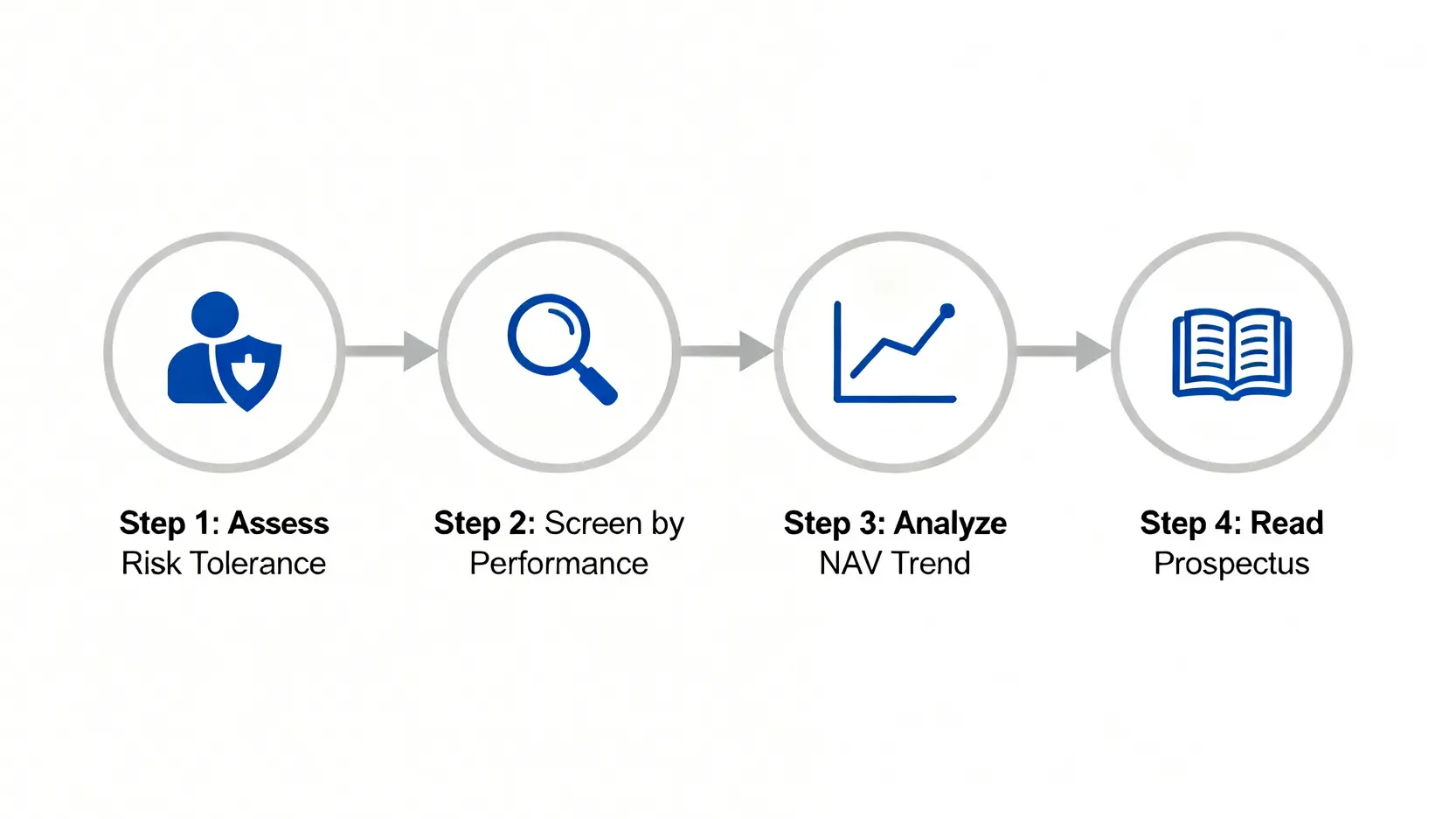
- Step One: Filter Funds Based on Your Personal Risk Tolerance and Suitable Fund Risk Levels
First, honestly assess your investment goals, time horizon, and psychological risk tolerance. Are you a conservative investor seeking stable retirement income, or an aggressive investor willing to accept higher risk for higher returns? This determines whether your selection range should be RR1-RR2 or RR4-RR5. This step is crucial and you may refer to how to assess personal investment risk to set the foundation for your investment journey. - Step Two: Use Fund Performance Rankings to Identify a List of Long-Term Stable Candidates
Within your selected risk level range, use fund ranking tools to identify funds that have consistently ranked among the top in their category over periods such as three years, five years, or longer. This step helps eliminate many short-lived performers and identify truly strong candidates. - Step Three: Review the Fund NAV Trend to Observe Its Stability and Growth Potential
Open the NAV trend charts of the candidate funds and compare them visually. Observe whether the curve rises relatively smoothly over time. During major market downturns (such as the 2008 financial crisis or the 2020 pandemic shock), how large was the drawdown and how quickly did it recover. An ideal NAV curve should demonstrate the “ability to rise during growth periods and remain resilient during declines”. - Step Four: Carefully Read the Fund Prospectus to Understand Its Structure and Fees
The final step, and often the most overlooked one, is to carefully read the fund prospectus. This document explains in detail the fund’s investment strategy, top holdings in stocks or bonds, the background of the fund manager, and most importantly the fee structure (such as management fees and subscription fees). Ensure that the fund’s investment philosophy aligns with your expectations and that the fee structure is reasonable.
Conclusion
Successful fund investing does not rely on luck but on a comprehensive framework of data analysis. By thoroughly understanding fund risk levels, recognizing various potential investment fund risks, making good use of fund NAV lookup tools, and objectively analyzing fund performance rankings, you can build your own evaluation system. This system will help you maintain clear judgment in complex markets and make smarter decisions that align with your personal interests. Start applying these strategies today and take a steady and confident first step toward growing your wealth.
FAQ: Common Questions
Q: Does a higher fund risk level always mean higher returns?
A: Not necessarily. A higher risk level (such as RR5) means the potential “upper limit” of returns is higher, but the potential “lower limit” of losses is also deeper. High risk does not guarantee high returns. It only indicates greater price volatility. When market conditions are unfavorable, high risk funds often experience the most severe declines. Investors should aim for the “best risk-adjusted return” within their own risk tolerance.
Q: Does a higher fund NAV mean the fund is more worth investing in?
A: No. The level of a fund’s NAV does not have absolute meaning and cannot be used alone to compare two different funds. For example, a fund established ten years ago with an NAV of 50 and a newly established fund with an NAV of 10 cannot be directly compared to determine which is better. The key lies in the “growth rate” and “trend” of the NAV. Investors should focus on the change in NAV over a period of time rather than its absolute value.
Q: Can you rely solely on fund performance rankings to choose a fund?
A: Absolutely not. Fund rankings summarize “past performance”, and past performance does not fully represent the future. Relying solely on rankings ignores many important factors, such as whether the fund manager has changed, whether the fund size has become too large and affected operational flexibility, and whether its investment strategy still suits the current market environment. Rankings are a useful screening tool, but they must be combined with risk evaluation, NAV analysis, and cost considerations to reach a comprehensive judgment.
Q: How much impact do fund management fees have on my returns?
A: The impact is very significant, especially in long-term investing. Management fees are deducted directly from fund assets every year, acting like an “invisible brake” that continuously slows the growth of your compound returns. Suppose two funds both generate an annual return of 8 percent. Fund A charges a management fee of 0.5 percent, while Fund B charges 1.5 percent. After 20 years, the seemingly small difference of 1 percent in fees can result in a final return difference of more than 20 percent. Therefore, when funds have similar performance, choosing the one with lower fees is a smart strategy.
Related Articles
-
Practical Applications of Volatility Surfaces: From Options Modeling to Advanced Skew Trading Strategies In options markets, implied volatility is never a flat line. Instead, it forms complex "smile" or "skew" surfaces. For advanced traders, mastering the practical applications of volatility surfaces is equivalent to possessing a lens that reveals market...2026 年 6 月 3 日
-
Building a Foreign Capital Flow Copy Trading Model: A Stock Market Indicator for Accurately Tracking Institutional Positioning In Asia-Pacific stock markets, foreign capital inflows and outflows often determine the direction of the index. However, simply looking at daily net buy and sell data is no longer enough. Only by building...2026 年 6 月 3 日
-
Options Buyer Strategies During Extreme Market Conditions: Black Swan Hedging and Cross-Market Arbitrage During Volatility Surges The most terrifying aspect of financial markets is not a gradual decline, but overnight flash crashes and cross-market capital withdrawals accompanied by volatility surges. In the highly unpredictable global macroeconomic environment of 2026, geopolitical...2026 年 6 月 3 日