What Is a Hedge Fund? 4 Core Strategies & Risks

Updated: 2026/03/03  |  CashbackIsland

對沖基金是什麼?揭秘頂級基金的4種核心策略與潛在風險

What Is a Hedge Fund? Revealing Four Core Strategies and Potential Risks of Top Tier Funds

Interested in entering the advanced world of investing, yet constantly confused by the term “hedge fund”? You may have heard that it can generate remarkable returns, but you are also concerned about the high risks involved. So what exactly is a hedge fund? What wealth generating logic lies behind its mysterious operating model? This article provides the most comprehensive hedge fund guide, covering its core definition, how hedge funds operate, an analysis of mainstream hedge fund strategies, and an in depth evaluation of potential hedge fund risks. All explained in the clearest way to help you build a solid investment knowledge foundation. 


What Is a Hedge Fund? A Mysterious Tool That Pursues Absolute Return

A hedge fund, sometimes referred to as a “risk hedging fund” is far more than a vehicle designed solely for hedging. It is a private investment partnership that adopts active investment strategies and is designed specifically (for high net worth individuals and institutional investors). Its core objective is straightforward: regardless of whether the market is bullish or bearish, it seeks to generate “absolute return”, meaning positive gains.


Core Definition: Profit Oriented Regardless of Market Conditions

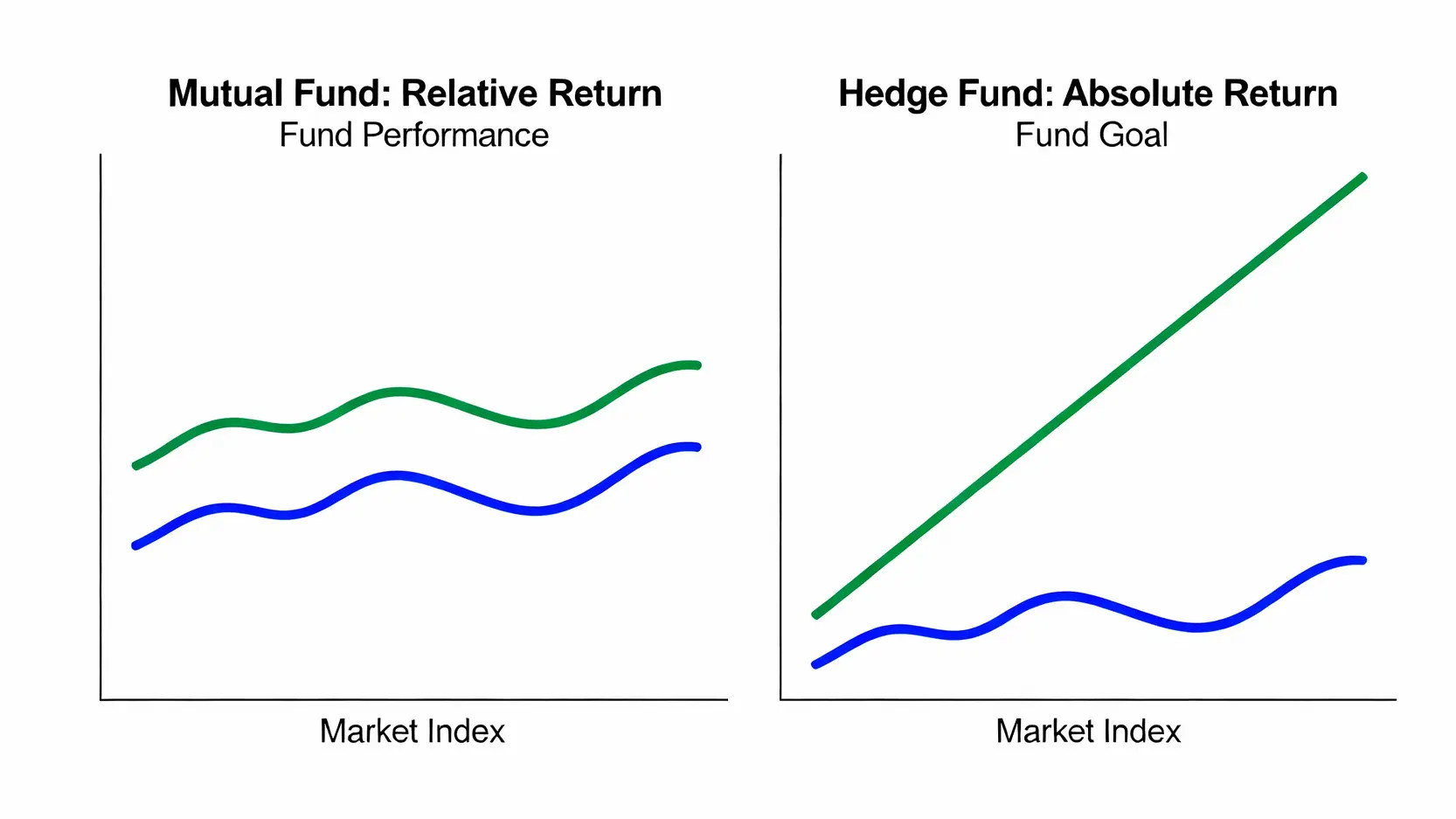
Traditional investment vehicles such as mutual funds typically aim to outperform a specific market index (for example the S&P 500). This means that even if the market declines by 20 percent, a fund that falls by only 15 percent has achieved its “relative return” objective. Hedge funds operate under a completely different philosophy. Their goal is to achieve positive growth under any market environment. To accomplish this, fund managers utilize an extremely broad and flexible range of investment tools and strategies, including short selling, leverage, and derivatives (such as futures and options), instruments that are rarely used or even restricted in traditional funds.

對沖基金與共同基金投資目標比較圖,說明絕對回報與相對回報的差異。

Hedge funds pursue “absolute return” (meaning profits regardless of market direction), while traditional funds pursue “relative return” (meaning outperforming a benchmark index).


Comparison Table of Key Differences Between Hedge Funds, Mutual Funds, and ETFs

To better understand the unique characteristics of hedge funds, the table below summarizes the key differences between them and the more familiar mutual funds and ETFs (Exchange Traded Funds).

Comparison Item Hedge Fund Mutual Fund ETF (Exchange Traded Funds)
Investment Objective Pursues absolute return regardless of market direction Pursues relative return, aiming to outperform the market benchmark Tracks a specific index, replicating market performance
Investment Strategy Highly flexible, can use leverage, short selling, and derivatives Subject to strict restrictions, typically long only Passively managed, fully replicates index constituents
Investment Threshold Very high, limited to qualified investors Lower, open to the public Very low, can be traded like stocks
Fee Structure 2-20 structure (2% management fee plus 20% performance fee) Primarily management fees (approximately 1-2 percent) Extremely low management fees (deducted internally)
Liquidity Relatively low liquidity, with lock-up periods and redemption restrictions High liquidity, typically redeemable daily Very high liquidity, can be bought and sold at any time during trading hours
Level of Regulation More loosely regulated, with lower transparency Strictly regulated, with high transparency Strictly regulated, with transparent holdings


How Do Hedge Funds Operate? Deconstructing Their Profit Model

Understanding how hedge funds operate is key to grasping their essence. Their structure, fee model, and investor eligibility differ significantly from traditional financial products, which explains why they often carry an aura of mystery.


Unique Legal Structure and High Investment Threshold

Most hedge funds adopt a Limited Partnership structure. The fund manager acts as the “General Partner”, responsible for all investment decisions and daily operations, while investors serve as “Limited Partners”, contributing capital without participating in management and enjoying limited liability (meaning their maximum loss is limited to their invested principal).

Due to the complexity and higher risk of hedge fund operations, regulators in various jurisdictions typically require that only “Qualified Investors” or “Professional Investors” who meet specific financial and experience criteria may participate. For example, in the US, individual investors generally must have a net worth exceeding USD 1 million (excluding their primary residence) or an annual income above USD 200,000. This high barrier ensures that participants possess sufficient risk tolerance.


Decoding the “2 and 20” Fee Structure: How Management and Performance Fees Affect Returns

“2 and 20” is the classic fee model in the industry and a major source of substantial income for hedge fund managers:

  • Management Fee: Typically 2 percent of the fund’s total assets under management (AUM). This fee is charged annually regardless of fund performance and is used to cover operational expenses such as office rent, research costs, and employee salaries.
  • Performance Fee: Typically 20 percent of the fund’s annual profits. This fee is only charged when the fund generates gains. The structure is designed to align the interests of the fund manager with those of investors, incentivizing superior performance.

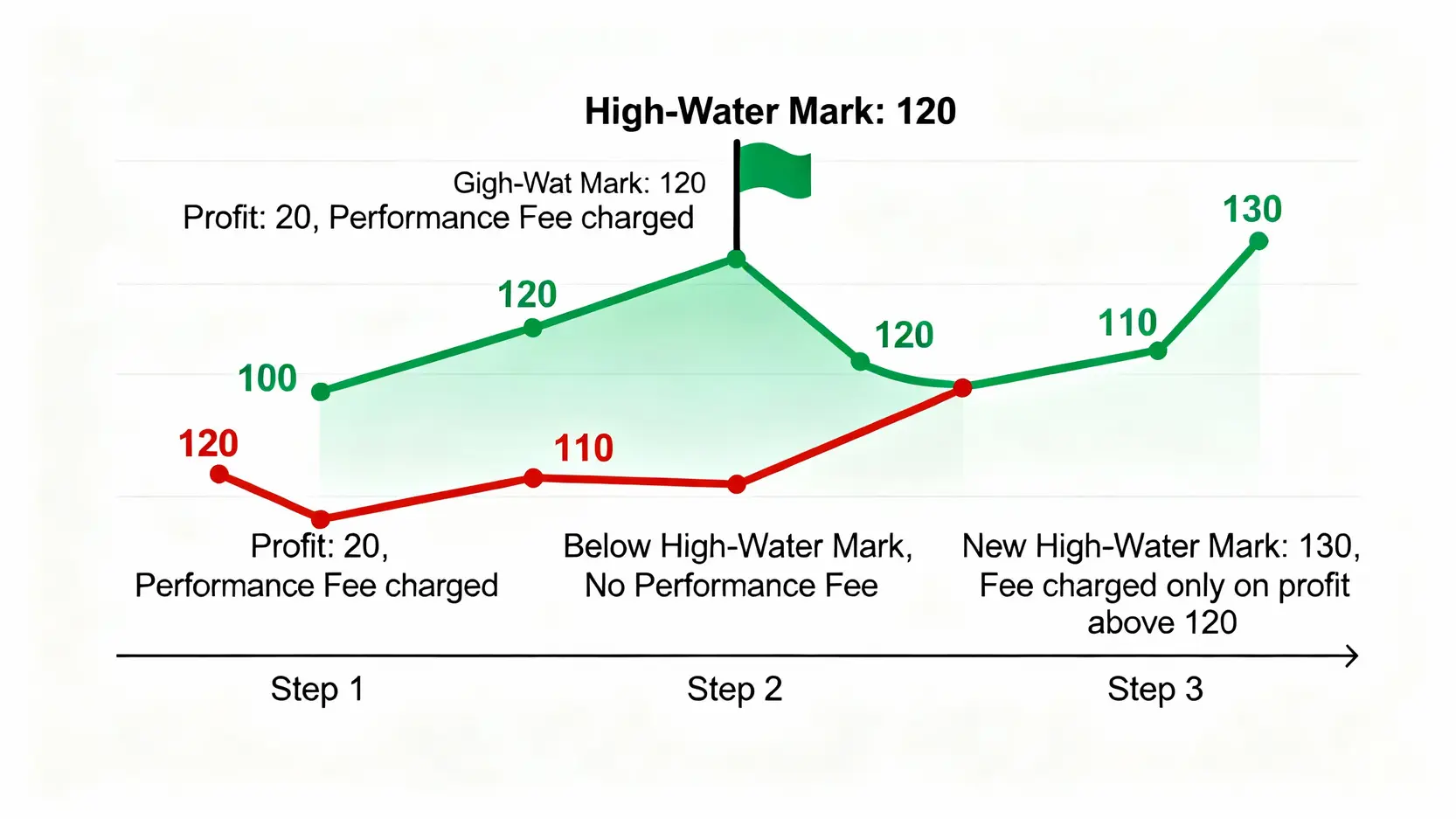
In addition, many funds incorporate a “High Water Mark” provision, ensuring that performance fees can only be charged after the fund’s net asset value reaches a new high. For example, if a fund rises from 100 yuan to 120 yuan in the first year, the manager may charge a performance fee on the 20 yuan of profit. If it declines to 110 yuan in the second year, no performance fee is charged. In the third year, the fund must exceed 120 yuan before a performance fee can be charged on profits above that level. This mechanism prevents managers from repeatedly charging fees due to performance fluctuations.

對沖基金高水位線收費機制示意圖,解釋績效費的收取條件。

The “High Water Mark” mechanism ensures that fund managers can only charge performance fees on profits exceeding the previous net asset value peak.


Further Reading (Highly Recommended)

What Are ETF Risks? A Comprehensive Analysis of ETF Risk Levels and Investment Management Strategies 

Mainstream Hedge Fund Strategies: Breakdown of Four Core Approaches

The success of hedge funds largely depends on the diversified strategies they employ. These strategies are often highly complex and require precise calculations and market judgment. The following are some of the most mainstream hedge fund strategies:


Equity Long Short Strategy

This is the oldest and most common hedge fund strategy. Fund managers simultaneously establish “long positions” (meaning buying) and “short positions” (meaning selling short).

股票長短倉策略示意圖,解釋同時做多與做空的對沖概念。

The core of the equity long short strategy is to buy stocks expected to rise (long) and sell stocks expected to fall (short) at the same time, hedging market risk while generating excess returns from stock selection.

  • Long: Buy stocks believed to be undervalued with future upside potential.
  • Short: Sell stocks believed to be overvalued with expected price declines.

The intelligence of this strategy lies in its dual profit potential. If the overall market rises, gains from long positions may exceed losses from short positions. If the overall market declines, profits from short positions can offset losses from long positions. Ideally, regardless of whether the broader market rises or falls, as long as stock selection is correct, the fund can achieve net gains. This represents the classic embodiment of the “hedging” concept.


Global Macro Strategy

Funds adopting this strategy focus on global macroeconomic trends. Based on forecasts of macroeconomic indicators such as interest rates, exchange rates, national policies, and international trade relations, managers take large scale leveraged positions across global markets. Investment targets include equities, bonds, currencies, and commodities across nearly all asset classes. For example, if a manager anticipates that a country’s central bank will raise interest rates, the fund may go long that country’s currency while shorting its bonds. The attack on the British pound in 1992 by Soros’s Quantum Fund is one of the most famous cases of a global macro strategy.


Event Driven Strategy

This strategy seeks profit opportunities arising from specific corporate events that may significantly impact stock prices, such as:

  • Merger Arbitrage: When Company A announces the acquisition of Company B, the share price of Company B typically rises but remains slightly below the acquisition price. The fund buys shares of Company B and may simultaneously short shares of Company A to capture the price spread.
  • Distressed Debt: The fund purchases bonds of financially troubled or near bankrupt companies at deep discounts and participates in restructuring negotiations, aiming for substantial value recovery if the company successfully reorganizes.


Quantitative Strategy

This strategy relies entirely on complex mathematical models and high speed computer algorithms to execute trades, with minimal human intervention. Models analyze vast amounts of historical data to identify price patterns and market anomalies and automatically execute trades when opportunities arise. High Frequency Trading is one extreme form of this approach. Renaissance Technologies’ “Medallion Fund” is a legendary representative of quantitative strategy.


Three Major Hedge Fund Risks That Must Be Confronted Before Investing

The high return potential of hedge funds is always accompanied by significant risks that cannot be ignored. Before considering this type of investment, it is essential to have a deep understanding of the following risks, which is why comprehensive risk management is crucial. 

Leverage Risk: Potential Losses May Exceed Principal

Leverage is a double edged sword. Hedge funds commonly use high leverage (meaning borrowing to invest) to amplify potential returns. Five times leverage can turn a 20 percent gain into 100 percent, but it can equally turn a 20 percent loss into a 100 percent loss of principal. In extreme cases, losses may even exceed the initial capital invested. The collapse of Long Term Capital Management (LTCM) in 1998 was a catastrophic consequence triggered by excessive leverage, and its impact even threatened the stability of the global financial system.


Liquidity Risk: Lock Up Periods Restrict Redemption

Unlike stocks or mutual funds, hedge funds offer very low liquidity. Investors’ capital is typically subject to a “lock up period”, which may last from one year to several years. During this lock up period, investors cannot redeem their funds at all. Even after the lock up period ends, redemption is usually subject to strict limitations, such as being permitted only quarterly or semi-annually, often requiring advance notice. This structure allows fund managers to focus on long term strategies without being forced to liquidate assets to meet short term investor demands, but it also means investors lose access to liquidity for extended periods.


Transparency and Regulatory Risk: Complex Operations with Lighter Regulation

Because hedge funds primarily serve professional investors, regulators generally assume these investors are capable of assessing risks independently, resulting in lighter regulation compared to public mutual funds. This leads to very low transparency. Investors often have limited visibility into the fund’s specific holdings and risk exposures. While such confidentiality helps protect proprietary trading strategies, it also conceals potential risks. To a large extent, investors must rely on the fund manager’s professional expertise and integrity. For more information about the definition of hedge funds, you may refer to Investopedia’s professional explanation.


Frequently Asked Questions About Hedge Funds

Q: Can ordinary retail investors invest in hedge funds?

A: Generally no. In most countries and regions, financial regulations stipulate that hedge funds are only open to “Qualified Investors” or “Professional Investors”. These investors must meet strict asset or income requirements, such as possessing net assets exceeding USD 1 million. This threshold is designed to protect ordinary investors who may lack sufficient risk tolerance and professional knowledge.

Q: Can hedge funds truly “hedge” all risks?

A: No. Although the term “hedge” is part of the name, modern hedge funds do not aim to eliminate all risks. Instead, they seek to manage and hedge “unwanted risks” (such as systemic market risk) in order to focus on generating “desired returns” (such as alpha derived from stock selection). Their strategies aim to produce positive returns under various market conditions, but they remain exposed to significant risks including strategy failure, high leverage, and liquidity constraints.

Q: What is the typical minimum investment threshold for hedge funds?

A: The threshold is very high and varies by fund. Generally, the minimum investment amount starts at USD 1 million. For certain top tier or well known hedge funds, the threshold may reach USD 5 million or even USD 10 million or more. This further highlights their nature as investment vehicles reserved for affluent individuals.

Q: What is the difference between hedge funds and private equity funds?

A: Both are alternative investments targeted at high net worth individuals, but their core businesses differ. Hedge funds primarily invest in liquid public market securities (such as equities, bonds, and currencies), employing flexible and diverse strategies with relatively shorter investment horizons. Private equity funds focus on acquiring equity in private companies, improving operations over the long term, and eventually exiting through an initial public offering or sale, with very long investment cycles lasting (typically five to ten years).


Conclusion

In summary, hedge funds are complex investment vehicles designed for high net worth individuals and institutional investors. Their flexible strategies and persistent pursuit of absolute return give them a unique and important position in the investment world. By utilizing strategies that traditional investment tools cannot easily access (such as short selling and high leverage), they attempt to create value in any market environment. However, behind this high return potential lies equally significant or even greater risk. Before considering an investment, it is essential to fully understand their distinctive operating model, diversified investment strategies, and substantial potential risks. Any qualified investor should seek advice from a professional financial adviser and carefully assess whether their own risk tolerance aligns with this type of high risk, high return investment before making a decision.

If you liked this article, please share it!

Related Articles

  • Volatility Surface Guide: Skew Trading Strategies
    Practical Applications of Volatility Surfaces: From Options Modeling to Advanced Skew Trading Strategies In options markets, implied volatility is never a flat line. Instead, it forms complex "smile" or "skew" surfaces. For advanced traders, mastering the practical applications of volatility surfaces is equivalent to possessing a lens that reveals market...
    2026 年 6 月 3 日
  • Foreign Capital Flow Model: Track Institutional Money
    Building a Foreign Capital Flow Copy Trading Model: A Stock Market Indicator for Accurately Tracking Institutional Positioning In Asia-Pacific stock markets, foreign capital inflows and outflows often determine the direction of the index. However, simply looking at daily net buy and sell data is no longer enough. Only by building...
    2026 年 6 月 3 日
  • Options Buying Strategies for Extreme Market Risks
    Options Buyer Strategies During Extreme Market Conditions: Black Swan Hedging and Cross-Market Arbitrage During Volatility Surges The most terrifying aspect of financial markets is not a gradual decline, but overnight flash crashes and cross-market capital withdrawals accompanied by volatility surges. In the highly unpredictable global macroeconomic environment of 2026, geopolitical...
    2026 年 6 月 3 日
返回顶部