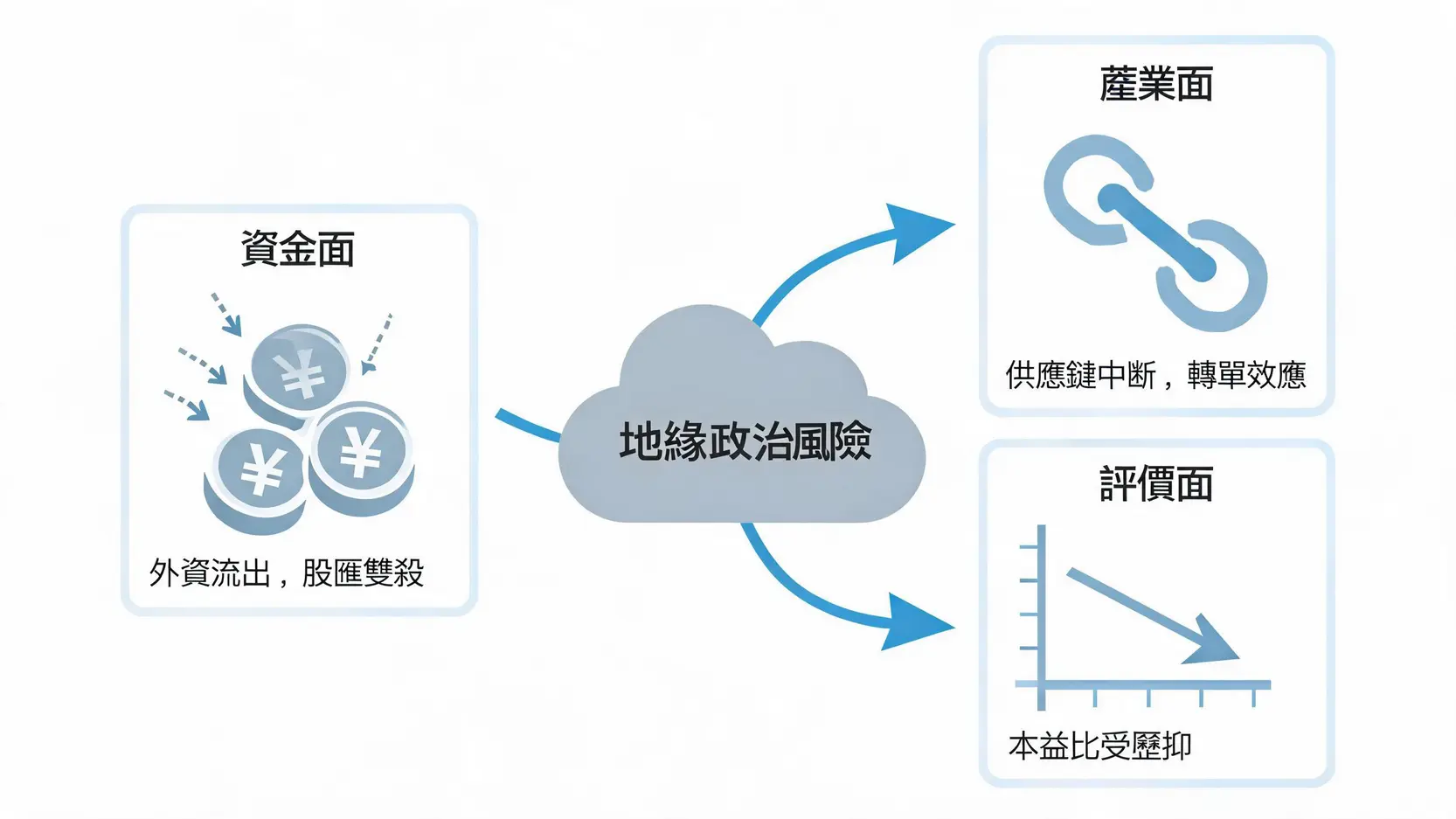
The Three Main Transmission Channels Through Which Geopolitical Risk Affects the Stock Market
Capital Flows: Reduced Foreign Investment Appetite and Capital Outflow Pressure
Foreign investors are one of the most important drivers of Taiwan’s stock market. When cross-strait tensions escalate or regional conflicts intensify, the most immediate consequence is risk-driven foreign selling. To reduce exposure to uncertainty, foreign capital often exits Taiwan stocks and shifts into defensive assets such as the US dollar, gold, or US Treasury bonds. Large-scale capital outflows not only create selling pressure on heavyweight stocks, but can also trigger depreciation of the Taiwan dollar, resulting in the so-called “double decline” of both stocks and the currency.
Industry Impact: Supply Chain Disruptions and Order Transfer Effects
Taiwan’s export-oriented economy, particularly its electronics sector, is deeply integrated into global supply chains. Geopolitical risks affect industries in several ways:
- Supply Chain Disruption Risk: In the event of a conflict, ports may close, shipping routes may be interrupted, and both inbound raw materials and outbound finished products may be affected, posing severe operational challenges for businesses.
- Order Transfer Effects: This represents an opportunity within the risk. To diversify exposure, multinational corporations have increasingly adopted the “China Plus One” strategy, establishing supply chains outside China. Taiwanese companies with manufacturing capacity in Southeast Asia, India, or Mexico may benefit from order transfers, strengthening their position within global supply chains.
Valuation Impact: Long-Term Pressure on Taiwan Stock Valuations Relative to Global Markets
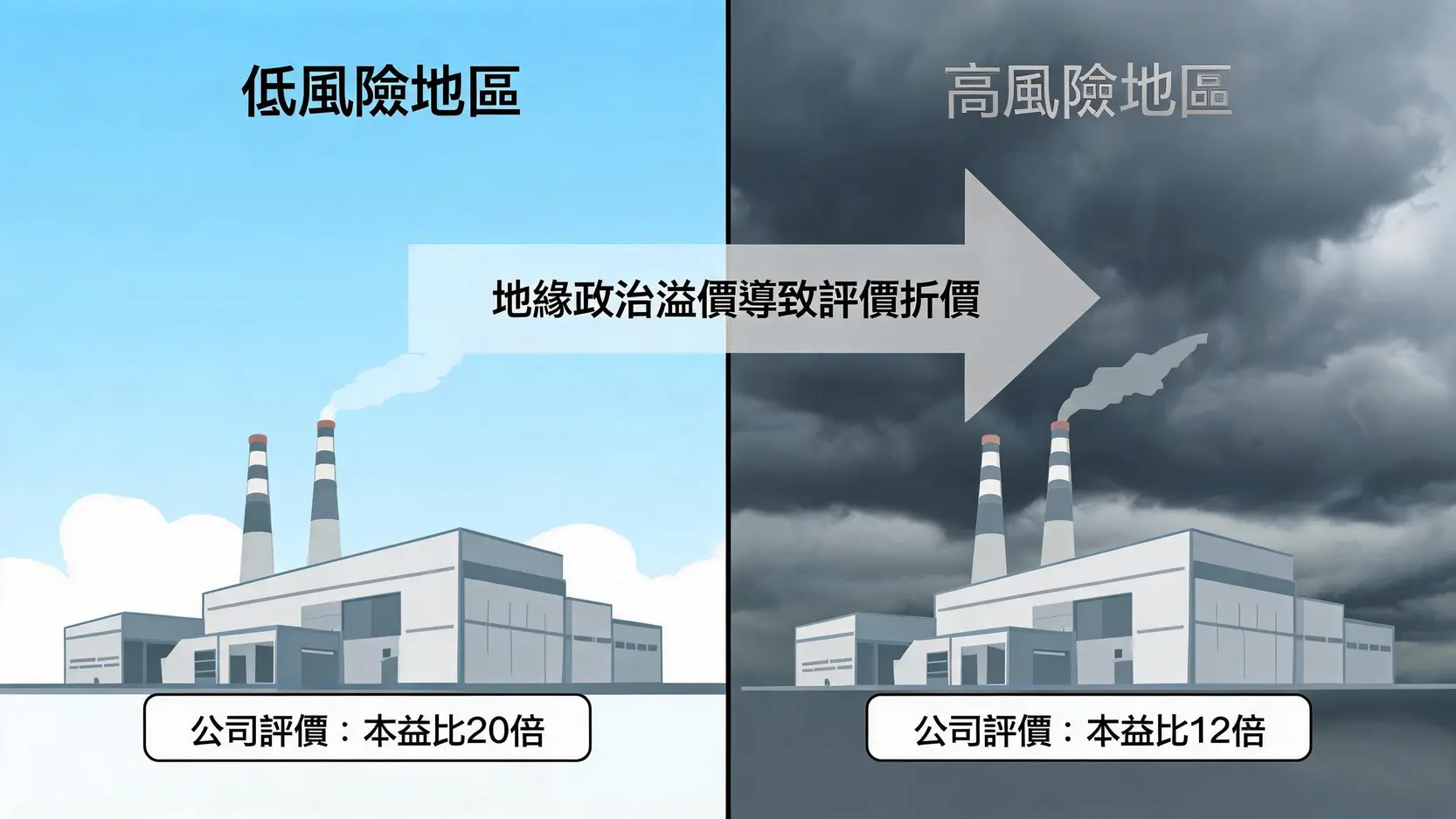
Although the AI boom has significantly increased Taiwan’s market valuation multiples in recent years, the geopolitical risk premium has historically placed downward pressure on overall market valuations. According to MacroMicro data, as of April 2026, the MSCI Taiwan Index traded at approximately 27.6 times earnings, above its historical average. However, compared with global markets, particularly after excluding major technology companies, many fundamentally strong Taiwanese industrial and financial stocks continue to trade at substantially lower valuation multiples than their international peers. This reflects investors’ reluctance to assign higher valuations due to concerns about geopolitical risks, illustrating the concept of a “valuation discount” in practice.
Further Reading (Highly Recommended)
Investing in Turbulent Times: Understanding Geopolitical Risks and Five Strategic Approaches to Wartime Asset Allocation
The Exchange Rate Impact of the Taiwan Strait Risk Premium: Hong Kong Dollar and Renminbi Trends and Investment Strategies During a Taiwan Strait Crisis
“Resilience” and “Opportunities” Amid Geopolitical Risks
When discussing geopolitics, most people focus only on the risks. However, from another perspective, opportunities often emerge from crises. Under the pressure test of geopolitical uncertainty, Taiwan’s stock market has developed unique industrial resilience while also creating new investment opportunities.
Taiwan’s Critical Role in the Global Supply Chain Has Become a “Silicon Shield”
The term “Silicon Shield” accurately describes Taiwan’s current position. Taiwan’s semiconductor industry, particularly its foundry sector, accounts for more than 60% of global market share and maintains a dominant lead in advanced manufacturing processes. This means that virtually all high-tech products worldwide, from iPhones and AI servers to electric vehicles, depend heavily on chips manufactured in Taiwan. This “indispensable position” has created an invisible economic barrier. Any attempt to disrupt regional stability would impose enormous costs on the global economy as a whole. As a result, Taiwan’s strategic importance indirectly contributes to maintaining peace and stability across the Taiwan Strait.
Order Transfer Opportunities Amid Risk: The Rise of Non-China Supply Chains
Since the onset of the US-China trade conflict, “de-risking” has become a central theme in global supply chain restructuring. To avoid concentrating risk in a single market, multinational corporations have increasingly required suppliers to relocate part of their production capacity outside mainland China. For many Taiwanese companies that had already established global manufacturing footprints, this trend has been highly beneficial. From servers and networking equipment to traditional industries such as textiles and footwear, Taiwanese manufacturers with overseas production facilities have benefited from a wave of order transfers, strengthening both revenue growth and profit stability.
Growth Opportunities in Defense, Cybersecurity, and Related Industries
Heightened tensions have also given rise to specific domestic-demand industries. To strengthen self-defense capabilities, defense self-sufficiency has become a key policy objective. Initiatives such as “Indigenous Defense Aircraft” and “Indigenous Submarine Programs” have driven demand across the entire defense industry supply chain. At the same time, in response to increasingly frequent cyberattacks and information warfare, demand for cybersecurity protection from both government agencies and private enterprises has grown explosively. As a result, defense, aerospace, and cybersecurity-related stocks have become some of the few industry groups with clear growth momentum amid geopolitical risks.
How Investors Can Position Their Portfolios Amid Geopolitical Risks
Faced with unavoidable geopolitical risks, investors should not panic and exit the market entirely. Instead, by adopting a disciplined investment strategy, it is possible to transform risk into a source of excess returns. The following four approaches may be considered:
Strategy 1: Diversify Investments by Including Non-Taiwan Assets to Reduce Single-Market Risk
This is the most fundamental and important principle. Do not put all your eggs in one basket. If 100% of your assets are concentrated in Taiwan stocks, your portfolio will be fully exposed to systemic shocks when geopolitical events occur. A well-balanced asset allocation should include assets with lower correlation to Taiwan stocks, such as:
- US Equity ETFs: Exposure to global market leaders through ETFs tracking indices such as the S&P 500 or Nasdaq.
- Global Bond ETFs: Providing stable cash flow and defensive characteristics during periods of stock market volatility.
- Gold: A traditional defensive asset that can effectively hedge against extreme risk events.
Through globally diversified asset allocation, investors can significantly reduce the impact of any single geopolitical event on their overall portfolio.
Strategy 2: Focus on Industry Leaders with Global Competitiveness and High Barriers to Entry
Even under the most challenging circumstances, companies with strong competitive advantages are typically far more resilient than ordinary businesses. When selecting Taiwan stocks, investors should prioritize companies that occupy critical positions in global supply chains, possess irreplaceable technologies, and serve customers worldwide. These companies often share the following characteristics:
- High market share and technological leadership (e.g., TSMC)
- Globally diversified customer bases that reduce dependence on any single market (e.g., MediaTek)
- Strong financial health and abundant cash flow
These competitive strengths provide the resilience necessary to withstand political and economic disruptions.
Strategy 3: Focus on “Resilience-Themed” Industries Such as Defense, Renewable Energy, and Cybersecurity
As discussed earlier, geopolitical risks can also create new industry opportunities. Investors may consider allocating a portion of their portfolios to so-called “resilience-themed” stocks. The common characteristic of these industries is that their growth is driven by risk mitigation needs rather than traditional economic cycles.
- Defense and Military Industries: Benefiting from defense self-sufficiency policies.
- Cybersecurity: Supported by the growing need for digital protection among governments and businesses.
- Renewable Energy and Energy Storage: Critical sectors as countries prioritize energy security and energy independence.
Developing the Right Mindset: Treat Geopolitical Risk as a Constant and Use Panic Selling as a Buying Opportunity
For Taiwan stock investors, the question is not “whether geopolitical risks will emerge”, but “when they will emerge”. Rather than viewing them as black swan events, investors should treat geopolitical risks as a normal part of the market environment. Historical experience shows that major market declines triggered by non-economic events (such as wars or political crises) are often temporary. When fear-driven selling creates irrational market conditions, long-term investors may find attractive opportunities to acquire high-quality assets at discounted valuations.
Further Reading (Highly Recommended)
The Ultimate Comparison of Gold ETFs, Gold Passbook Accounts, and Physical Gold: A Beginner’s Investment Guide
The Complete Guide to S&P 500 Annual Returns: Historical Performance Analysis and the Best US Equity ETFs
Frequently Asked Questions About the Geopolitical Risk Premium and Its Impact on Taiwan Stocks
Q: If a cross-strait conflict occurs, how far could Taiwan stocks fall?
A: There is no definitive answer to this question. The extent of the decline would depend on the scale of the conflict, its duration, and the level of international involvement. In the short term, panic-driven liquidity crises could lead to sharp declines with little buying support, and trading curbs could potentially be triggered. However, looking at other regional conflicts in history (such as the Russia-Ukraine war), stock markets often experienced a sharp initial sell-off before gradually returning to a focus on fundamentals. For Taiwan, the global importance of its semiconductor industry (Silicon Shield), could be a key factor supporting market confidence. Rather than attempting to predict a market bottom, investors may be better served by evaluating the quality of their holdings and maintaining disciplined capital management.
Q: Is the US-China technology conflict good or bad for Taiwan stocks?
A: It has both positive and negative implications. On the downside, Taiwan sits between two major powers, and supply chain companies may face pressure to choose sides, while US export restrictions on China could result in lost business opportunities. On the upside, the trend toward supply chain “diversification” away from China has created order transfer opportunities for many Taiwanese companies, helping them increase international market share and strengthen customer relationships. Over the long term, companies that can flexibly adjust manufacturing locations and maintain a global operational footprint are likely to emerge as winners.
Q: Can investing in Taiwan stock ETFs help diversify geopolitical risk?
A: Yes, but only to a limited extent. Investing in Taiwan stock ETFs (such as 0050 or 0056) can diversify “individual stock” risk by reducing exposure to company-specific events. However, ETFs cannot eliminate the overall “systemic risk” associated with Taiwan’s stock market. If cross-strait tensions trigger broad foreign capital outflows, virtually all Taiwan stocks (including ETF components), are likely to decline, causing ETF net asset values to fall as well. To truly diversify geopolitical risk, investors need cross-market global asset allocation that includes non-Taiwan assets such as US equities, global bonds, and gold.
Q: Do traditional defensive assets still have value during periods of geopolitical risk?
A: Absolutely. Gold, the US dollar, the Swiss franc, and US Treasury securities have all proven themselves as defensive assets throughout history. When uncertainty rises, capital naturally seeks the safest places to preserve value. Allocating a portion of a portfolio (such as 5% to 15%), to defensive assets is similar to purchasing insurance for your investments. While these assets may appear less attractive during strong bull markets, they can significantly reduce portfolio drawdowns during market downturns or crises while also providing liquidity for future investment opportunities.
Conclusion
The geopolitical risk premium is an unavoidable reality for Taiwan stock investors. It represents both risk and the potential for excess returns. Rather than exiting the market out of fear, disciplined investors should acknowledge geopolitical risk as a normal part of the investment landscape. By understanding how geopolitical risks affect markets and implementing effective strategies, such as globally diversified asset allocation, selecting industry-leading companies with strong competitive advantages, and even taking advantage of excessive market pessimism through contrarian investing, investors can transform geopolitical uncertainty from a source of concern into a valuable component of their investment decision-making process.