HK Government Bonds Guide 2026: iBond & Silver Bonds

Updated: 2026/04/14  |  CashbackIsland

hk-government-bond-guide

Hong Kong Government Bonds Beginner’s Guide: How to Choose Retail Bonds, iBond, and Silver Bonds? 2026 Subscription Guide and Complete Risk Analysis

Looking for a stable income-generating instrument in a volatile market but do not know where to start? Government bonds (also known as sovereign bonds) have become a safe haven for many investors due to their very low-risk characteristics. In particular, various retail bonds issued by the Hong Kong government are especially popular among the public. This article provides you with a complete guide to the different types of Hong Kong government bonds, covering basic concepts, comparisons of popular options such as iBond and Silver Bonds, and practical subscription guidance, allowing you to grasp all key information at once and make the most informed investment decisions.


What Are Government Bonds (Sovereign Bonds)? Why Are They Worth Investing In?

Before diving into the different types of Hong Kong government bonds, let’s first understand what government bonds are. Simply put, they are a “loan note”, representing that you lend money to the government, and the government promises to repay the principal on a specified future date, while paying you interest regularly during the period.


Basic Definition: How the Government “Borrows Money” Through Bond Issuance

Imagine that the government needs a large amount of funding to support major infrastructure projects (such as building airports or railways) or to finance public services, but its short-term tax revenue is insufficient. In this case, the government can “borrow money” from the public or institutions, and this process is known as “issuing bonds”. Investors who purchase these bonds effectively become creditors of the government. Several key elements are clearly stated on the bond:

  • Face Value: The principal amount that the government will repay to you at maturity.
  • Coupon Rate: The interest rate that the government promises to pay annually.
  • Maturity Date: The date on which the government repays the principal.

This means that as long as you hold the bond until maturity, you can generally recover your principal and earn stable interest income during the holding period.

一張解釋政府債券運作原理的示意圖,顯示投資者將資金借給政府,並隨後收到定期的利息和最終的本金償還。

How Government Bonds Work: You lend money to the government, and the government pays interest regularly and repays the principal at maturity.


Three Major Advantages of Investing in Government Bonds: Stability, Low Risk, and Government Credit Guarantee

Compared to the more volatile stock market, investing in government bonds offers several irreplaceable advantages:

  1. Extremely high credit rating: Government bonds are issued and guaranteed by the government, with very low credit risk and almost no possibility of default. They are considered one of the safest investment instruments in the financial market.
  2. Stable cash flow: Most government bonds pay interest regularly (such as every six months), providing investors with predictable and stable passive income, making them especially suitable for retirees or investors with lower risk tolerance.
  3. Portfolio diversification: Bond prices often move in the opposite direction or have low correlation with the stock market. Adding government bonds to a portfolio helps balance and reduce overall asset volatility during stock market downturns.


Potential Risks You Should Know: Interest Rates, Inflation, and Liquidity

Although government bonds are very low risk, they are not “risk-free”. Before investing, you must understand the following potential risks:

  • Interest rate risk: This is the primary risk of bonds. If market interest rates rise, newly issued bonds will offer higher yields, making your existing bonds with lower coupon rates less attractive, and their prices in the secondary market may decline. You can refer to the Hong Kong Monetary Authority’s guidance on interest rate risk management.
  • Inflation risk: If the inflation rate exceeds your bond’s coupon rate, the real purchasing power of your interest and principal will decrease, effectively resulting in “earning interest but losing value”. This is one of the reasons why the Hong Kong government issues inflation-linked iBonds.
  • Liquidity risk: Although Hong Kong retail bonds can be traded in the secondary market (Hong Kong Exchange) during periods of low market activity, you may not be able to sell your bonds at your desired time or price.

一張說明債券利率風險的對比圖,用蹺蹺板比喻市場利率上升時,新發行的高息債券比舊有的低息債券更具吸引力。

Interest Rate Risk Illustration: When market interest rates rise, the higher yields of newly issued bonds reduce the value of the lower-yield bonds you hold in the secondary market.


Overview of Hong Kong Government Bond Types: Understand Four Major Retail Bonds in One Article

In recent years, the Hong Kong government has introduced various retail bonds, allowing the public to participate directly in subscriptions. Each has its own characteristics and targets different investment needs. Below is a detailed breakdown of the four main options.


[Comparison Table] Quick Comparison of iBond, Silver Bond, Green Bond, and Infrastructure Bond

To help you better understand the differences among various retail bonds, we have compiled the following comparison table:

Item iBond (Inflation-Linked Bond) Silver Bond Green Retail Bond (Green Bond) Infrastructure Retail Bond
Target Investors Hong Kong residents aged 18 or above Hong Kong residents aged 60 or above Hong Kong residents aged 18 or above Hong Kong residents aged 18 or above
Primary Purpose Hedge against inflation and provide a minimum guaranteed interest Provide stable and higher interest returns for seniors Fund green projects and promote sustainable development Fund large-scale infrastructure projects
Tenor Usually 3 years Usually 3 years Usually 3 years To be announced
Interest Payment Mechanism Floating rate (linked to inflation) plus a fixed minimum rate Floating rate (linked to inflation) plus a higher fixed minimum rate Fixed interest, higher than iBond of the same period To be announced
Secondary Market ✅ Tradable on the Hong Kong Exchange ❌ Not transferable ✅ Tradable on the Hong Kong Exchange ✅ Tradable on the Hong Kong Exchange
Early Redemption ✅ Redeemable upon request to the government ✅ Redeemable upon request to the government ✅ Redeemable upon request to the government ✅ Redeemable upon request to the government


iBond (Inflation-Linked Bond): A Value-Preserving Choice Against Inflation

iBond is the most widely recognized retail bond in Hong Kong. Its key feature is that the interest is linked to local inflation, with interest payments made every six months. The interest is calculated based on the year-on-year change in the average Composite Consumer Price Index (CPI) over the past six months, with a “minimum guaranteed rate” in place. This means that regardless of inflation levels, you will receive at least the minimum return, while during periods of high inflation, your interest income will increase accordingly, effectively preserving the value of your capital.


Silver Bond: A Stable Income Tool Exclusively for Seniors

Silver Bonds can be regarded as an “enhanced version” of iBond for seniors. Eligibility is limited to Hong Kong residents aged 60 or above. Its design is similar to iBond, as it is also linked to inflation, but its “minimum guaranteed rate” is usually significantly higher than that of iBond and Green Bonds, historically reaching as high as 5%! In addition, Silver Bonds are not tradable in the secondary market and cannot be transferred, with the intention of encouraging seniors to hold them until maturity to earn stable retirement income.

Retail Green Bond: Investing in a Sustainable Future

Green Bonds are an emerging investment instrument in recent years. The funds you invest are specifically allocated to eligible green projects, such as renewable energy, waste management, and green buildings. For investors who wish to earn stable returns while contributing to environmental protection and sustainable development, Green Bonds are a meaningful choice. Their interest rate is typically fixed and is set above the prevailing market level at the time of issuance, making them relatively attractive.


Infrastructure Retail Bond: Participating in Hong Kong’s Long-Term Infrastructure Development

This is the latest type of retail bond planned by the Hong Kong government, aimed at financing large-scale infrastructure projects (such as the Northern Metropolis). Specific terms have not yet been announced, but it is expected to be similar to other retail bonds, providing the public with an investment channel to directly participate in and share the benefits of Hong Kong’s long-term development.

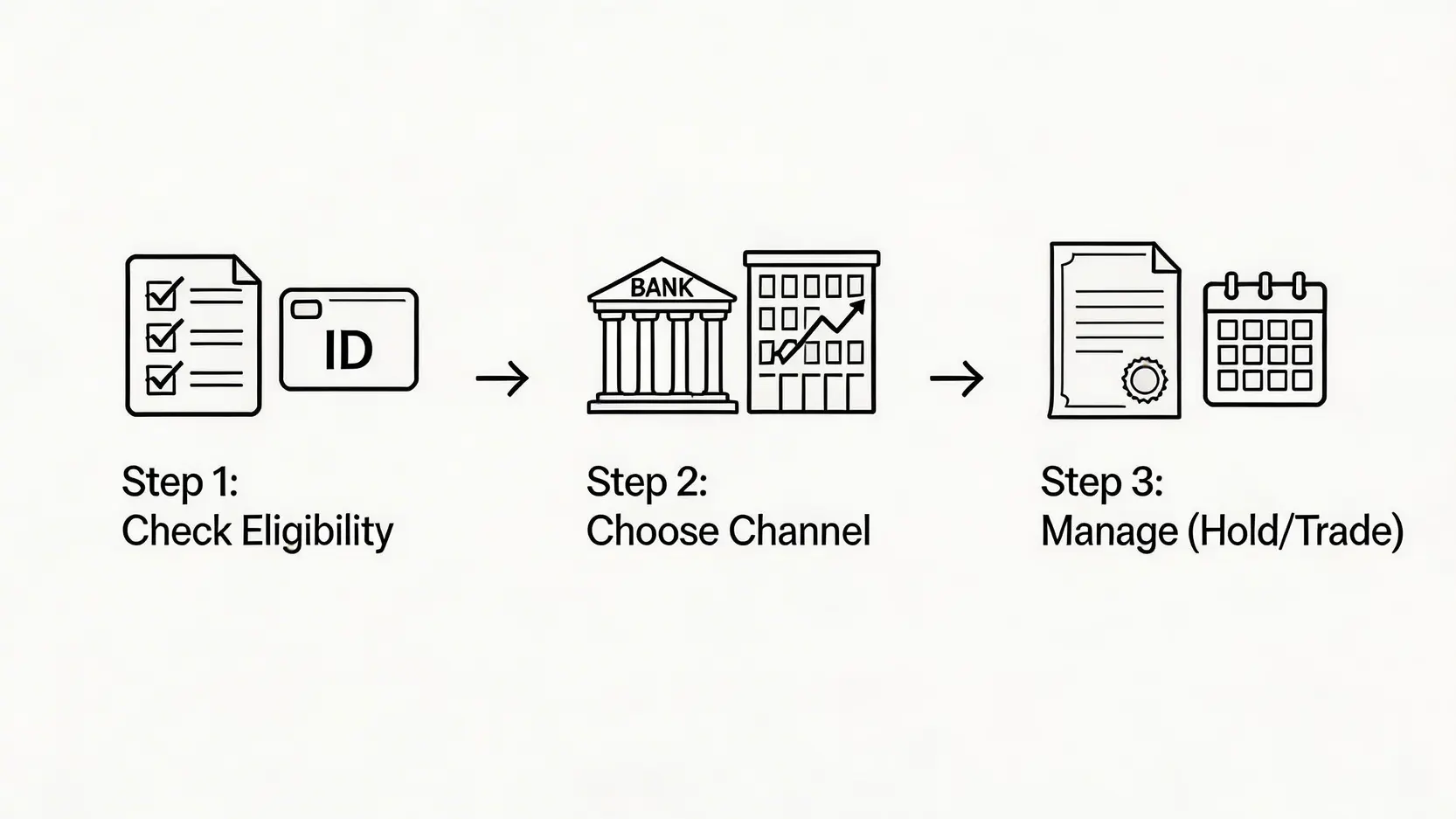
[Practical Guide] Complete Hong Kong Retail Bond Subscription in 3 Steps

After understanding the differences among various government bonds, the next step is practical execution. Subscribing to Hong Kong government retail bonds is very simple and mainly involves the following three steps:

香港零售債券申請三步驟流程圖,包括檢查資格、選擇認購渠道,以及成功獲派後的管理選項。

Three-Step Process for Hong Kong Retail Bond Subscription.


Step 1: Check Eligibility and Prepare Documents

After the government announces the issuance details, the first step is to confirm whether you meet the eligibility requirements. Generally, the basic requirements include:

  • Holding a valid Hong Kong identity card.
  • Meeting the age requirement of the bond (for example, Silver Bonds require applicants to be aged 60 or above).
  • Having a local securities account and bank account.

You will need to prepare your identity card and relevant account information for the application.


Step 2: Choose Subscription Channel (Placing Banks vs Securities Brokers)

You have two main channels to submit your subscription application:

  1. Placing banks: Most local banks act as placing banks for retail bonds. You can apply through online banking, mobile apps, phone banking, or by visiting a branch in person, making it very convenient.
  2. Securities brokers: If you already have a stock account, you can also subscribe through your broker.

💡 Tip: For each retail bond issuance, major banks and brokers often launch promotional offers to attract customers, such as waiving subscription fees, custody fees, dividend collection fees, and early redemption fees. Be sure to compare options before applying and choose the most cost-effective channel!


Step 3: Secondary Market Trading and Early Redemption Mechanism

After successfully receiving bond allocation, in addition to holding until maturity to receive the principal, you have other options:

  • Secondary market trading: Except for Silver Bonds, instruments such as iBond and Green Bonds can be listed and traded on the Hong Kong Exchange (HKEX), with trading methods identical to stocks. If you sell on the first day of listing, you may capture price differences.
  • Early redemption: All retail bonds have an early redemption mechanism. You can request the government to redeem your bonds at par value (100% of face value) together with accrued interest. This provides an important safeguard, ensuring you can retrieve your funds when needed, although processing may take time.


Conclusion

In summary, Hong Kong government bonds provide a relatively stable and low-risk investment channel, especially suitable for investors seeking steady cash flow and unwilling to take excessive risk. From inflation-protected iBond, to high-yield Silver Bonds designed for seniors, to environmentally focused Green Bonds, different types of Hong Kong government bonds can meet diverse financial goals. After gaining a thorough understanding of the features and potential risks of each retail bond, you can choose the most suitable government bond based on your age, investment objectives, and expectations for the future economy, adding a layer of security to your investment portfolio.


Frequently Asked Questions (FAQ)

Q: Do I need to pay tax on interest income from government bonds?

A: No. Under Hong Kong tax regulations, interest income earned from bonds issued by the Hong Kong government is exempt from profits tax. This is one of the key advantages of investing in government bonds.

Q: What should I do if I do not get allocated in the ballot, or if I want to buy more retail bonds?

A: If you do not receive an allocation during the initial public offering (IPO), or if the allocated amount is insufficient, you can purchase bonds in the secondary market on the Hong Kong Exchange after they are officially listed, just like trading stocks. However, prices in the secondary market will fluctuate based on supply and demand as well as interest rate expectations, and may be higher or lower than the issuance price of 100 yuan.

Q: Can all retail bonds be redeemed early? What are the conditions?

A: Yes. iBond, Silver Bonds, and Green Bonds issued by the Hong Kong government all have an early redemption mechanism. Holders can submit redemption requests to the placing institutions within a specified period before any interest payment date. The government will redeem the bonds at 100% of face value (original price), plus accrued interest up to the redemption date. This provides investors with a high level of flexibility and capital protection.

Q: What happens to Silver Bonds if the holder passes away?

A: Although Silver Bonds are not transferable, they can be inherited as part of an estate. The beneficiary can choose to continue holding the bonds until maturity to receive the remaining interest, or apply for early redemption with the government to recover the principal along with accrued interest.

编者
Evan Lin

Evan Lin

我是Evan Lin,从大学时期开始接触外汇交易,至今已有多年实战经验,熟悉技术分析与EA策略,热衷于研究市场脉动与风险管控,喜欢分享实战经验和交易技巧,和大家一起学习、一起进步!

If you liked this article, please share it!

Related Articles

  • US PPI Misses Forecast: Is Inflation Cooling?
    US PPI Comes in Below Expectations: Is Inflation Cooling? Understand the Impact on the Stock Market, Interest Rate Hikes, and Your Wallet The recently released US Producer Price Index (PPI) once again came in below market expectations, sparking optimism that inflation is cooling. What exactly does this key US PPI...
    2026 年 7 月 21 日
  • PPI vs CPI: What Rising Inflation Means for Your Money
    PPI and CPI Surge: Is the Inflation Monster Coming? Understand the Two Key Indicators and Protect Your Wallet! Have you recently felt that your money is worth less and less, with the price of everything rising except your salary? Everyone is talking about “inflation”, but where exactly does this monster...
    2026 年 7 月 21 日
  • Oil Prices and Currency Pairs: Which Currencies Benefit?
    When Oil Prices Rise, Which Currencies Benefit? Understanding Investment Strategies for Crude Oil Currency Pairs What Are Crude Oil Currencies? Uncovering the Relationship Between Oil Prices and Forex As volatility in the global energy market intensifies, every movement in crude oil prices affects the foreign exchange market. For perceptive investors,...
    2026 年 7 月 21 日
返回顶部