Foreign Investors Buy NT$62.7B: Stocks & FX Signals

The Fourth Largest Net Buy in History! Foreign Investors Snap Up NT$62.7 Billion of Taiwan Stocks, Revealing Three Key Signals Behind Stocks and the Currency Rising in Tandem
Taiwan’s stock market staged a stunning rally, surging more than 900 points in a single day with trading volume reaching extraordinary levels. The biggest driving force behind this move was massive foreign buying. Foreign investors’ net purchase of NT$62.7 billion in Taiwan stocks not only set the fourth-largest record in history, but also drove a strong appreciation of the Taiwan dollar, creating a grand “stocks and currency rising in tandem” capital inflow party. What market signals does this aggressive foreign-led buying spree reveal? Is it merely a short-lived burst of capital enthusiasm, or the formal establishment of a bullish market trend? More importantly, how should investors interpret its significance and prepare for future market movements? This article provides an in-depth analysis of the logic behind foreign investors’ positioning and the strategies investors can adopt in response.
Event Overview: How Did NT$62.7 Billion of Foreign Buying Ignite Taiwan Stocks?
This market surge was fueled by a powerful wave of foreign buying. More than NT$60 billion of net capital inflows in a single day directly ignited Taiwan’s stock market. Let us review this historic day through the data.
Review of Taiwan Stock Index and Trading Volume Performance
On that day, the Taiwan Capitalization Weighted Stock Index opened higher and continued climbing throughout the session. At one point, gains approached 1,000 points, before the market ultimately closed up 927 points. Even more noteworthy was the trading volume, which exceeded NT$600 billion, demonstrating active turnover and overwhelming bullish momentum. This massive bullish candlestick supported by exceptional volume undoubtedly injected a strong dose of confidence into the market.
Historical Ranking and Significance of the NT$62.7 Billion Foreign Net Buy
A single-day net purchase of NT$62.7 billion is extremely rare in Taiwan stock market history. According to Taiwan Stock Exchange data, it was not only the largest net buy of 2026, but also ranked among the top four single-day net purchases ever recorded. This indicates a significant shift in international investors’ views toward Taiwan’s market, moving from caution or even net selling to large-scale aggressive buying. Its significance as a market indicator is undeniable.
Further Reading (Highly Recommended)
A Guide to Tracking Capital Flows: Five Free Tools to Help You Monitor Stock Market Money Flows
Analysis of the Taiwan Dollar’s Simultaneous Reaction
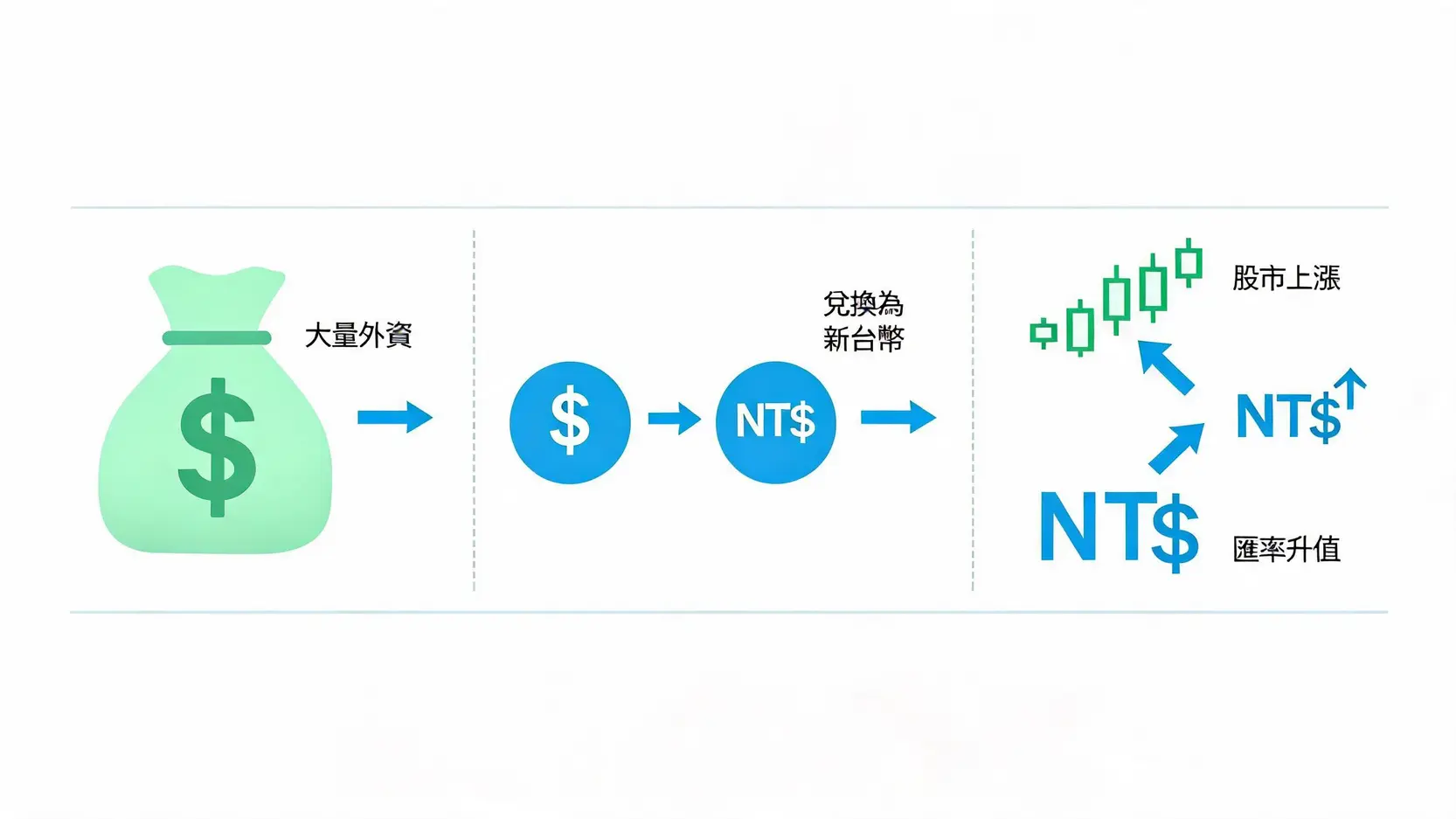
The most immediate impact of these capital inflows appeared in the foreign exchange market. The Taiwan dollar strengthened sharply against the US dollar during the session, even breaking through a key psychological level. This pattern of stocks and currency rising together is a classic sign of “hot money” inflows. To buy Taiwan stocks, foreign investors must first convert foreign currencies (primarily US dollars) into Taiwan dollars. This substantial demand for currency conversion pushed the Taiwan dollar higher. Simultaneous gains in both stocks and the currency are generally viewed as a positive sign of a healthy and attractive market.

How Foreign Capital Inflows Trigger “Stocks and Currency Rising in Tandem”
Why Did Foreign Investors Suddenly Pour in Capital? An In-Depth Analysis of Three Key Reasons
Markets do not become euphoric without reason. Behind this massive foreign buying lies a set of well-considered factors. Based on both domestic and international developments, the main reasons behind this record foreign net buying are as follows:
Shift in Global Financial Market Risk Sentiment
Recently, the US Federal Reserve’s monetary policy stance has become increasingly clear, and concerns about aggressive rate hikes have eased significantly. As inflation data has shown signs of moderating, global risk aversion has declined, prompting capital to seek new opportunities in risk assets. Taiwan, as a key hub in the global technology industry, has naturally become one of the preferred destinations for capital returning to emerging markets.
Strong Fundamentals of Taiwan Technology Stocks
The core target of this buying wave is undoubtedly Taiwan’s powerful technology sector. In areas such as AI (Artificial Intelligence) and semiconductors, Taiwanese companies occupy critical positions within the global supply chain. As AI applications expand from cloud infrastructure to end-user devices (such as AI PCs and AI smartphones), revenue and earnings expectations across related supply chains have risen substantially. Foreign investors are optimistic about this long-term AI-driven growth trend and have aggressively increased their holdings in TSMC and other AI-related stocks. This can be viewed as a strong vote of confidence in Taiwan’s technological strength.
Positioning Ahead of Potential Rate Cuts
Although the rate hike cycle appears to have paused, markets are already looking ahead to eventual “rate cuts”. Sophisticated foreign investors often begin positioning six months or even a year in advance. In an environment where interest rates are expected to decline, risk assets such as equities become relatively more attractive. Securing positions in high-quality assets before a rate-cutting cycle officially begins is standard practice among major institutional investors. This substantial net buying can therefore be interpreted as early positioning for a future easing cycle.
Where Is the Money Going? Analyzing Foreign Investors’ Major Net Buys and Net Sells
Understanding what foreign investors are buying and selling is key to identifying the strategy behind their moves. Through the daily institutional trading data published by the Taiwan Stock Exchange, we can gain insight into the complete picture of institutional trading activity.
Analysis of the Top Five Net Bought Stocks
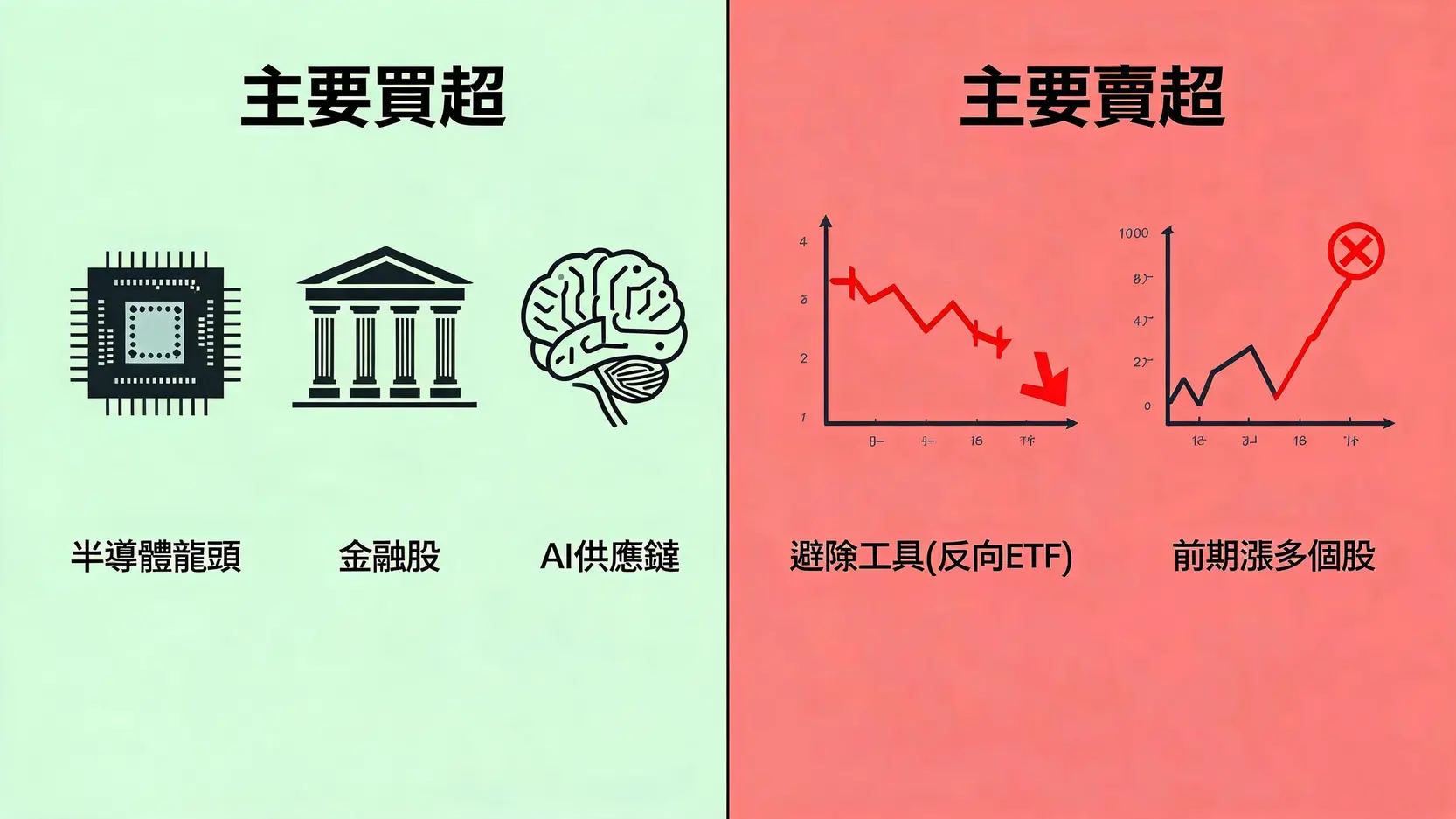
Based on the day’s net buying rankings, capital was primarily concentrated in the following categories:
- Heavyweight Market Leaders: Semiconductor giants led by TSMC formed the core of foreign investors’ buying activity. Their massive market capitalization and industry leadership make them ideal choices for stabilizing market sentiment.
- Undervalued Financial Stocks: Some financial stocks had previously experienced significant price corrections and offered stable dividend policies, making them attractive options for investors seeking both defensive positioning and income.
- Panel and Memory-Related Stocks: Companies such as UMC and Innolux attracted institutional buying as cyclical industries began showing signs of recovery, offering the potential for capital gains through improving pricing trends.
- High-Dividend ETFs: Some foreign investors also purchased high-dividend ETFs to gain exposure to a diversified basket of high-quality stocks through a single investment.
- AI-Related Supply Chain Companies: Secondary suppliers involved in thermal solutions, chassis manufacturing, and server assembly also benefited from broad-based buying interest.
Analysis of the Top Five Net Sold Stocks
On the other hand, the net selling list reveals that foreign investors were engaged in a strategy of “eliminating weaker positions and strengthening stronger ones”:
- Certain Hedging Instruments: Inverse ETFs (such as Yuanta Taiwan 50 Inverse ETF), naturally became among the first positions sold by foreign investors during a major market rally.
- Stocks That Had Already Rallied Significantly: Foreign investors took the opportunity to lock in profits on stocks that had already posted substantial gains or where fundamental outlooks had become less certain, reallocating capital to opportunities with greater potential.
- Specific ETFs: Interestingly, while foreign investors were buying high-dividend ETFs, they were also selling market-cap-weighted ETFs such as the 0050 (Yuanta Taiwan 50 ETF). This may indicate a belief that “active stock selection” is superior to “passively following the broader market”, with a preference for concentrating capital more precisely in selected industries.
Understanding Foreign Investors’ Industry Views Through Net Buying and Selling Activity
Overall, the core logic behind foreign investors’ positioning is very clear: “heavily overweight AI while maintaining exposure to cyclical recovery opportunities“. On one hand, they have aggressively increased exposure to AI supply chain companies centered around the semiconductor sector, reinforcing their long-term bullish outlook on technology stocks. On the other hand, they have begun selectively positioning in industries showing signs of cyclical recovery. This demonstrates a strategy that combines both aggressiveness and flexibility. These shifts in capital flows represent one of the most important indicators for investors when formulating future investment strategies.

Foreign Investors’ Choice: Overweight Technology and Replace Weak Positions with Stronger Ones
Further Reading (Highly Recommended)
The Impact and Opportunities of Stocks and Currency Rising in Tandem for Different Types of Investors
This capital-driven rally carries very different implications depending on the type of investor. Understanding its effects can help identify opportunities that align with your own investment goals.
For Stock Market Investors: Strategies and Risks of Following the Trend
For stock investors, massive foreign buying is undoubtedly positive news. It indicates strong market liquidity and momentum, making it easier for the market to rise than fall in the short term. Under such conditions, following the prevailing trend is a reasonable approach. Investors may consider focusing on sectors receiving significant foreign inflows, such as AI and semiconductors. However, the risk is that foreign capital can enter quickly and exit just as rapidly. If global financial conditions change or Taiwan stocks rise too far too fast, profit-taking pressure could emerge at any time. Therefore, setting stop-loss levels and avoiding emotional chasing of rallies or panic selling remain essential principles for protecting capital during this market advance.
For Foreign Exchange Investors: Assessing the Future Direction of the Taiwan Dollar
Foreign capital inflows directly support the Taiwan dollar, creating pressure for investors holding US dollars. In the short term, as long as foreign investors continue bringing capital into Taiwan, the Taiwan dollar is likely to maintain an appreciation trend. However, exchange rates are influenced by a much broader range of factors. In addition to capital flows, the Taiwan central bank’s policy stance, exporter activity, and Federal Reserve policy all play important roles. If the Taiwan dollar appreciates too rapidly, the central bank may intervene to “smooth” market movements and preserve the competitiveness of export-oriented industries. Therefore, foreign exchange investors should consider multiple factors rather than assuming that a single day of large foreign inflows guarantees continued Taiwan dollar strength.
For the General Public: Implications for Imports, Exports, and Consumer Prices
A stronger New Taiwan dollar brings the most direct benefit to the general public through “lower prices for imported goods”. Whether it is overseas travel, purchasing foreign luxury products, or goods that rely heavily on imported raw materials (such as bread and coffee), costs are likely to decline. On the other hand, Taiwan’s economic lifeblood is “exports”. If the New Taiwan dollar becomes too strong, it can weaken the price competitiveness of export products. For employees working in export-related industries, this may not be good news. This is what is known as the “double-edged sword of exchange rates”.
Frequently Asked Questions (FAQ)
Q: Where does this foreign net buying rank in history?
A: According to historical data, the single-day net purchase of NT$62.7 billion ranks as the fourth-largest single-day net buy in Taiwan stock market history. This is an exceptionally large figure that reflects strong international confidence in Taiwan stocks.
Q: If foreign investors are buying aggressively, does that mean Taiwan stocks will definitely continue to rise?
A: Not necessarily. Large-scale foreign buying is an “important source of momentum” for market gains, but it is not an “absolute guarantee”. Stock prices are also influenced by multiple factors, including corporate fundamentals, domestic and international policies, and market sentiment. Historically, there have been cases where foreign investors bought heavily and then took profits and turned into net sellers the very next day. Therefore, foreign investor activity should be viewed as an important reference indicator rather than the sole basis for investment decisions.
Q: How does stocks and currency rising in tandem affect my finances?
A: If you are a stock investor and hold stocks that are among the primary targets of foreign buying, the value of your investments may increase. If you are planning to travel abroad or purchase imported goods, Taiwan dollar appreciation allows you to spend less. However, if you work in an export-oriented industry, an excessively strong currency may create operational challenges for your company.
Q: Should retail investors follow foreign investors’ trades?
A: You can use it as a reference, but do not follow it blindly. The key to a “copy trading” strategy is understanding the logic behind building a foreign capital flow tracking model, rather than simply replicating a list of buy and sell transactions. Foreign investors have capital scales, cost structures, and risk tolerances that differ significantly from those of retail investors. Retail investors are advised to rely on their own research and treat the stocks bought or sold by foreign investors as a “theme” or “direction”, then select companies they are familiar with and whose value they genuinely recognize before investing.
Q: Where does foreign investors’ capital come from?
A: Foreign investors (Foreign Institutional Investors, FII) generally refer to institutional investors located outside Taiwan. Their capital comes from a wide variety of sources, including large global pension funds, sovereign wealth funds, insurance companies, mutual funds, hedge funds, and other institutional entities. These organizations pool savings and capital from around the world and seek the best investment opportunities across global markets.
Conclusion
Foreign investors’ single-day purchase of NT$62.7 billion has undoubtedly delivered the strongest vote of confidence yet for Taiwan’s bullish market. The simultaneous rise in both stocks and the Taiwan dollar has further strengthened positive market sentiment. The core driver behind this wave of capital inflows is the global market’s strong recognition of Taiwan’s irreplaceable position within the AI supply chain, along with early positioning for future shifts in monetary policy. From a capital flow perspective, foreign investors’ strategy of “heavily overweighting technology while maintaining exposure to cyclical recovery opportunities” is clearly evident.
However, while celebrating the market rally, investors should also remain rational and cautious. Although foreign investor activity is an important market indicator, financial markets can change rapidly, and no uptrend lasts forever. Investors should use this event as an opportunity to reassess their portfolios, evaluate whether they are aligned with prevailing market trends, and establish clear investment strategies and discipline based on their own risk tolerance. In a market where opportunities and risks coexist, only through thorough research and maintaining flexibility can investors navigate capital flows successfully over the long term.
Related Articles
-
[Second Half of 2026] Complete Japanese Yen Outlook Forecast: The Ultimate Currency Exchange Strategy for Investors and Travelers Following record-breaking market interventions, the future outlook for the Japanese yen is filled with both uncertainty and opportunity. Will the yen regain its strength, or will it fall to new lows? This...2026 年 6 月 5 日
-
How Significant Is the Impact of the Geopolitical Risk Premium on Taiwan Stocks? Understanding the Risks, Opportunities, and Investment Strategies In an increasingly globalized world, Taiwan's stock market is influenced not only by economic fundamentals but is also constantly exposed to complex geopolitical risks. From tensions in cross-strait relations to...2026 年 6 月 5 日
-
New Taiwan Dollar Surges to Close at 31.46! A Complete Guide to How Taiwan Dollar Appreciation Affects the Stock Market, Industries, and You The New Taiwan dollar exchange rate has recently strengthened significantly, at one point reaching a high of 31.46 against the US dollar, drawing widespread market attention. Many...2026 年 6 月 5 日