Why Haven’t Local Gold Prices Fallen?

Why Haven’t Local Gold Shop Prices Fallen Despite the Plunge in International Gold Prices? Uncovering the Impact of Exchange Rates on Gold Prices
Many investors often feel puzzled: they clearly see news reports showing a sharp plunge in international gold prices, so why, when they actually walk into a physical store hoping to pick up a bargain, do they find that prices in the local gold market seem unmoved? Behind this are actually the impact of Federal Reserve rate cuts on gold prices and the even more critical impact of exchange rates on gold prices. For investors in Taiwan, Malaysia, and other regions, simply watching international US dollar quotes is not enough. Today, we will take an in-depth look at the impact of the Taiwan dollar exchange rate on local gold prices, and comprehensively break down the differences in local gold shop quotes and the premium secrets behind them, helping you see the real costs clearly in your gold investment planning for 2026.
Debunking the Myth: Why Do International Gold Prices and Local Gold Prices Diverge? Exploring the Impact of the Taiwan Dollar Exchange Rate on Local Gold Prices
In most people’s understanding, gold is a globally priced asset and should logically show a globally consistent price trend. However, in practice, when we convert the international market’s “US dollars/ounce” into the local “Taiwan dollars/mace” or “ringgit/gram”, the conversion mechanism in between can create a significant gap.
Pricing Currency Differences: The Conversion Mechanism Between US Dollar Pricing and Local Currency Pricing
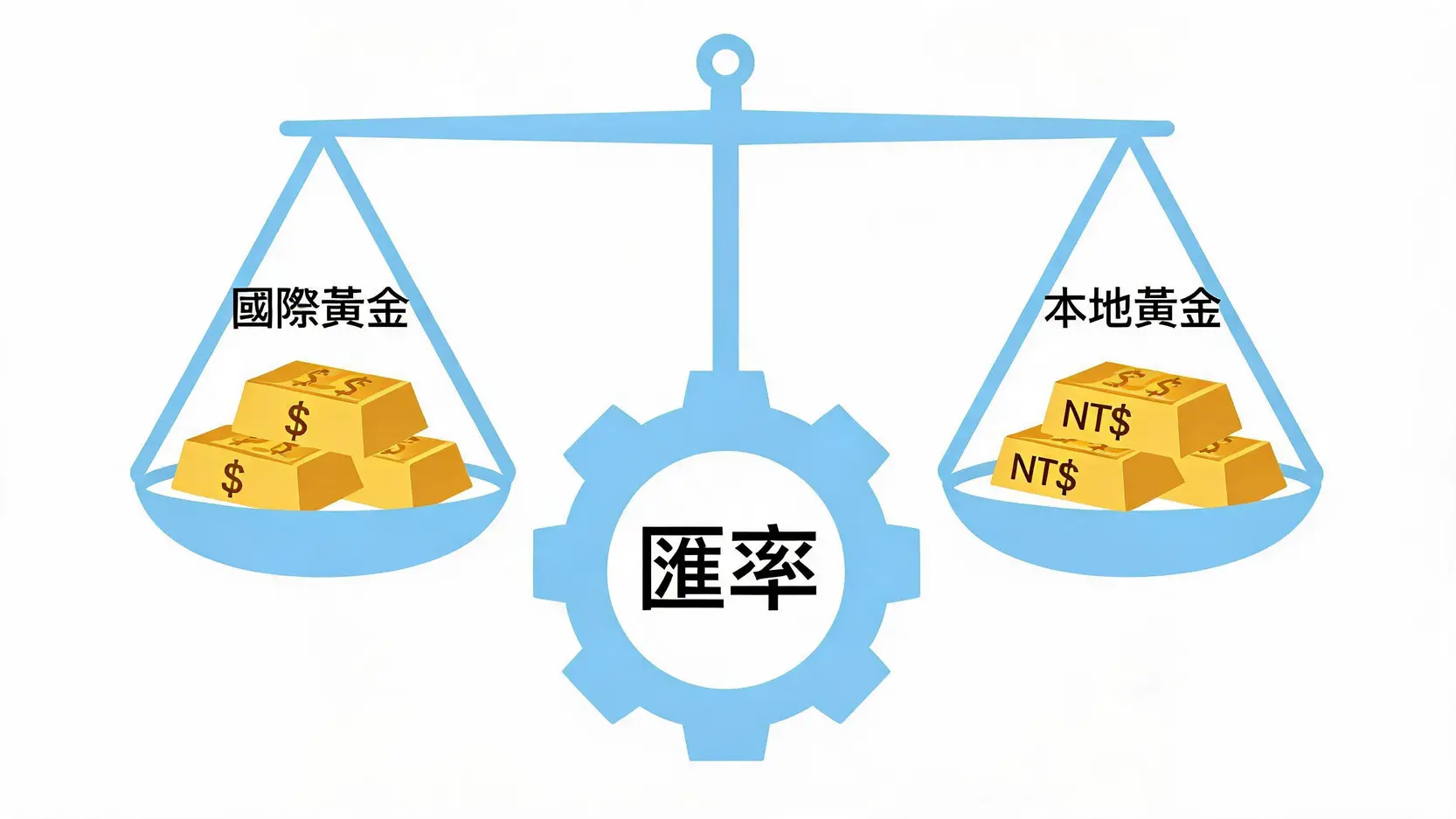
International gold trading is usually priced in US dollars. Therefore, for countries that do not use the US dollar, gold prices are essentially a combination of two variables: “gold’s value against the US dollar” and “the exchange rate of the US dollar against the local currency”. When international gold prices (denominated in US dollars) fall, but the local currency depreciates sharply against the US dollar at the same time, the two effects may offset each other, causing quotes in the local gold market to remain firm. This is also why exchange rate risk cannot be ignored when assessing the relationship between gold investment risks and interest rates.
Practical Case Analysis of the Impact of Exchange Rates on Gold Prices
For example, suppose international gold prices fall from US$2,500 per ounce to US$2,400 per ounce (a decline of about 4%), but during the same period, affected by global monetary easing policies or geopolitical factors, the Taiwan dollar depreciates against the US dollar from 31 to 32.5 (a depreciation of about 4.8%). In this scenario, the local gold price converted into Taiwan dollars not only does not fall, but may even rise slightly. This is the most direct reflection of the impact of exchange rates on gold prices. You can also refer to Reuters’ reports on Federal Reserve interest rates and gold prices to understand how macroeconomic data indirectly affects exchange rates and gold prices.

The Linkage Mechanism Between International Gold Prices and Local Exchange Rates
Further Reading (Highly Recommended)
In-Depth Analysis of the Impact of Federal Reserve Rate Cuts on Gold Price Trends
Interest Rate Risks and Safe-Haven Strategies Every Gold Investor Should Know
Breaking Down the Quotation Structure of the Local Gold Market: Understanding Differences in Local Gold Shop Quotes
Besides exchange rate variables, the operating costs of physical stores are also a core reason for price differences. When you walk into different silver shops or jewelry stores, you may find that even on the same day, quotes vary slightly from one store to another. This is what is known as differences in local gold shop quotes.
International Benchmark Price, Handling Fees, Design Fees, and Store Premiums
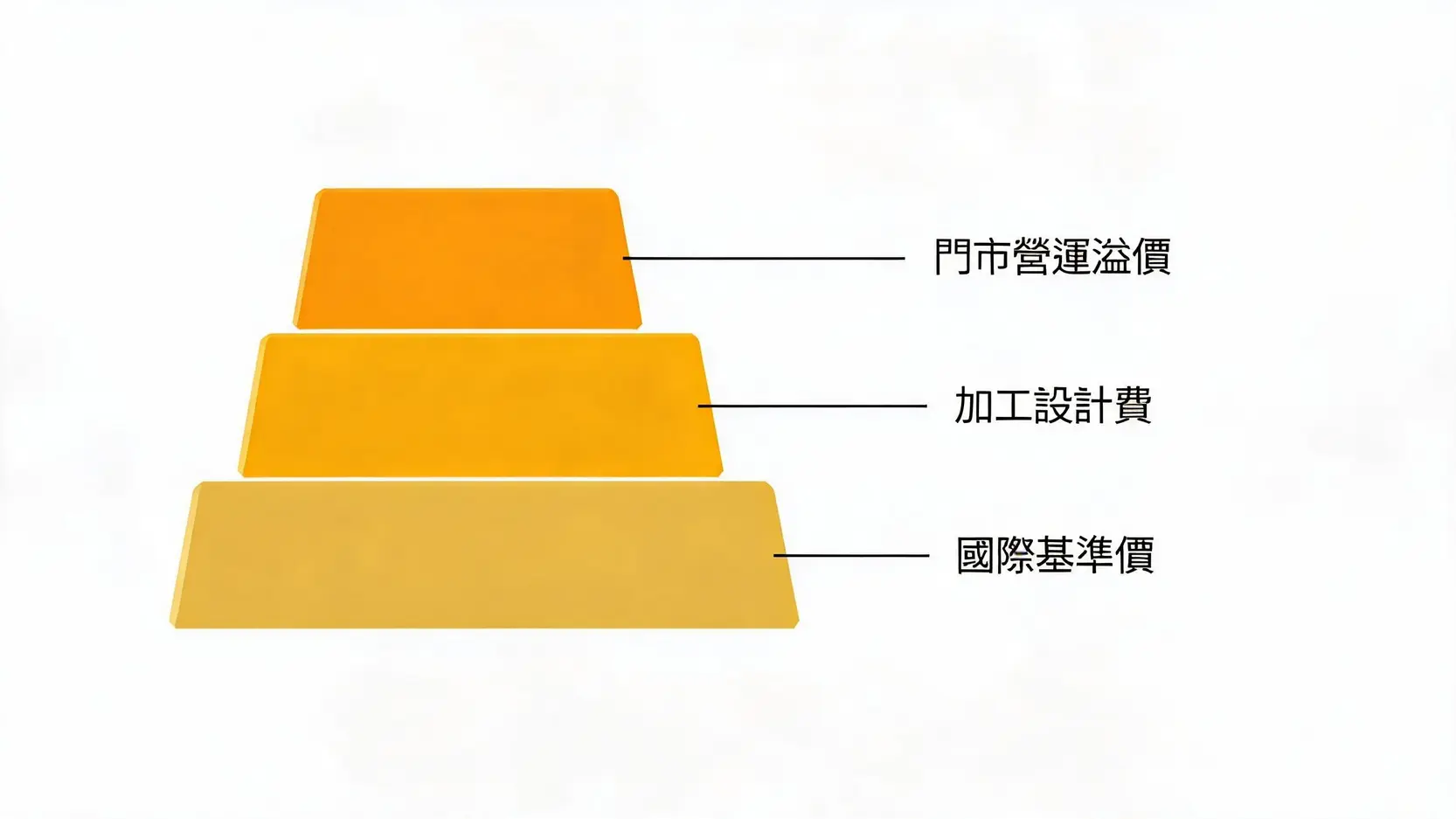
The final selling price of physical gold jewelry or gold bars is not just the raw material value of the gold itself. It usually includes:
- International benchmark price: The core value that fluctuates with the international market.
- Processing and design fees (workmanship fees): Charged according to the complexity of the gold jewelry, with more intricate styles carrying higher workmanship fees.
- Store operating premium: Includes store rent, labor costs, brand marketing expenses, and more.
These additional costs mean that the price of physical gold will always be higher than the international spot price. When international gold prices fall, if a store’s operating costs rise or workmanship fees increase, they will also offset part of the decline.

The Three Major Components of Physical Store Gold Quotes
Differences Between Bank Gold Passbooks and Jewelry Store Listed Prices
If you turn your investment focus to “gold passbooks” offered by banks, you will find that their quotes are usually closer to international market prices than those of physical silver shops, and the bid-ask spread is smaller. This is because a gold passbook is an investment tool without physical delivery, saving the costs of minting, transportation, insurance, and physical inventory. For investors who simply want to earn price differences, this is a relatively efficient choice.
Money-Saving Strategies for Local Investors Buying Gold: Master Local Gold Premium Analysis
After understanding the quotation structure, how should we position ourselves smartly in the local gold market? The following practical strategies can help you reduce investment costs.
Using Exchange Rate Fluctuation Expectations for a “Dual Arbitrage” Approach
When experienced investors buy and sell gold, they not only forecast gold price trends but also monitor exchange rate trends at the same time. If international gold prices are expected to rise in the future and the local currency is facing depreciation pressure, buying gold with local currency at this time may offer the chance to enjoy the dual benefits of “gold price gains + exchange rate gains” in the future. Conversely, if the local currency is expected to appreciate strongly, investors may consider using a US dollar account to invest directly in gold investment tools to avoid foreign exchange losses.
Comparing the Real Transaction Costs of Three Major Local Gold Buying Channels
Choosing the right channel is crucial for different needs:
- Physical silver shops: Suitable for those with needs for physical collection or gifting, but the bid-ask spread is the largest, and workmanship fees must also be considered.
- Bank gold passbooks: Suitable for medium- to long-term investment and regular fixed investments, with moderate spreads and excellent liquidity.
- Gold ETFs: Suitable for stock market investors, with the lowest trading costs and the highest linkage to international market prices, but they will incur some embedded management fees.

Comparison of the Pros, Cons, and Costs of Three Major Local Gold Investment Channels
Buying Tips to Avoid High-Premium Periods Such as Holidays
Lunar New Year, wedding seasons, and major traditional holidays are often peak periods for demand for physical gold jewelry. At such times, market demand is strong, and some stores may slightly adjust premiums or raise workmanship fees. If the purchase is purely for investment purposes, investors should try to avoid these traditional peak seasons and choose the off-season, when market trading is relatively quiet, to position in physical gold, thereby securing more reasonable room for negotiation.
Frequently Asked Questions FAQ: Clarifying the Gap Between International Gold Prices and Local Gold Prices
Q: Is It Cheaper to Buy Gold Overseas?
A: Not necessarily. Although some regions exempt sales tax, you still need to consider local store premiums, exchange rate conversion fees, and the customs declaration and tariff issues you may face when bringing it back into the country. After comprehensive calculation, it may not necessarily be more cost-effective than finding low-premium channels locally.
Q: Why Is There Such a Large Difference Between a Gold Shop’s Buyback Price and Selling Price?
A: This includes the store’s profit margin and the loss costs of remelting. After a store buys back old gold, it must bear the risk of price fluctuations and pay the costs of refining and processing it again, so the buyback price will inevitably be lower than the selling price. This is also why physical gold is not suitable for frequent short-term trading.
Q: How Do You Calculate a Reasonable Purchase Price for Local Gold?
A: You can divide the international gold price (US dollars/ounce) by 31.1035 to obtain the US dollar price per gram, then multiply it by the current bank spot selling exchange rate to get the “pure gold cost” excluding any handling fees and premiums. By comparing this figure with the store’s quote, you can clearly calculate the premium percentage you are bearing.
Q: If the Federal Reserve Enters a Rate Cut Cycle, Will Local Gold Prices Definitely Rise?
A: Rate cuts are usually favorable for the rise of US dollar-denominated international gold prices. However, if rate cuts cause the US dollar to weaken significantly and the local currency appreciates accordingly, the price increase after conversion into the local gold market may be suppressed. Therefore, the impact of exchange rates on gold prices still needs to be assessed comprehensively.
Conclusion
In summary, the impact of exchange rates on gold prices is an important issue that every gold investor cannot ignore. A plunge in international gold prices cannot be fully equated with a discount sale of local physical gold. When making investment decisions, it is essential to take into account exchange rate fluctuations of the pricing currency, store operating premiums, and the transaction costs of different buying channels. Only by understanding the structures hidden behind these quotes can you formulate a long-term investment strategy that best aligns with your own interests in the rapidly changing local gold market.
Related Articles
-
Hawkish Fed Weighs on Gold: How Could Rising Rate Hike Expectations End the Gold Bull Market? Every statement from the Federal Reserve affects the nerves of global capital markets. Recently, the phenomenon of a hawkish Fed weighing on gold has become especially evident. As rate hike expectations rise, a strong...2026 年 7 月 3 日
-
Unveiling the SK Hynix Options Frenzy: How Do Leveraged ETFs Dominate Nearly 70% of Trading Volume? Recently, SK Hynix’s share price has experienced unusually severe volatility in the Korean stock market. What is shocking is that data shows nearly 70% of its trading volume actually comes from derivatives hedging. How...2026 年 7 月 2 日
-
Gold Price Plunges to $4,100! The Shocking Truth Behind the Sharp Drop in International Gold Prices and Future Trends Recently, the international gold market has experienced severe turbulence, with gold prices plunging below the $4,100 mark, catching countless investors off guard. This rare sharp drop in international gold prices has...2026 年 7 月 2 日