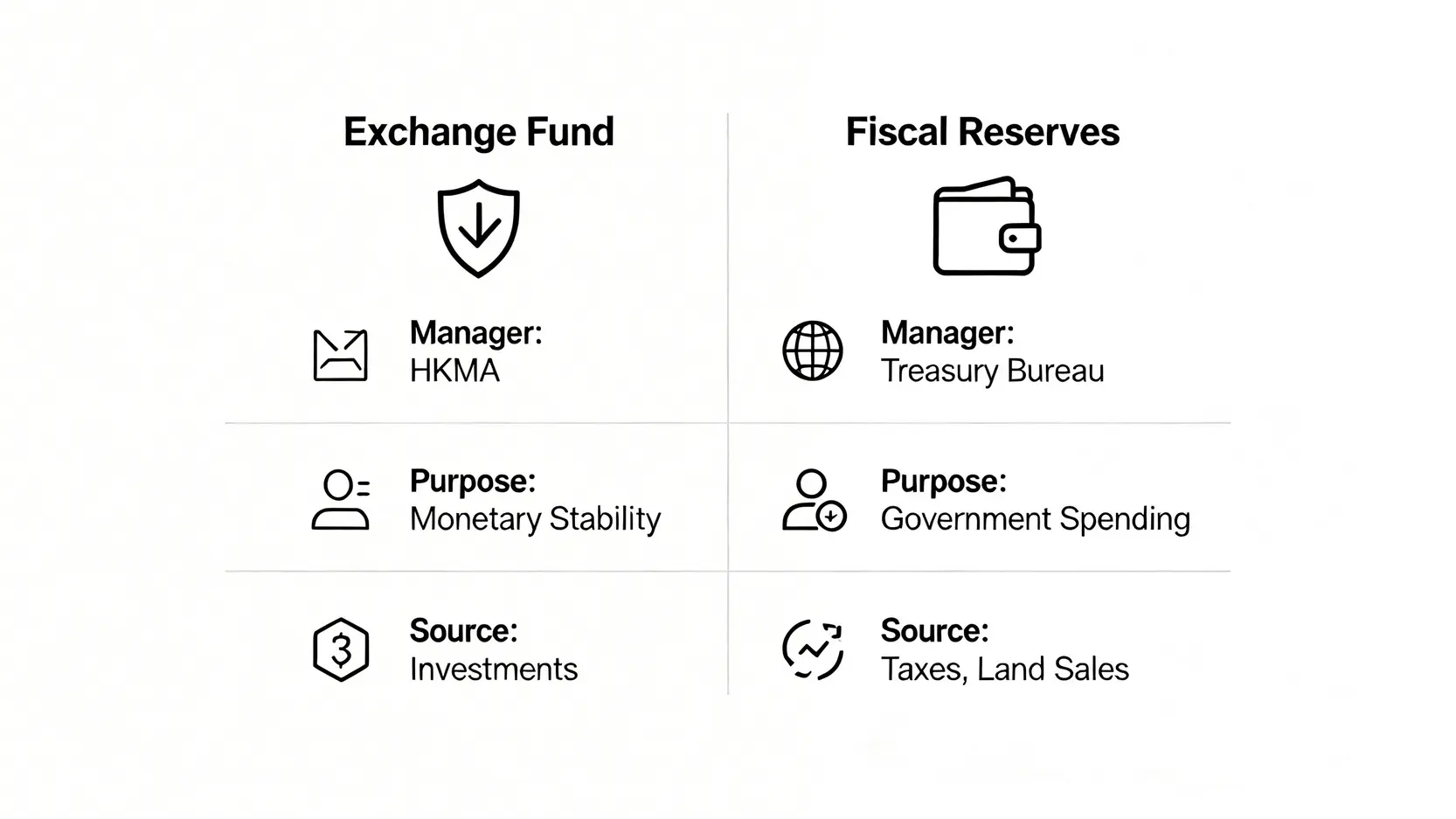
Illustration: Exchange Fund vs. Fiscal Reserves.
Although a portion of the fiscal reserves is held within the Exchange Fund for investment to generate returns, the ownership and statutory purposes of the two are entirely separate.
Further Reading (Highly Recommended)
US Dollar Exchange Rate Trends 2026 Revealed: Smart Currency Exchange for Investment Advantage and Pitfall Avoidance!
Comprehensive Analysis of New Taiwan Dollar Appreciation: 5 Key Reasons, 3 Major Impacts, and Smart Response Strategies (2026 Update)
Global Rankings of Hong Kong’s Foreign Exchange Reserves
As an international financial center, Hong Kong’s foreign exchange reserves have consistently ranked among the top globally. This not only symbolizes strength but also serves as a confidence guarantee.
2026 Global Foreign Exchange Reserves Top 10 Rankings
For the most authoritative global ranking data, the International Monetary Fund (IMF) is an important reference. Although rankings may slightly fluctuate due to countries’ data update timings and asset valuation changes, the overall pattern remains relatively stable. The following is the estimated 2026 ranking compiled from publicly available data:
| Ranking |
Country/Region |
Foreign Exchange Reserves (Estimated, Trillions of US Dollars)
|
| 1 |
Mainland China |
3.4
|
| 2 |
Japan |
1.3 |
| 3 |
Switzerland |
0.9 |
| 4 |
Russia |
0.6 |
| 5 |
India |
0.6 |
| 6 |
Taiwan |
0.55 |
| 7 |
Saudi Arabia |
0.45 |
| 8 |
Hong Kong |
0.43 |
| 9 |
South Korea |
0.42 |
| 10 |
Brazil |
0.35 |
Note: The above data are estimates for reference only. For the latest authoritative data, please refer to the official publications of the Hong Kong Monetary Authority or the IMF.
Hong Kong’s Ranking Changes and Their Significance
As shown in the table, Hong Kong, despite its relatively small economic size, holds foreign exchange reserves among the top globally, reflecting the robustness of its financial system. A stable high ranking indicates:
- Strong Risk Resilience: Sufficient resources to respond to potential capital outflows or financial shocks.
- International Confidence: Large foreign exchange reserves are an important source of confidence for international investors and rating agencies.
- Solid Monetary Policy Foundation: Provides a credible and firm basis for the Linked Exchange Rate System.
Recent Challenges and Debunking Market Myths
Whenever market volatility occurs, myths about foreign exchange reserves often circulate, causing unnecessary concern. Below we debunk two of the most common myths.
Myth One: A Decline in Foreign Exchange Reserves Equals Capital Outflow
This is a common misunderstanding. A drop in the book value of foreign exchange reserves does not directly equate to funds leaving Hong Kong. Possible reasons include:
- Asset Valuation Changes: The reserves include assets in multiple currencies such as euros and yen. When the US dollar strengthens, the book value of these non-US dollar assets converted into US dollars decreases.
- Normal HKMA Operations: For example, when the Hong Kong dollar is strong, the HKMA sells Hong Kong dollars and buys US dollars, increasing foreign exchange reserves (US dollar assets). Conversely, when the Hong Kong dollar is weak, the HKMA buys Hong Kong dollars, reducing reserves. This is normal operation under the Linked Exchange Rate System.
- Investment Return Fluctuations: The Exchange Fund conducts diversified investments, and the prices of its holdings in bonds, stocks, and other assets fluctuate, affecting the total value of reserves.
Therefore, determining whether there is large-scale “capital outflow” requires a comprehensive analysis of multiple indicators such as banking system aggregate balances and Hong Kong dollar deposits and loans, rather than merely observing short-term reserve fluctuations.
Myth Two: The Exchange Fund’s Money Can Be Used for Cash Handouts or Infrastructure
The answer is no. As previously stated, the Exchange Fund’s primary statutory purpose is to support the Hong Kong dollar. Its existence safeguards the currency’s purchasing power, not to serve as the government’s second wallet. Arbitrarily using the Exchange Fund for cash handouts or public spending would severely weaken its capacity to support the Hong Kong dollar, undermining the foundation of the Linked Exchange Rate System. If market confidence in the Hong Kong dollar wavers, it could trigger serious financial shocks with immeasurable economic losses.
Frequently Asked Questions (FAQ)
Q: Are Hong Kong’s foreign exchange reserves sufficient to cope with a financial crisis?
A: It is generally considered sufficient. Hong Kong currently holds about US$430 billion in foreign exchange reserves, roughly twice the monetary base (cash in circulation plus banks’ balances with the HKMA). This coverage is very high by international standards, meaning Hong Kong has more than enough reserves to meet demand even if all physical currency were required to be converted into US dollars. This strong buffer is an important safeguard against financial crises.
Q: How can ordinary citizens check the latest foreign exchange reserve data?
A: The HKMA regularly publishes the latest foreign exchange reserve figures on its official website, usually at the beginning of each month for the previous month, accompanied by detailed press releases explaining changes. This is a transparent and public information channel.
Q: Will the Exchange Fund’s investment performance affect my retirement funds?
A: Directly, the impact is minimal. The Exchange Fund’s investment returns mainly affect its own size and government investment income. Your Mandatory Provident Fund (MPF) is managed independently by your chosen trustee, and its portfolio and performance are separate from the Exchange Fund. However, if overall financial market conditions benefit from the stability provided by the Exchange Fund, your retirement investments may indirectly benefit.
Q: What are the benefits of the Linked Exchange Rate System for Hong Kong?
A: The main benefit is providing a stable and transparent monetary environment. It eliminates exchange rate volatility between the Hong Kong dollar and major global trade and financing currencies (US dollar), supporting international trade, cross-border investment, and financial market development. Over decades, this system has successfully helped Hong Kong navigate multiple regional and global financial crises.
Conclusion
In summary, Hong Kong’s foreign exchange reserves are a crucial foundation for maintaining local financial stability, consistently ranking among the top globally, demonstrating strong defensive capability. The Hong Kong Exchange Fund plays a significant role, not only as the guardian of the Hong Kong dollar’s exchange rate but also as the stabilizer of the entire financial system. It is entirely distinct from fiscal reserves used for government spending, and its independence and dedicated purpose are key to financial stability. Understanding the current status and operation of Hong Kong’s foreign exchange reserves is essential for anyone concerned about Hong Kong’s economic prospects.