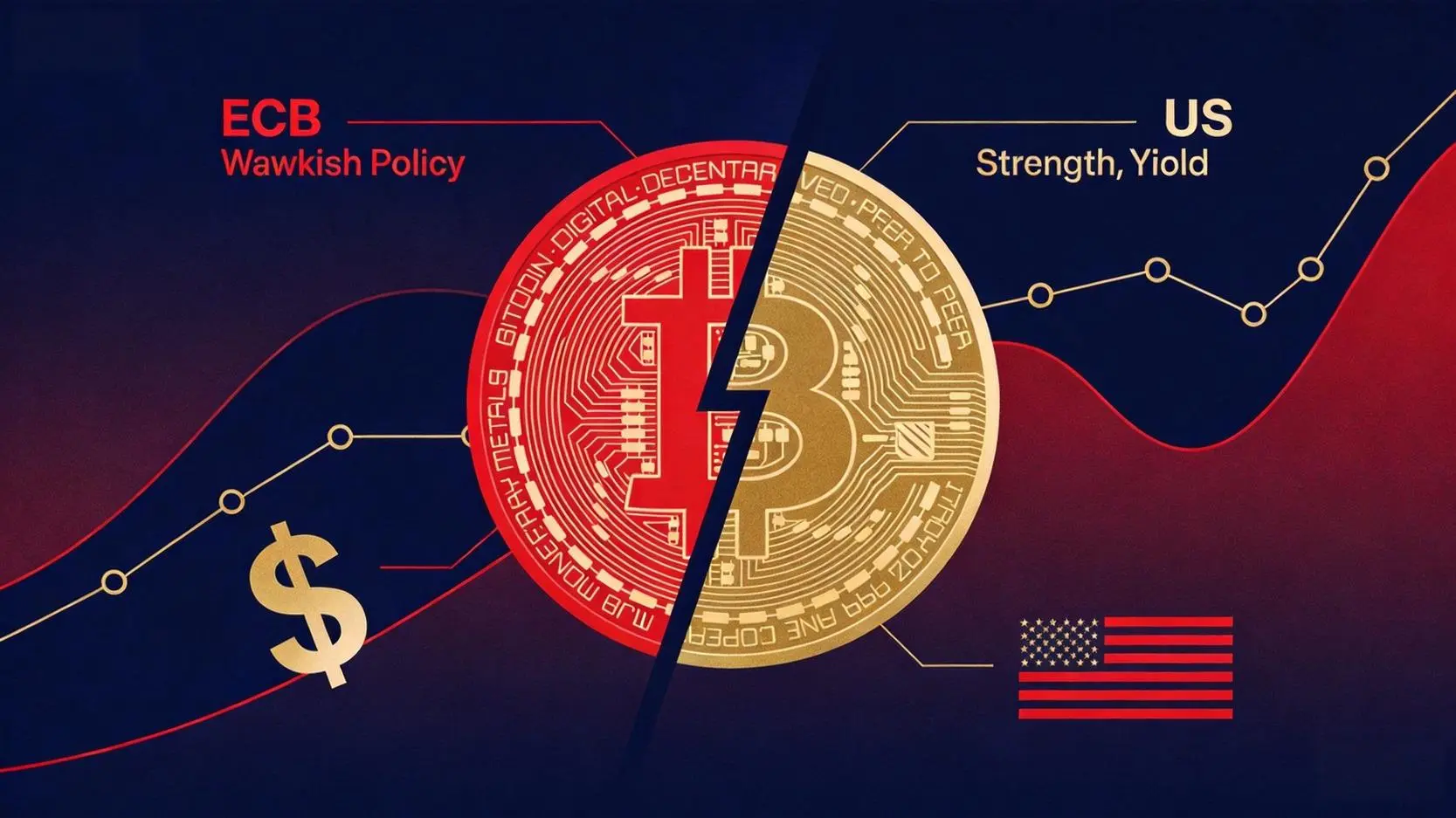
How to Interpret the ECB’s Hawkish Stance? Lagarde’s Signals, Key EUR/USD Levels, and Investment Strategies Explained in One Go
The ECB’s hawkish stance has once again become the main theme in the foreign exchange market. This is especially true when the market had originally bet that “the European Central Bank would soon pivot to rate cuts”, only for Lagarde’s wording and post-meeting communication to reset those expectations, making EUR/USD prone to a pattern of “first falling sharply, then rebounding, and finally returning to a range”. If you are tracking the impact of US-Europe monetary policy divergence on the FX market and want to understand EUR/USD support level analysis, this article will break down the European Central Bank’s policy logic, key technical zones, and emerging market spillover effects in a way investors can understand.
To put the key point plainly: foreign exchange is not about betting on whether a central bank is labeled “hawkish or dovish”, but about estimating the gap in interest rate paths and the speed at which market expectations are revised. As long as the ECB continues to prioritize “bringing inflation back to 2%”, the euro is unlikely to be beaten down all the way. However, if US interest rates remain elevated for longer, EUR/USD will also struggle to enter a one-sided major bull market.
The Core Motivation Behind the ECB’s Hawkish Stance and the Inflation Challenge: Why Rate Cut Expectations Keep Falling Through
The market often interprets “hawkish” as meaning rate hikes, but a more precise way to put it is: at this stage, the European Central Bank is more concerned about inflation stickiness and the anchoring of inflation expectations. Therefore, even if economic growth is not particularly strong, it is unwilling to lower interest rates too quickly, in order to prevent “prices that were finally brought down” from rising again.
Eurozone Economic Data and Core Inflation Stickiness: Why the Central Bank Does Not Dare to Loosen Its Grip
The inflation structure in the eurozone is not exactly the same as that of the US. What investors really need to watch is core inflation (which excludes volatile items such as energy and food), as well as services inflation and wage trends. When services prices and wage growth remain relatively high, the central bank will pay closer attention to whether “rate cuts will cause inflation to rise again”.
In addition, economic conditions vary widely across eurozone countries: some countries face weak demand, while others still have relatively strong wages. The reality of “using one interest rate to manage multiple countries” will make the European Central Bank rely more on overall inflation and expectations management, rather than focusing only on the short-term growth pressure of a single country. This is also one of the reasons why the ECB’s hawkish stance is often underestimated by the market.
If you want to quickly build background knowledge on the euro exchange rate, you can first refer to this internal summary: Will the Euro Keep Falling? Euro Exchange Rate Trend Analysis and Key Factor Forecasts, which provides a more complete framework for “how official remarks affect volatility” and the common factors that influence exchange rates.
Lagarde’s Guidance on the Future Interest Rate Path: Understanding “Post-Meeting Remarks” Is More Important Than Reading News Headlines
Many beginners only look at the outcome of “whether rates were hiked or cut”, but professional traders pay more attention to forward guidance: for example, whether the central bank emphasizes “data dependence and meeting-by-meeting decisions”, whether it downplays the rate cut timetable, and whether it repeatedly mentions that inflation still needs to be ensured to return to target.
In terms of authoritative primary sources, the European Central Bank’s post-meeting statement and press conference transcript are among the most direct signal sources. You may refer to: European Central Bank PRESS CONFERENCE – Monetary Policy Statement. Such documents usually clearly present the basis for decision-making, the balance of risks, and the stance on “keeping interest rates restrictive”.
A more practical way to interpret this for investment is to break Lagarde’s remarks into three layers:
- Assessment of inflation: Is the decline in inflation an “established trend” or a “short-term pullback”?
- Attitude toward financial conditions: Does the central bank believe current interest rates are already restrictive enough to curb demand?
- Tone on the pace of rate cuts: Has it given clearer thresholds (such as wage growth or services inflation)?
As long as these three layers remain conservative, even if the market calls for rate cuts, it can easily be corrected by a hawkish tone of “wait a little longer”, making the euro less likely to see a one-sided collapse.
FX Market Volatility Under US-Europe Monetary Policy Divergence: Why EUR/USD Keeps Pulling Back and Forth Around Key Ranges
The essence of an exchange rate is the relative price between two economies, and the most sensitive variable in the short to medium term is interest rate differential expectations. When the market believes the Federal Reserve will cut rates slowly and the European Central Bank will cut rates quickly, the US dollar’s interest rate advantage will widen, putting pressure on EUR/USD. Conversely, if the ECB’s hawkish stance pushes rate cut expectations further back, interest rate differential expectations will narrow, giving the euro some breathing room.
The Gap Between Federal Reserve and European Central Bank Policy Expectations: Carry Trade Is the Main Battlefield
A common script in the foreign exchange market is:
- Stronger US data -> the market raises expectations for how long US rates will stay elevated -> the US dollar strengthens
- Sticky eurozone inflation or stronger wages -> the market lowers expectations of rapid European Central Bank rate cuts -> the euro stops falling or rebounds
- If both sides lean hawkish -> the exchange rate enters range-bound volatility, making technical levels more important
For investors in regions such as Taiwan and Malaysia, the most direct impact of this divergence is: the FX gains and losses of US dollar assets (such as US dollar fixed deposits, US dollar-denominated bonds, and overseas US equity positions), will fluctuate more sharply; while euro assets (such as European stocks and euro-denominated bonds) are more likely to be dragged by repeated shifts in “ECB rate cut expectations”.
Key Technical Support and Resistance for EUR/USD: Using “Scenarios” Is Better Than Using “Price Points” for Trading
Technical analysis is not fortune-telling. Its greatest value lies in dividing prices into “zones that both bulls and bears will seriously defend”. Since quotes may vary slightly across brokers, using the concept of “range zones” here is closer to real trading than rigidly defending decimal points.
| Scenario |
Common EUR/USD Market Reaction
|
Key Points Investors Can Observe |
| The ECB’s hawkish stance continues, and rate cut expectations are pushed back |
The euro is more likely to attract buying around the lower support zone |
Services inflation, wage growth, and Eurozone bond yield trends |
| US data strengthens, and the Federal Reserve becomes more hawkish |
The US dollar strengthens, and the euro’s rebound is easily pushed back when it reaches the resistance zone |
US nonfarm payrolls, core PCE, and yield curve changes |
| Both sides remain cautious (with neither in a hurry to cut rates) |
The exchange rate enters range-bound consolidation, with more false breakouts |
Volatility, option risk reversals, and the upper and lower bounds of the technical range |
In practice, if you are exchanging euros or building positions in batches, instead of chasing a single “perfectly accurate support level”, it is better to break the plan down into:
- Entering in batches: Use time diversification instead of trying to call the bottom all at once.
- Avoid direct confrontation around major events: Volatility often increases around events such as European Central Bank rate decisions, Lagarde’s press conferences, and Federal Reserve meetings.
- Decide the purpose first: Is the foreign currency for travel/study abroad, or for hedging an investment position? Different purposes require different strategies.
If you want to further explore “the five major drivers of the euro’s trend” and common currency exchange strategies, the previous internal article also provides more examples: Euro Exchange Rate Trend Analysis and Key Factor Forecasts.
The Hidden Impact of the ECB’s Hawkish Stance on Emerging Market Currencies: Capital Flows Are the Second Battlefield
Most people discussing the ECB only focus on EUR/USD. However, in capital markets, European interest rates being “a little higher for a little longer” will affect emerging market currencies (including some Asian and Central and Eastern European currencies) through capital reallocation. This type of spillover effect usually does not happen on the same day, but slowly filters into bond, equity, and foreign exchange positions.
Capital Outflow Pressure and Foreign Capital Allocation Shifts: The Real Cost of a High-Interest-Rate Environment
When the European Central Bank remains relatively hawkish, it means the risk-free return on euro assets (such as short-term euro interest rates) is relatively attractive. When global capital compares “risk-adjusted returns”, two phenomena may occur:
- Capital flows back to developed markets: Reducing exposure to more volatile emerging market bonds or equities.
- Hedging costs change: The cost for companies or investors to hedge exchange rates may rise, thereby affecting willingness to invest across borders.
For investors in Taiwan and Malaysia, if they hold emerging market funds, Asian high-yield bonds, or multi-currency asset allocations, they should treat “European interest rates remaining restrictive” as a volatility amplifier: once market sentiment weakens, emerging market currencies are more likely to be sold off.
Diverging FX Trends Caused by Different Central Bank Paths in Central and Eastern Europe: Even Within Europe, They Are Not the Same
Many Central and Eastern European countries are highly connected with the eurozone in trade and economic terms, but their domestic central bank policies do not necessarily follow the European Central Bank. When the ECB’s hawkish stance continues, some central banks may be forced to maintain high interest rates because domestic inflation remains high; others may pivot to easing earlier due to heavy economic pressure or because inflation has already fallen. The result is divergence in currency trends, rather than “Europe rising and falling together”.
In foreign exchange trading or foreign currency asset allocation, this serves as a reminder: if you simply want to bet on “Europe becoming stronger/weaker”, directly trading EUR/USD is usually more intuitive than touching less liquid currencies; if you really want to position in Central and Eastern European currencies, risk control and transaction costs must be calculated clearly first.
Practical Observation Checklist: How to Track the ECB’s Hawkish Stance and EUR/USD Trends
Make information tracking more like an investment process rather than chasing the news. You can use the following checklist (with each item corresponding to price):
- Eurozone inflation (including core and services): Determines “how long the hawkish stance can last”.
- Wages and employment: The fuel behind services inflation.
- Eurozone bond yields: The market’s real-time vote on the interest rate path.
- US core PCE and nonfarm payrolls: The root of US dollar strength and weakness.
- Geopolitics and energy prices: Europe is sensitive to energy, which can easily affect inflation expectations.
In terms of layout and visual presentation, if you want to create key reminder cards or infographics, it is recommended to use the website’s theme color #FFD73A as the background color for “key conclusions” or “risk reminders”, paired with dark gray text for the best readability.
FAQ
How Long Will the ECB’s Hawkish Stance Continue?
It will usually continue until the European Central Bank has greater confidence that “inflation can sustainably return to 2%”. In particular, if core and services inflation, as well as wage growth, remain elevated, the hawkish tone will not easily shift quickly. To assess this, watch whether the post-meeting statement continues to emphasize “data dependence, meeting-by-meeting decisions”, and “restrictive policy needs to be maintained for a sufficiently long period”.
Does EUR/USD Still Have Room to Rise This Year?
There is a chance, but it will mostly appear in the form of “the upper end of the range”, rather than a one-way rise all the way. The key lies in whether the US enters a rate-cut cycle more quickly, and whether the European Central Bank delays easing due to inflation stickiness. If US-Europe interest rate differential expectations converge, the euro will have better conditions for a rebound.
What Negative Impact Would European Central Bank Rate Hikes or Maintaining High Interest Rates Have on Global Stock Markets?
The main effects are raising the global discount rate, compressing valuations, and making capital more inclined toward low-risk interest-bearing assets. Risk assets (especially high-valuation growth stocks and emerging market equities) are prone to amplified volatility. If geopolitical risks simultaneously push up energy costs, this will also create dual pressure on corporate earnings.
What Words Should Investors Watch in Lagarde’s Remarks to Identify a Hawkish Bias?
Common hawkish signals include repeatedly emphasizing that inflation risks remain, mentioning that wages or services inflation are still not reassuring, downplaying the market’s assumptions about the timing of rate cuts, and emphasizing that policy will remain restrictive and be decided on a “meeting-by-meeting” basis. Conversely, if she more frequently mentions downside risks to growth and excessively tight financial conditions, the tone will lean dovish.
How Can Investors in Taiwan or Malaysia Use EUR/USD for Hedging?
If your main assets and expenses are primarily in local currency and US dollars, the euro can be used as a diversification tool. However, before hedging, you must first confirm whether you are hedging “US dollar volatility” or “global risk sentiment”. Next, you need to assess transaction costs and the holding period. More common approaches include exchanging currencies in batches, or reducing single-currency exposure through multi-currency asset allocation.
Conclusion
The reason the ECB’s hawkish stance repeatedly causes the market to “guess wrong” does not lie in slogans, but in the European Central Bank’s cautious attitude toward inflation (especially core and services inflation) as well as Lagarde’s continued use of “data dependence, meeting-by-meeting” in post-meeting communication to push rate cut expectations further back. Returning to trading and asset allocation, the most important thing for EUR/USD is not chasing short-term news, but combining US-Europe interest rate differential expectations, the inflation path, and technical ranges into scenarios. Once Middle East geopolitical risks push up energy prices, or the risk of renewed inflation emerges, the euro’s downside support and volatility may both be repriced.