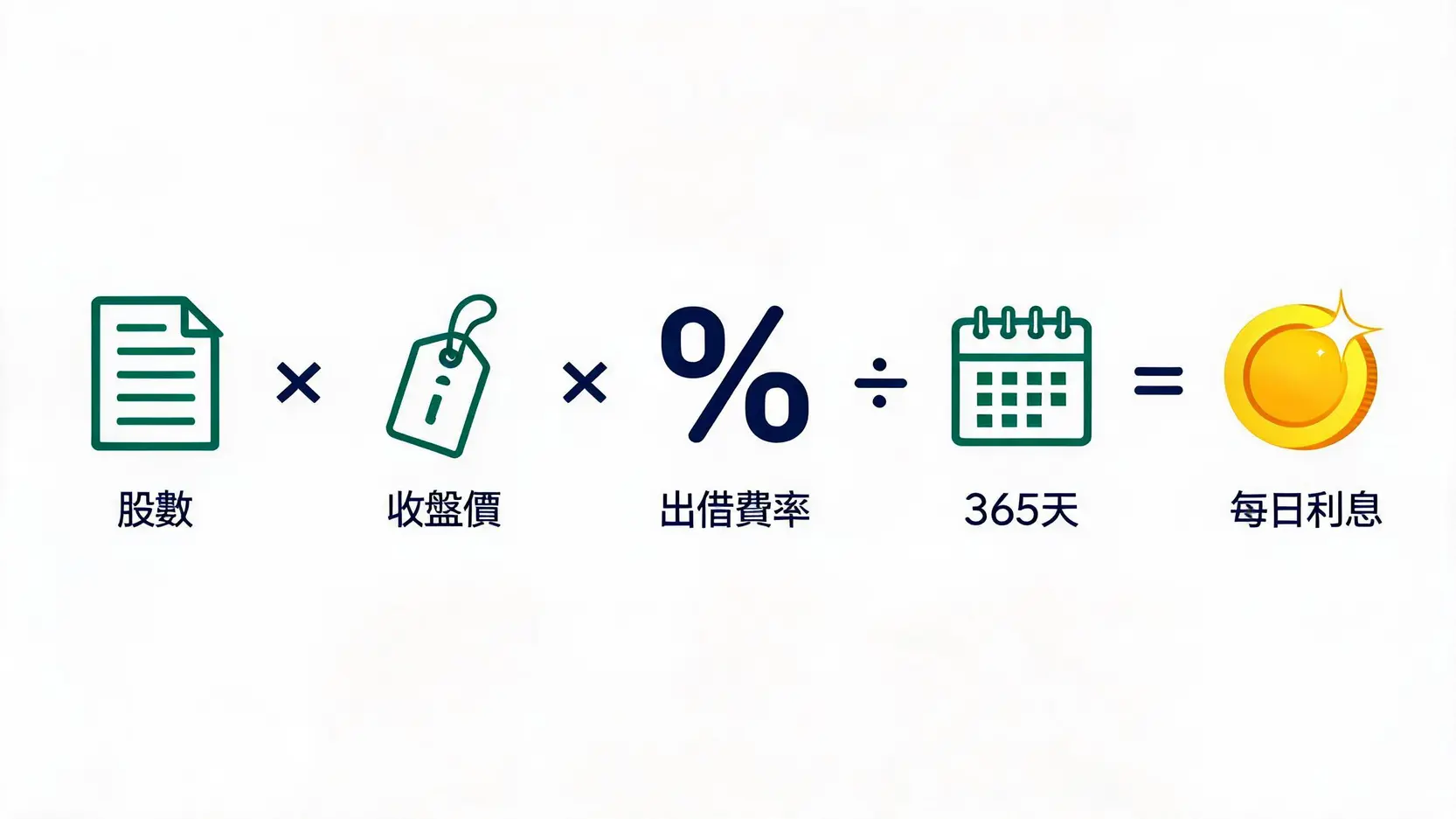
Master the Daily Lending Interest Calculation Formula to Accurately Estimate Passive Income
If this securities lending transaction lasts for 100 days, your gross return would be 8,219 yuan. This money is generated completely passively and has a meaningful positive effect on the overall allocation of your investment portfolio.
Explanation of Brokerage Fees and Withholding Income Tax
Brokerages provide the platform and match securities lending demand for you, so they naturally charge a corresponding service fee. Generally speaking, brokerage fees are around 20% to 30% of the interest income, and this fee is deducted directly when the interest is credited.
In addition, using the Taiwan market as an example, according to the relevant regulations of the Taiwan Stock Exchange, when the net interest from a single securities lending transaction exceeds NTD 20,000, the brokerage will withhold 10% income tax in accordance with the law. Therefore, when setting lending conditions and evaluating final returns, be sure to include these hidden costs in your calculations so you can accurately understand the actual cash flow received.
The Process of Activating Idle Stocks to Earn Interest: Differences Between Two-Way Securities Lending and One-Way Securities Lending
As fintech continues to advance, today’s stock lending process has become extremely simplified. As long as you understand the differences between the mechanisms and are familiar with the operation of brokerage apps, anyone can get started quickly.
Comparison Between One-Way Securities Lending and Two-Way Securities Lending
In the past, stock lending mostly used “one-way securities lending” (also known as trust-based securities lending) which had a relatively high threshold and usually required assets at the million or even tens of millions level to participate, shutting out most retail investors. But now, “two-way securities lending” has become the market mainstream.
Two-way securities lending allows ordinary retail investors to lend small amounts of stocks in their hands (even odd lots) to brokerages. The brokerages then consolidate these shares and relend them to institutional investors or other clients with demand. This model greatly lowers the participation threshold, allowing investors with smaller capital sizes to easily participate in this investment tool, while significantly improving the efficiency of capital and stock liquidity across the market.
How to Set a Lending Fee Rate That Is More Likely to Be Matched?
The lending fee rate can usually be set by investors themselves (generally within a range of 0.1% to 16%). If the rate is set too high, there may be little interest. If it is set too low, the return may not feel attractive enough. So how should you strike the right balance?
The key strategy is to observe market demand. If it is a popular stock with large recent volatility, high short-selling demand, or during the peak ex-rights and ex-dividend season, you can boldly try a lending fee rate of 3% or even above 7%. However, if it is a large-cap heavyweight stock or financial stock with a stable trend and relatively lower market demand, it is recommended to set a “low-key rate” of around 0.1% to 1% to increase the chance of being matched. As long as it can be successfully lent out, it is helping you create passive income.
Steps to Quickly Set Up Recurring Lending in a Brokerage App
Modern brokerage apps have very intuitive interface designs, and the operation process usually takes no more than three minutes:
- Enable permissions: Log in to the brokerage app, find the “stock lending” or “two-way securities lending” module, and sign the risk disclosure statement and activation consent form online.
- Select securities: In your inventory list, tick the stocks you want to lend out.
- Set conditions: Enter your desired “lending fee rate” and “number of lots to lend”.
- Enable recurring lending: It is strongly recommended to enable the “automatic lending” or “recurring lending” function. Once the stocks are returned, the system will automatically place a new order using the original settings, allowing you to continuously earn interest without interruption.
Extended Reading (Highly Recommended)
Long-Term Investment Strategy Guide: Short-Term Tools, Dividend Investing, and Passive Investment Allocation Principles
How to Build a Long-Term Investment Portfolio? Learn 5 Beginner Strategies in One Go
Frequently Asked Questions (FAQ)
Q: What Is the Minimum Number of Shares Required for Stock Lending?
This depends on the specific rules of each brokerage. For the two-way securities lending function offered by most brokerages, investors can apply to lend as long as they hold 1 lot (1,000 shares). Recently, more and more brokerages have opened up “odd-lot lending” in order to promote inclusive finance, allowing small-budget investors to participate in activating idle stocks without pressure.
Q: Can Stocks That Have Been Lent Out Be Sold at Any Time?
Although stocks that have been lent out are not reflected in your current account balance, you still retain the right to sell or recall them at any time. If you want to sell, you need to apply for “early return of securities” (recall) through the brokerage app. It usually takes 1 to 3 business days (T+1 to T+3) for the stocks to return to your account. Therefore, if you expect to sell that stock in the short term, lending it out is not recommended, so as to avoid missing the trading opportunity.
Q: What Lending Fee Rate Is More Reasonable?
The fee rate setting is closely related to market demand for the stock. If it is a popular thematic stock or during the peak ex-rights and ex-dividend season, demand is high, and the rate can be set at 3% to 5%, or even higher. If it is a stable dividend stock, it is recommended to set it at 0.5% to 1.5%, increasing the chance of a successful match through a lower-margin, higher-turnover approach.
Q: Will Securities Lending Have Any Negative Impact on the Market?
Securities lending itself is a neutral financial market mechanism. Although borrowers may conduct short selling, they may also use it for hedging or cross-market arbitrage. For long-term investors who firmly hold quality securities, short-term price fluctuations do not affect the company’s core value. Instead, this mechanism can bring them tangible interest income.
Conclusion: An Essential Asset Activation Strategy for Dividend Investors
Stock lending is undoubtedly a quality strategy for dividend investors to amplify returns and reduce the long-term cost of holding stocks. By understanding lending conditions, carefully calculating related fees, and making good use of automated settings in brokerage apps, you can build another stable passive cash flow for yourself without adding extra investment capital. Investing is not only the art of buying low and selling high, but also the wisdom of making every asset in your hands work to its fullest potential. Open your brokerage account now, review your stock holdings, and start letting your stocks create value for you!