VIX Index Guide: Volatility Trading Strategies

What Is the VIX Index? A Complete Guide to Implied Volatility Trading Strategies and How to Capture Market Volatility Opportunities
Seeing the market swing wildly and feeling nervous, yet wanting to seize the opportunity? In fact, market volatility itself is an investment opportunity. Many investors only know how to buy when prices rise or fall, while overlooking “volatility” as a powerful profit-making tool. This complete volatility trading guide will help you deeply understand what the VIX Index is and teach you how to make good use of implied volatility investing, turning market uncertainty into your advantage. Whether you want to hedge risk or actively capitalize on opportunities, this knowledge can take your trading to the next level.
What Exactly Is the VIX Index? Quickly Understand the True Meaning of the Fear Index
To learn volatility trading, the first thing you need to know is the VIX Index. It is like the market’s “heartbeat monitor”, constantly reflecting the market’s level of anxiety.
Definition of the VIX Index: Why Is It Also Called the Fear Index?
The VIX Index, officially known as the Chicago Board Options Exchange Volatility Index (CBOE Volatility Index), primarily measures the market’s expected volatility of the S&P 500 Index over the next 30 days. When investors generally expect market conditions to become highly volatile, usually during market declines, they buy large amounts of options to hedge risk, driving option prices higher and causing the VIX Index to surge. Conversely, when markets remain calm, the VIX Index stays at lower levels. Because it typically spikes during market sell-offs and periods of widespread panic, it earned the fitting nickname “Fear Index”.
How Is the VIX Index Calculated? What Is Its Relationship With the S&P 500 Index?
The VIX Index calculation is relatively complex. It is derived from the weighted average prices of a range of S&P 500 Index options, including both in-the-money and out-of-the-money options. Simply put, it reflects how much insurance premium options market participants are willing to pay for future “uncertainty”.
Its relationship with the S&P 500 Index is very close, and it usually shows a “negative correlation”. This means:
- When the S&P 500 Index declines: Market fear intensifies, and the VIX Index usually rises sharply.
- When the S&P 500 Index rises: Market sentiment becomes optimistic, and the VIX Index usually declines gradually.

The VIX Index and the S&P 500 Index usually move in opposite directions, making the VIX a “contrarian indicator” for the market.
This negative correlation makes the VIX Index an excellent contrarian market sentiment indicator and hedging tool.
How to Interpret VIX Readings: What Do High and Low Levels Mean for Market Sentiment?
There is no absolute “good” or “bad” VIX reading, but it helps us gauge the market’s current “temperature”. Generally, it can be interpreted as follows:
- VIX Below 20: Market sentiment is relatively stable and optimistic, remaining in the “comfort zone”. Investors have a higher risk appetite, and the stock market may rise steadily or gradually.
- VIX Between 20-30: Market uncertainty begins to emerge, and caution increases. Larger price fluctuations may occur.
- VIX Above 30: The market enters the “panic zone”. Investors become extremely risk-averse, usually accompanied by sharp stock market declines. Although dangerous, this may also mark the beginning of opportunities.
Remember, the VIX Index is a forward-looking indicator, not a crystal ball. It tells us what the market “may” do, not what it “will definitely” do.
Essential Investment Concept: What Is Implied Volatility (IV)?
If the VIX represents a macro-level fear indicator for the overall market, then “Implied Volatility” (IV) serves as the fear indicator for individual stocks or asset options. Understanding it is a crucial step toward implied volatility investing.
Implied Volatility vs. Historical Volatility: The Difference Between Past Data and Future Expectations
Many people confuse implied volatility with historical volatility, but they are actually two completely different concepts:
| Characteristics | Implied Volatility | Historical Volatility |
| Data Source | Derived from the market prices of options | Calculated from the historical price movements of an asset over a specific period |
| Time Horizon | Forecasts future volatility levels | Records actual past volatility |
| Nature | Subjective, forward-looking, and influenced by market sentiment | Records actual past volatility |
| Purpose | Used to evaluate whether option prices are expensive and to formulate trading strategies | Used to analyze the asset’s historical level of risk |

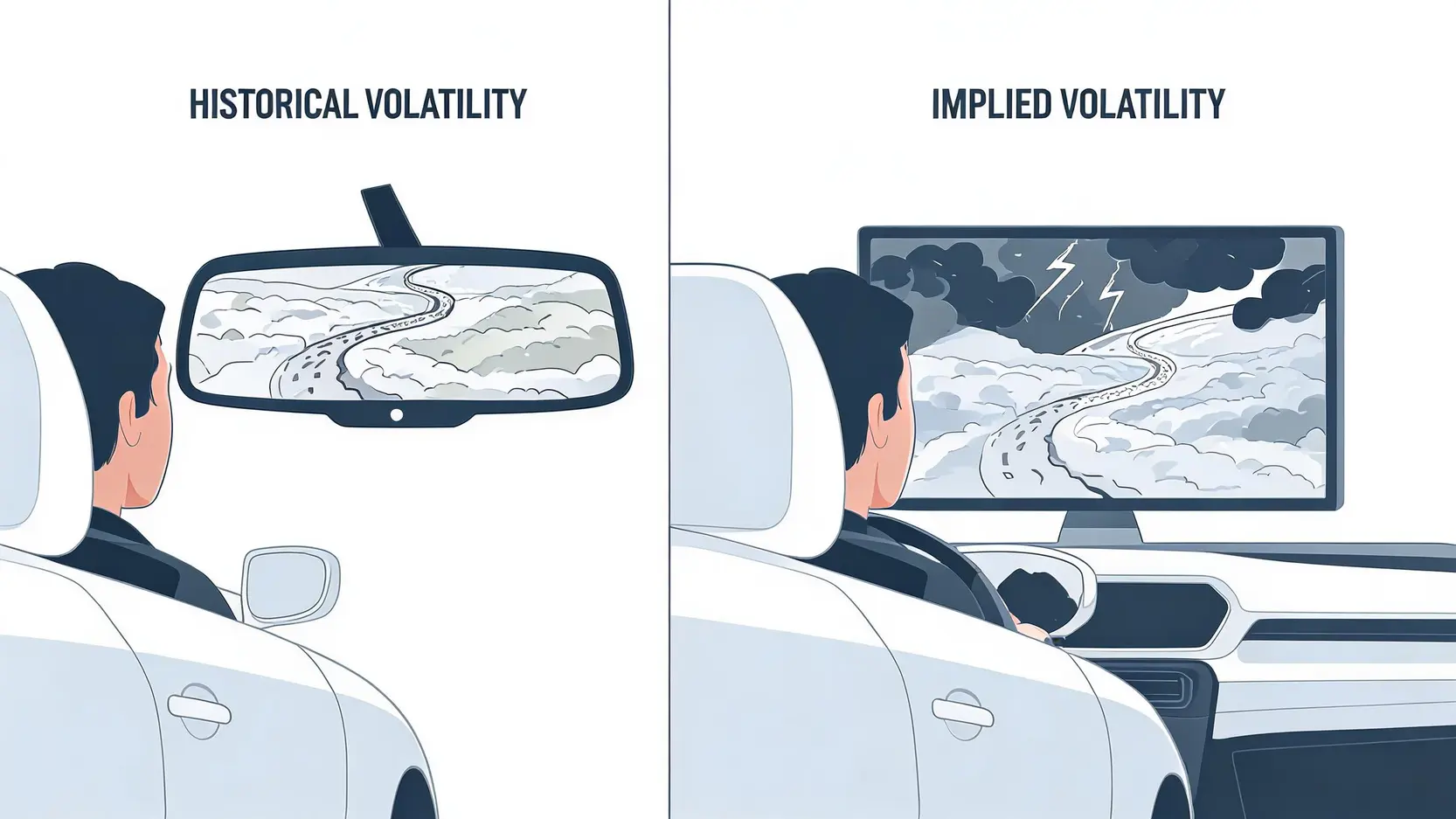
Historical volatility looks at the past, while implied volatility predicts the future.
A simple analogy: historical volatility is like driving while looking in the rearview mirror, telling you how bumpy the road was before. Implied volatility, on the other hand, is like checking the weather forecast ahead, telling you how rough the road “might” become in the future.
Why Is Implied Volatility So Important in Pricing Options and Warrants?
Implied volatility is one of the most important factors affecting the pricing of options and warrants, and can even be considered the core driving force behind their value. The value of an option mainly consists of “intrinsic value” and “time value”, while implied volatility is the key factor determining the size of the “time value”.
- High Implied Volatility: This means the market expects significant price swings in the future. Whether prices rise or fall, larger volatility increases the chances of the option moving into the money. As a result, the option’s time value becomes higher, making the option more expensive. It is similar to buying travel insurance before a typhoon, where premiums are naturally more expensive.
- Low Implied Volatility: This means the market expects stable future price movements. The probability of the option moving into the money becomes lower, reducing time value and making the option cheaper.
Therefore, when learning options trading, it is not enough to simply predict the market direction correctly. You must also accurately assess changes in implied volatility. Sometimes, even if your market direction prediction is correct, buying options when IV is excessively high can still lead to losses if IV later declines. This is known as “getting the direction right but losing on volatility”.
Volatility Trading Guide for Beginners: 3 Mainstream Investment Strategies
After understanding the basic concepts of the VIX and implied volatility, it is time to turn knowledge into action. Below are three mainstream volatility trading strategies suitable for investors with different risk appetites.
Strategy 1: Directly Trade VIX-Related Products (Such as ETFs and Futures)
The most direct method is trading financial products linked to the VIX Index. Common examples include:
- VIX Futures: A tool commonly used by professional investors, allowing direct speculation on the future direction of the VIX Index. The entry barrier is relatively high.
- VIX-Related ETFs/ETNs: Examples include the ProShares Ultra VIX Short-Term Futures ETF (UVXY) and the iPath Series B S&P 500 VIX Short-Term Futures ETN (VXX). These products allow retail investors to participate in VIX trading. However, extreme caution is required. Due to futures rollover costs (Contango), these ETF products are almost guaranteed to lose value over the long term, making them suitable only for short-term trading or precise market timing.
Warning: Directly trading VIX products carries extremely high risk, especially leveraged ETFs, which experience intense price volatility. Beginners should not attempt them casually.
Strategy 2: Use Options Strategies to Trade Implied Volatility
This is a more professional and flexible approach. Instead of directly buying the VIX, traders seek to profit from changes in implied volatility itself. The core concept is “sell high, buy low”.
- When You Expect Implied Volatility to Decline (Selling Volatility): Traders may use strategies such as a Short Straddle or Short Strangle. As long as the stock price remains within a certain range and implied volatility declines, traders can profit from the time decay of option premiums.
- When You Expect Implied Volatility to Rise (Buying Volatility): Traders may use strategies such as a Long Straddle or Long Strangle. As long as the stock price makes a significant move upward or downward and volatility surges, there is an opportunity to profit.

Long Straddle Strategy: As long as volatility is sufficiently large, there is an opportunity to profit regardless of whether the market rises or falls.
The advantage of this strategy is that you do not need to predict the market direction correctly. You only need to correctly predict the “volatility” itself.
Further Reading (Highly Recommended)
Strategy 3: Observe Implied Volatility to Determine Entry Timing for Stocks or Other Assets
Even if you do not directly trade options or the VIX, implied volatility remains a highly practical supplementary indicator.
- When IV Is Extremely High: This indicates the market is either extremely fearful or overly excited about a particular stock, such as before earnings announcements. At this point, option prices become very expensive, and directly buying the stock also carries higher risk. For conservative investors, this may serve as a warning signal to remain cautious.
- When IV Is Extremely Low: This suggests the market is exceptionally quiet, with few expecting major price movements. At this point, option prices are very cheap. If you have a unique view and believe the market is too calm, with potential “black swan” events ahead, buying options with a small amount of capital for protection or speculation can offer excellent cost efficiency.
Simply put, treat implied volatility as the market’s “emotional thermometer” to help determine when to be aggressive and when to stay defensive.
Practical Implied Volatility Investing: How to Access Data and Avoid Common Pitfalls
Now that the theory is covered, practical application becomes the priority. Knowing where to find data and avoiding common beginner mistakes can save you from many costly lessons.
Recommended Free Tools: Where Can You Find VIX and Implied Volatility Data?
If you want to invest using implied volatility, data is your ammunition. Fortunately, there are many free resources available today:
- CBOE Official Website: Provides the most authoritative real-time VIX Index data and historical charts.
- Major Financial Websites: Platforms such as Yahoo Finance, Bloomberg, and TradingView allow you to view VIX Index trends simply by entering “^VIX”.
- Broker Trading Platforms: If you have an options trading account, your trading software will usually provide an option chain for individual stocks, clearly displaying the implied volatility (IV) data for each option contract.
By regularly reviewing these data points, you will gradually develop a stronger sense of the market’s “rhythm”.
The 3 Most Common Beginner Mistakes: How to Avoid Losing Money in Volatility Trading
Volatility trading is a double-edged sword. Used correctly, it can help generate profits, but used poorly, it can lead to significant losses. Below are three traps beginners must be cautious of:
- Treating VIX ETFs as Long-Term Stock Investments: This is the most dangerous mistake. Due to futures rollover decay, the value of VIX ETFs will “automatically” decline over time. They are trading instruments, not investment instruments. You should never buy and hold them indefinitely.
- Focusing Only on Absolute Implied Volatility Levels Without Considering Relative Positioning: Seeing a stock with IV at 80% may seem high, but perhaps it is usually that volatile. What matters is not the absolute value, but whether the IV is at the high or low end of its own historical range, namely IV Rank or IV Percentile. Buying volatility at relatively low levels and selling volatility at relatively high levels offers better odds of success.
- Ignoring Event-Driven Factors: Implied volatility usually surges before major events such as earnings reports, product launches, or FDA approvals. After the event passes, IV often declines sharply regardless of the outcome. If you aggressively buy options before the event, even correctly predicting the market direction may still result in losses because of the rapid IV collapse. This phenomenon is known as “IV Crush”.
Conclusion
In summary, whether you want to hedge risk or discover new investment opportunities, learning volatility trading is an essential skill for modern investors. Understanding the concepts behind the VIX Index and implied volatility is like obtaining a map for interpreting market sentiment. You can use VIX-related products to capture market fear and greed, apply options strategies to precisely trade expected volatility in individual stocks, or simply use IV as a supplementary indicator to improve your trading decisions. Always remember that risk control comes first. Staying calm during volatile market conditions is the key to making the smartest decisions.
FAQ
Q: If the VIX Index surges, does it mean the stock market will definitely crash?
A: Not necessarily. A sharp rise in the VIX Index means the market “expects” future volatility to increase, and this volatility is usually associated with market fear and declines, which is why the two are highly negatively correlated. However, the VIX is a forward-looking indicator, and there are times when it may signal danger without a major market sell-off actually occurring. That said, if the VIX remains elevated for a prolonged period, it is definitely a risk signal that investors should pay close attention to.
Q: Is higher implied volatility always better?
A: Absolutely not. There is no absolute “good” or “bad” level for implied volatility. It is simply a matter of whether options are “expensive” or “cheap”. For option buyers, high IV means significantly higher entry costs, similar to paying more for insurance. For option sellers, high IV means higher potential returns, but also greater risk. Smart traders evaluate whether current IV is expensive or cheap relative to its historical level, then apply appropriate “buy low, sell high” volatility strategies.
Q: Besides the VIX Index, are there other indicators that measure market volatility?
A: Yes. The VIX is the most well-known, but it is not the only one. For example, the Nasdaq 100 Index has its own volatility index called VXN, while the Russell 2000 Index has RVX. There are also several variation indicators, such as VIX3M, which measures expected volatility over the next three months, and the VVIX Index, which measures volatility within the VIX itself. Different markets and asset classes often have their own corresponding volatility indicators for reference.
Q: What should beginners do first when getting started with volatility trading?
A: The first step is definitely not rushing into trading VIX ETFs or options immediately. It is recommended to begin with observation. Spend one to two months tracking the VIX Index and the implied volatility changes of several stocks you follow on a daily basis. Observe how these volatility indicators react before and after earnings announcements or major news events. Connect theory with actual market movements and gradually build your own feel for volatility trading before trying the simplest strategies with small amounts of capital.
Related Articles
-
Practical Applications of Volatility Surfaces: From Options Modeling to Advanced Skew Trading Strategies In options markets, implied volatility is never a flat line. Instead, it forms complex "smile" or "skew" surfaces. For advanced traders, mastering the practical applications of volatility surfaces is equivalent to possessing a lens that reveals market...2026 年 6 月 3 日
-
Building a Foreign Capital Flow Copy Trading Model: A Stock Market Indicator for Accurately Tracking Institutional Positioning In Asia-Pacific stock markets, foreign capital inflows and outflows often determine the direction of the index. However, simply looking at daily net buy and sell data is no longer enough. Only by building...2026 年 6 月 3 日
-
Options Buyer Strategies During Extreme Market Conditions: Black Swan Hedging and Cross-Market Arbitrage During Volatility Surges The most terrifying aspect of financial markets is not a gradual decline, but overnight flash crashes and cross-market capital withdrawals accompanied by volatility surges. In the highly unpredictable global macroeconomic environment of 2026, geopolitical...2026 年 6 月 3 日